-
-
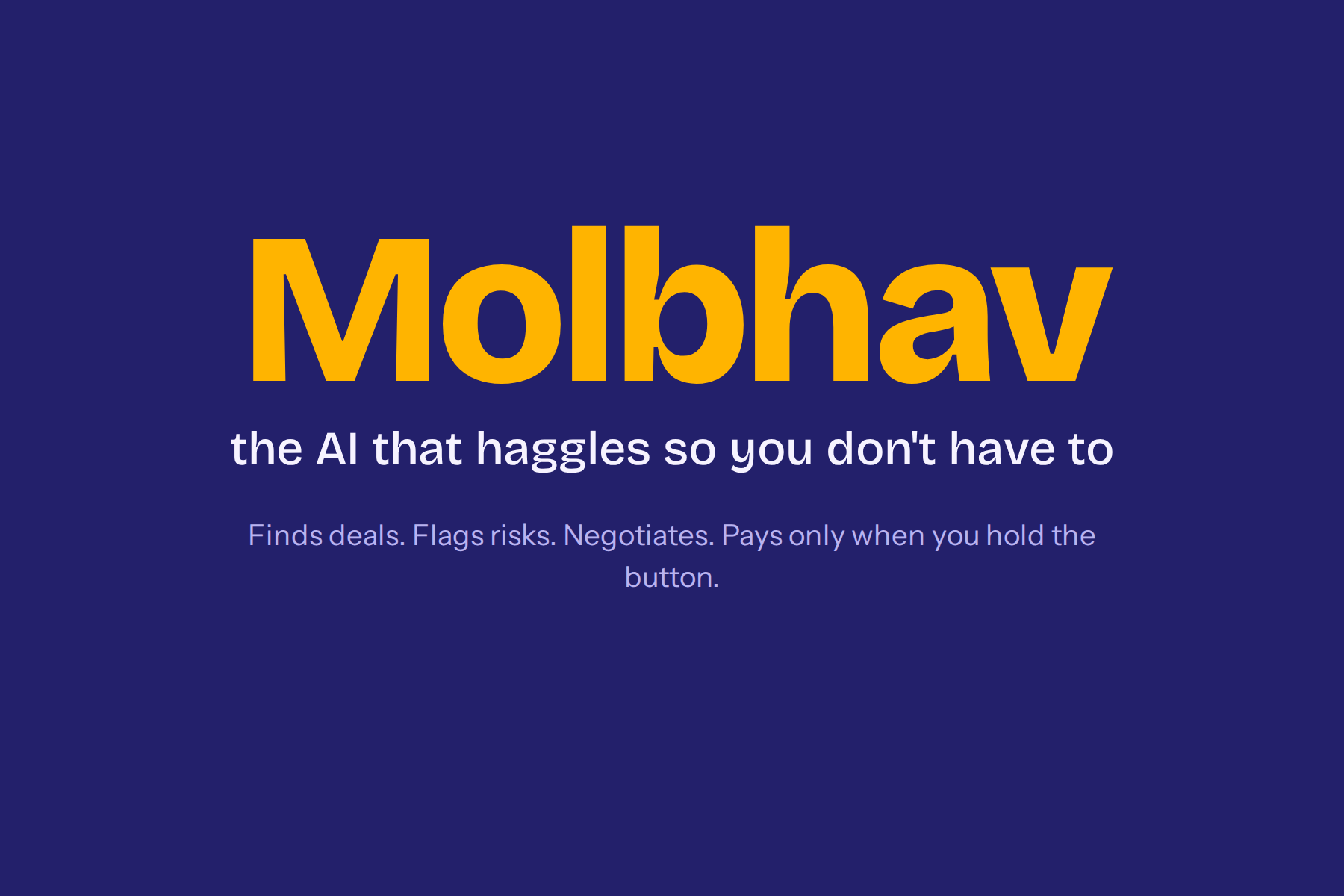
Cover
-
Input bar
-
Agent Log
-
Receipt
-
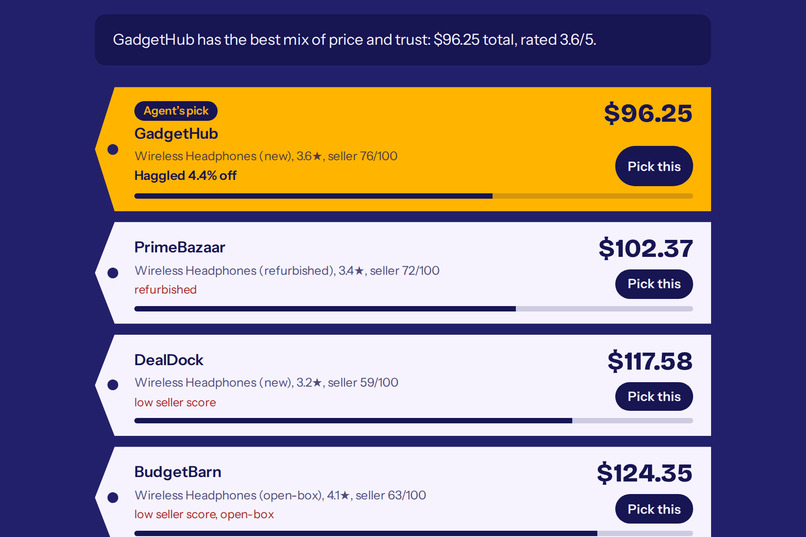
Price Tags
-
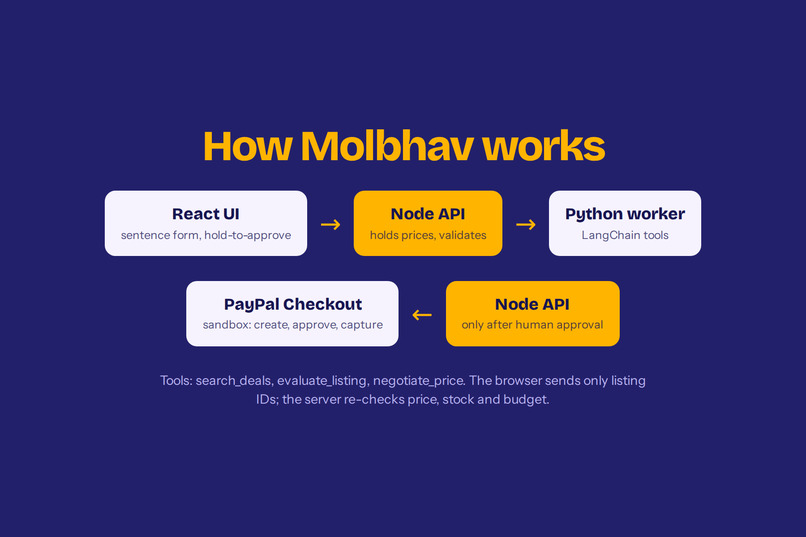
Architecture Of App
-
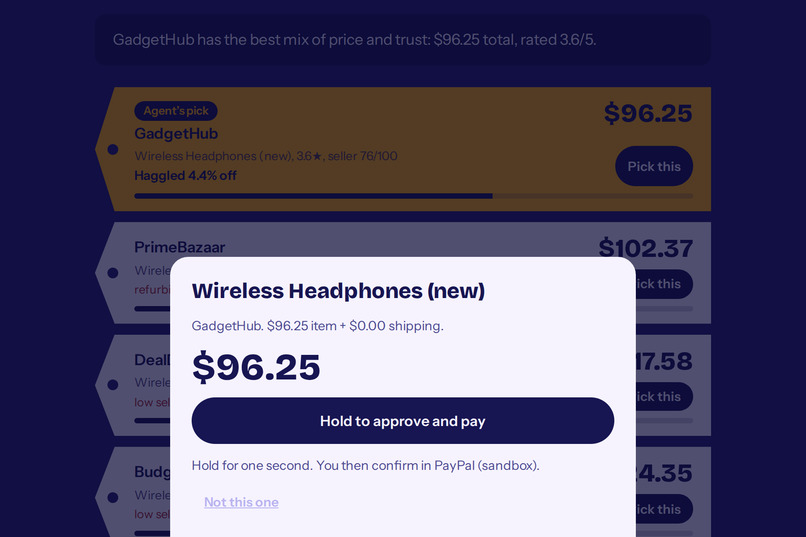
Hold To Approve
Inspiration
"Bhaiya, last price?"
Every Indian shopper has said this. No app has ever said it for us.
In our families, nobody pays the first price. At a street stall, the real price is the one you reach after a little drama, a walk-away, and a smile. Online, that art is gone. You get ten tabs, a "limited time offer" countdown, and a seller with a perfect rating and eleven reviews.
So we asked: what if an AI agent did the haggling, but we kept the wallet? The second half became the whole point. Plenty of agents can find things, but few have earned enough trust to be near your money.
What it does
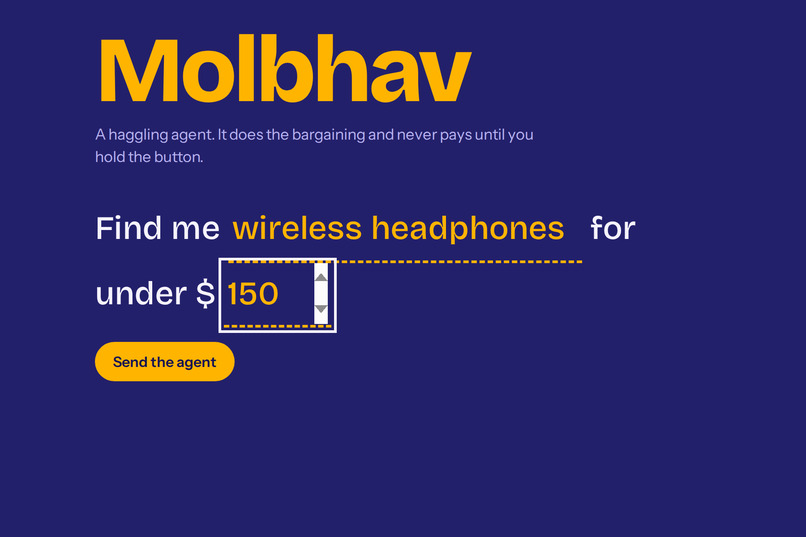
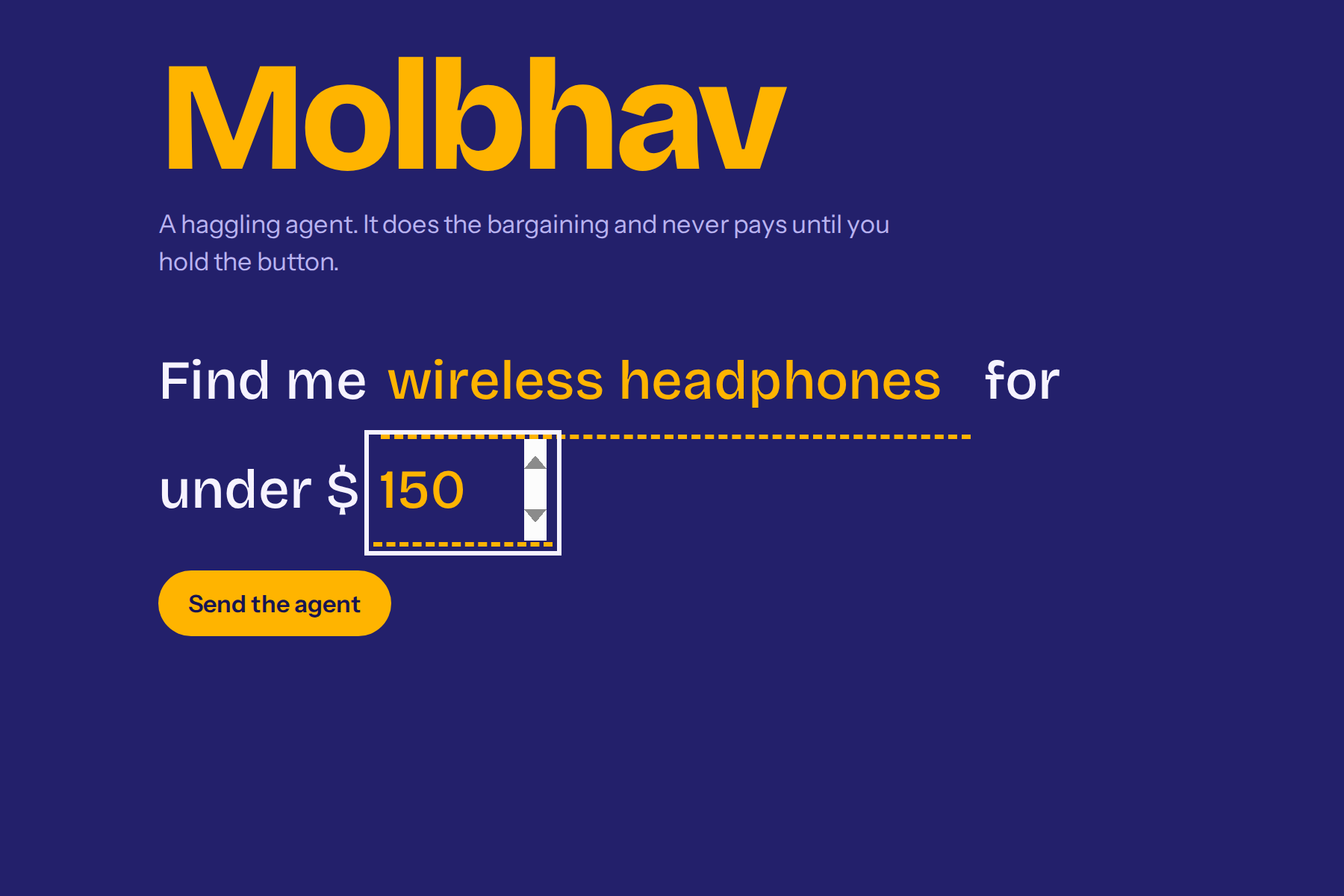
Molbhav (Hindi for haggling) is an AI shopping agent. You don't fill in filters. You finish a sentence:
Find me a pair of headphones for under $ 150
Then the agent goes to market:
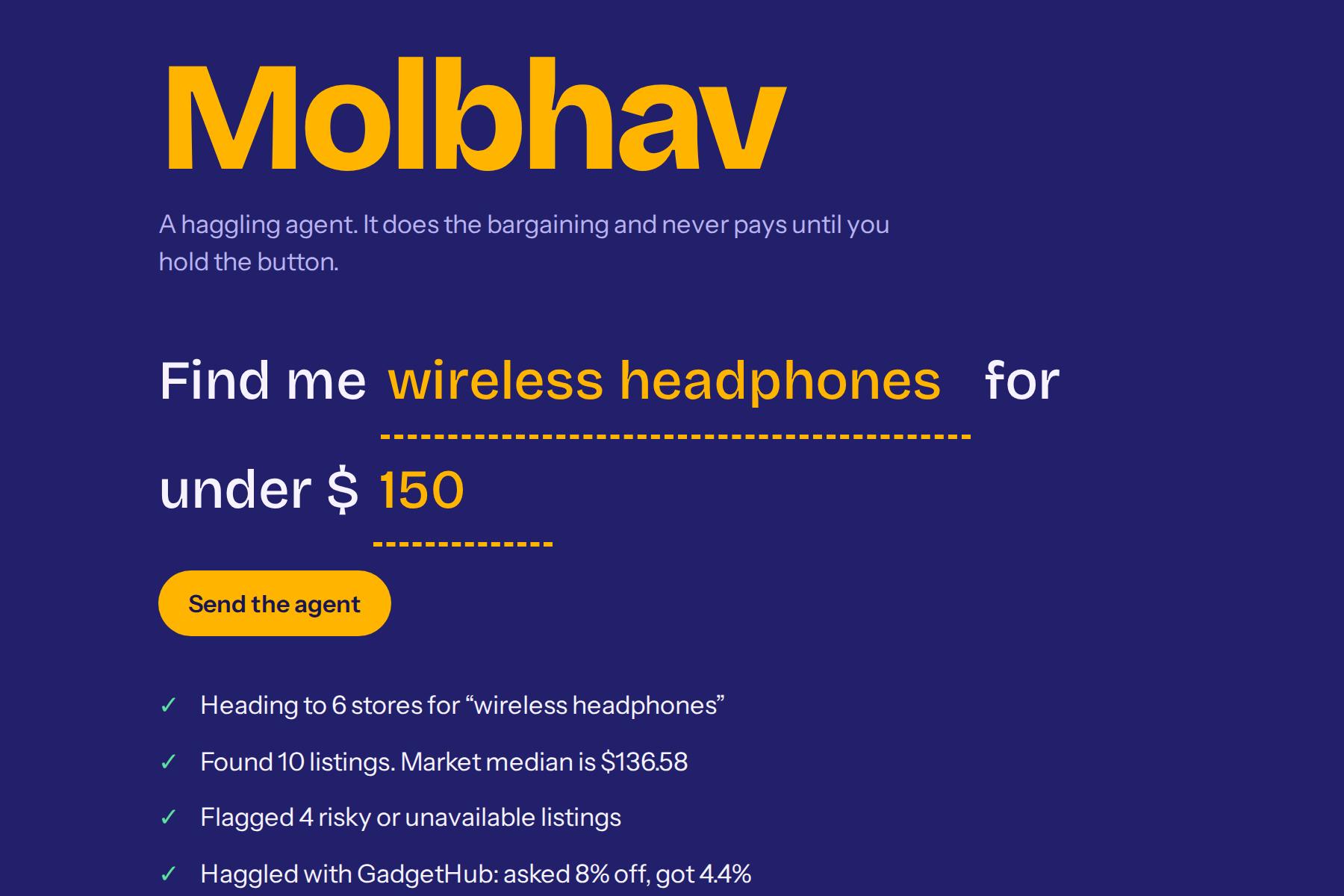
- Searches multiple stores for listings
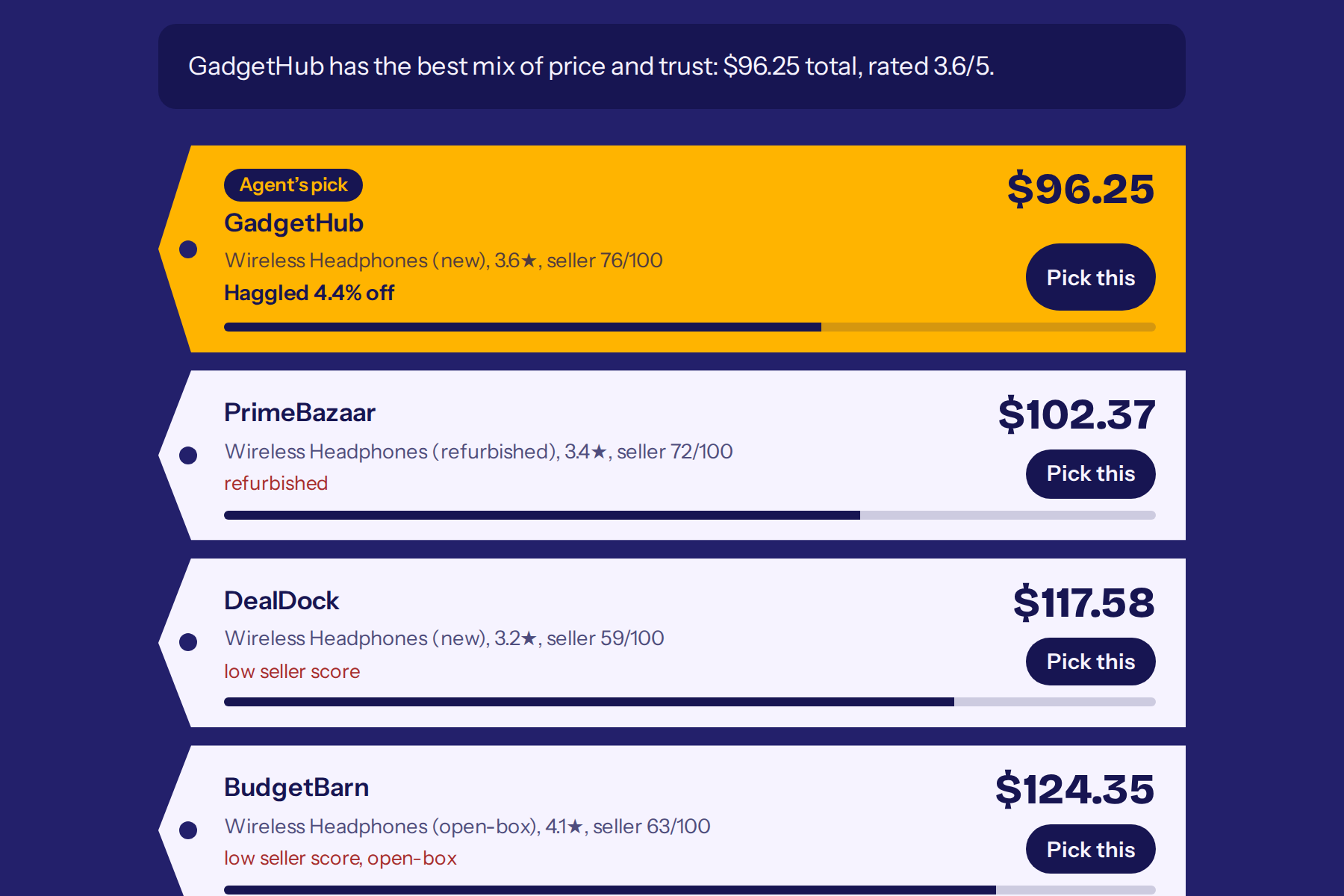
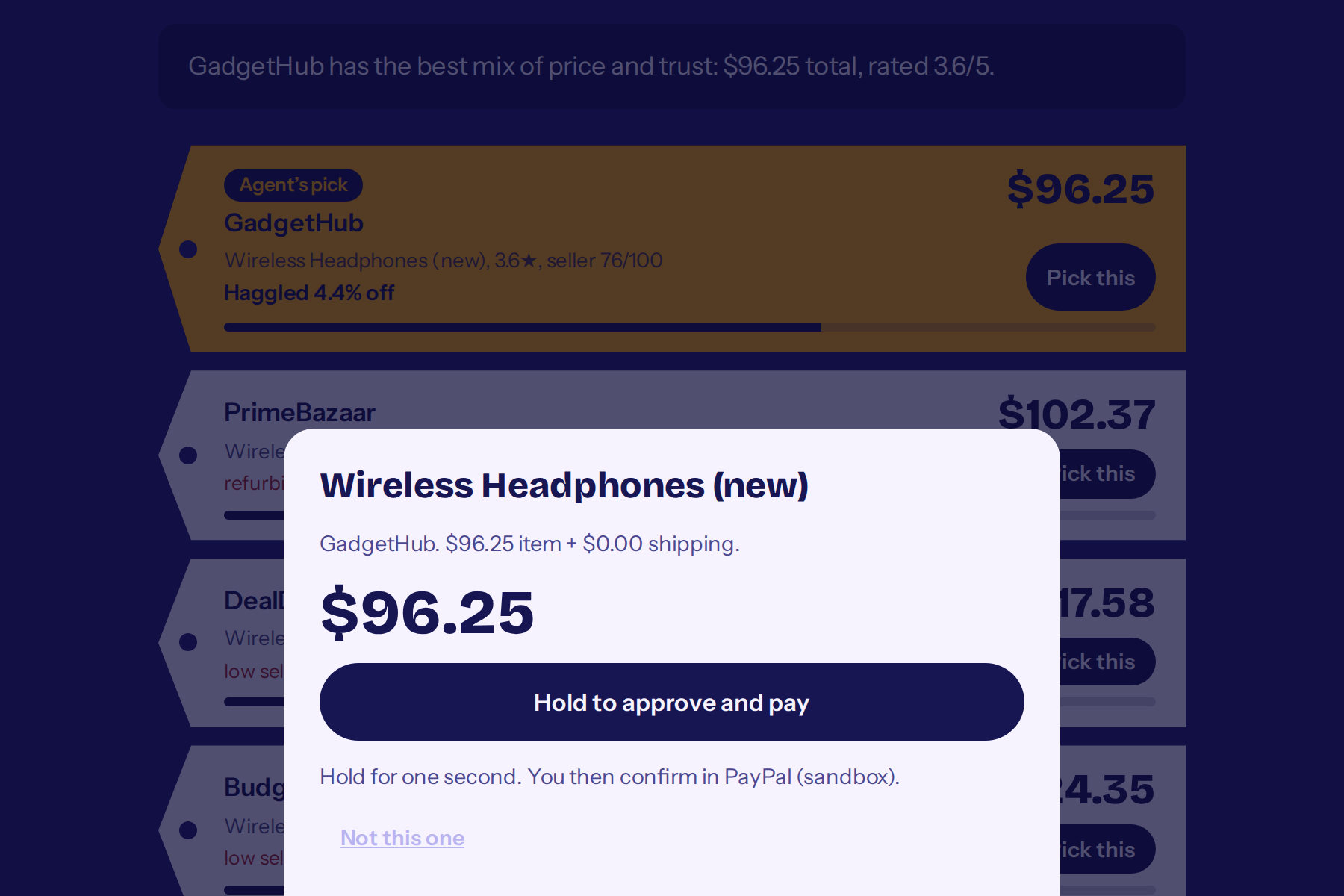
- Scores each one on price, rating, and seller trust
- Flags risky listings: out of stock, over budget, or priced "too good to be true"
- Haggles with the seller of its top pick
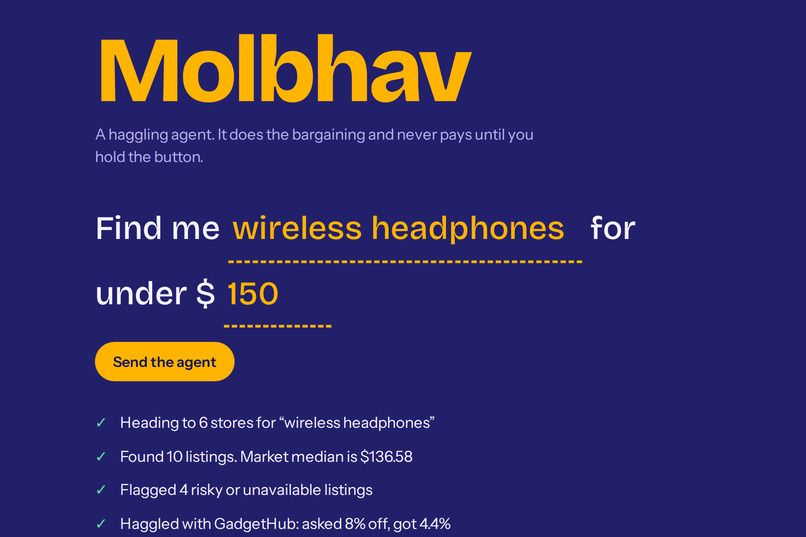
- Shows its work in a step-by-step log you can read before deciding
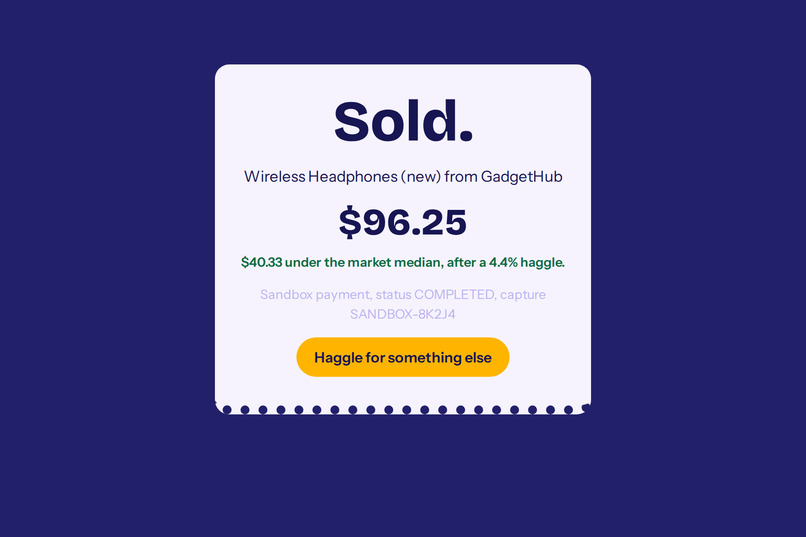
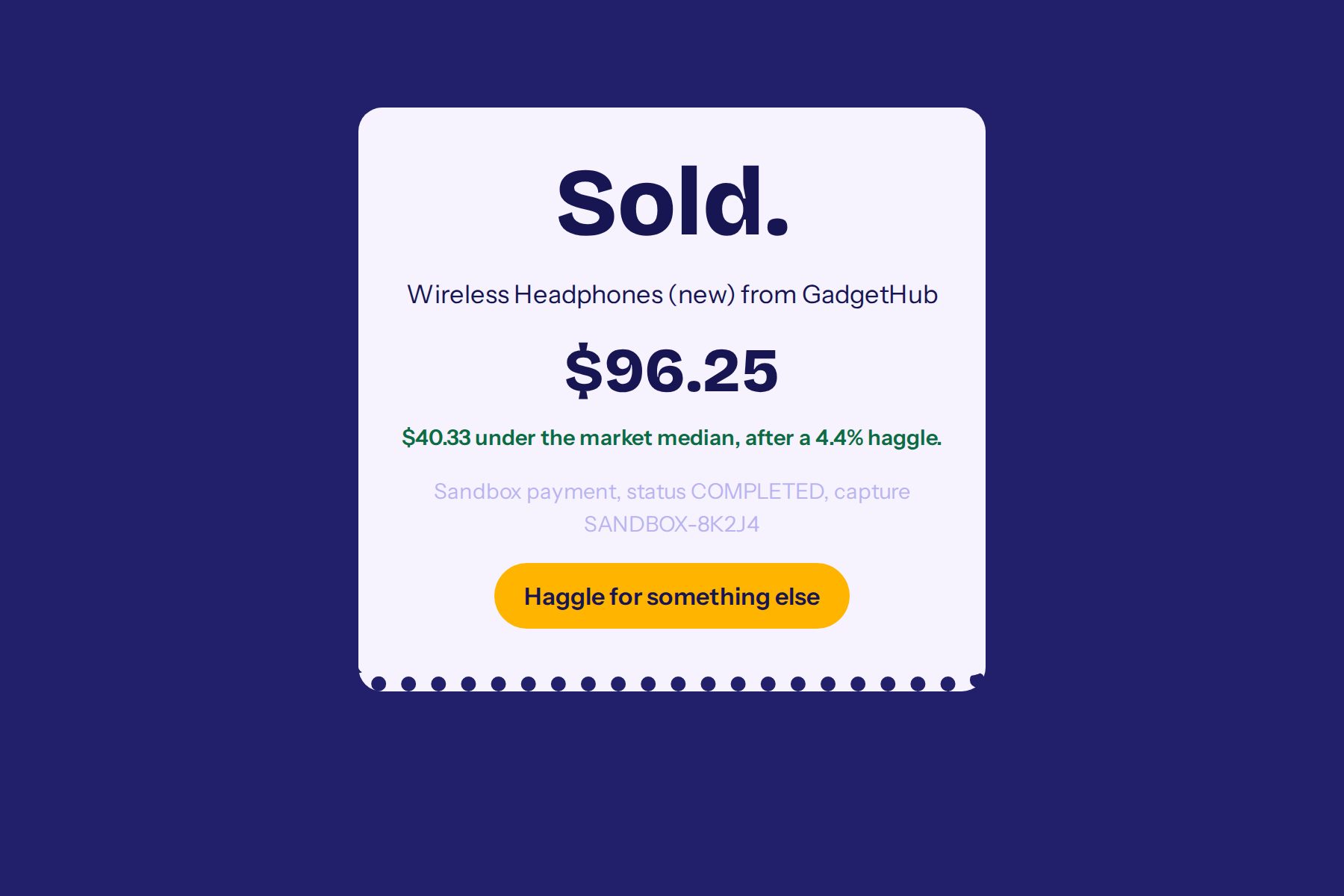
- Waits. Nothing is paid until you hold a button for one second
Only then does it call the PayPal Checkout sandbox to complete the purchase.
How we built it
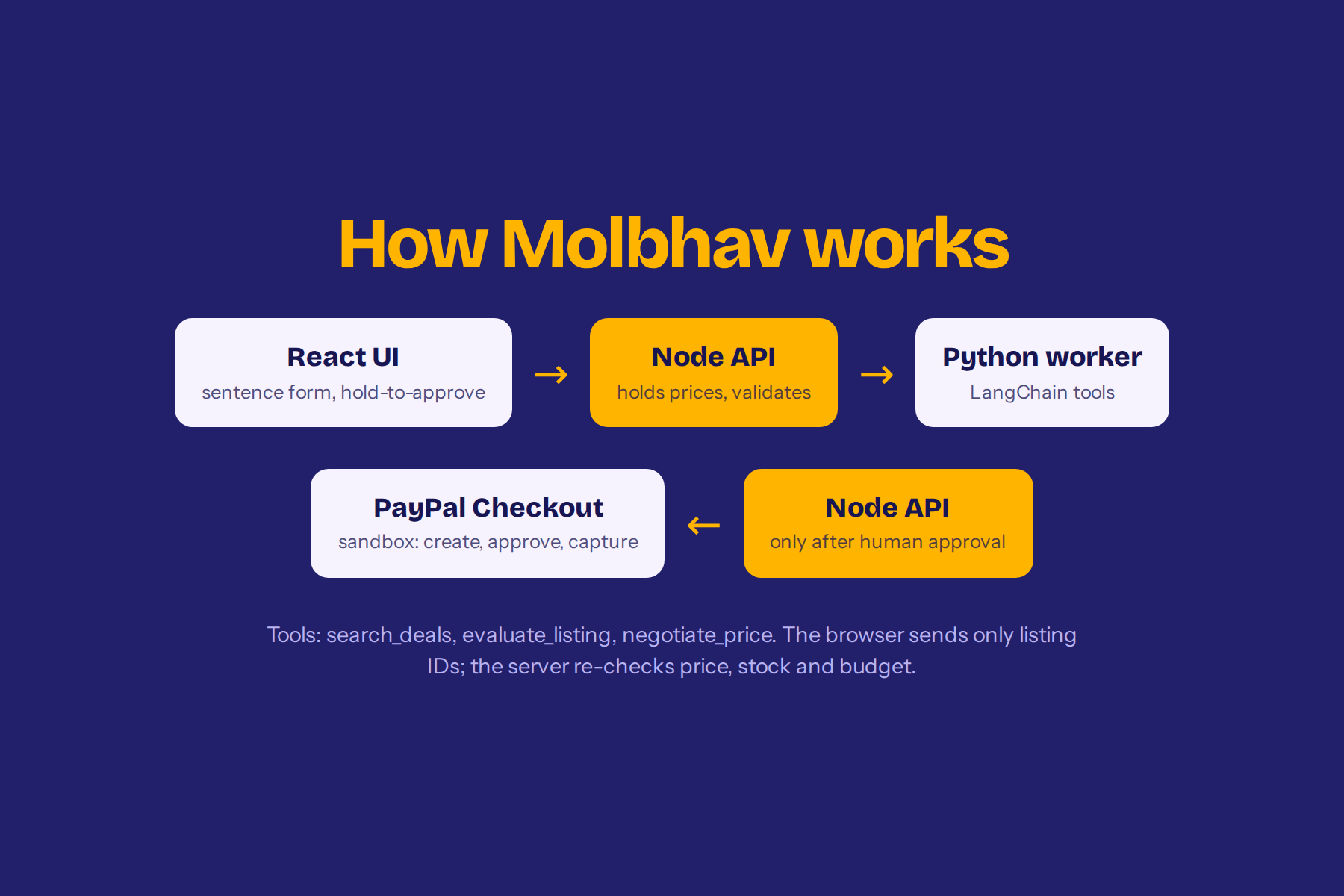
| Layer | Tech | Job |
|---|---|---|
| Face | React + Vite | Sentence-style input, hanging price tags, budget bars, hold-to-approve |
| Gatekeeper | Node.js + Express | Holds the real prices, talks to PayPal Orders v2 |
| Brain | Python + FastAPI + LangChain | Tools: search_deals, evaluate_listing, negotiate_price |
Each listing gets a score built around what a cautious shopper worries about:
$$ S = \underbrace{40\,\frac{B-T}{B}}{\text{headroom}} + \underbrace{30\,\frac{r}{5}}{\text{reviews}} + \underbrace{20\,\frac{s}{100}}_{\text{seller trust}} + c - 30f $$
where $B$ is the budget, $T$ the total with shipping, $r$ the rating, $s$ the seller score, $c$ a bonus for new items, and $f$ the number of serious red flags.
The haggling tool follows a bazaar rule: a more flexible seller concedes more. The discount grows with seller score $s$ and is capped at the percentage the agent asked for. An optional LLM chain writes a two-sentence verdict on the top pick.
Challenges we ran into
- An agent near money is a risk. A tampered request could change the price. The browser sends only listing IDs, and the Node server re-checks price, stock, and budget before it creates a PayPal order.
- An answer you can't inspect is hard to trust. The agent returns a trace of every step, such as "Flagged 3 risky listings" and "Asked 8% off, got 5.2%", and the UI replays it line by line.
- One click felt too easy. A stray click shouldn't spend money, so approval is a deliberate one-second hold that also works from the keyboard.
- No live store data. We used mock listings seeded by the product name, so demos are repeatable. Search is one swappable tool, ready for a real retailer or price API.
Accomplishments that we're proud of
- A full path from a typed sentence to a PayPal sandbox payment, with the human approval step in the middle
- A trust-first design: the server is the source of truth for money, and the agent can never change the amount charged
- An agent that explains itself, so you see why it picked a deal and what it flagged
- An interface that feels like a bazaar price tag instead of another dashboard
What we learned
- LangChain tools work best when each does one small job and the pipeline does the thinking
- The PayPal Orders v2 flow is create, redirect for approval, then capture
- Anything involving money needs server-side validation
- Approval is a design feature: the hold button is part of what makes the agent trustworthy
Fine print: listings are mock data, haggling is simulated, and payments run in the PayPal sandbox only. No real money moves.
What's next for Molbhav
- Real retailer and price-comparison APIs in place of the mock search
- A "wait for the drop" mode that watches a price and alerts you
- Spending limits and an audit log of every agent action
- Haggling in regional languages, so it works in more than one bazaar
- A database for saved searches and order history
Built with React, Node.js, Express, Python, FastAPI, LangChain, and PayPal Checkout (sandbox).
Built With
- css
- express.js
- fastapi
- html5
- javascript
- langchain
- node.js
- paypal
- paypal-checkout
- pydantic
- python
- react
- rest-api
- uvicorn
- vite

