Inspiration
During COVID-19, the world needed a vaccine fast, and researchers had to find ways to quickly test and evaluate candidates. Developing any drug means a lot of testing, and unintended drug interactions are easy to miss until late. We wanted a way to see and trust what a compound does inside a cell before spending months on experiments.
What it does
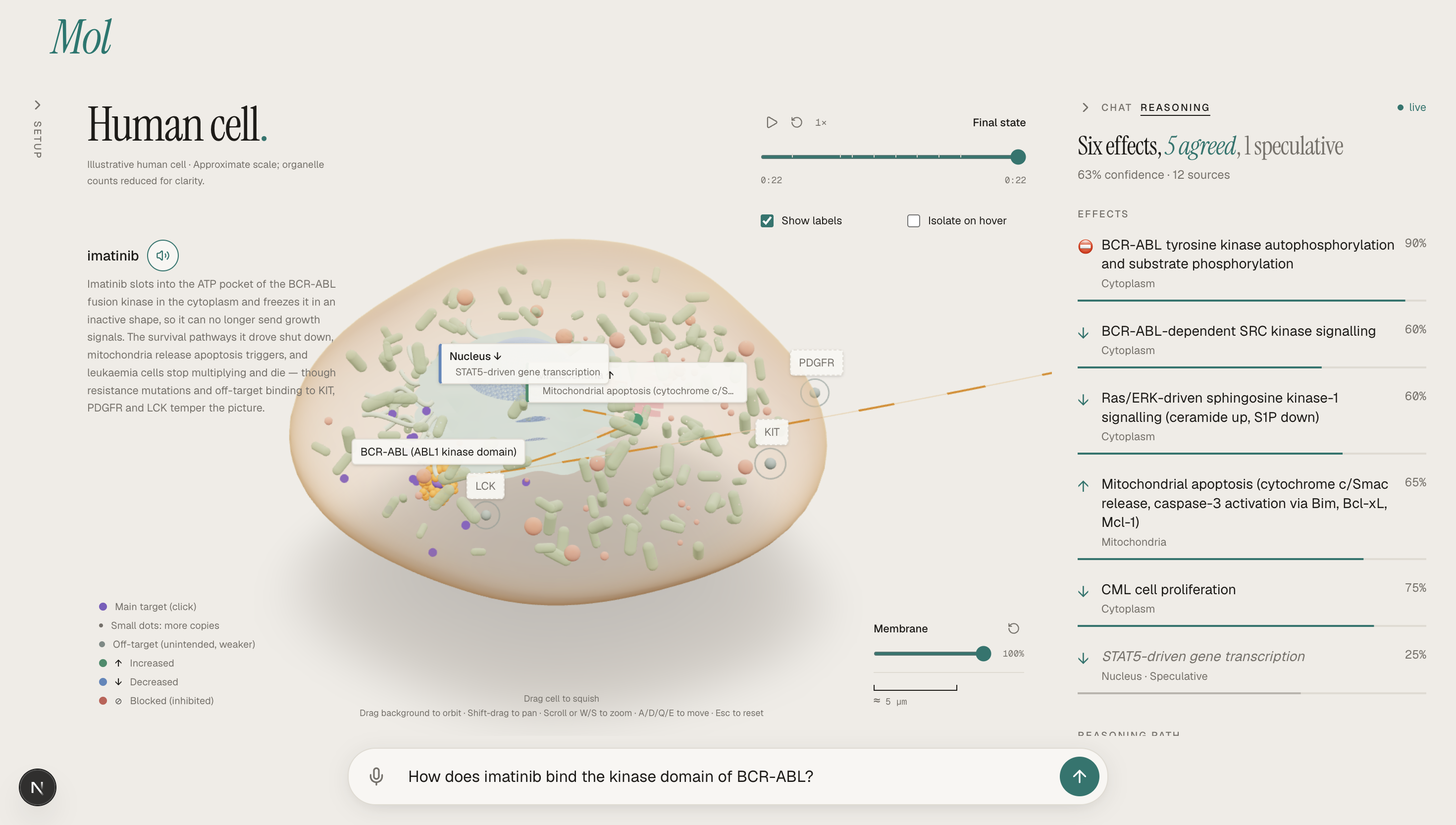
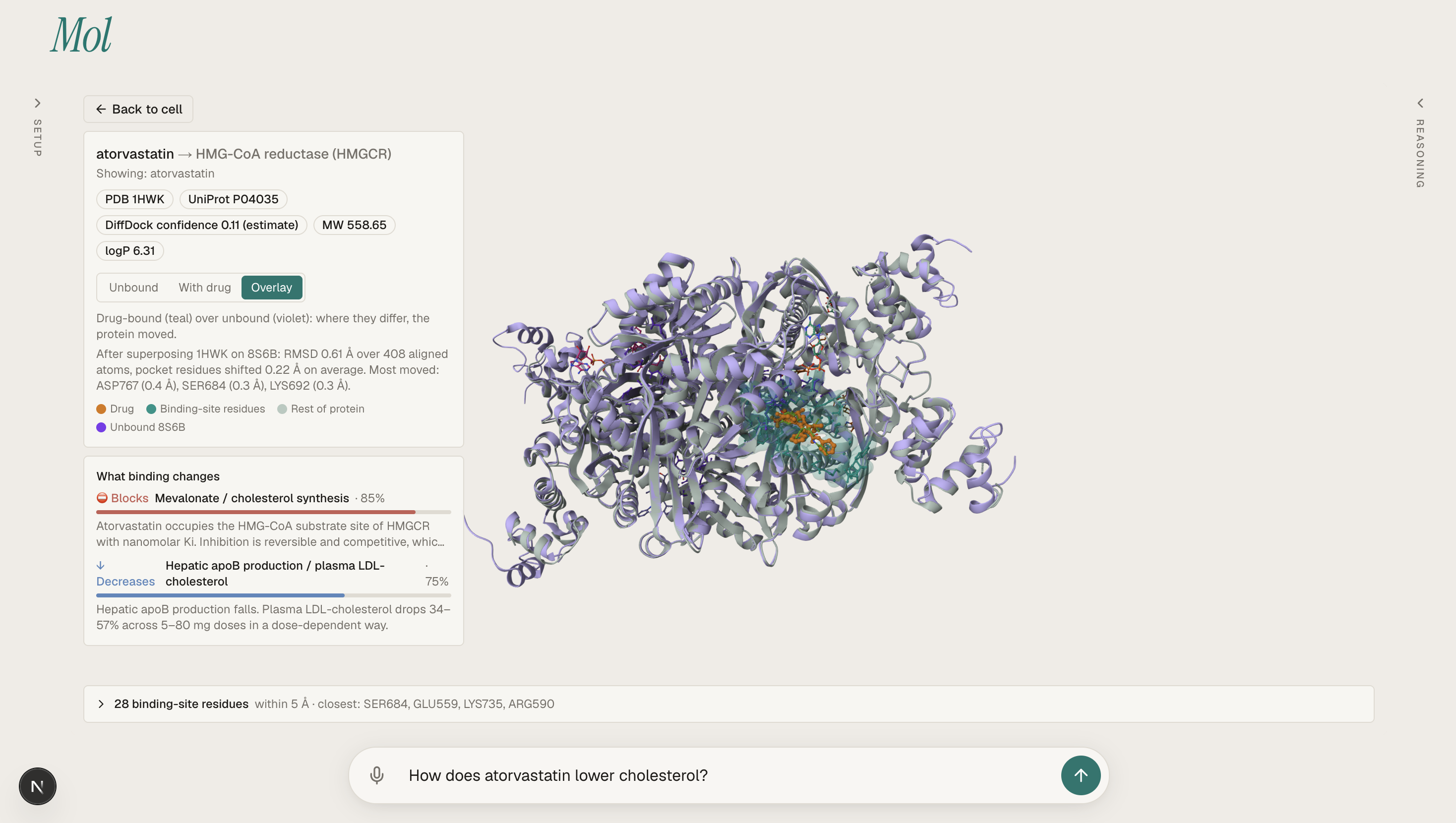
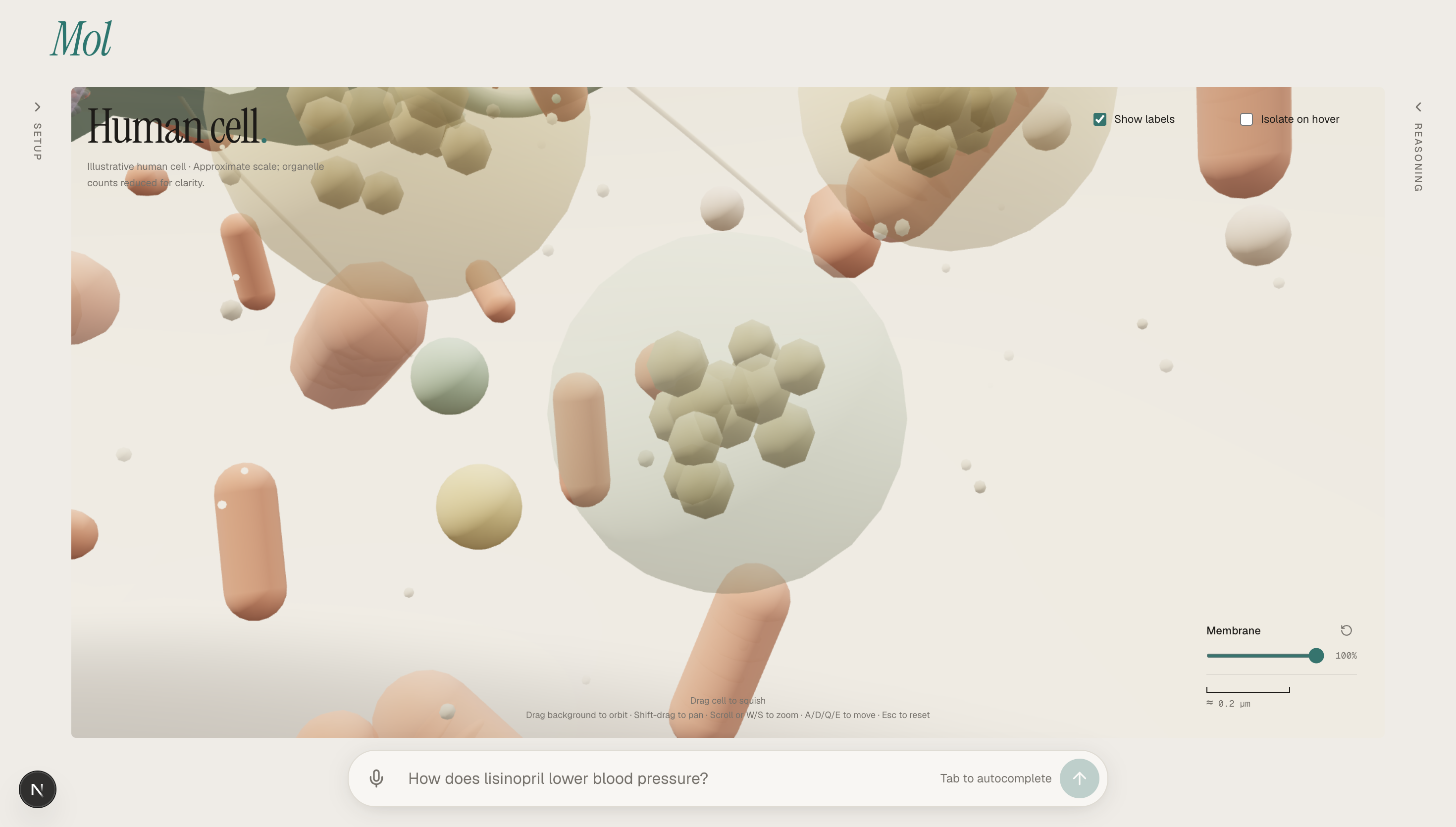
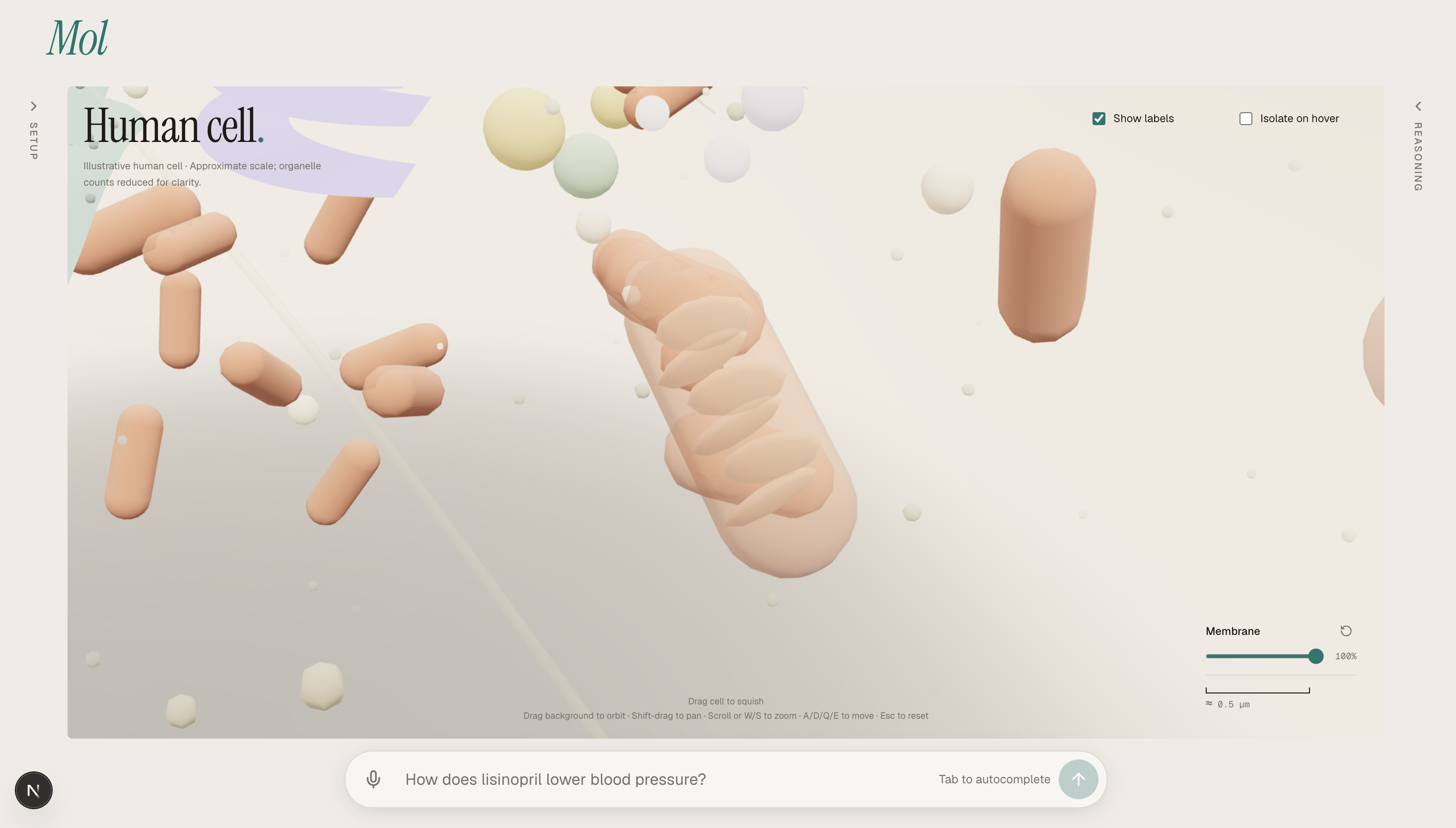
Mol lets you drop a drug onto a 3D human cell and watch AI agents debate what happens. It pulls from protein databases (RCSB PDB, AlphaFold), public chemical data (PubChem), a biomedical knowledge graph (Hetionet) and literature (PubMed, ClinicalTrials.gov). From these it works out how a medication reaches its targets, which pathways it touches, and what off-target effects it might have. Claude proposes a mechanism, Gemini challenges it as a skeptic, and Claude judges the result. The verdict is shown as a cell view with organelle-level effects on a timeline, and you can zoom into a molecular view of the drug bound to its target (with an unbound comparison). Every claim carries a citation and a confidence level. You can also keep asking follow-up questions in chat. This gives a quick, cheap first look at a drug without expensive experiments or hours of reading.
How we built it
Frontend: Next.js and Tailwind. The cell view uses React Three Fiber (three.js) and the molecule view uses Mol*. Voice dictation uses the browser’s Web Speech API.
Backend: FastAPI streaming over SSE. A debate orchestrator runs three agents: a Claude proposer, a Gemini skeptic and a Claude judge. The judge returns structured SimulationResult JSON, and the proposer gets one rebuttal if challenged.
Evidence tools: PubChem, RCSB PDB, RDKit, molecular docking (DiffDock NIM, with a Vina fallback), live PubMed search, and a Hetionet knowledge graph of drug → target → pathway → organelle. Tool results go into a shared evidence cache, so every agent argues from the same facts.
Retrieval: Elastic Serverless for hybrid and vector search over PubMed and ClinicalTrials.gov, with Bright Data for ingestion. If Elastic is unavailable, the agents fall back to live PubMed. Persistence: SQLite stores finished runs and chats, and precomputed demos are cached.
Challenges we ran into
Keeping the agents grounded. We shared one evidence cache and required citations on every claim, so the models couldn’t invent mechanisms. Mapping biology onto visuals. The ranked effects had to become a readable timeline of organelle changes, and we had to tune the camera to cut distortion at cell scale. Combining two 3D engines (three.js for the cell, Mol* for molecules) behind one smooth zoom. Making docking and multi-agent runs feel fast enough for a live demo, by streaming results and caching. Staying honest about uncertainty, since this is a prototype and not medical advice.
Accomplishments that we’re proud of
A full pipeline from a prompt to a cited, debated, visualized prediction. A two-layer view where you go from the whole cell down to a drug docked in its protein pocket. A skeptic from a different model family that actually changes the answer, so the output isn’t one model agreeing with itself. Reasoning and sources that are fully visible and traceable.
What we learned
Adversarial debate between different models, grounded in shared tool evidence, gives more trustworthy answers than a single model. Public biomedical data is rich but messy, so cleaning and caching it matters as much as the model. Visual explanation makes AI reasoning much easier to inspect and trust. How to orchestrate agents, streaming, tools and 3D in a hackathon timeline.
What’s next for Mol
Check the predictions against known experimental and clinical outcomes, and report accuracy. Add multi-drug interaction and dose modeling, which is the original unintended-interaction problem. Cover more cell types and tissues, plus vaccine and antigen scenarios. Add pathway-level simulation, and let researchers upload their own compounds and structures. Work with domain scientists to validate and refine it before anyone treats it as more than a research aid.

Log in or sign up for Devpost to join the conversation.