-
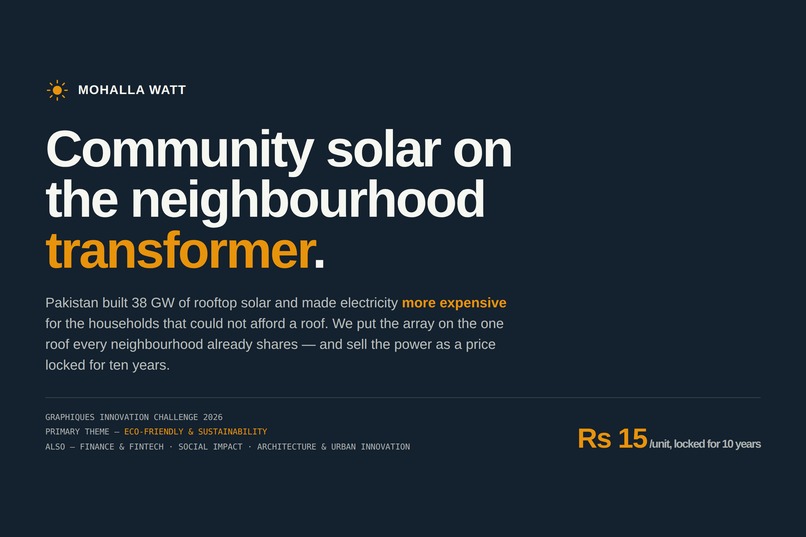
Community solar on the neighbourhood transformer. Rs 15 a unit, locked for ten years.
-
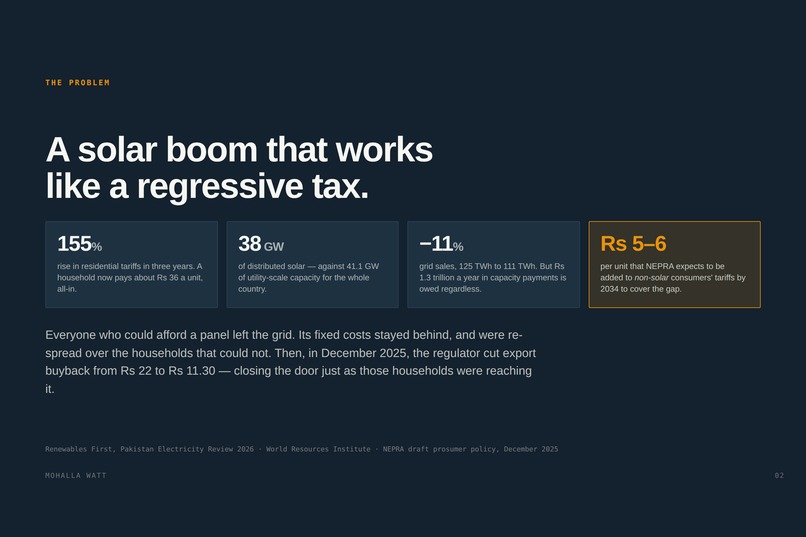
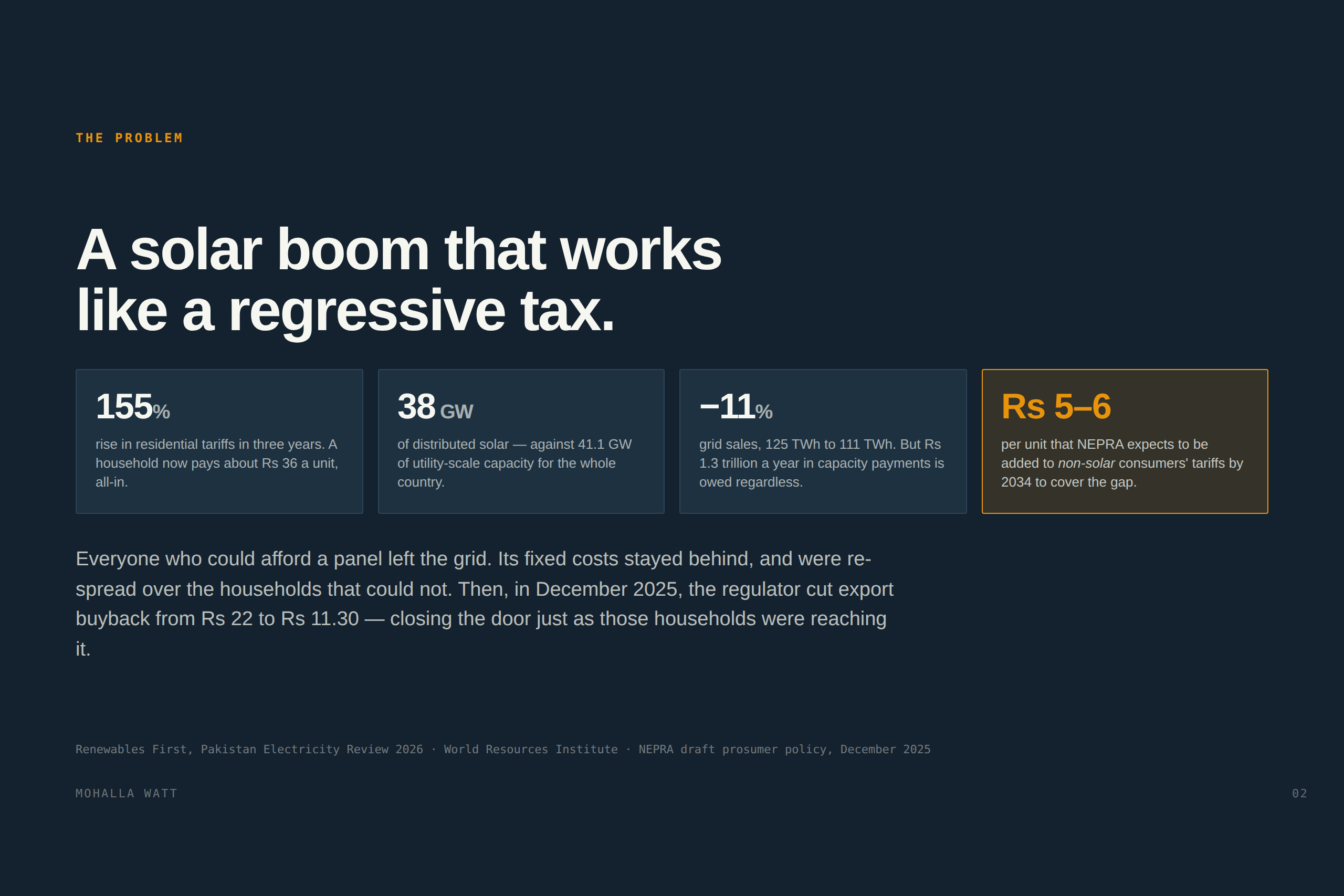
Pakistan added 38 GW of distributed solar. NEPRA expects the cost shift to add Rs 5-6 a unit to everyone who could not join.
-
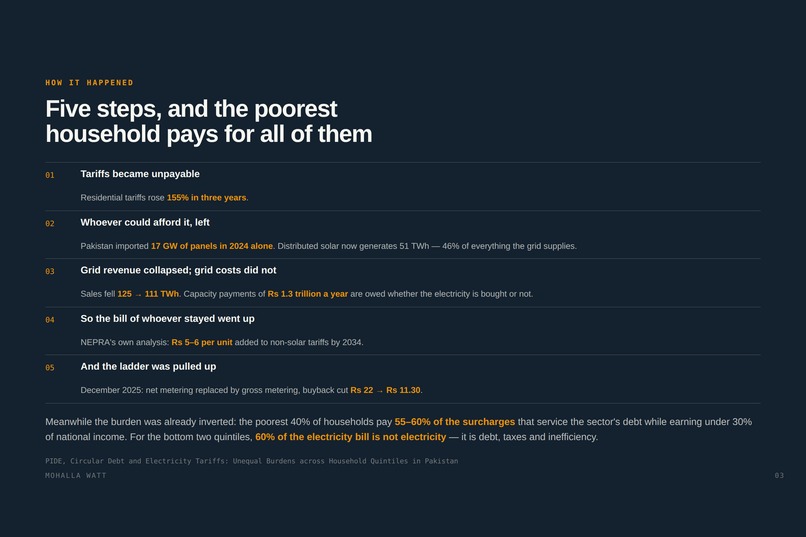
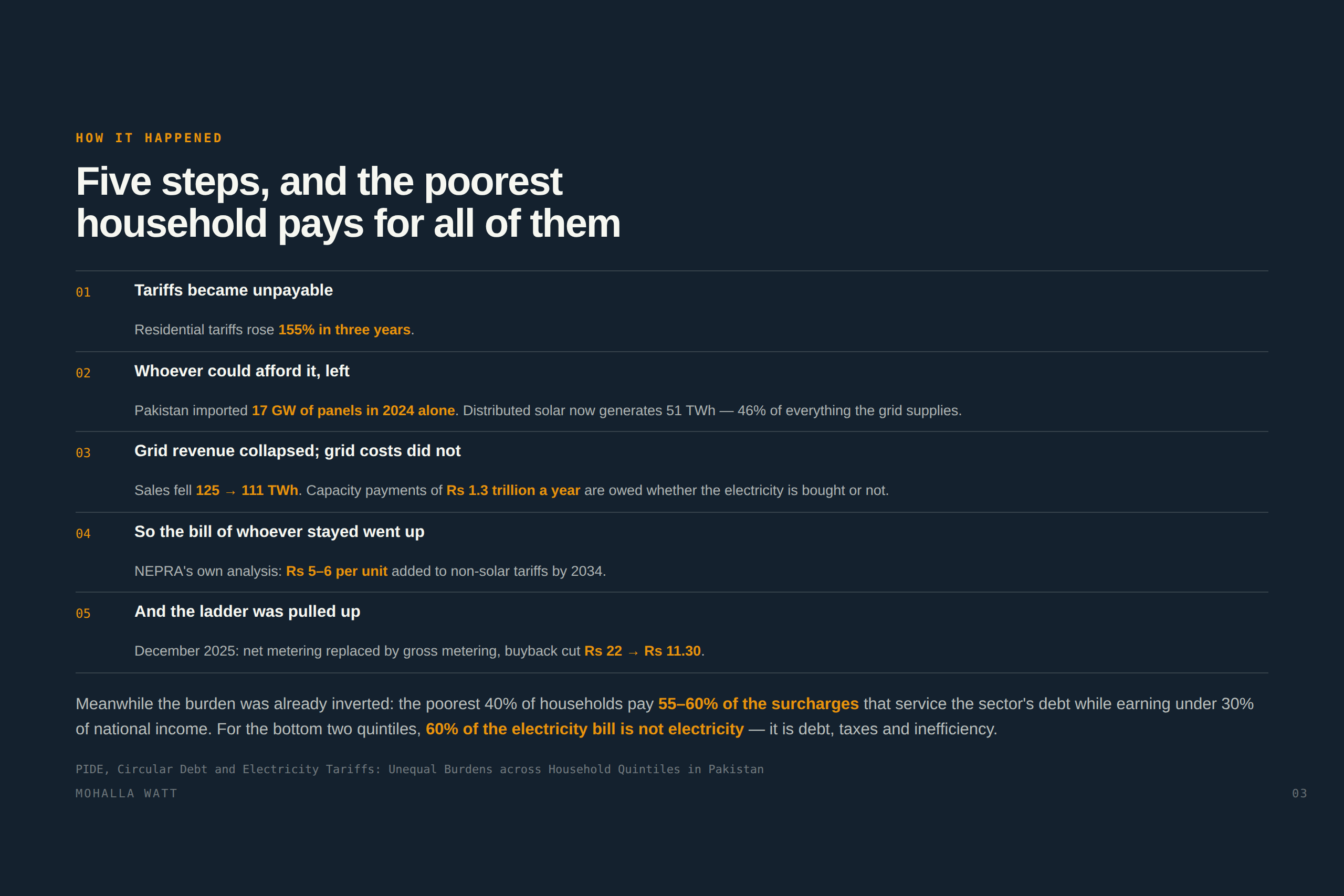
The five steps, and why the poorest household pays for all of them.
-
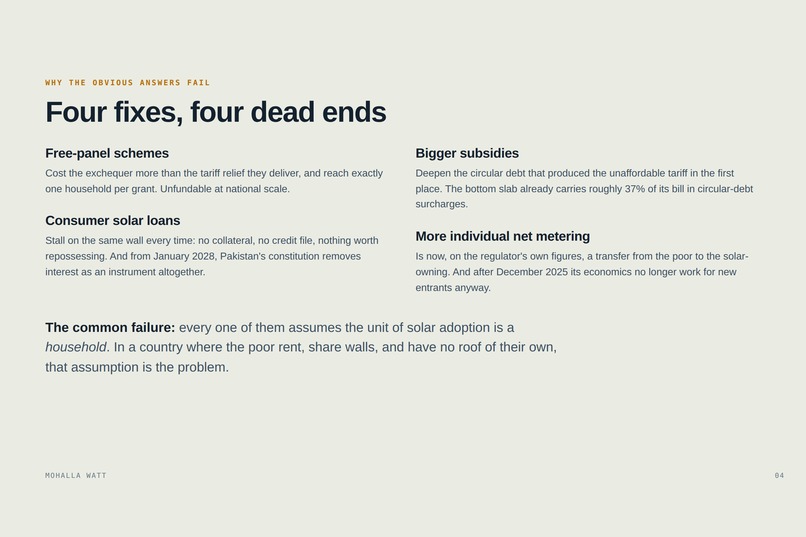
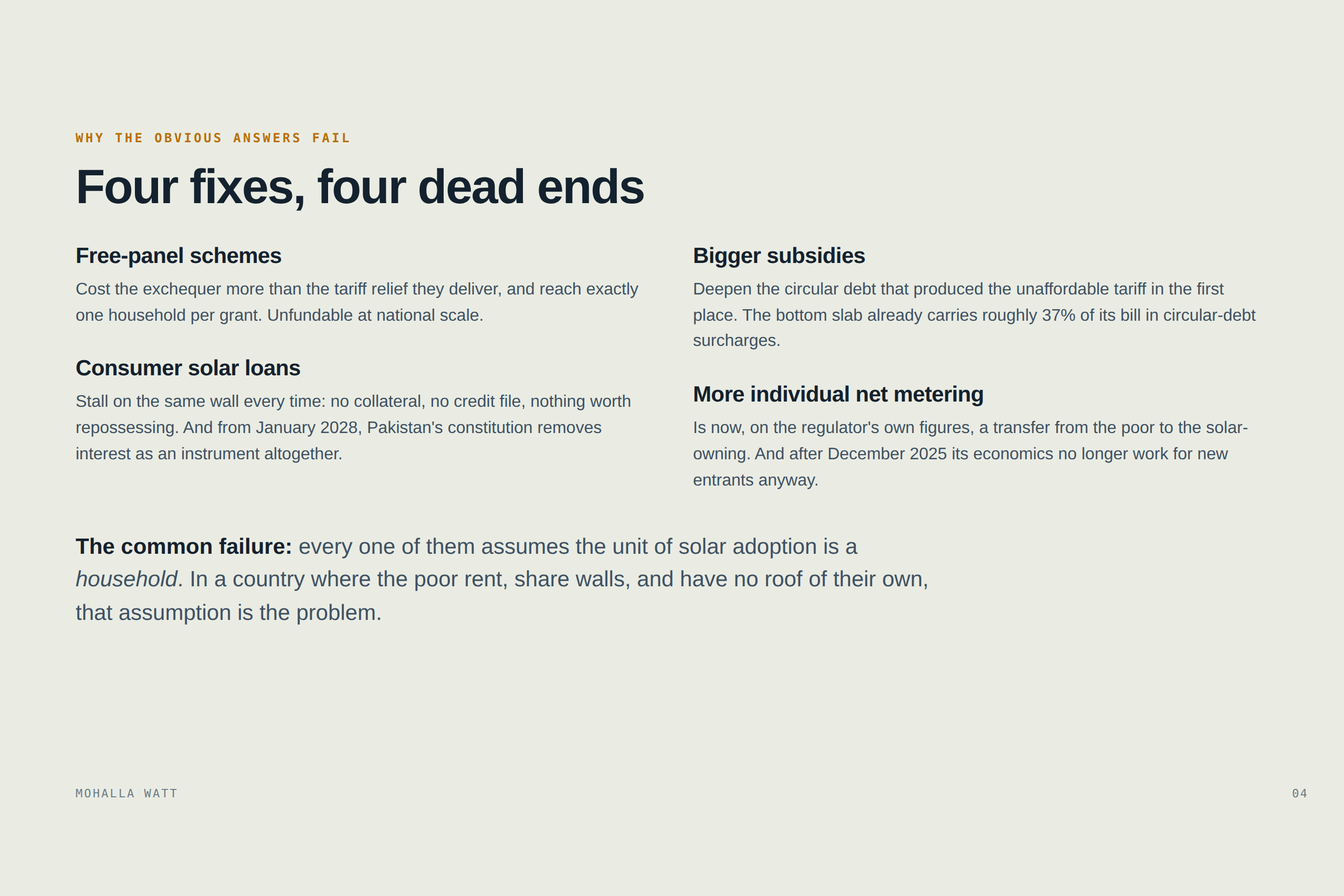
Four standard fixes, four dead ends. Each assumes the unit of solar adoption is a household.
-
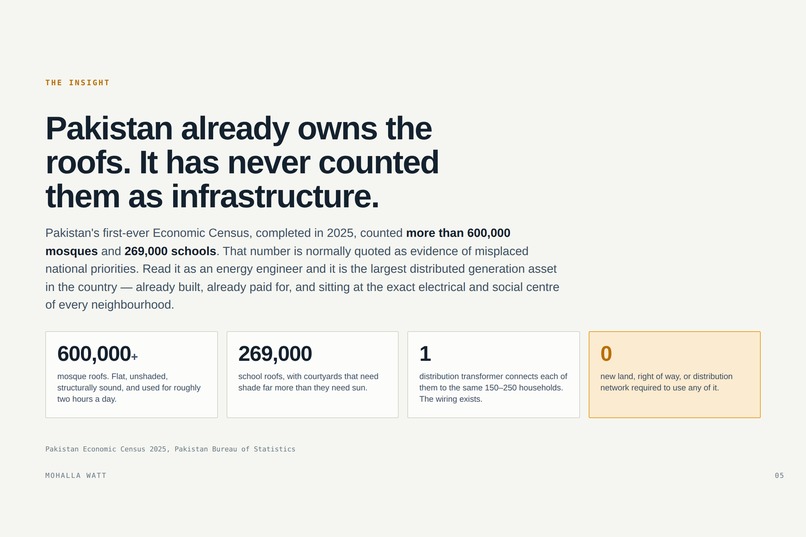
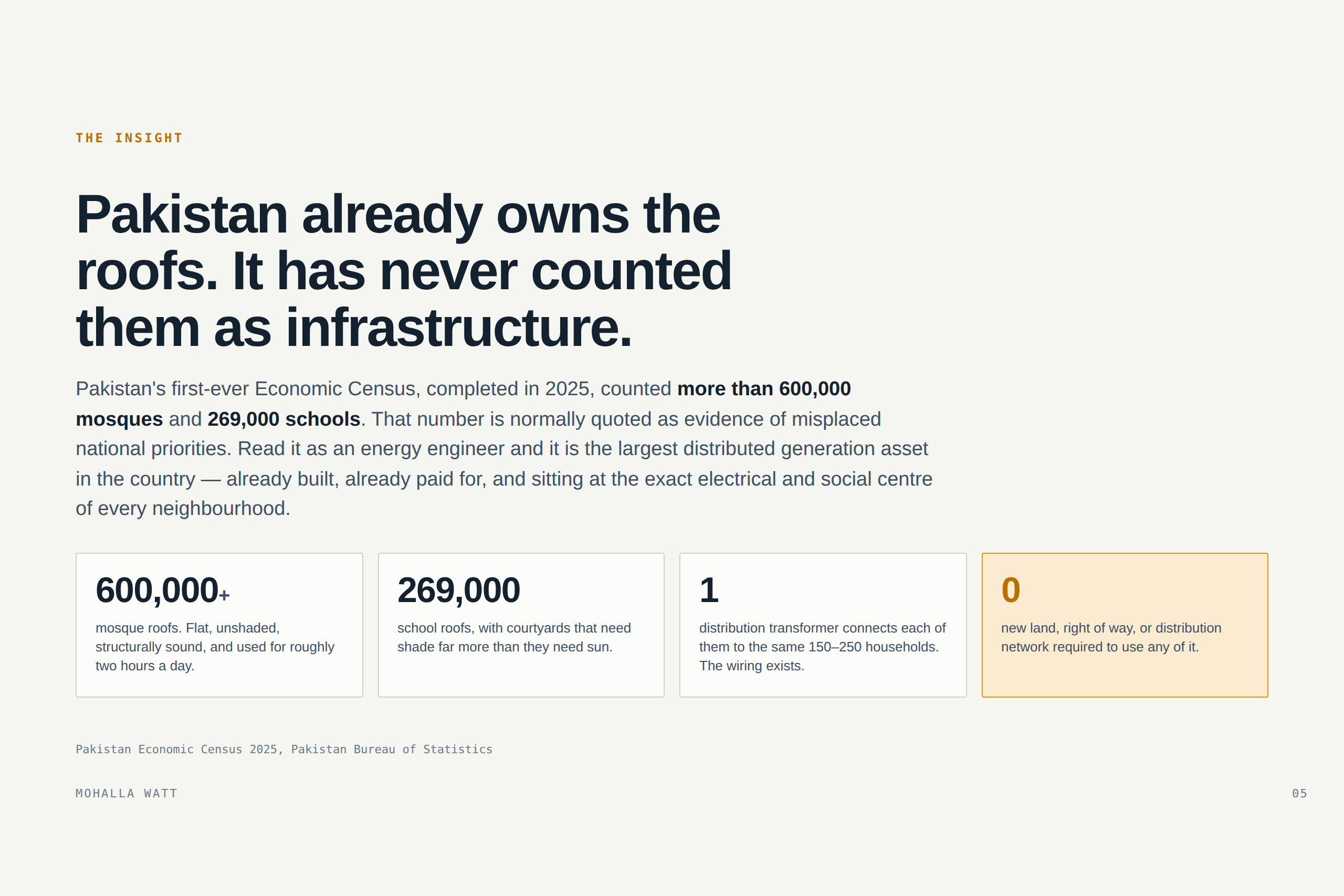
The 2025 Economic Census counted 600,000 mosques. Read as an asset register, that is the largest distributed generation asset in the country
-
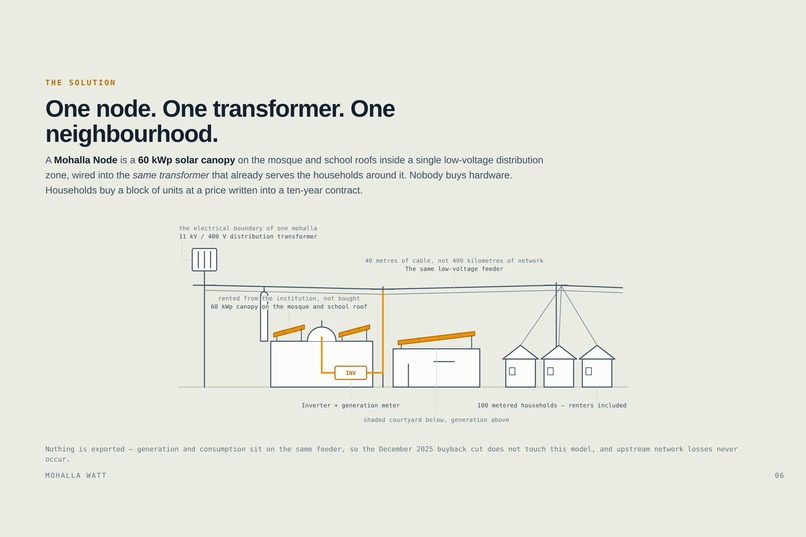
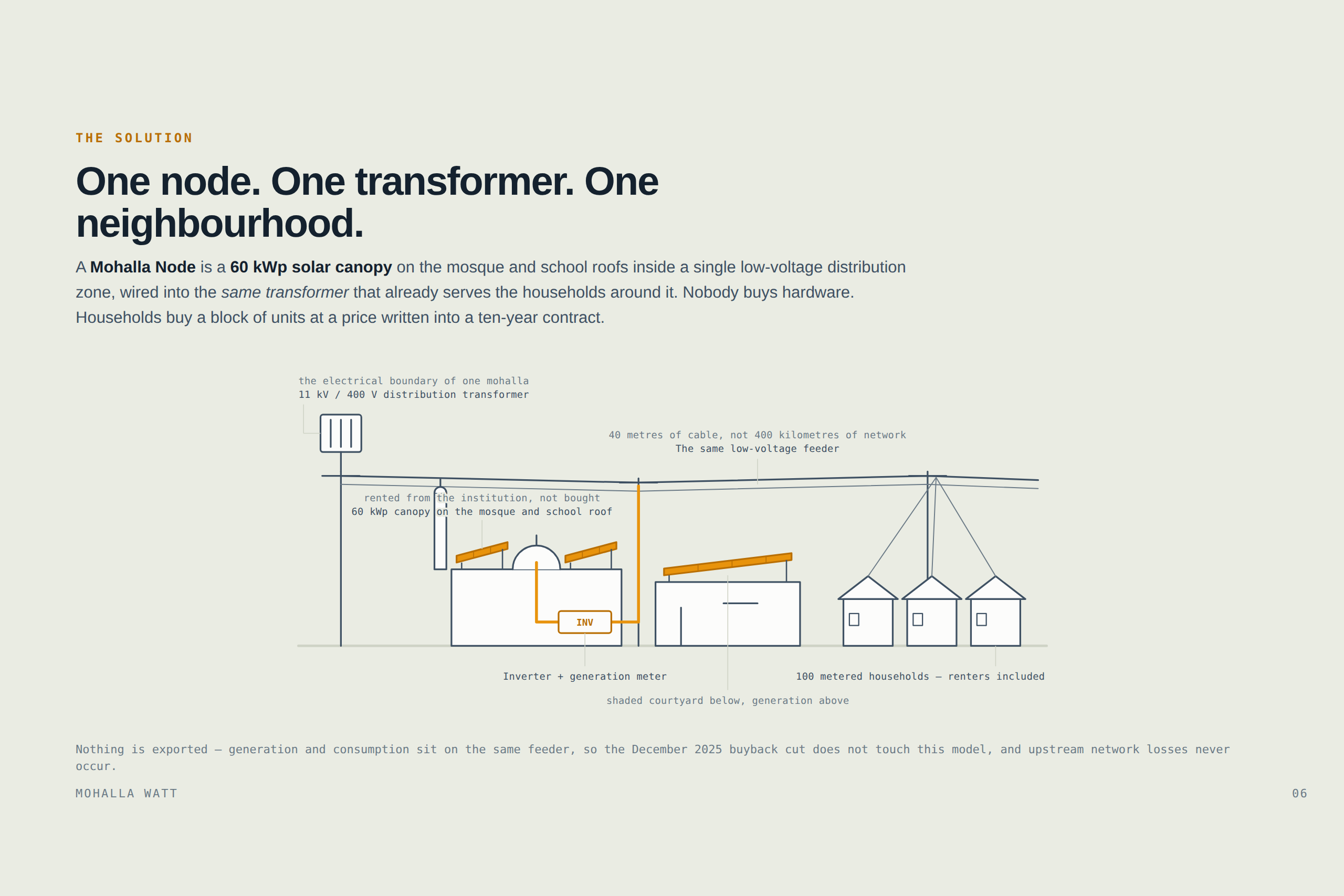
How a Mohalla Node works: 60 kWp on the mosque and school roof, wired into the same transformer that serves the houses.
-
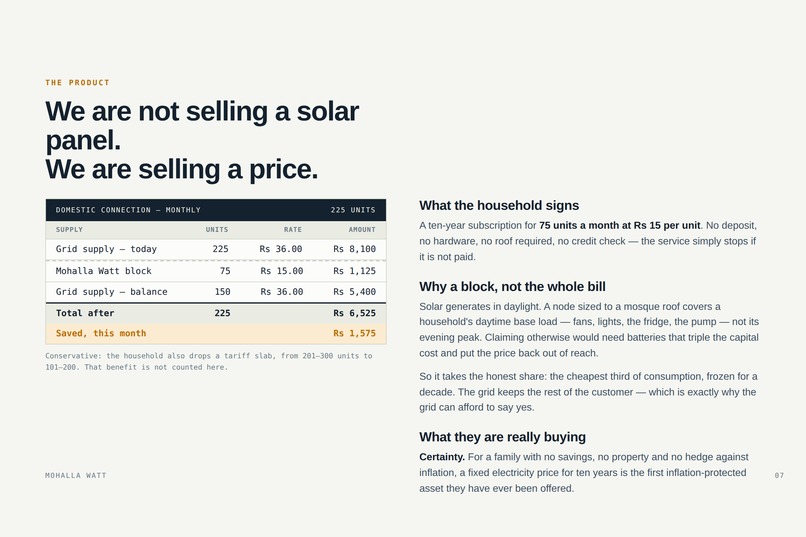
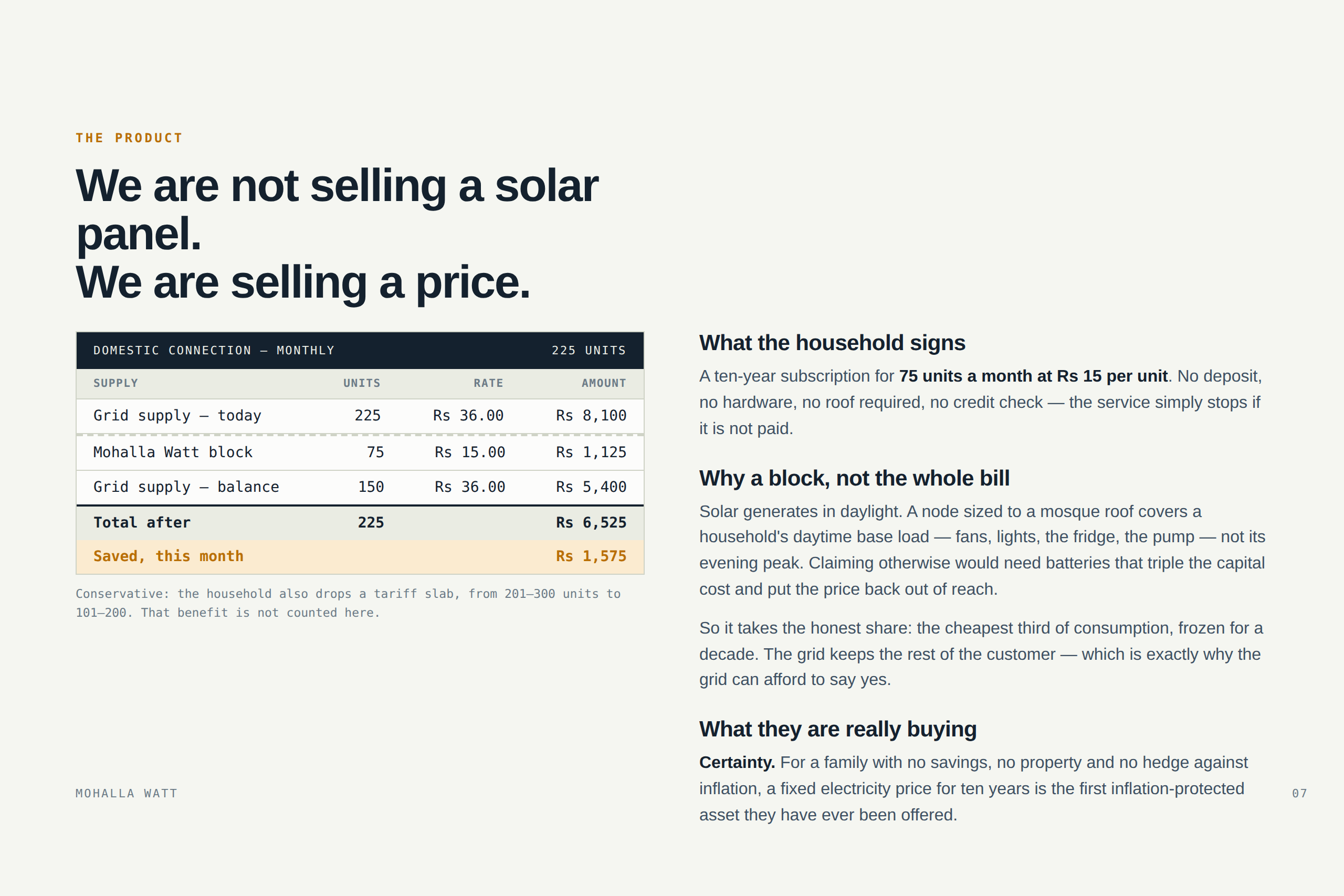
A real bill, before and after. 225 units, Rs 1,575 saved every month.
-
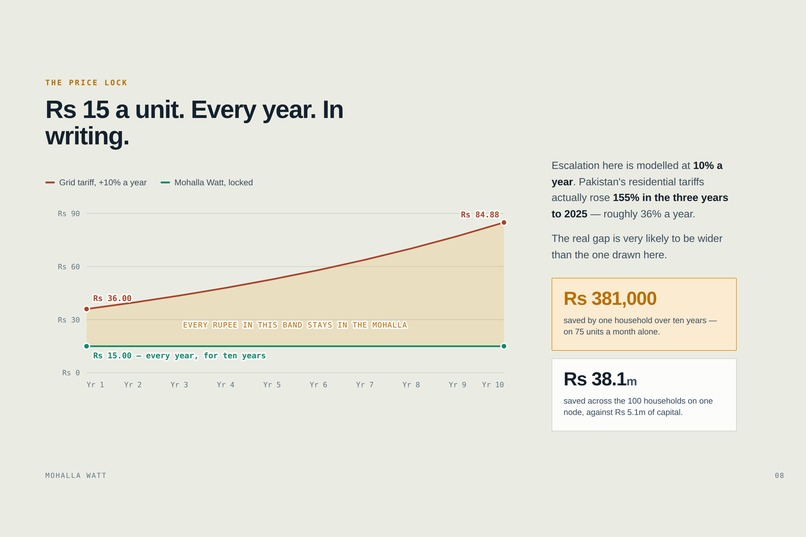
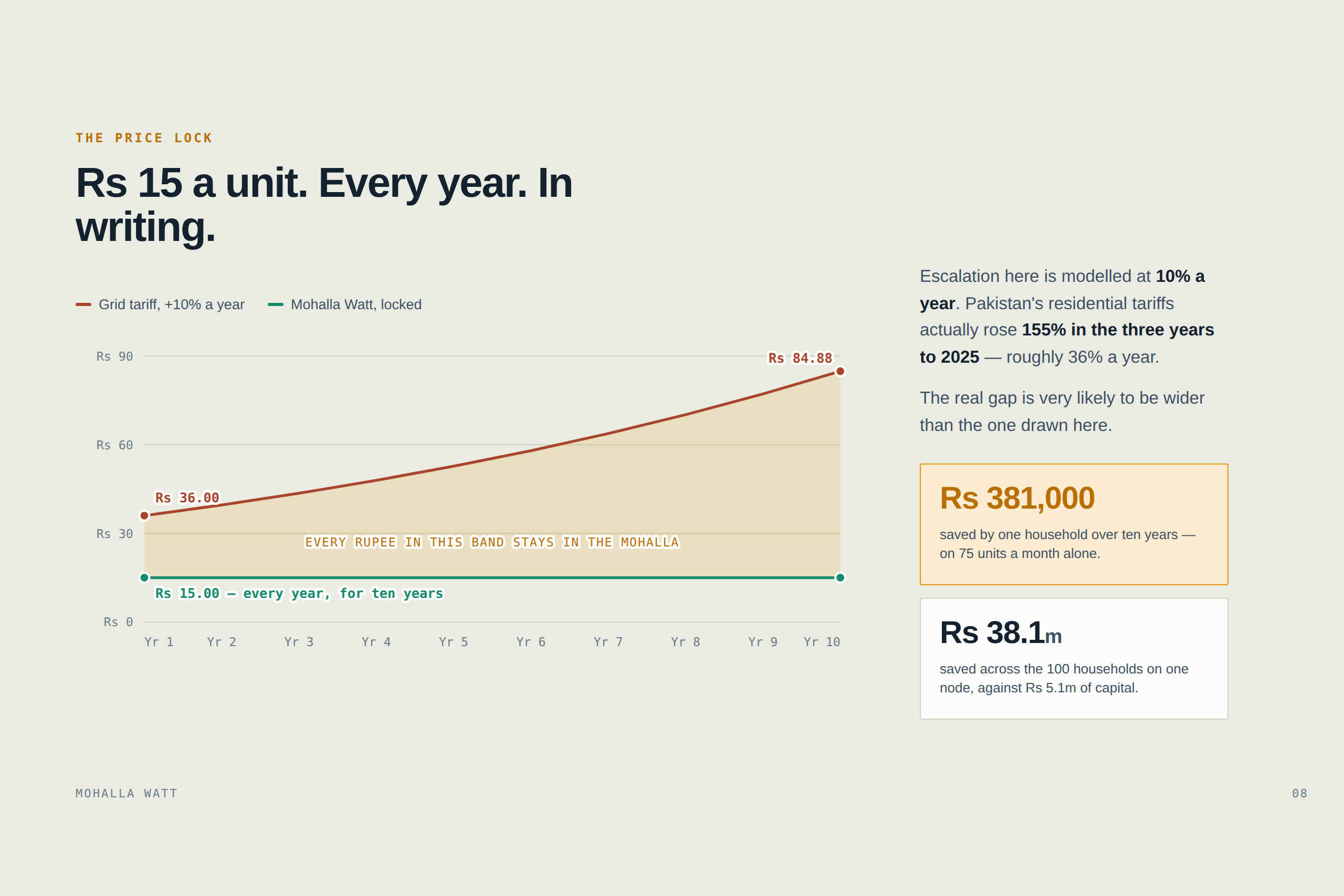
The grid tariff climbs. Ours does not. Everything in the shaded band is household saving.
-
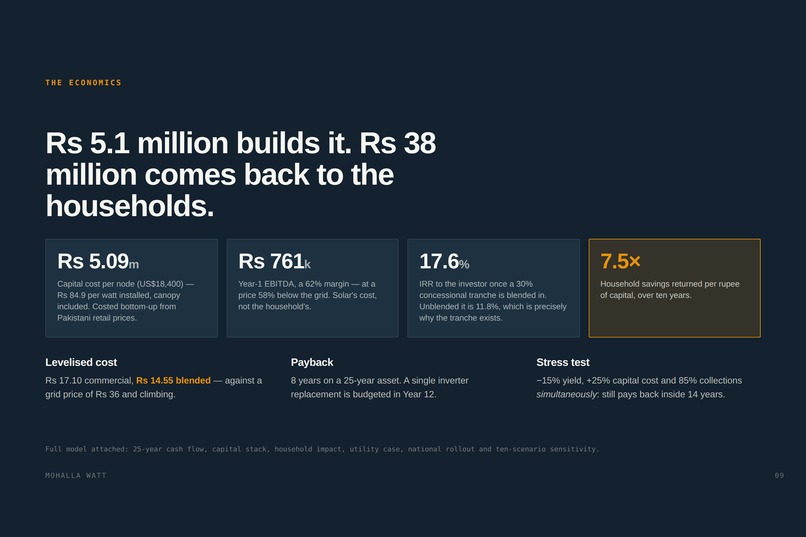
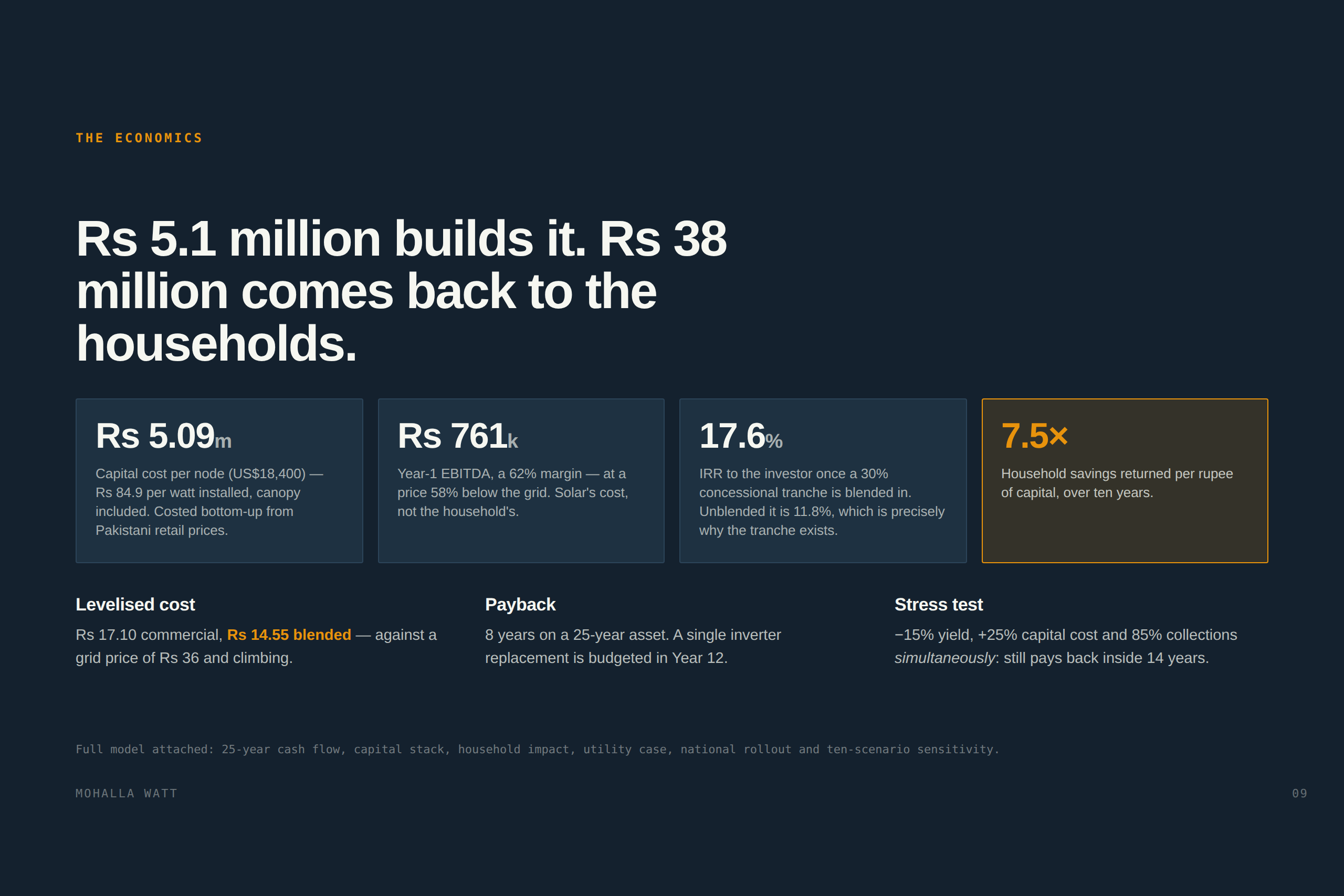
Rs 5.09m builds a node. Rs 38.1m of household savings comes back over ten years.
-
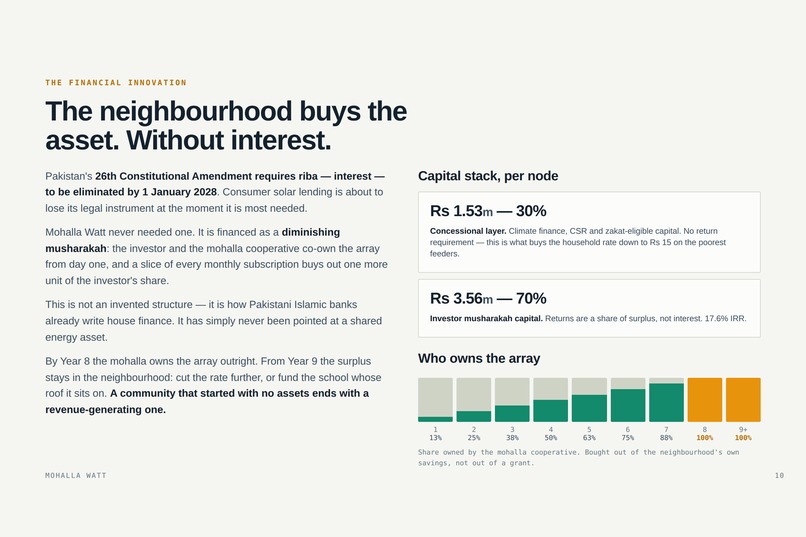
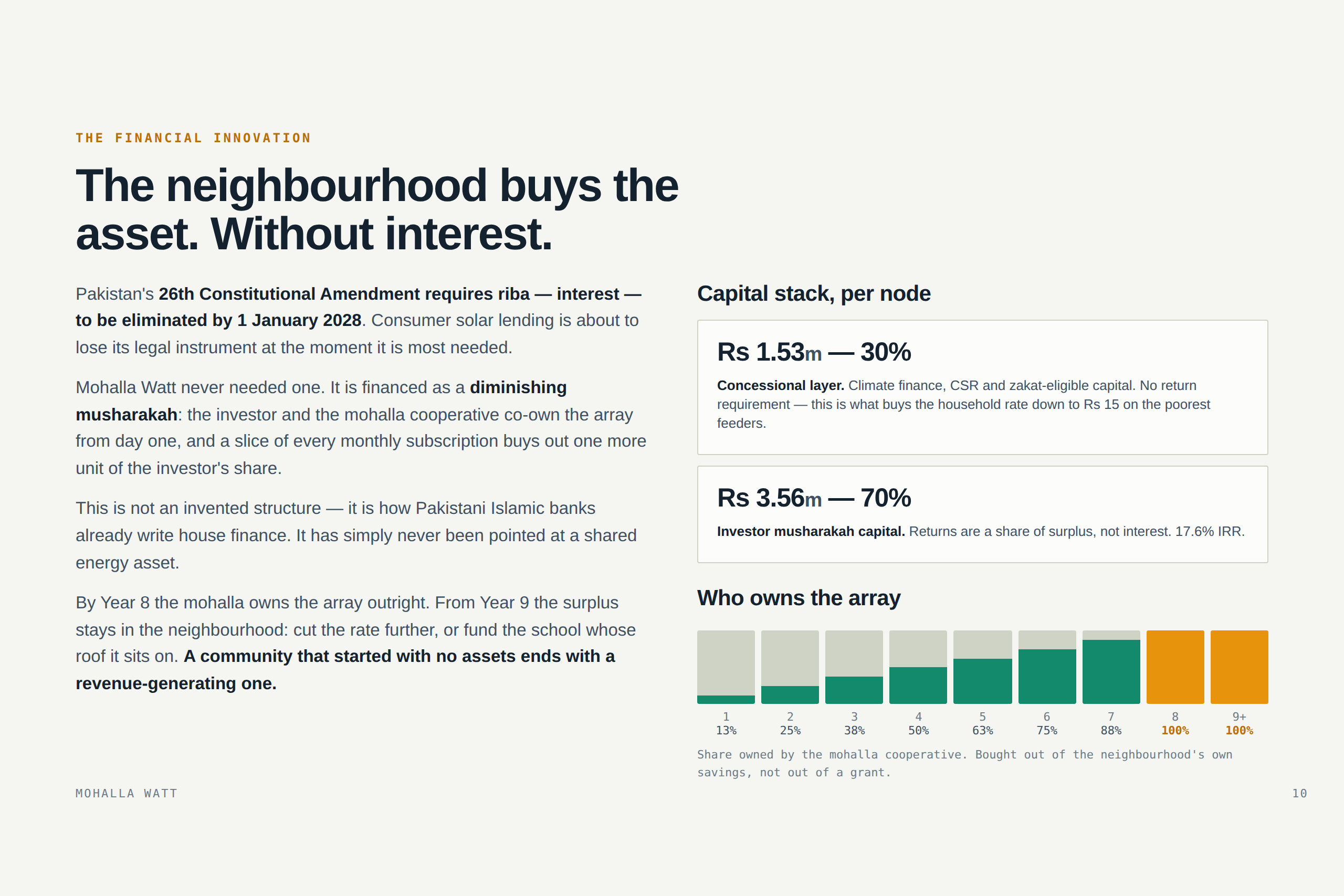
Diminishing musharakah: no interest, and the mohalla owns the array outright by Year 8.
-
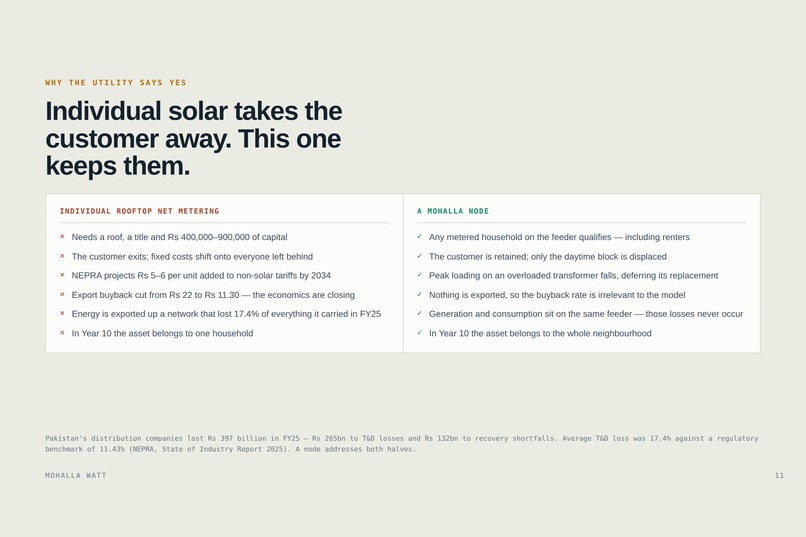
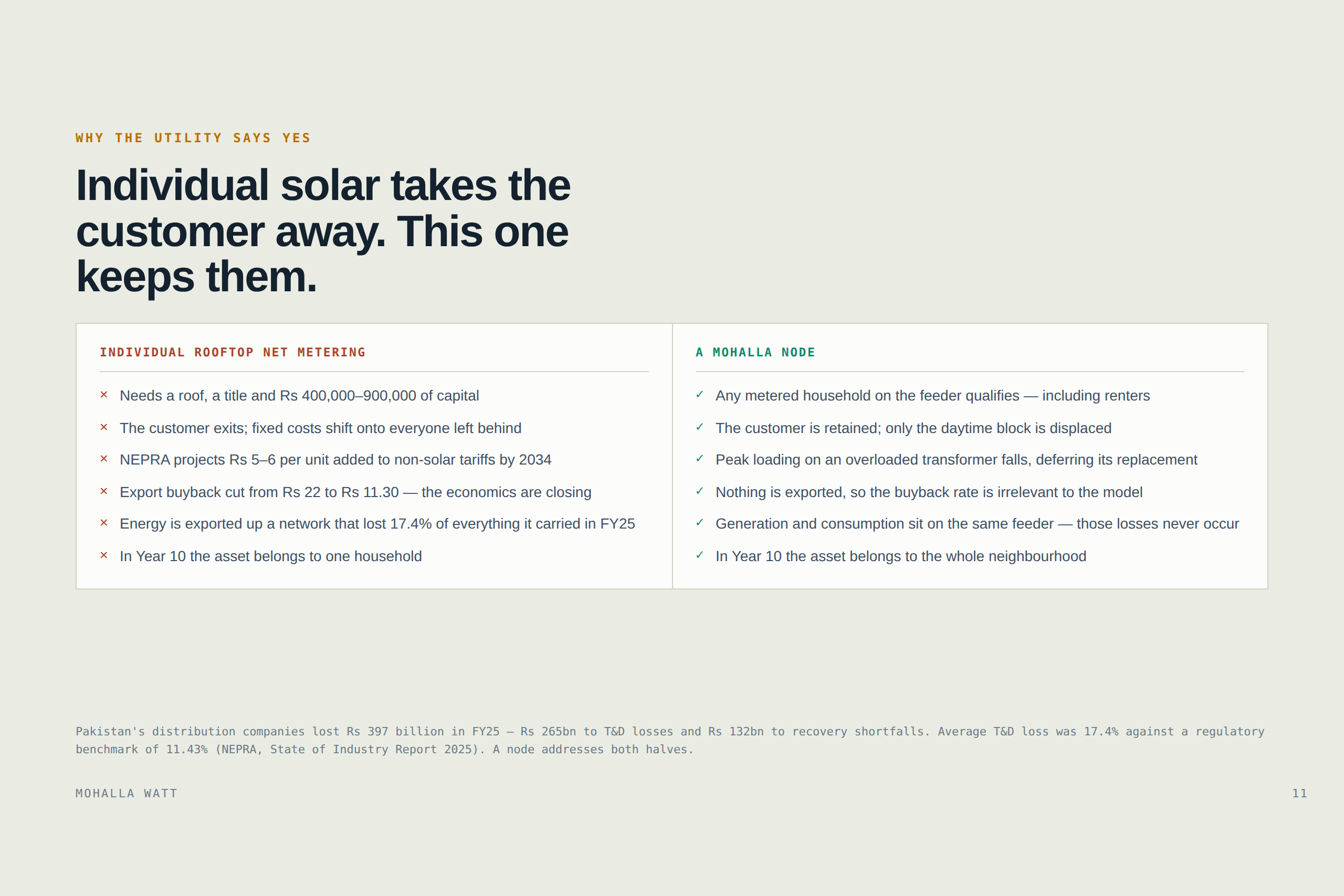
Individual rooftop solar takes the customer off the grid. A Mohalla Node keeps them on it.
-
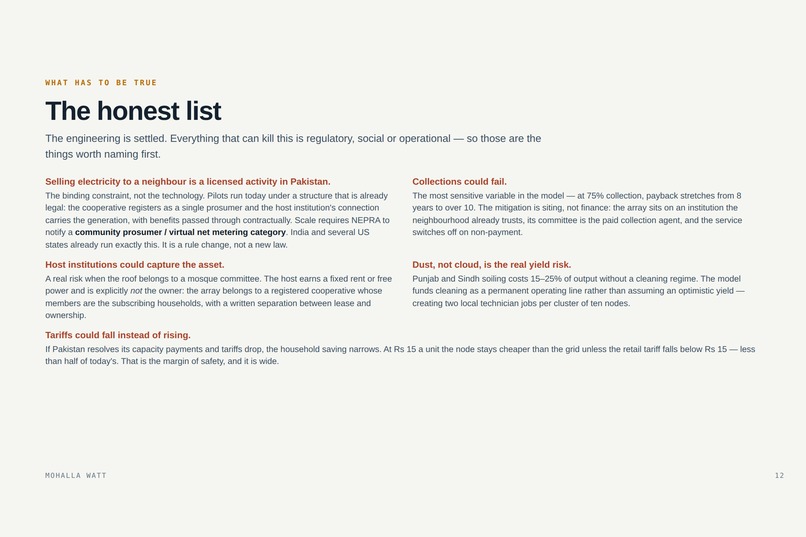
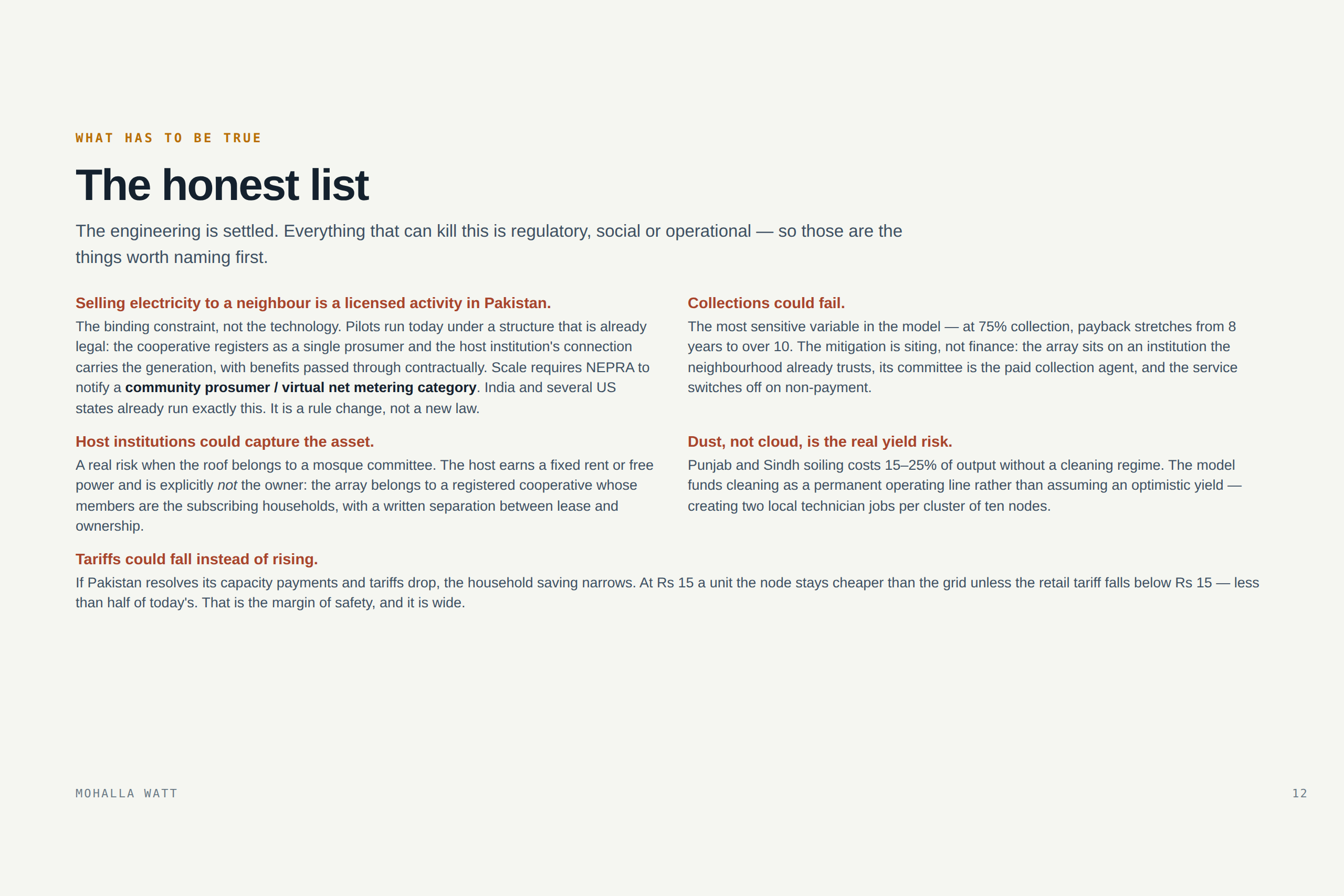
The honest list. Regulatory, social and operational risks, and what is done about each.
-
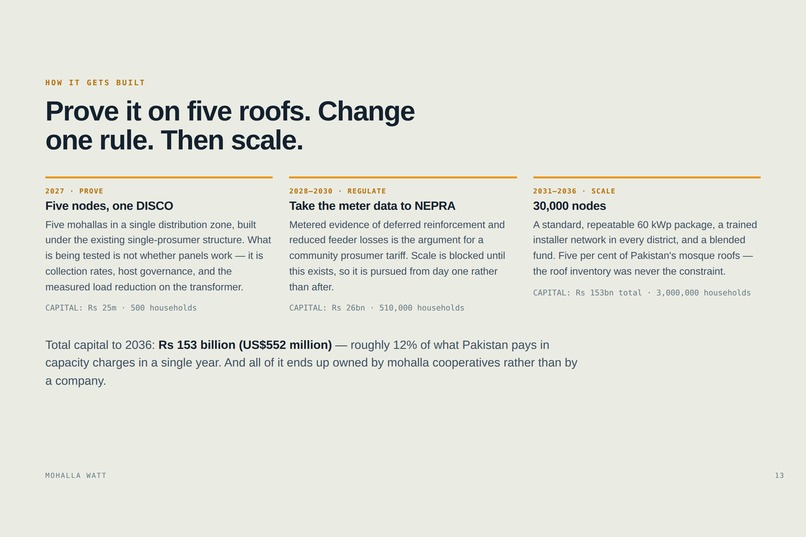
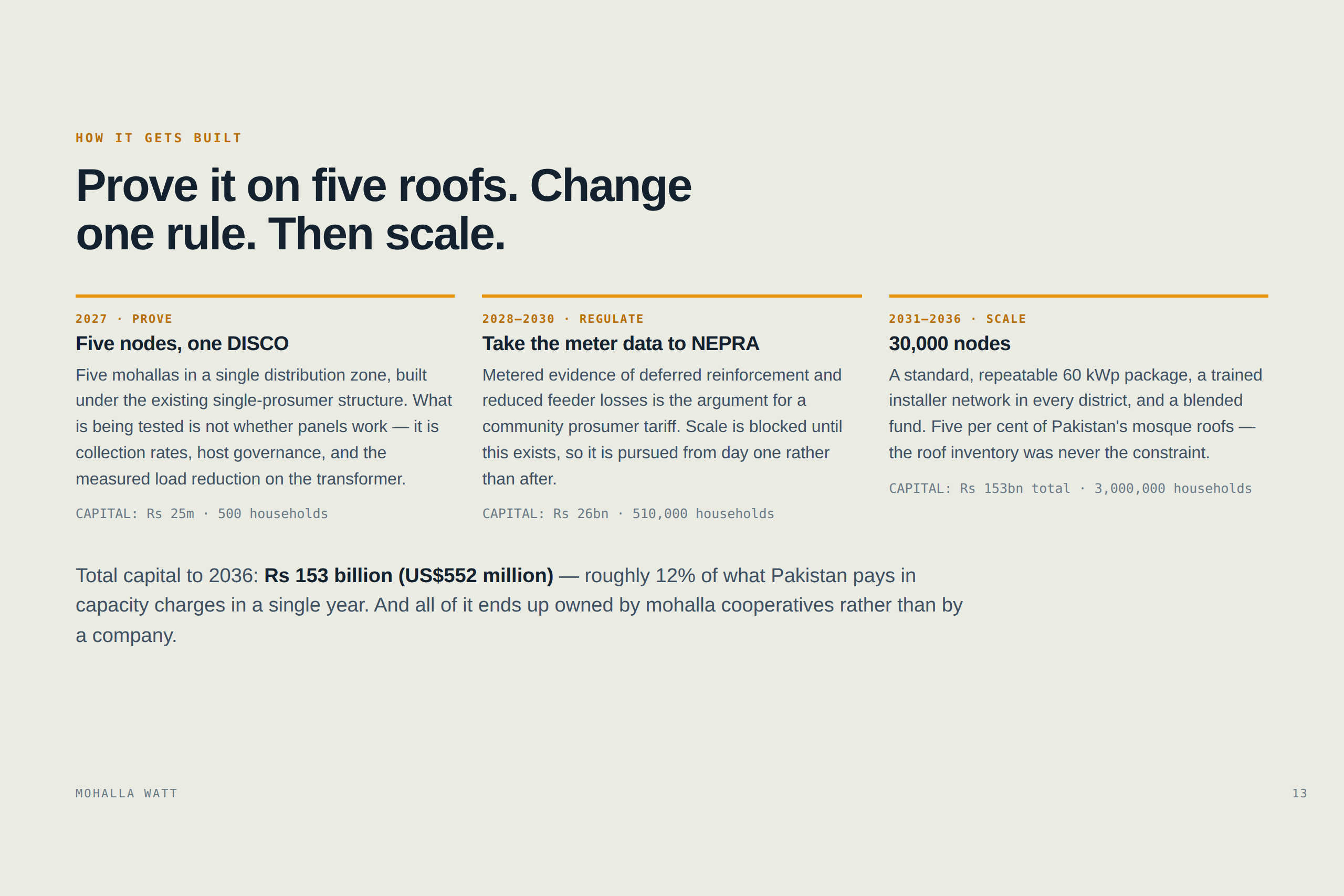
Prove it on five roofs, change one rule at NEPRA, then scale to 30,000 nodes.
-
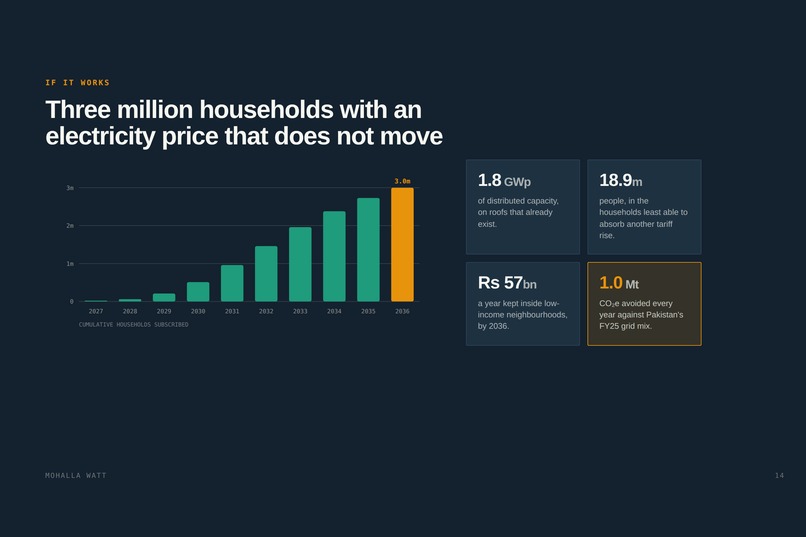
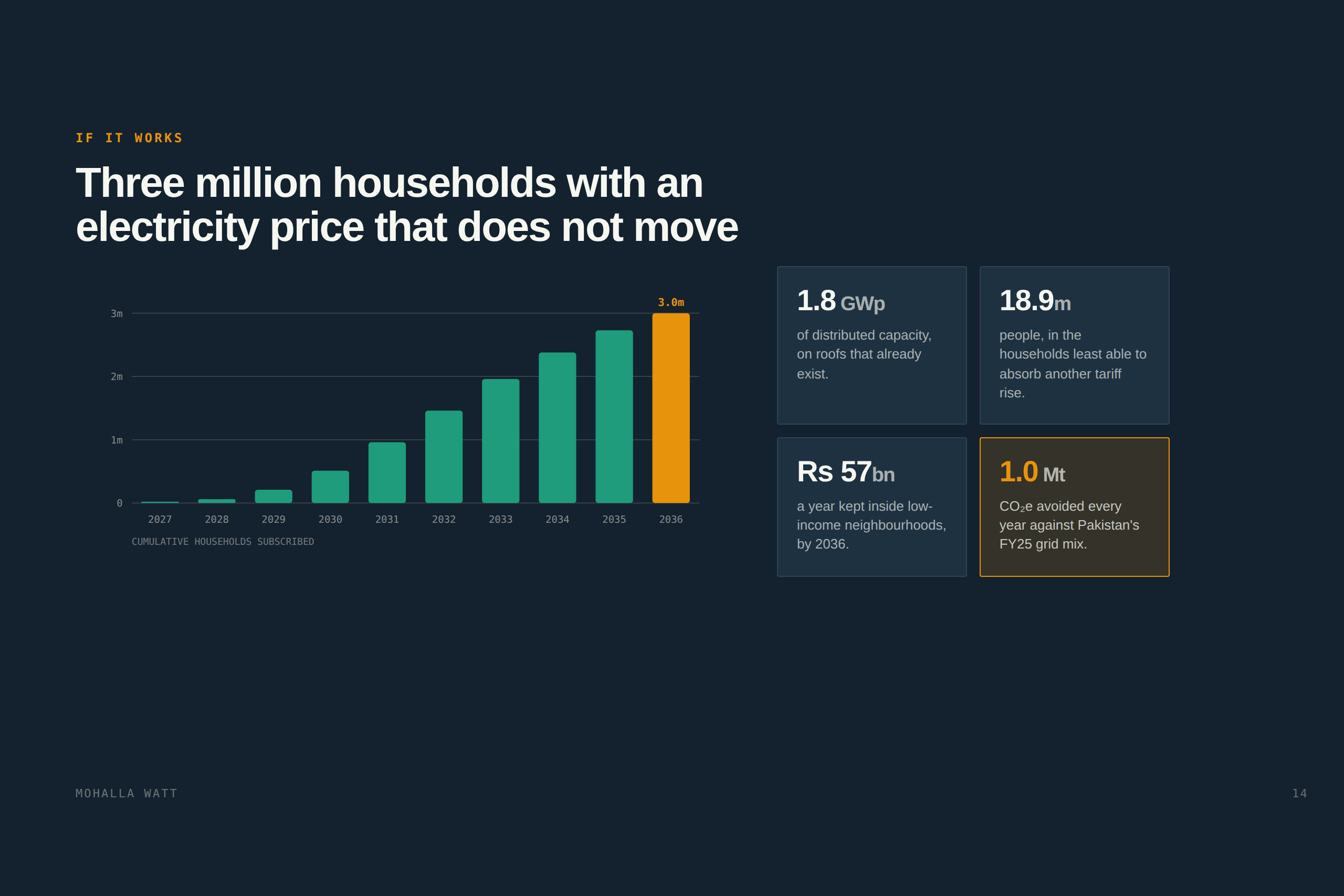
By 2036: three million households with an electricity price that does not move.
-
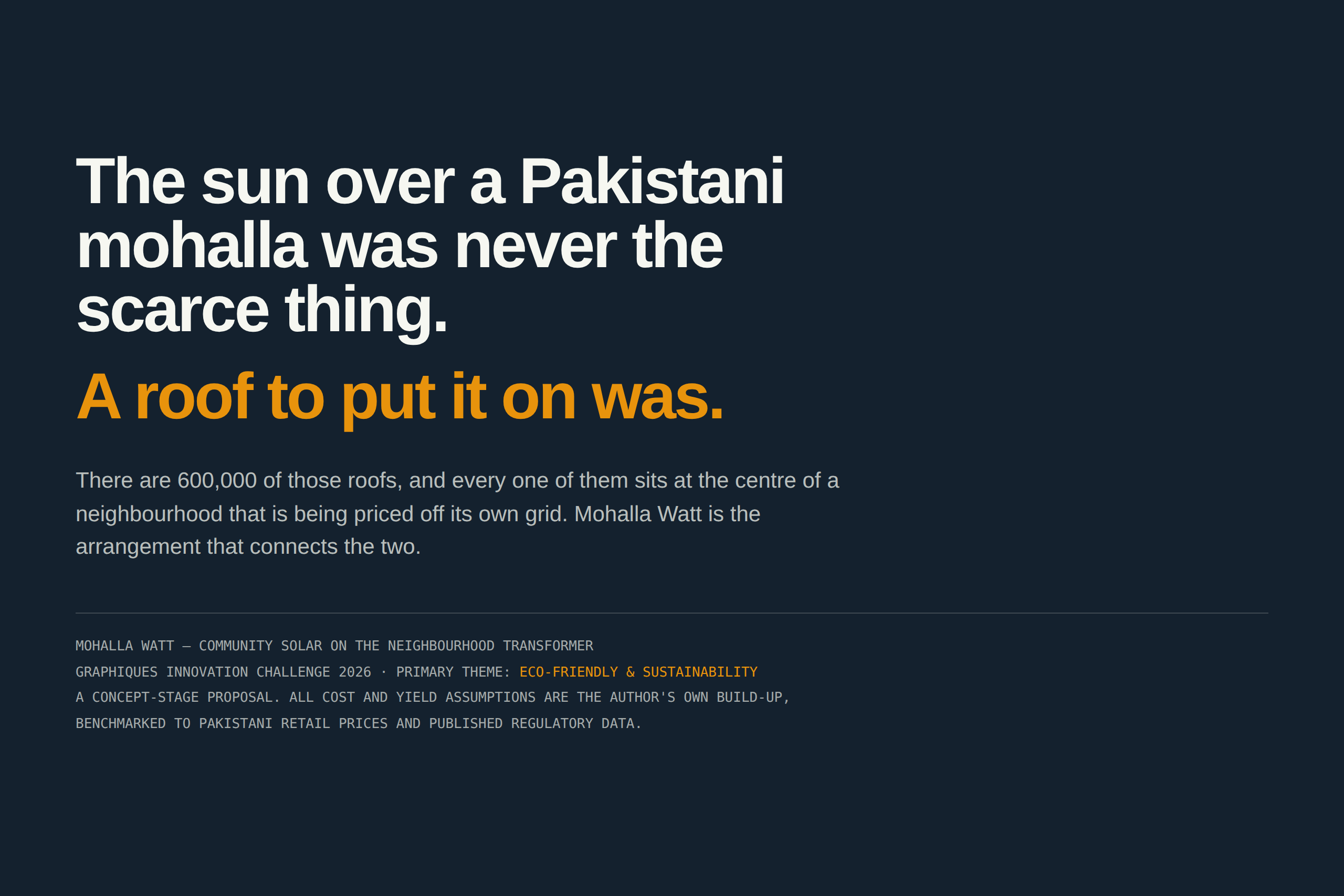
The sun over a Pakistani mohalla was never the scarce thing. A roof to put it on was.
The one-line version
Pakistan put 38 GW of solar on its roofs and made electricity more expensive for the people who could not afford a roof. Mohalla Watt builds the array on the one roof every neighbourhood already shares, and sells the power at Rs 15 a unit, locked for ten years.
(A "mohalla" is the Urdu word for a neighbourhood or urban quarter. It is the unit of social life in every Pakistani city.)
Primary theme: Eco-Friendly & Sustainability. The project also runs through Finance & FinTech, Social Impact & Community Innovation, and Architecture & Urban Innovation.
Inspiration
I live in Pakistan, so I did not have to look for this problem. It arrives every month on a piece of paper.
What got me started was a contradiction I could not make sense of. Pakistan is having one of the fastest solar booms on earth. Imports hit 17 GW of panels in 2024 alone. Distributed solar now stands at roughly 38 GW against 41.1 GW of utility-scale capacity for the entire country. By any normal reading, that is a climate success story.
And yet electricity is getting more expensive, and the people it is getting most expensive for are the people with no panels.
Once I started pulling on that thread, the mechanism was ugly and simple. Everyone who could afford a system left the grid. The grid's costs did not leave with them. Capacity payments to power producers run at about Rs 1.3 trillion a year and are owed whether anyone buys the electricity or not. So those fixed costs get re-spread across a shrinking group of customers who stayed because they had no choice. NEPRA, the regulator, says in its own analysis that this cost shift could add Rs 5 to 6 per unit to the bills of non-solar consumers by 2034.
That is the thing I wanted to fix. Not "Pakistan needs more solar." Pakistan has plenty of solar. The problem is who it is reaching.
The problem, in full
What is broken. Residential tariffs rose 155% in three years. A household on the 201-300 unit slab now pays roughly Rs 36 per unit all in. Grid sales have fallen from 125 TWh to 111 TWh in three years, not because people use less electricity, but because the paying customers left.
Who is affected. Households that rent, share walls, live in flats, or simply cannot raise Rs 400,000 to 900,000 for a rooftop system. Pakistan has 38.29 million households and a rooftop system is out of reach for the large majority.
Why it matters. The burden was already upside down before solar arrived. PIDE's research finds the poorest 40% of Pakistani households pay 55 to 60% of the surcharges that service the power sector's debt, while earning under 30% of national income. For the bottom two income quintiles, 60% of the electricity bill is not electricity at all. It is debt, taxes and inefficiency. For the richest quintile that figure is 30%.
Why the existing answers do not work.
- Free-panel government schemes cost more than the relief they deliver and reach one household per grant. They cannot scale fiscally.
- Consumer solar loans hit the same wall every time: no collateral, no credit file, nothing worth repossessing. And Pakistan's 26th Constitutional Amendment requires interest to be eliminated from the financial system by 1 January 2028, which removes the instrument entirely.
- Bigger subsidies deepen the circular debt that produced the unaffordable tariff in the first place. Roughly 37% of a lifeline-slab household's bill is already circular-debt surcharge.
- More individual net metering is, on the regulator's own numbers, a transfer from the poor to the solar-owning. And in December 2025 NEPRA moved to replace net metering with gross metering, cutting the export buyback rate from Rs 22 to Rs 11.30 per unit, so the individual rooftop route is closing anyway.
Every one of these assumes the unit of solar adoption is a household. In a country where the poor rent, share walls and own no roof, that assumption is the problem.
The insight
Pakistan's first ever Economic Census, completed in 2025, counted more than 600,000 mosques and 269,000 schools.
That number normally gets quoted as evidence of misplaced national priorities. I read it as an asset register instead.
Six hundred thousand rooftops. Flat, unshaded, structurally sound, already built, already paid for, used for about two hours a day, and sitting at the exact electrical and social centre of every neighbourhood in the country. Nothing new has to be built to start.
The solution
A Mohalla Node is a 60 kWp solar canopy on the mosque and adjoining school roofs inside a single low-voltage distribution zone, wired into the same 11 kV / 400 V distribution transformer that already serves the 150 to 250 households around it.
- The host institution leases its roof and earns rent, or takes the value as free power. The canopy doubles as shade over the courtyard and the school playground, which matters in a 45 C summer and is the reason hosts agree.
- About 100 households on that same transformer subscribe to a block of 75 units a month at Rs 15 per unit, fixed for ten years by contract. The grid currently costs them about Rs 36 and rising.
- Nothing is exported. Generation and consumption sit on the same feeder, so the energy travels forty metres instead of four hundred kilometres. Pakistan's distribution companies lost 17.4% of the energy they carried in FY25 against a regulatory benchmark of 11.43%. The upstream share of that loss simply does not occur here.
- Households pay nothing upfront. No hardware, no deposit, no roof, no credit check. The service stops if the subscription is not paid.
We are not selling a solar panel. We are selling a price.
For a family with no savings, no property and no hedge against inflation, a fixed electricity price for ten years is the first inflation-protected asset they have ever been offered.
What makes it different
Community solar itself is not new. Versions of it run in the United States and India. What is new here is the specific combination, engineered for Pakistan's regulatory, financial and social reality.
1. It sits on the transformer, not on a solar farm. Conventional community solar builds a remote array and credits distant subscribers, which needs a wheeling and settlement regime Pakistan does not have. A Mohalla Node sits behind the same distribution transformer as its subscribers, so nothing is exported. The December 2025 policy change that is killing individual rooftop solar leaves this model untouched, because self-consumption inside the mohalla is now the highest-value use of a solar unit in Pakistan.
2. The host is a trusted institution, not a landlord. Putting the array on a mosque or school solves three problems at once: no land purchase, the electrical centre of the feeder, and a committee the neighbourhood already trusts. Recovery in Pakistan is a social problem before it is a credit problem.
3. The product is a ten-year price lock. In a country where tariffs rose 155% in three years, the scarcest thing a poor household can buy is certainty. Over ten years, on 75 units a month alone, that lock is worth Rs 381,000 to one household.
4. It is financed as a diminishing musharakah, with no interest at any point. Investor and mohalla cooperative co-own the array from day one, and a slice of every monthly subscription buys out one more unit of the investor's share. This is not an invented structure. It is how Pakistani Islamic banks already write house finance. It has simply never been pointed at a shared energy asset. By Year 8 the neighbourhood owns the array outright. A community that started with no assets ends with a revenue-generating one.
5. It makes the distribution company better off, not worse. Every other distributed solar product takes the customer off the grid. This one keeps them. Only the daytime block is displaced, peak loading on an overloaded transformer falls, feeder losses that would have happened do not, and collections improve because the neighbourhood polices them itself.
How I built it
This is a non-code project, so "built" means research, modelling and design.
I started with primary and regulatory sources rather than opinion pieces: the Renewables First Pakistan Electricity Review 2026, NEPRA's State of Industry Report 2025, the December 2025 draft prosumer policy, PIDE's work on tariff burden by income quintile, and the 2025 Economic Census. Then I costed a node bottom up from current Pakistani retail solar prices rather than picking a number that made the returns look good.
The centre of the project is a nine-tab financial model in Excel with 771 live formulas and no hardcoded results. Every input is editable and everything recalculates: node economics over 25 years, household impact, the utility case, the musharakah ownership transfer, national rollout to 2036, and a ten-scenario sensitivity table including a combined stress case.
On top of that I built a designed microsite, a 15 slide deck, and a hand-drawn system diagram of a node showing the transformer, the canopy, the inverter, the feeder and the subscriber houses.
The numbers
Per node
| Capital cost | Rs 5.09 million (about US$18,400), Rs 84.9 per watt installed |
| Year-1 generation | 90,000 kWh |
| Year-1 revenue / EBITDA | Rs 1,231,200 / Rs 761,397 (62% margin) |
| Levelised cost of energy | Rs 17.10 commercial, Rs 14.55 blended, against a grid price of Rs 36 |
| Simple payback | 8 years, on a 25-year asset |
| Investor IRR | 17.6% blended, 11.8% unblended |
| Household saving | Rs 1,575 a month in Year 1, Rs 381,000 over ten years |
| Return to the community | Rs 38.1 million of household savings from Rs 5.1 million of capital, or 7.5x over ten years |
| Stress case | -15% yield, +25% capital cost and 85% collections at the same time: still pays back inside 14 years |
By 2036, at 30,000 nodes (5% of Pakistan's mosque roofs)
- 1.8 GWp of distributed capacity on roofs that already exist
- 3,000,000 households and about 18,900,000 people with an electricity price that does not move
- Rs 57 billion a year kept inside low-income neighbourhoods
- 1.0 million tonnes of CO2e avoided every year
- About 22,500 local jobs in installation, cleaning, O&M and collections
- Rs 153 billion (US$552 million) of blended capital over ten years, roughly 12% of what Pakistan pays in capacity charges in a single year, and all of it ends up owned by mohalla cooperatives rather than by a company
Challenges I ran into
The model did not clear its own hurdle rate, and I decided not to hide it. At Rs 15 a unit the node returns 11.8% unlevered, which is below a commercial 14% hurdle for Pakistani infrastructure. My first instinct was to raise the price until the number looked good. Instead I left the price where the household needs it and built the concessional layer explicitly: a 30% grant tranche that carries no return requirement lifts the investor IRR to 17.6% and buys the rate down to Rs 15. That is how blended climate finance actually works, and showing the gap is more useful than papering over it.
Selling electricity to a neighbour is a licensed activity in Pakistan. This is the binding constraint on the whole idea, and it is regulatory, not technical. Phase 1 therefore runs entirely inside what is already legal: the cooperative registers as a single prosumer and the host institution's connection carries the generation, with the benefit passed to members contractually. Scale needs NEPRA to notify a community prosumer or virtual net metering category. India and several US states already run exactly this, so it is a rule change rather than new legislation.
Collections are the single most sensitive variable. At 75% collection, payback stretches from 8 years to over 10. I could not solve that with finance, so the answer is baked into where the array sits: a trusted host institution, a paid local collection agent drawn from its committee, and a service that switches off on non-payment.
Dust, not cloud, is the real yield risk. Punjab and Sindh soiling can cost 15 to 25% of output. Rather than assume an optimistic yield, I funded cleaning as a permanent operating line, which also creates local jobs.
What I learned
The biggest lesson was that the interesting problem is almost never the one stated in the headline. "Pakistan needs more solar" is false. Pakistan has enormous amounts of solar. The real question was who the unit of adoption is, and once I stopped assuming it was a household, the roof inventory, the financing structure and the utility's incentives all reorganised themselves around the answer.
The second lesson was that a widely quoted negative statistic can be an asset register read the other way round. 600,000 mosques is the same number whether you read it as a criticism or as infrastructure.
The third was about honesty in modelling. Every number in this submission comes from a formula I can show you, sourced or built up from retail prices, and the sensitivity tab exists specifically so someone can try to break it.
How it gets built
2027, Prove. Five nodes in one distribution zone under the structure that is already legal today. What is being tested is not whether panels work. It is collection rates, host governance, and the measured load reduction on the transformer. Rs 25 million, 500 households.
2028 to 2030, Regulate. Take the metered evidence of deferred reinforcement and reduced feeder losses to NEPRA and argue for the community prosumer category. Scale is blocked until this exists, so it is pursued from day one rather than after. Rs 25.9 billion, 510,000 households.
2031 to 2036, Scale. A standard repeatable 60 kWp package, a trained installer network in every district, and a blended fund. Rs 153 billion cumulative, 30,000 nodes, 3,000,000 households.
What's next
The immediate next step is not more modelling. It is one conversation with one distribution company and one mosque committee, to test the two assumptions the spreadsheet cannot: whether a host institution will sign a roof lease that leaves ownership with a cooperative, and what collection actually looks like in month six rather than month one.
Supporting materials
- Project microsite with the full concept, the system diagram, all charts and every source, linked under "Try it out".
- Pitch deck, 15 slides.
- Financial model, Excel, 9 tabs and 771 live formulas, fully editable and re-runnable.
- System diagram of a Mohalla Node, included in the gallery.
Sources
- Renewables First, Pakistan Electricity Review 2026 - distributed solar around 38 GW against 41.1 GW utility-scale; 51 TWh distributed generation, equal to 46% of grid supply; grid sales 125 to 111 TWh; net metering 0.7 to 6.8 GW across FY20-FY25.
- World Resources Institute, The Perfect Storm Fueling Pakistan's Solar Boom - 17 GW of panels imported in 2024; residential tariffs up 155% in three years.
- NEPRA draft prosumer policy, December 2025 - net metering replaced by gross metering, buyback cut Rs 22 to Rs 11.30 per unit, projected Rs 5 to 6 per unit cost shift onto non-solar consumers by FY2034.
- NEPRA, State of Industry Report 2025 - DISCO losses Rs 397 billion in FY25 (Rs 265bn T&D, Rs 132bn recovery shortfall); average T&D loss 17.4%, down from 18.31%, against an allowed benchmark of 11.43%.
- NEPRA-approved residential tariff schedule 2026 - Rs 28.91 for 101-200 units, Rs 33.10 for 201-300 units, about Rs 36 per unit effective with fixed charges, FCA and 18% GST.
- PIDE, Circular Debt and Electricity Tariffs: Unequal Burdens across Household Quintiles in Pakistan.
- Pakistan & Gulf Economist, June 2026 - capacity payments of approximately Rs 1.3 trillion a year.
- Pakistan Economic Census 2025, Pakistan Bureau of Statistics - 600,000+ mosques, 269,000 schools, 119,000 hospitals and clinics.
- 7th Population and Housing Census 2023 - 38.29 million households, 81.9% owned, 11.9% rented.
- Pakistani solar retailer price lists, 2026 - 10 kW on-grid system Rs 645,000 to 885,000, panels Rs 43 to 48 per watt.
- 26th Constitutional Amendment, Government of Pakistan - riba to be eliminated by 1 January 2028.
- Exchange rate Rs 277 per US dollar, 13 September 2026. The grid emission factor of 0.38 kgCO2 per kWh is my own estimate derived from Pakistan's FY25 generation mix, and is flagged as an estimate in the model.
All cost, yield and operating assumptions are my own build-up, benchmarked against the published prices and regulatory data above. This is a concept-stage proposal for an innovation challenge, not an investment prospectus.
Built With
- climate-finance
- community-solar
- cooperative-ownership
- diminishing-musharakah
- distributed-generation
- energy-access
- energy-poverty
- excel
- financial-modelling
- islamic-finance
- non-code
- pakistan
- social-impact
- solar-pv
- systems-design
- urban-infrastructure
- utility-economics
- virtual-net-metering

Log in or sign up for Devpost to join the conversation.