-
-
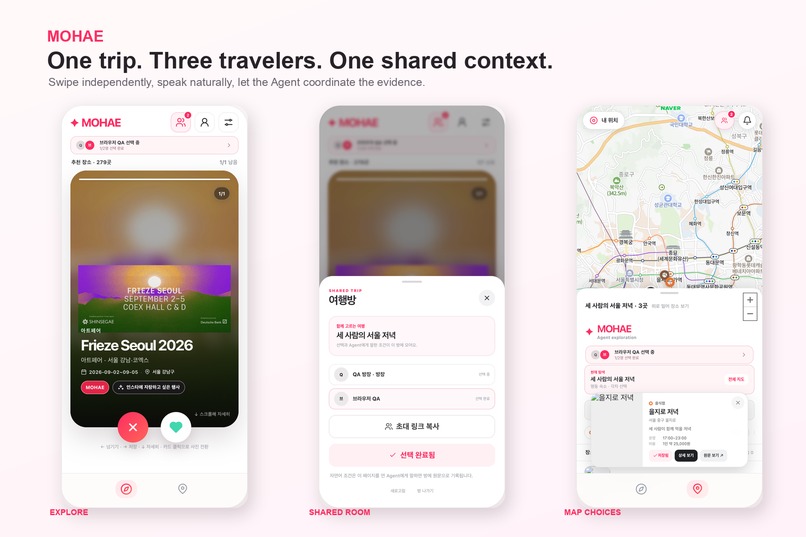
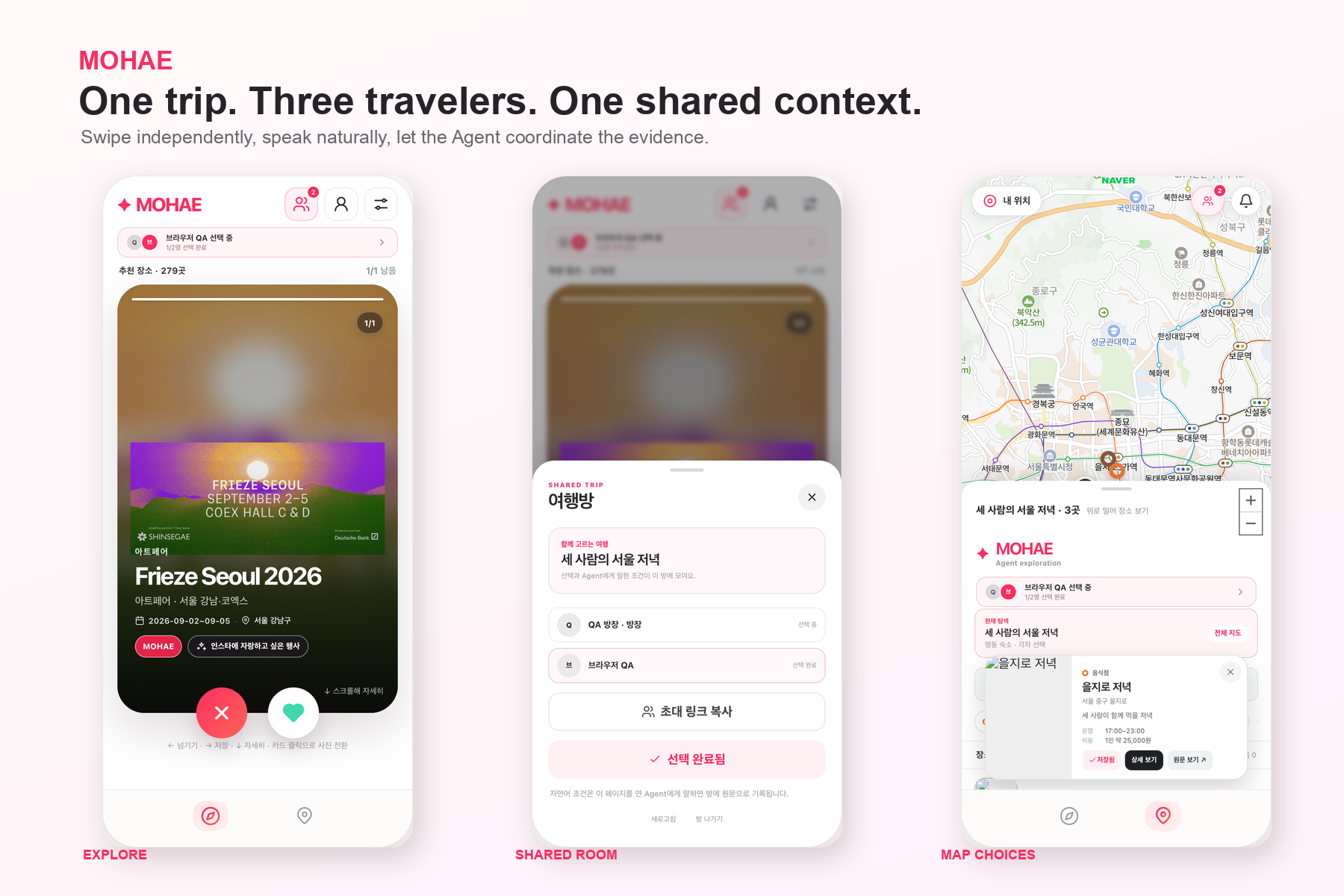
Three travelers choose independently across Explore, the shared room, and the map.
-
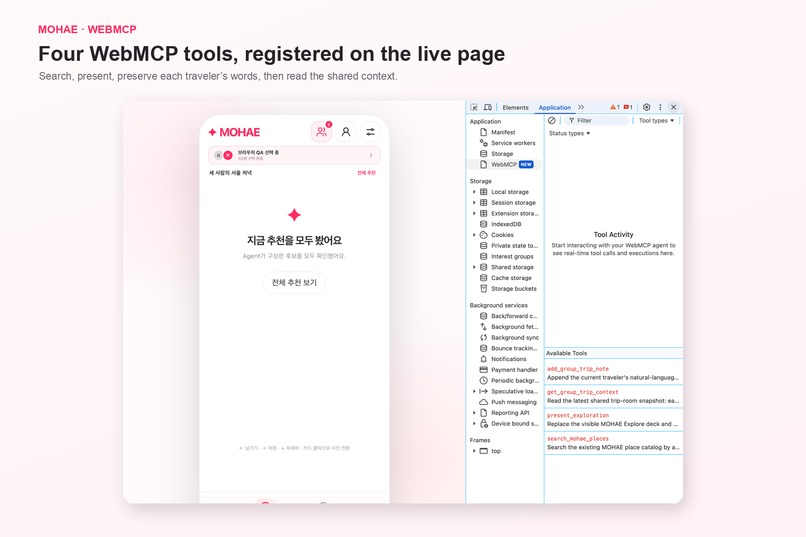
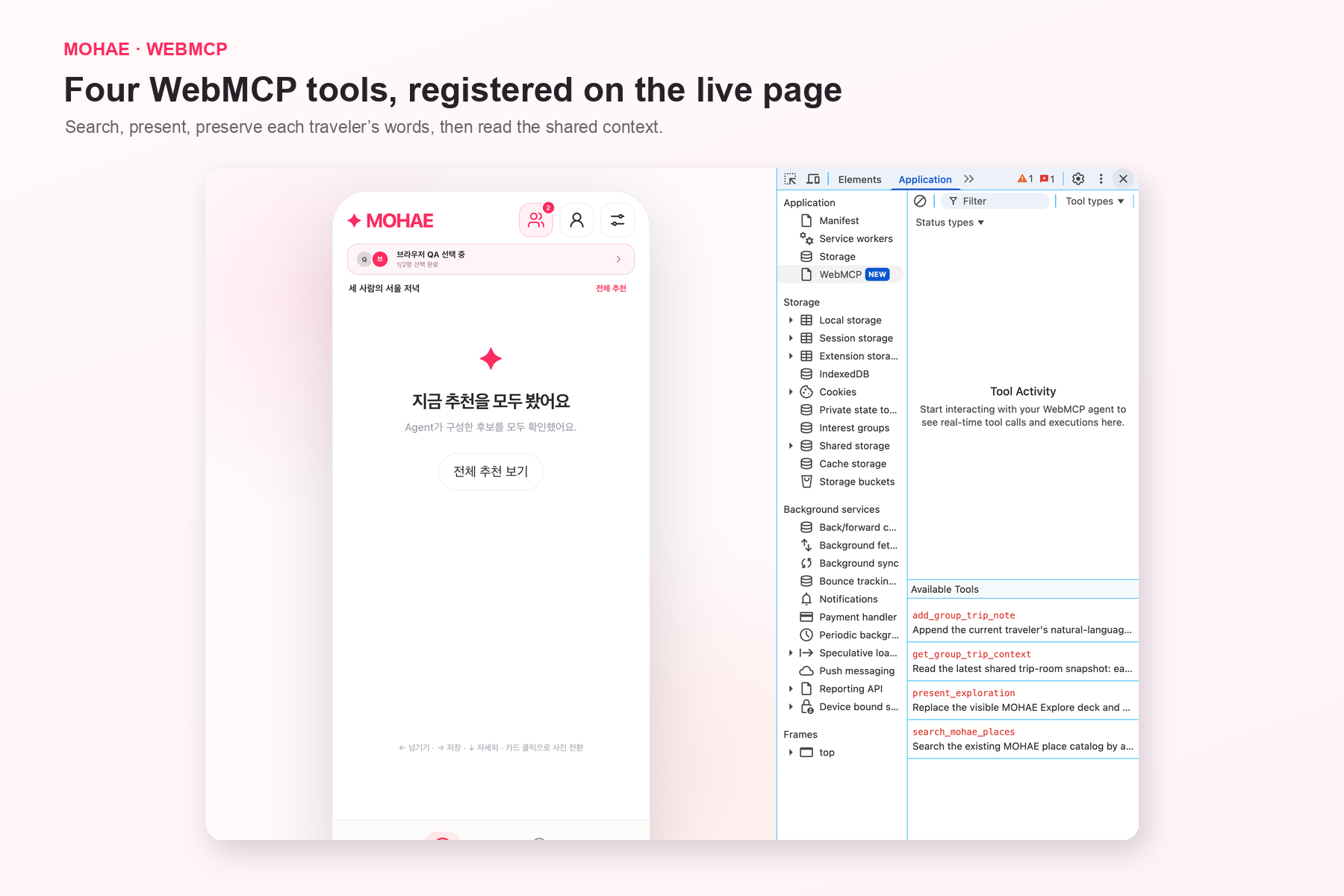
Four WebMCP tools registered on the live MOHAE page in Chrome’s Tool Inspector.
-
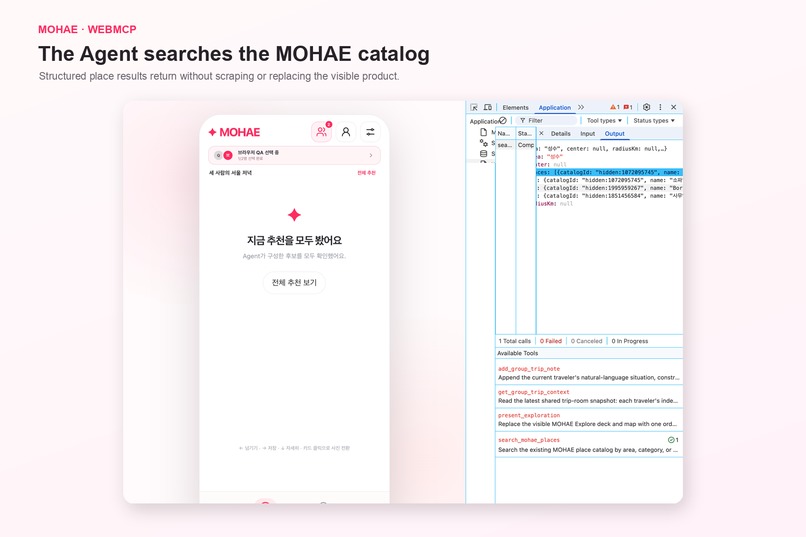
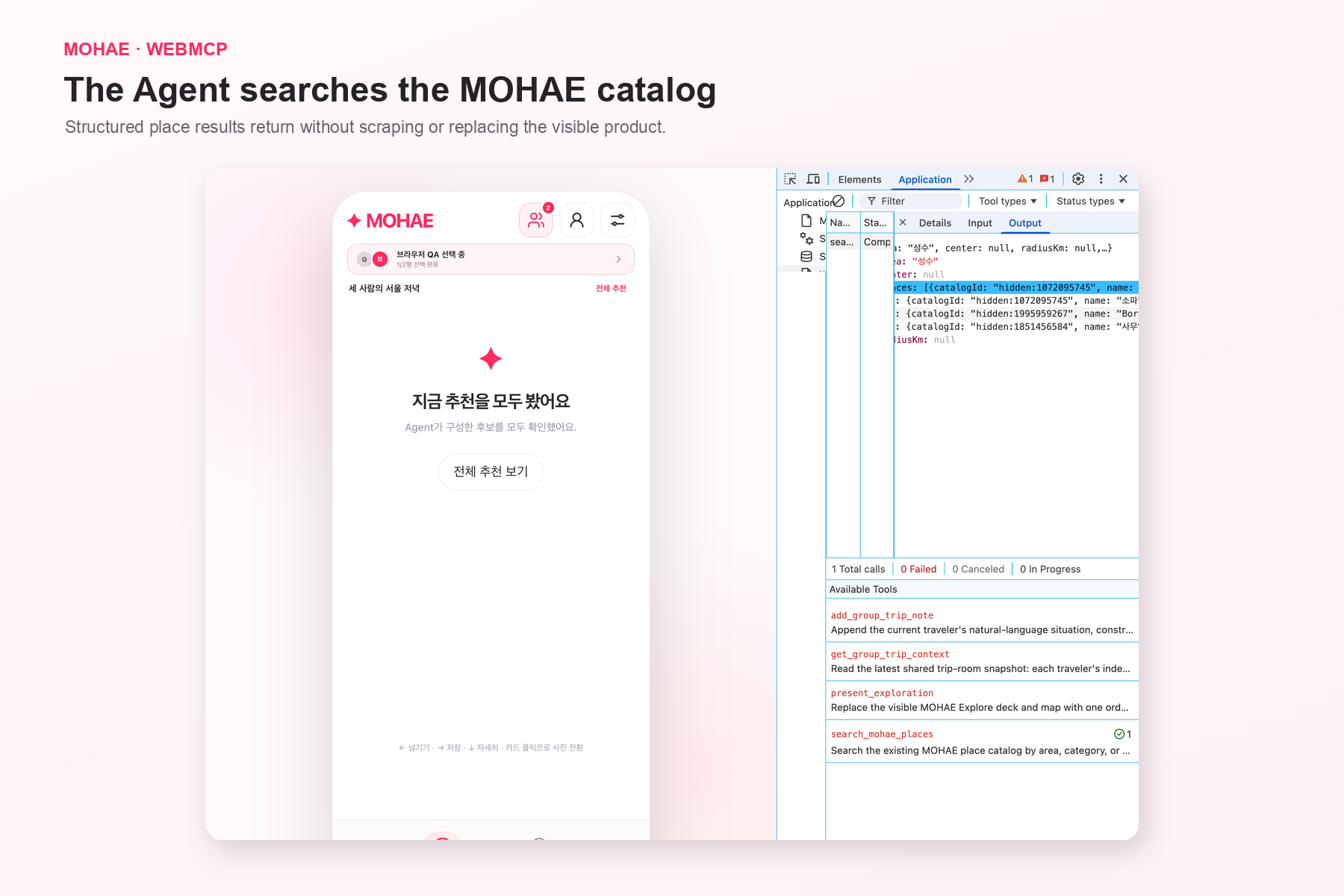
The Agent searches MOHAE’s structured Korea place catalog through WebMCP.
Inspiration
Inspired by exploration vs exploitation in RL. Nowadays people are mostly locked in their everyday routine (exploitation). I wanted people to explore lot more to find possibilities beyond and what they really want to do.
I'm the first user of this project mohae. This web gives me events, places, opportunities that I can try. With agent I can put in my context like where I live, current place, what I want right now like cafe or food or events. I can see and get inspiration from given cards and see them in map. Also you can get all random events for exploration. This can also help people who came to korea, and when evolved it will help me traveling other country. You can also put own agent's result in the web and see your result in our template and map. Finally you can share link and plan travel within all the participants in the travel.
What it does
MOHAE is a mobile-first Korea place discovery product. A traveler can swipe to save or pass places, inspect candidates on a Naver map, and ask a WebMCP Agent to search and render visible candidate scenes.
For a shared trip, a host creates an expiring invite link. Travelers join from their own devices, make independent save/pass and map choices, tell their own Agent natural-language needs, and mark their selection complete. The host Agent then reads the accumulated evidence and proposes an approximate ordered plan.
Demo flow
- Open MOHAE and explore Korea place cards by saving or passing.
- Inspect candidates on the map and save useful places.
- Create a shared trip and send the expiring invite link.
- Join from another device, make independent choices, and add a raw trip note through an Agent, such as ‘must-visit food’ or ‘less walking.’
- Mark that traveler’s selection complete.
- Ask the host Agent to read the room context and present an ordered candidate scene.
- Switch to route mode to see the Agent-supplied order numbered with a guide line.
Why WebMCP
WebMCP lets an Agent read and change the currently visible shared product state while humans continue choosing in the UI. The browser page is not just a chat attachment: it exposes explicit tools for catalog search, scene rendering, preserving traveler language, and reading room evidence. Agent actions remain visible and inspectable in the same interface the group is using.
MOHAE deploys four WebMCP tools with document.modelContext.registerTool:
search_mohae_places: read-only catalog search.present_exploration: renders ordered deck/map scenes and can publish them to the shared room.add_group_trip_note: preserves a joined traveler’s raw natural-language note.get_group_trip_context: reads travelers’ save/pass/map choices, notes, readiness, anchors, and candidates.
Provenance and scope
Agent-researched external candidates stay provenance-tagged and separate from catalog admission. Route mode displays the Agent-supplied order and a guide line; it does not claim route optimization or travel-time calculation. MOHAE does not provide booking, live queue data, or full realtime presence.
How we built it
The product uses vanilla JavaScript, HTML, and CSS. WebMCP tools are registered with document.modelContext.registerTool. Supabase Postgres stores shared-trip data behind protected RPCs and row-level security, with append-only room events. The app is deployed on Vercel and uses the Naver Maps JavaScript SDK.
Challenges and lessons
The central design challenge was making Agent side effects visible, scoped, and auditable while several people continue using ordinary UI controls. We learned that coordination works better when the product preserves behavioral evidence and each traveler’s original words instead of compressing everyone into a single averaged profile.
Built With
- css3
- html5
- javascript
- naver-maps-javascript-sdk
- postgresql
- supabase
- vercel
- webmcp


Log in or sign up for Devpost to join the conversation.