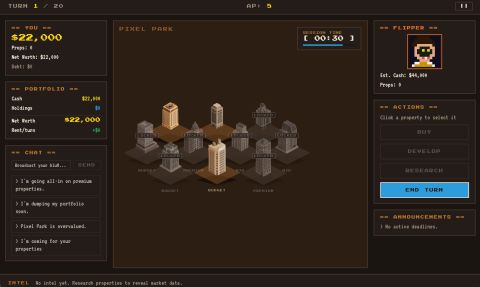
Many online tycoon games devolve into mindless "idle clickers" where the optimal strategy is simply to buy everything and wait. We wanted to build something that required genuine strategic thought and risk management. Inspired by the cutthroat nature of the real estate market, we set out to create an economic simulator where Action Points (AP) are scarce, market crashes are devastating, and "insider trading" is your best weapon.
What it does Mogul Blocks is a brutal, turn-based real-estate strategy game where you face off against an AI rival known as the "Flipper."
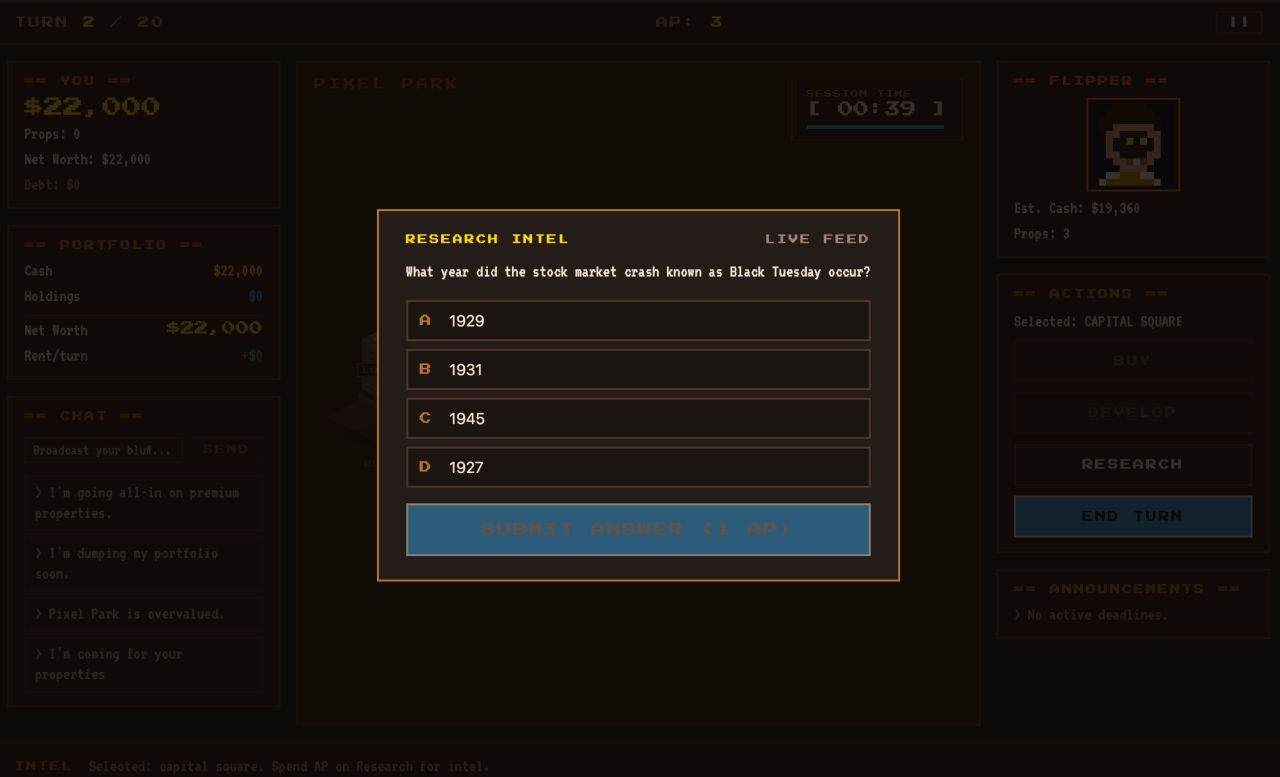
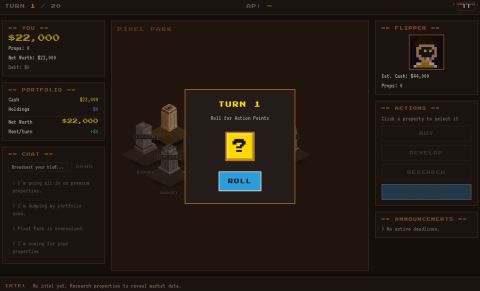
The Economy: You must acquire, develop, and eventually sell properties to grow your net worth. The Catch: You use a very limited pool of Action Points (AP) generated by a storyline dice roll to perform any action. The Market Catalysts: The market is highly volatile. Properties are subject to unpredictable "Booms" and "Busts" that can multiply your income or drain your cash reserves. Insider Trading: You can spend AP to "Research" upcoming market events by answering real-world trivia. If you get the answer right, you receive a cash grant and the Intel needed to dump toxic assets on your AI rival before a crash, or buy up cheap land right before a boom! How we built it The game is split into a highly reactive frontend and a stateful backend engine:
Frontend: Built with React and TypeScript, leveraging modern CSS to create a beautiful, dynamic property board and a clean, responsive "intel feed". Backend: Powered by Python and FastAPI. The game engine stores complex event histories, AI scanning behaviors, and market queues using SQLAlchemy and SQLite. Dynamic Trivia: The research mechanic uses the OpenAI API to dynamically generate category-specific trivia questions based on the properties the player interacts with. Challenges we ran into Our biggest hurdle was Game Balance and Economy Exploits. In our early architecture, we discovered a "dominant strategy" flaw: players could easily snowball their income by buying the cheapest properties on Turn 1 and developing them to the maximum level, completely ignoring the expensive late-game properties.
To fix this, we had to heavily rework our engine's economic math. We introduced steep Broker Fees on selling to prevent instant liquidation, restricted maximum development levels by property tier, and strictly starved the Action Point economy.
Accomplishments that we're proud of We are incredibly proud of the Flipper AI and the Catalyst Engine. Writing an AI that doesn't just act randomly, but actively reads the market, evaluates profit thresholds, and competes with the human player for the same limited resources made the game truly feel alive. We are also incredibly proud of the "Insider Trading" mechanic, turning a standard trivia minigame into a high-stakes tool for market manipulation.
What we learned We learned that Game UI and "Juice" are just as important as the backend math. During testing, we realized that if the AI takes its turn instantly, it feels like a spreadsheet calculating rather than a rival making moves. We had to learn how to sequence and animate the backend events so the player can actually watch their rival steal a property in real-time. We also learned a massive amount about managing persistent, turn-based game state safely in FastAPI.
What's next for Mogul Blocks We want to add a Sabotage Mechanic. We have the architecture outlined for players to spend their precious AP to launch targeted attacks on the Flipper, like triggering "City Inspections" to freeze property development or "Smear Campaigns" to cut their rent. We also envision expanding the map into multiple distinct districts with unique property synergies!


Log in or sign up for Devpost to join the conversation.