
Inspiration
We've all been there. Someone drops a "we should do this" in the group chat, everyone hypes it up, and then nothing. The conversation moves on and the plan quietly dies. It's not that people don't want to follow through. It's that actually doing something requires leaving the chat, bouncing between apps, and by the time you've opened a calendar or Venmo, the moment's already gone. iMessage moves fast but it has no structure to catch a plan before it falls through. The few things that have worked inside messaging, like GamePigeon, prove people will engage with features that feel native. That's what pointed us here. The ideas aren't the problem, execution is. Everything you need to make something happen already exists, it's just all outside the conversation. So we stopped thinking about building another app and started thinking about building the missing layer inside the place where plans are actually born.
What it does
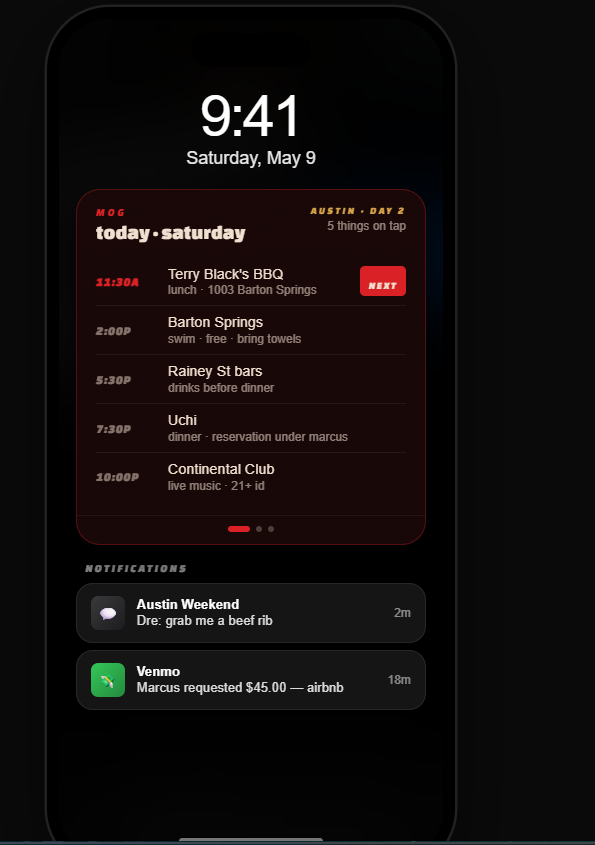
MOG (Make it Out the GC) is an AI-powered group chat agent that lives directly inside iMessage as an extension, acting as the “6th member” of any group chat. While conversation is actively occurring, MOG ensures that no plan, big or small, is left behind in the process.
Instead of being a passive chatbot, MOG is an autonomous multi-function AI agent that listens, interprets intent, and executes coordination tasks in real time. It transforms unstructured conversation into structured outcomes without requiring users to leave the chat.
The agent is activated through lightweight commands and natural language, and dynamically adapts to the group’s context and preferences in real-time. The AI agent is beyond its simple commands, but it allows users to connect to the agent through a natural language common ground. It handles planning, decision-making, coordination, and memory – all within the instant messaging interface.
Core capabilities include:
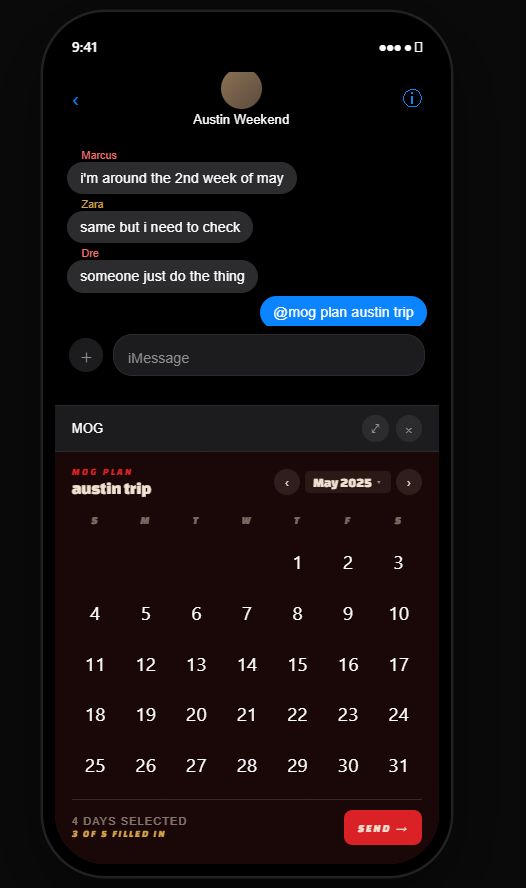
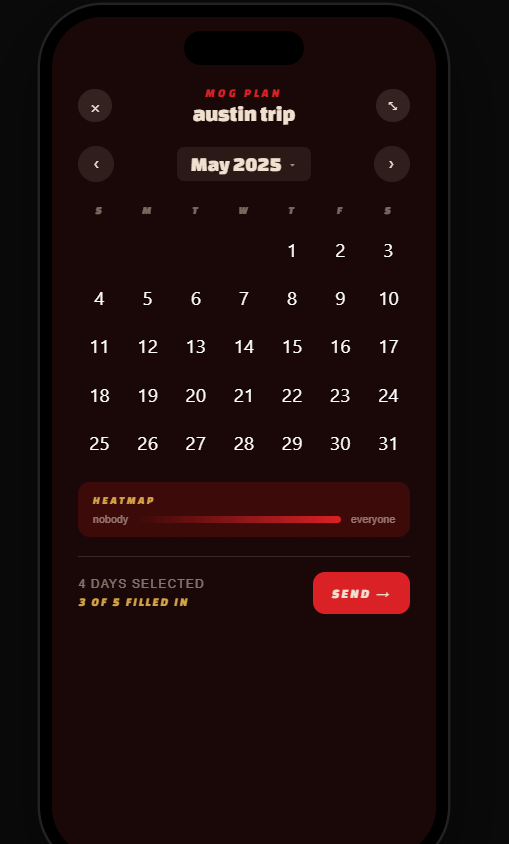
- @mog plan — parses conversational intent, extracts plans, confirms participants, assigns roles, and drives execution
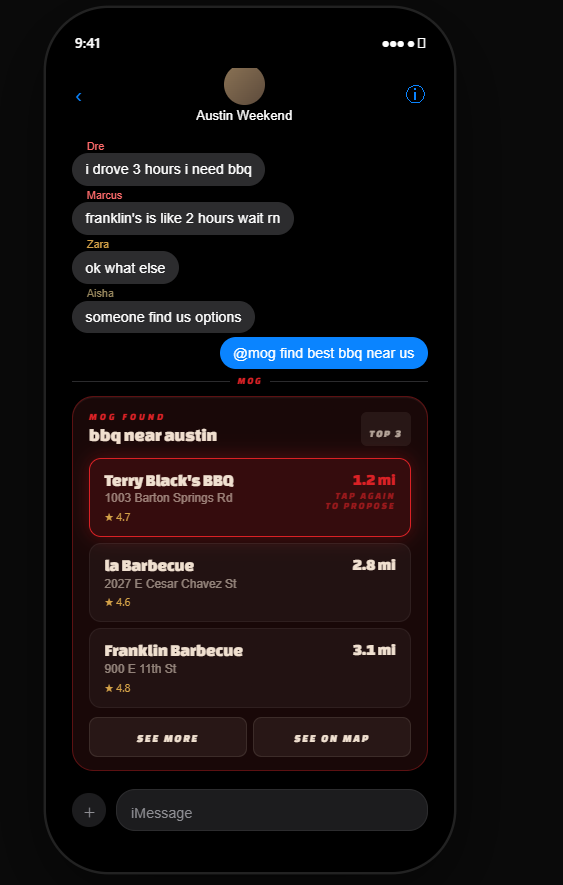
- @mog find — uses location intelligence and preference modeling to recommend optimized options with interactive voting and map-based UI
- @mog split — manages group payments with real-time tracking, state updates, and settlement confirmation
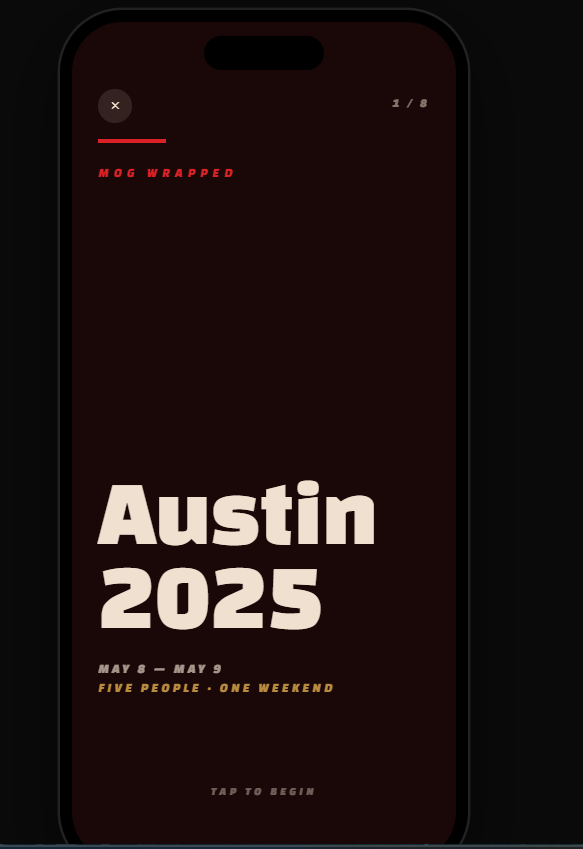
- @mog wrapped— generates AI-powered summaries of shared experiences, inside jokes, and completed events
- @mog budget – aids in group trip budget planning by accounting for individual budgets.
How we built it
MOG is built as a full-stack, agent-driven system consisting of a chat-native frontend, a real-time orchestration backend, and a modular AI reasoning layer.
On the frontend, we developed a native iMessage extension interface using it, enabling interactive components directly within conversations. This includes dynamic cards, inline action buttons, voting interfaces, and real-time state updates.
On the backend, we built a distributed orchestration system using Python, FastAPI, and Node.js microservices, responsible for parsing messages, managing agent state, and coordinating actions across multiple domains such as planning, payments, and recommendations.
The core intelligence of MOG is powered by a multi-agent LLM architecture, where specialized agents handle different responsibilities. A central orchestration agent decomposes user intent into sub-tasks, which are routed to domain-specific agents such as a planning agent, a financial agent, and a recommendation agent.
Challenges we ran into
One of the most complex challenges was designing an agent that could reliably interpret messy, unstructured group chat conversations. Unlike traditional inputs, group chats contain overlapping intents, sarcasm, incomplete sentences, and multiple simultaneous topics. Building a system that could extract actionable meaning from this required careful prompt engineering, NLP understanding, context window management, and fallback logic.
We also faced significant constraints in designing a system that feels native to messaging rather than intrusive. The agent had to be powerful enough to execute tasks, but subtle enough to integrate seamlessly into the social flow of conversation and without raising privacy concerns.
Accomplishments that we're proud of
We are proud that we built a system that redefines what a messaging product can be. Our prototype demonstrates a fully interactive, agent-driven experience where plans are created, decisions are made, and outcomes are achieved without ever leaving the chat.
We are also proud of the user experience we created by embedding functionality directly into a familiar environment.
Most importantly, we built something that feels immediately intuitive in the end. Users don’t need to learn MOG, since they already understand it the moment they see it in action.
What we learned
We learned that the future of software isn't more apps, it's more intelligence inside the ones people already use. The market is oversaturated with AI-powered productivity tools, and most of them fail for the same reason: people just don't have the energy to follow through on another app's recommendations. Users don't want to manage tools. They want outcomes. And the best place to deliver those outcomes is inside the environments they're already in.
What's next for MOG
The next step is deploying MOG as a fully functional iMessage extension.
We plan to enhance the agent architecture by incorporating deeper personalization, long-term memory, and predictive capabilities, allowing MOG to proactively assist groups rather than waiting to be invoked.
To follow through with the agent enhancement, future integration plans include travel booking APIs, real-time availability systems, and financial transaction platforms to enable end-to-end execution of plans within the chat.
Overall, long term, our vision is for MOG to become the default coordination layer for all types of interaction; essentially, an invisible system that turns conversations into reality, and ensures that plans don’t just exist in messages (on paper), but actually happen.
Built With
- ai-agent
- claude
- extension
- fastapi
- google-maps
- html
- llm
- multi-agent-system
- natural-language-processing
- node.js
- python
- react
- replit
- typescript
- xcode

Log in or sign up for Devpost to join the conversation.