-
-
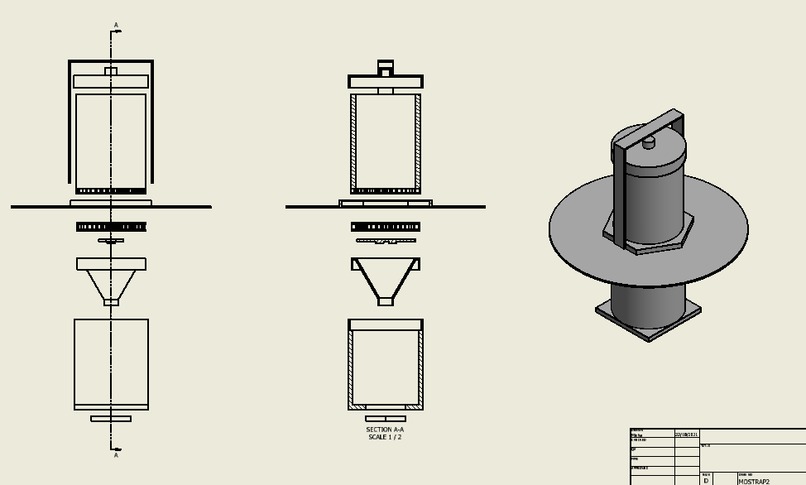
Mosquito Trap Schematics
ModuTrap
ModuTrap Team
Michael Miller -Team Leader-
Michael Miller is a PhD student in the School of Environmental and Life Sciences. Michael brings expertise in mechanical design for 3D printing as well as electronics.
Evan Gibbs
Evan Gibbs is a PhD student in the School of Environmental and Life Sciences. Previously Evan has successfully bid a project for the Grand Challenge.
Ben Matthews
Dr Matthews has emerged from a career in Media and Marketing startups to pursue an academic career and is a member of the School of Creative Industries Future Arts, Science and Technology lab (FASTlab).
Describe and Illustrate the proposed solution.
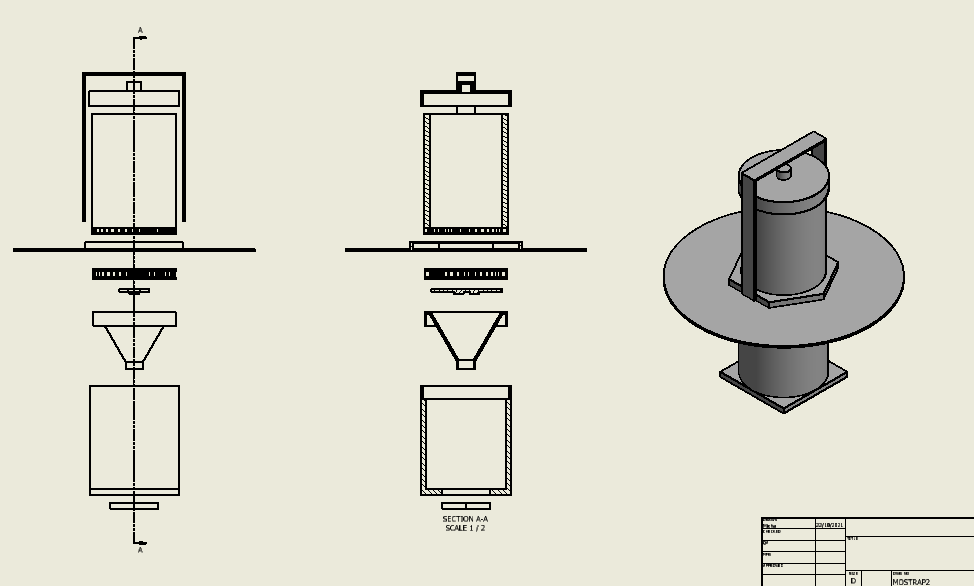
Commercial mosquito traps have often been developed with no regard to sample integrity or species specificities. We aim to develop a trap that will increase the proportion of live mosquitoes as well as offer at platform for additional research into chemical attractants as a way of increasing both catch rate and reducing bycatch. As an add bonus the trap can optionally have sensors that will record and report back local environmental conditions as well as catch rate that will allow researchers to correlate catch and species specificity as a function of environment conditions. The proposed mosquito trap will operate in a similar manner to establish downflow mosquito traps. Where mosquitoes will initially be attracted to the trap with a source of CO2 provided from a vessel of dry ice or optionally a compressed CO2 gas cylinder through a electronically controlled gas regulatory. The insects will then be sucked into the trap through a funnel into a fine mesh bag via air flow generated by a fan. The funnel can include beam break sensors to record the number and time of each catch event. An additional advantage of the proposed design is the mosquitoes do not pass through the fan which will maximise sample integrity. The innovation that we propose is the inclusion of an ultrasonic atomiser into the trap. This will have two primary benefits. The ultrasonic atomiser will allow the dispersal of water-soluble chemical attractants into the air with may modify catch rate and species selectivity. Additionally, dehydration of the catch due to the constant air flow through the trap is major source sample death. The ultrasonic atomiser has the added advantage of humidifying the air stream which will minimise mosquito death by dehydration while also minimising sample damage by water soaking.
Experimental Methodology
Hypothesis 1: Humidification of the Airstream will prevent captured sample death.
This hypothesis will be tested in both field as well as in controlled laboratory setting. Laboratory testing will be conducted using lab reared Aedes vigilax to optimise water flow rate. These experiments will be conducted by manually loading the trap with a set number of mosquitoes and varying the humidification flow rate. Mosquitoes will be evaluated at the end of 16 hour period to determine if they are alive/dead and then frozen and examined microscopy to determine if each which humidification level results in sample damage. To test this hypothesis in the field two identical traps will be placed in the same geographical area. One trap will have the ultrasonic atomiser enabled and loaded with ultrapure water, the other will have the atomiser disabled. After a collection session the catch will count and scored alive/dead. Experiment will be repeated across multiple days and in different locations to provide additional statistical rigor.
Hypothesis 2: Addition of chemoattractant will increase the catch rate of Aedes vigilax
To initial test this hypothesis traps will be load of a mixture of 1-octen-3-ol and ultrapure water, and calibrated to provide a dosing rate of 30 mg of 1-octen-3-ol per hour. Traps will be placed at least 200 m apart. Catch at the end of a 16 hour period will be scored by overall catch rate, and percentage of target species. Experiment will be repeated multiple time, switching the location of the baited trap to control for environmental effects. Optimal dosage rate can also be determined by comparing varied dosage rates. Depending on time allowances, additional studies will be conducted to explore the effectiveness of secreted animal metabolites such as lactic acid and hexanoic acid as well amino acid degradation products, 1,5-pentanediamine and butane-1,4-diamine as mosquito attractants.
What's next
If this project is successful, there are multiple directions we would like to explore. We would like to expand the studies into chemoattractants and repellents to identify optimum combinations to enable a more target surveillance of different mosquito species. To further speed up surveillance we would like to develop automated in situ speciation of mosquitos that enter the trap using an integrated high-speed camera and machine learning. As well as developing larger fixed location killing traps which are optimised for the suppression of biting mosquitoes while minimising disruption of other species.
Project Timeline and Budget
Budget
The bulk of the budget is allocated for the mechanical prototyping and construction of multiple mosquito traps. Due to the size of mosquito trap and necessity of using UV-resistant materials a large enclosed FDM 3D printing will be purchased for both the initial trap prototyping as well as final trap manufacturing with much of the housing designed to be 3d printable to minimise tooling costs. The estimated cost of the 3D printer and associated consumables is $2000. Hardware and electronics to manufacture the sensor enabled traps are estimated to initially cost $150 per trap, with cost reducing in the final design. We envision the production of 10 traps to facility multiple parallel experiments as well as to account failures and breakage, this totals $1500. The chemical attractant used to bait the traps for the chemical attractant studies will be purchased through reputable scientific supply companies. While the cost of the chemicals per trap per session are low, due to minimum volume requirements we expect that the total cost of the chemicals will be $1500. The chemicals that have been selected for testing have well established safety profiles and have selected based off scientific literature searches.
Timeline
Finalisation of protype design – November Manufacture of Initial Prototype devices - December Finalisation of Device design and production documentation January-February Field Testing January – March Production of Final Report – April
Built With
- 3d-printing
- autodesk
- raspberry-pi


Log in or sign up for Devpost to join the conversation.