-
-
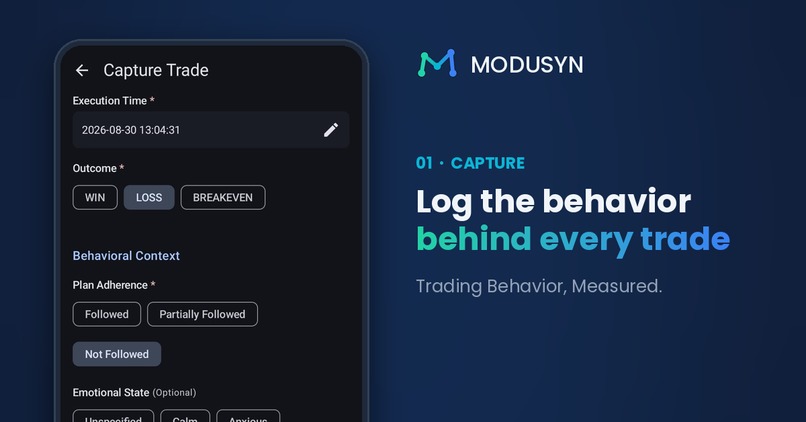
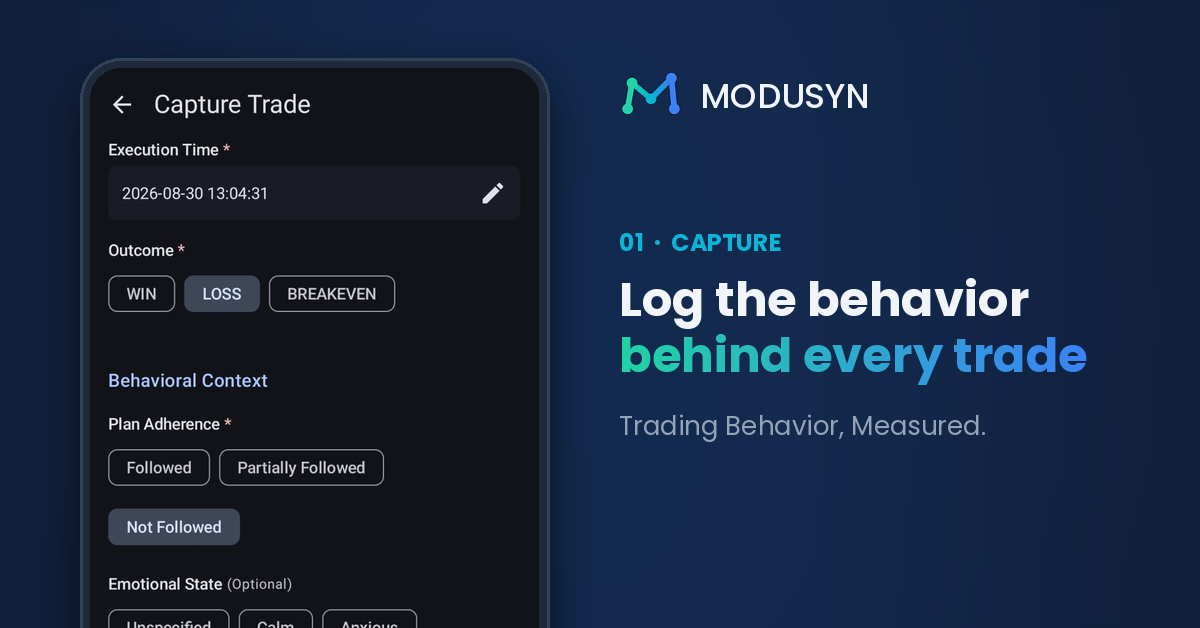
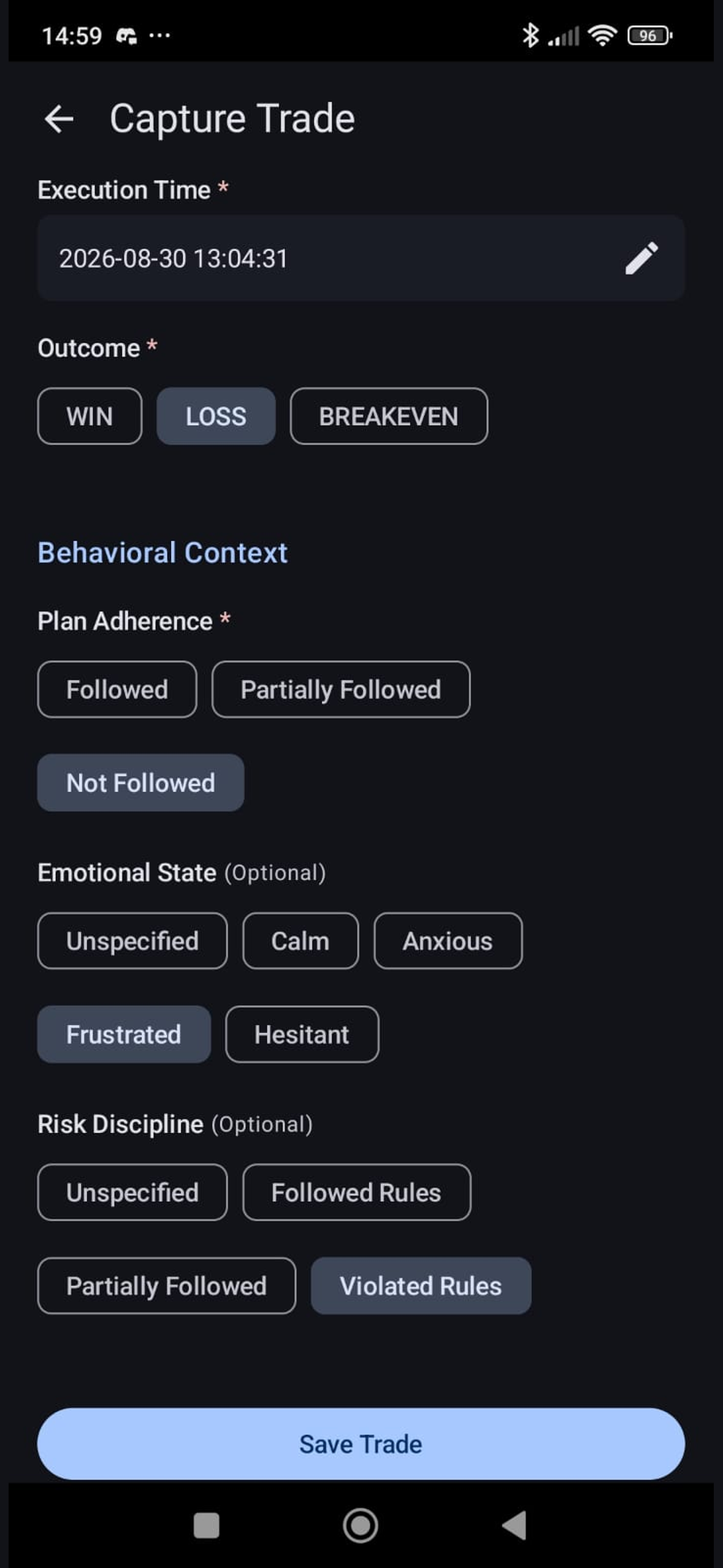
Log each trade with lightweight behavioral context: plan adherence, emotional state and risk discipline.
-
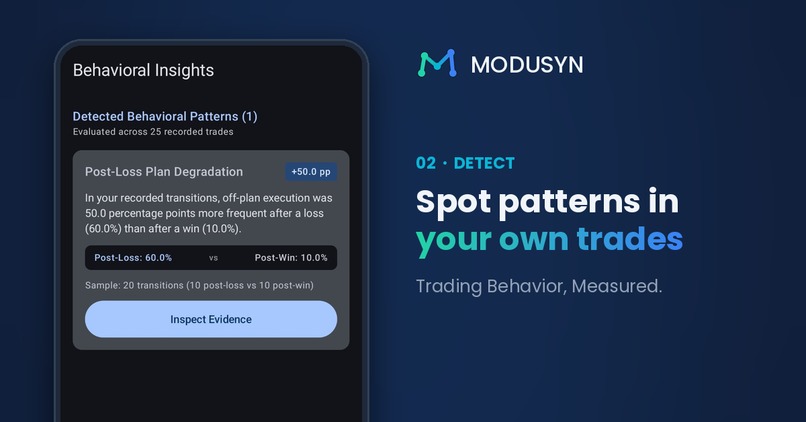
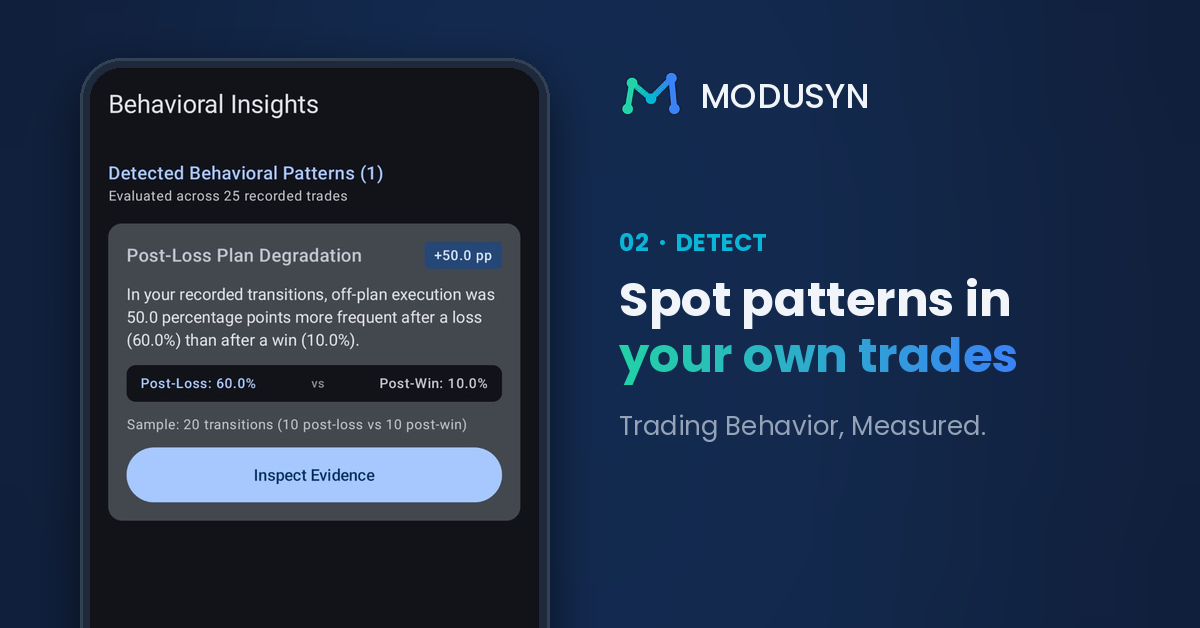
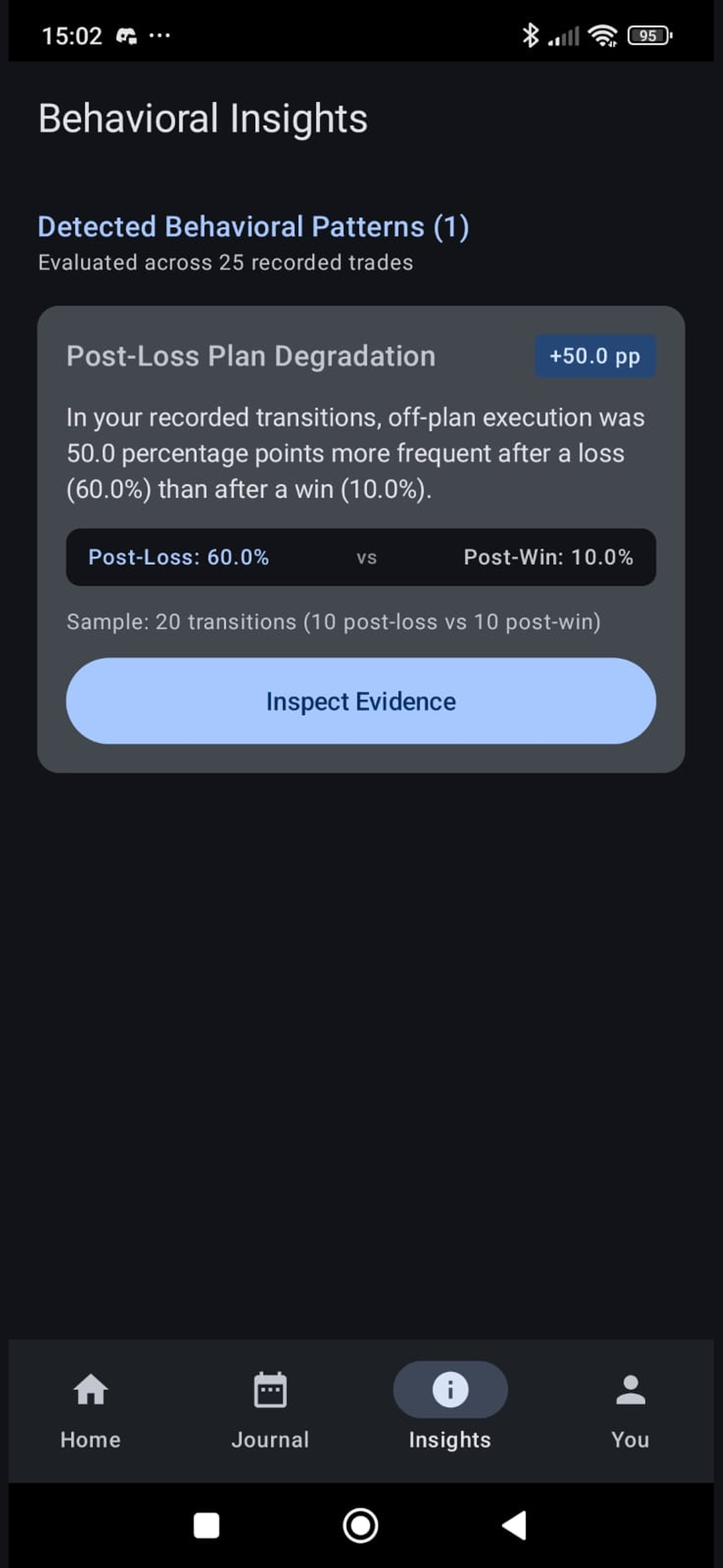
Deterministic analysis surfaces recurring patterns in your own trades. Demo dataset shown.
-
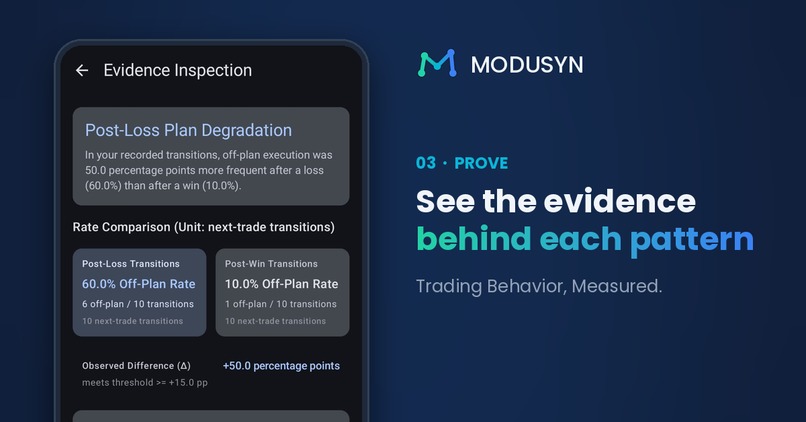
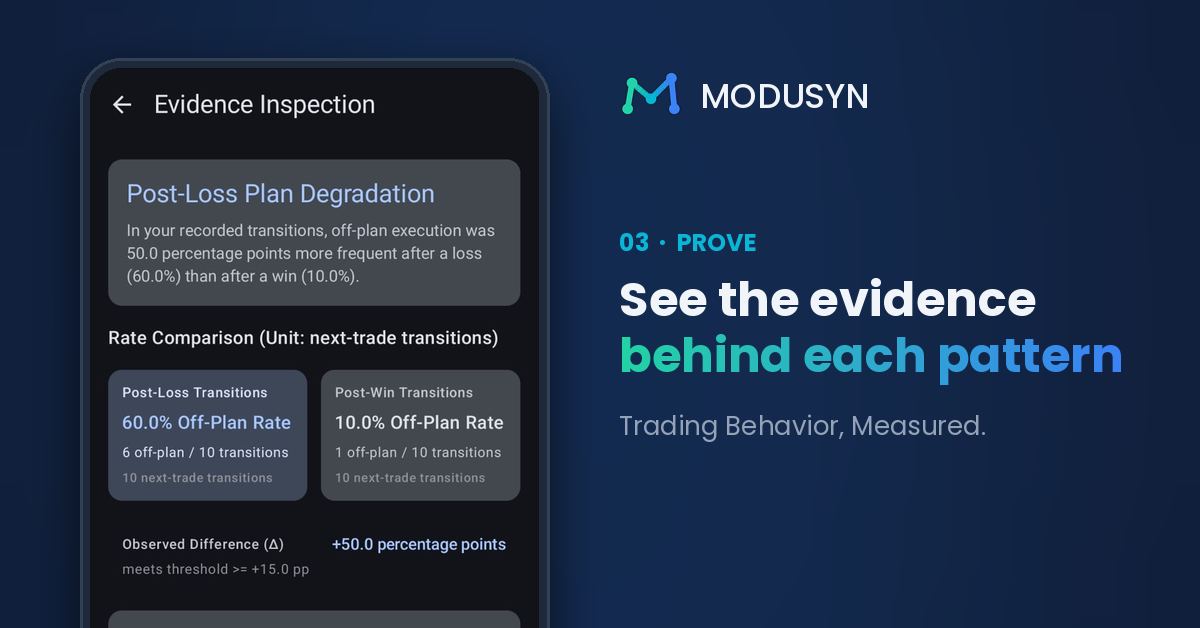
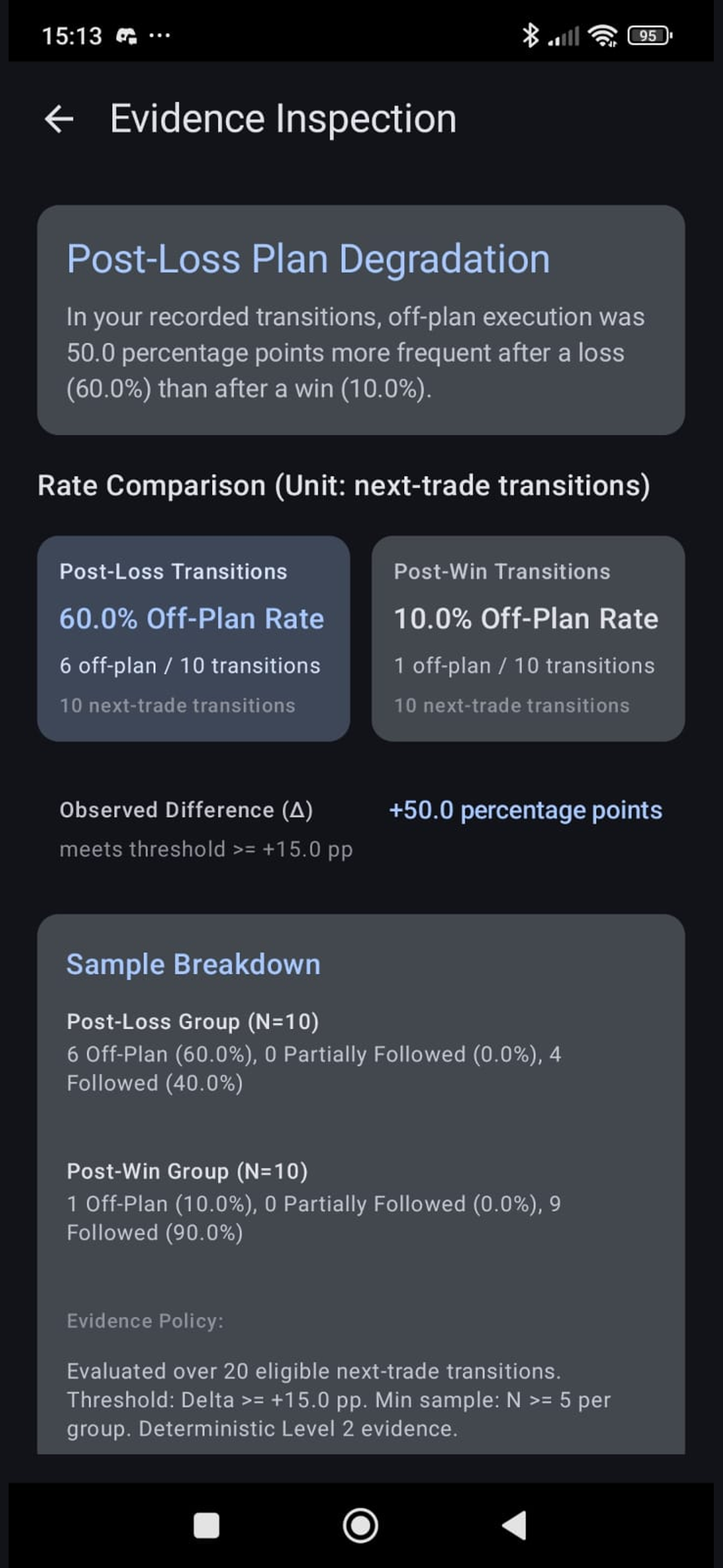
Every pattern exposes the evidence behind it: sample sizes, rates and thresholds. Demo dataset shown.
-
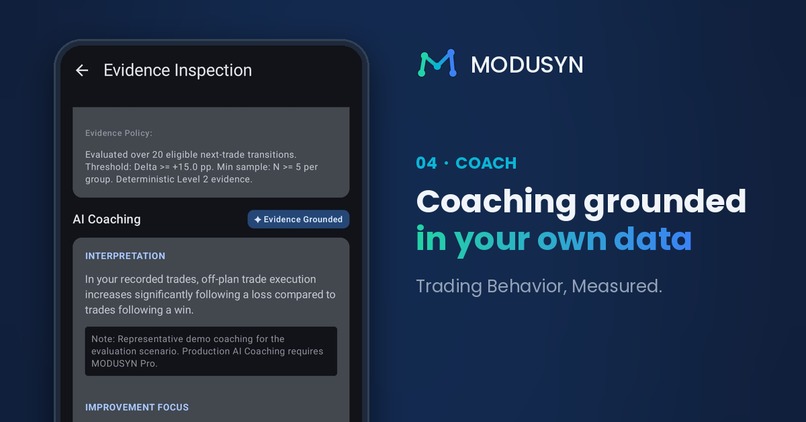
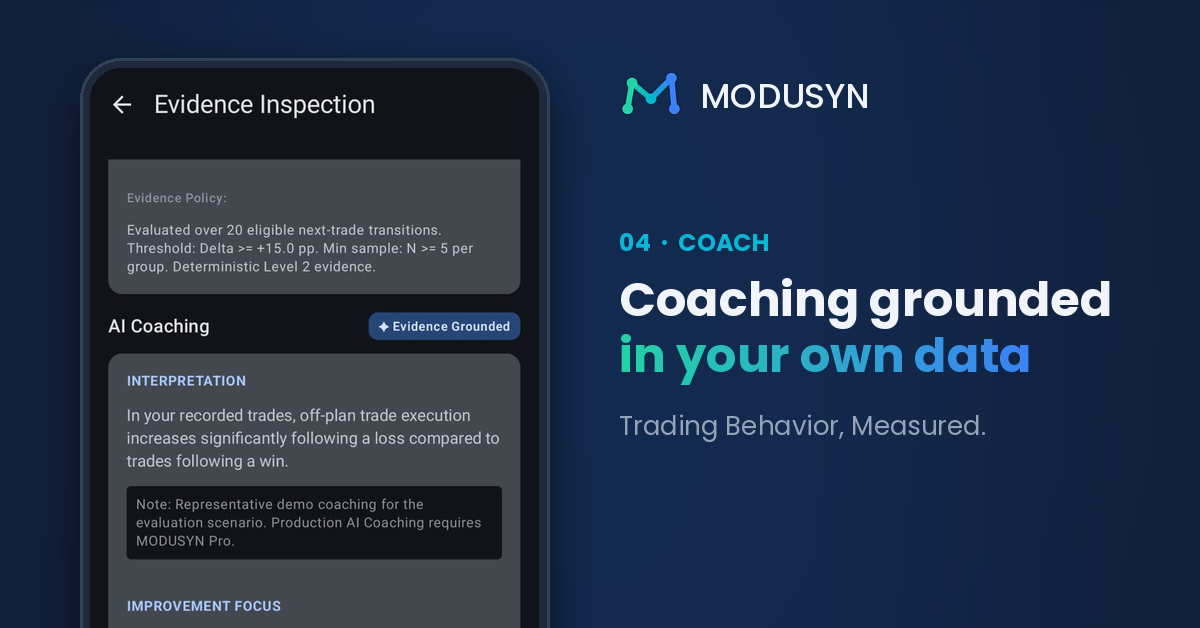
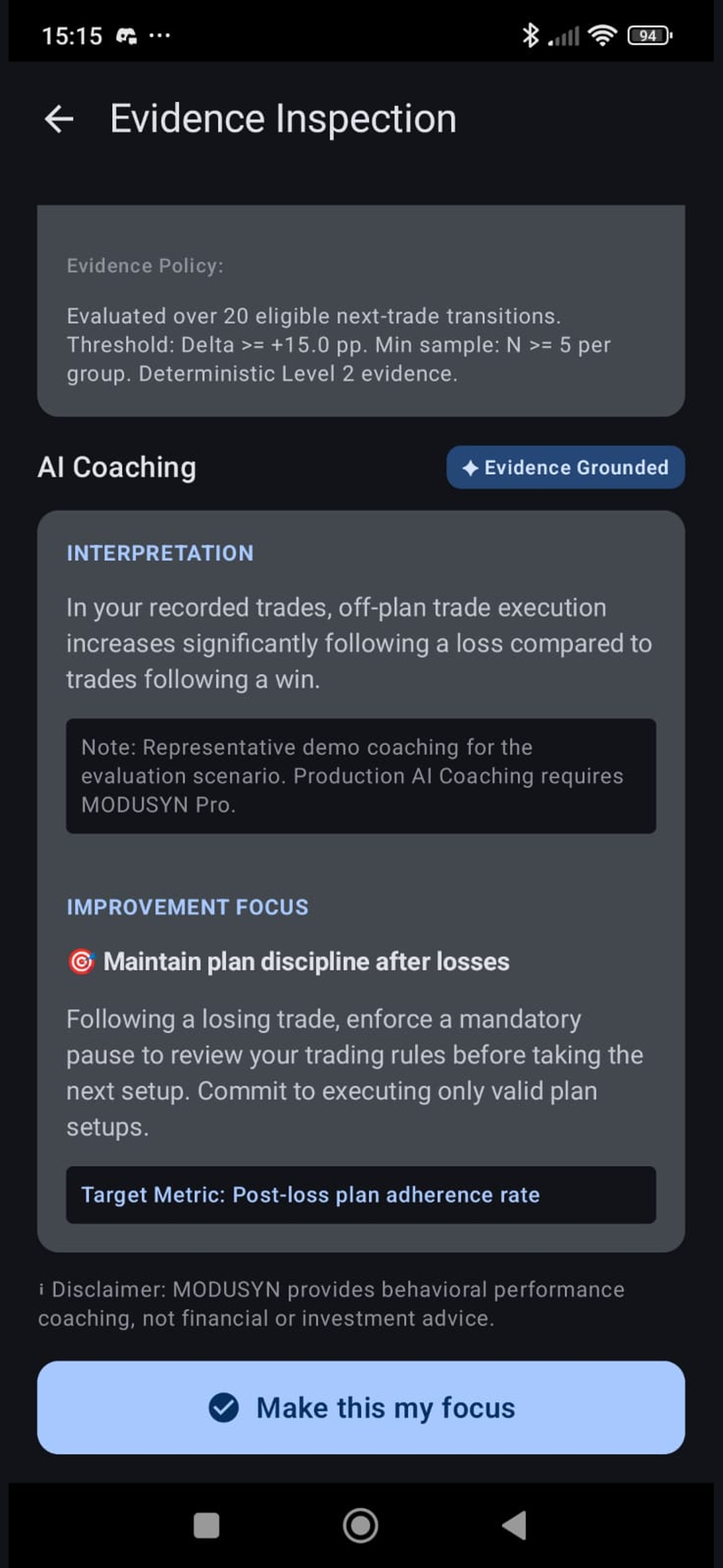
AI explains the evidence and proposes one improvement focus. Representative demo coaching; live AI Coaching requires Pro.
-
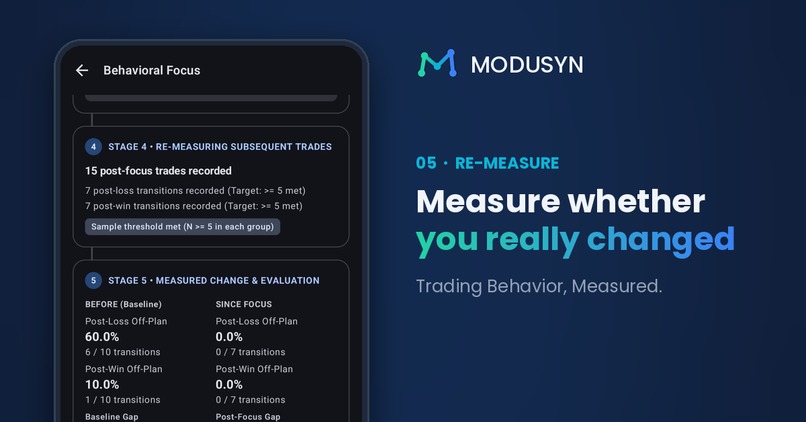
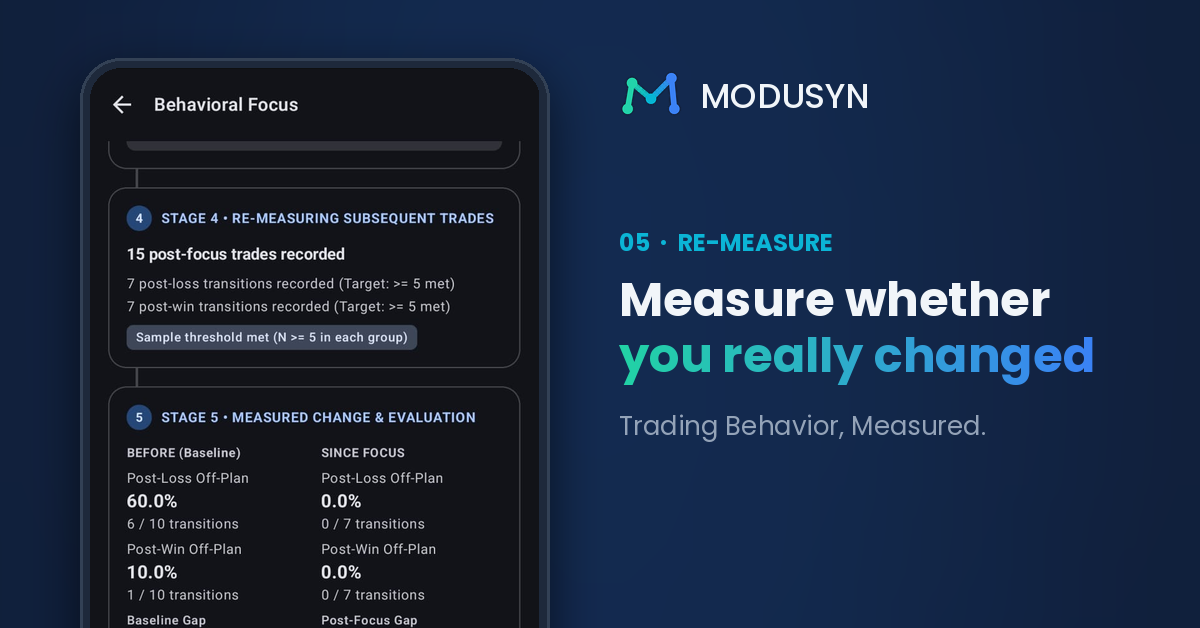
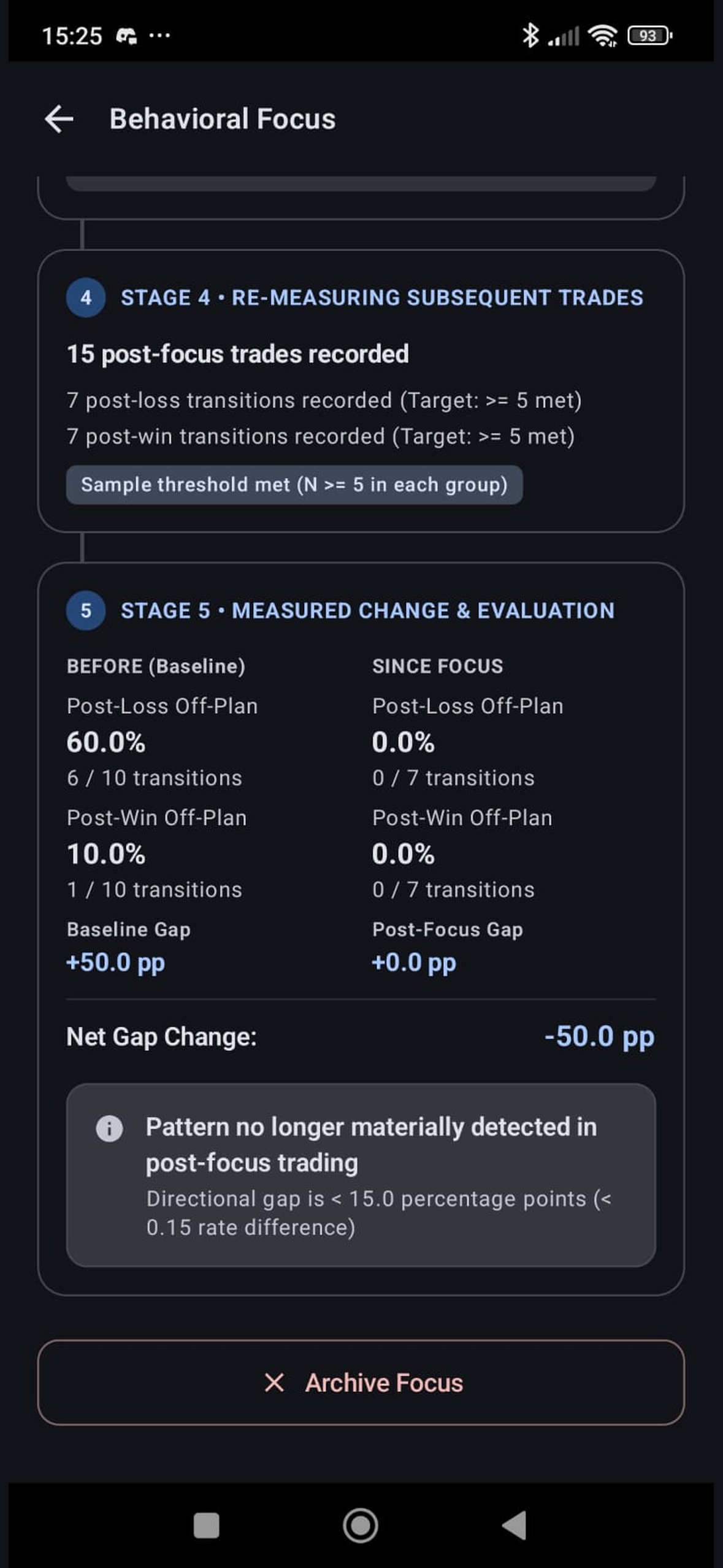
Compare behavior before and after a Focus to see whether it really changed. Demo data, not user results.
-
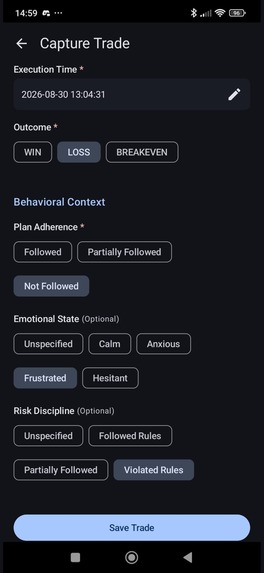
Real app screen: Capture Trade. Outcome plus plan adherence, emotional state and risk discipline in a few taps.
-
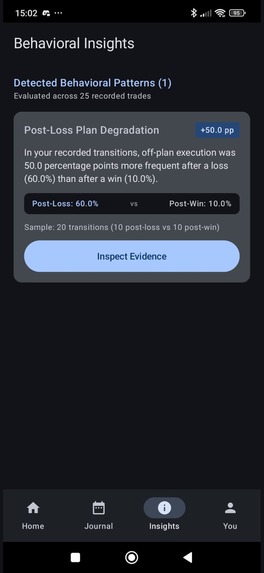
Behavioral Insights: a pattern is shown only once the deterministic evidence threshold is met. Demo dataset.
-
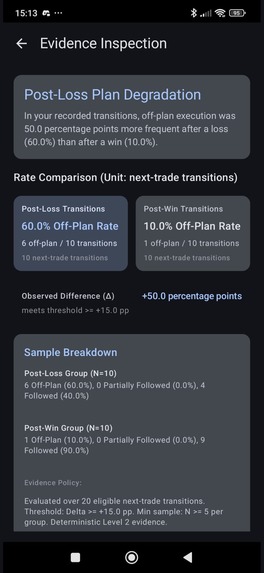
Evidence Inspection: rates, sample breakdown and evidence policy (Δ ≥ 15 pp, N ≥ 5 per group). Demo dataset.
-
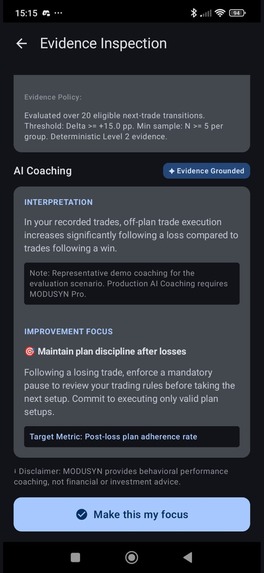
AI Coaching is labeled Evidence Grounded and ends in one focus with a target metric. Representative demo coaching.
-
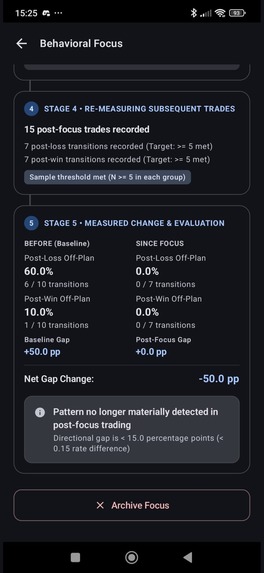
Behavioral Focus: baseline vs post-focus comparison with sample thresholds. Demo data, not user results.
-
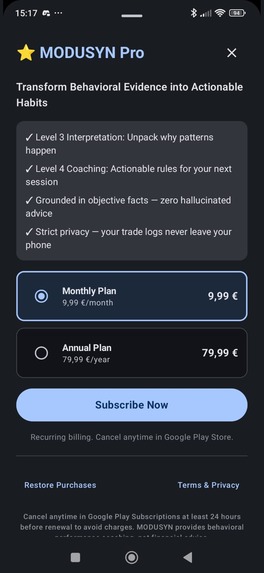
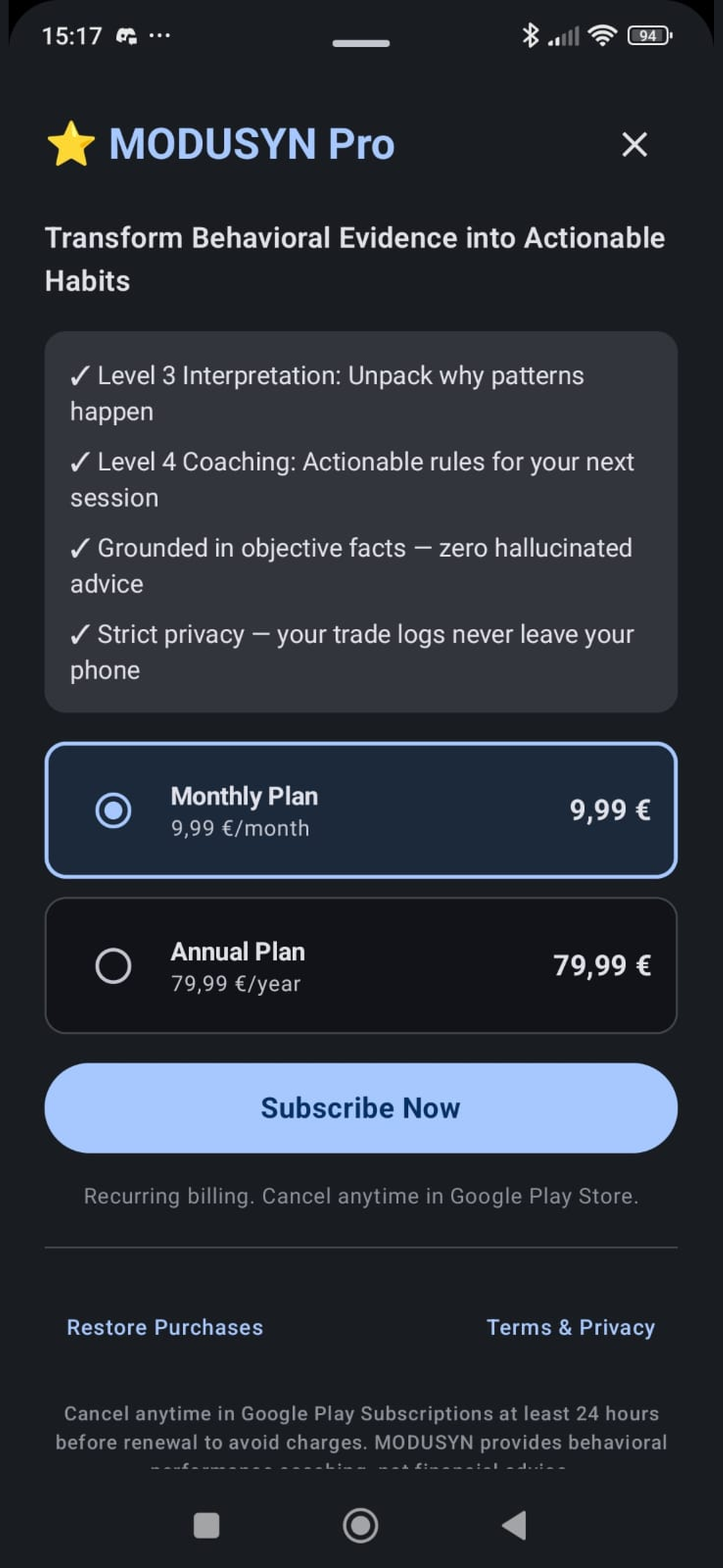
MODUSYN Pro paywall powered by RevenueCat: monthly and annual plans, restore purchases, terms and privacy.
-

MODUSYN app icon (1024×1024).

Inspiration
Trading tools are very good at analyzing markets and measuring results. They can tell a trader their P&L, win rate, risk/reward ratio, or which instruments performed best.
But they often leave a more important question unanswered:
What does my own trading behavior tell me about how I can improve?
MODUSYN started from the idea that many trading problems are not prediction problems. They are behavioral problems: abandoning a plan, changing risk after losses, acting impulsively, or repeating decisions without realizing they form a pattern.
We wanted to build something different from another trading journal or AI-powered market assistant.
We don't predict the market. We improve the trader.
What it does
MODUSYN is an AI-powered Trading Performance Coach for Android.
The trader captures a trade together with lightweight behavioral context: whether they followed their plan, their emotional state, and their risk discipline.
MODUSYN then turns accumulated observations into behavioral evidence.
The core loop is:
Capture → Understand → Improve → Repeat
Instead of simply showing statistics, MODUSYN can surface patterns in the trader's own behavior, show the evidence supporting them, and turn that evidence into a concrete improvement focus.
Crucially, MODUSYN is also designed to say:
"I don't know yet."
When there is not enough evidence to support a conclusion, the product explicitly communicates that rather than manufacturing an insight.
How we built it
MODUSYN is a native Android application built with Kotlin and Jetpack Compose, using a feature-oriented architecture and unidirectional state flow.
Trading data is local-first, with Room as the source of truth for user-entered trading history. This keeps the core experience fast and useful without requiring trading history to be uploaded to a cloud service.
Behavioral analysis is deliberately separated from generative AI.
A deterministic evidence engine evaluates structured trading and behavioral data first. Only after evidence exists does the AI layer help explain it and translate it into constructive coaching.
The architecture is intentionally:
Trading data → deterministic evidence → detected pattern → AI explanation → improvement focus
AI never becomes the source of truth for the underlying evidence.
For AI coaching, the Android app communicates with a secure server-side gateway rather than embedding private provider credentials in the application.
MODUSYN also includes stable authentication and RevenueCat-powered MODUSYN Pro, with subscription entitlements kept separate from user identity. Premium server-side capabilities are authorized without trusting client-declared premium state.
The application was built as a real product rather than a presentation-only prototype, including its release pipeline, authentication, monetization, privacy and account-deletion flows, production website, and Google Play distribution.
Challenges we ran into
One of the hardest challenges was deciding where AI should — and should not — be used.
It would have been much easier to send raw trading history to a language model and ask it to find interesting patterns. But that would make it difficult to distinguish genuine evidence from a plausible-sounding interpretation.
We instead built the product around an evidence-first boundary: deterministic logic establishes what the data supports, while AI explains and coaches from that evidence.
Another challenge was the cold-start problem. Behavioral coaching becomes more valuable as trading history accumulates, but a judge or new user should not need to enter dozens of trades before understanding the product.
We solved this with a deterministic demo dataset that demonstrates the full coaching loop while remaining clearly separated from real user data.
Finally, turning a prototype into a distributable product introduced challenges that hackathon demos can often avoid: authentication, subscription lifecycle, secure AI access, offline behavior, privacy, account deletion, store compliance, testing, and release readiness.
Those constraints ultimately made MODUSYN a stronger product.
What we learned
The biggest lesson was that adding AI is not the same as designing an AI product.
For MODUSYN, trust comes from knowing exactly where an insight came from.
We learned to treat deterministic evidence and generative interpretation as different layers. The system should be able to explain what was observed before attempting to explain why it may matter.
We also learned that insufficient evidence is a valid product state. Saying "I don't know yet" can build more trust than generating another impressive-looking insight.
And we learned that behavioral capture only works if it is lightweight. Every additional question may provide more data, but it also increases the chance that the trader stops journaling altogether.
The best behavioral model is not the one that captures everything. It is the one traders will actually use.
What's next
MODUSYN's long-term goal is to build an increasingly useful behavioral understanding of each trader.
Future directions include automated trade imports, richer longitudinal analysis, strategy-level behavioral patterns, deeper progress measurement, and more personalized coaching.
But the principle will remain the same:
Evidence first. AI second. Improvement always.
Built With
- android
- google-cloud-run
- google-credential-manager
- hilt
- jetpack-compose
- kotlin
- openai
- revenuecat
- room

Log in or sign up for Devpost to join the conversation.