-
-
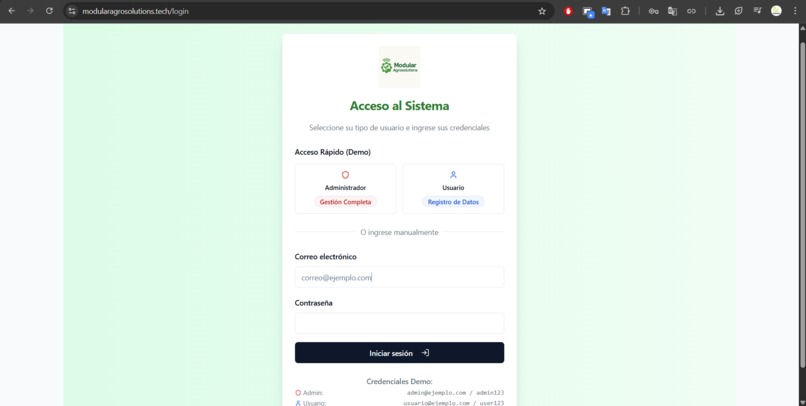
Wireframe-Login
-
Logotype
Inspiration
Our inspiration arises from the growing challenges facing the agro-industrial sector in Latin America. We observed a significant gap between available technologies and their effective adoption by rural stakeholders. The structural problems are clear: a great difficulty in structuring and monitoring agricultural projects in real time, low traceability in operational processes, and limited adoption of technologies due to a lack of connectivity and intuitive tools adapted to the rural context. We saw the need for a comprehensive solution that not only digitizes the field, but does so in an inclusive, functional, and methodologically robust way, even under the most adverse conditions.
What it does
Modular Agrosolutions is an integrated mobile-web solution designed to plan, monitor, and document agro-industrial projects. Through a mobile application that works offline, users in the field record activities using "Electronic Logbooks" and low-cost NFC tags to ensure physical and digital traceability of each resource, process, or location. When a connection is restored, the information is automatically synchronized with a SaaS web platform, where our Artificial Intelligence analyzes the data to generate predictive recommendations, early warnings, and optimize decision-making. Fundamentally, we help users manage their projects by facilitating quality management and compliance with demanding standards.
How we built it
We built Modular Agrosolutions on a modern and scalable technological architecture, designed for the rural environment: The project is a full-stack web application built with the following main technologies: Frontend: React (with Vite) and TypeScript, using Tailwind CSS and the shadcn/ui component library. Backend and Database: Supabase, which in turn uses PostgreSQL as its database. Payments: Stripe, integrated via Supabase Functions.
Challenges we ran into
Low Digital Literacy: We anticipated that the difficulty in training rural users with low technological familiarity would be a "High" risk. Our challenge was to design an extremely intuitive interface and a blended training plan with printed materials and direct support via WhatsApp. Intermittent Connectivity: The risk of failures in the offline-online synchronization under variable connectivity conditions is "Moderate." The challenge was to build a robust synchronization logic that works automatically and without data loss as soon as a minimal signal is detected. Adoption and Trust: Potential rejection by rural associations and distrust towards a payment model (SaaS) are "High" risks. To mitigate this, our strategy is based on collaborative pilot tests, the appointment of local ambassadors, and offering a freemium plan to demonstrate value before purchase. Hardware Compatibility: The risk that users would not have NFC-compatible devices was "Moderate." We researched and confirmed that most current mid-range devices already include this technology, making the solution accessible.
Accomplishments that we're proud of
We are proud to have designed a solution with unique and strategic differentiators: Pioneering NFC + Rural AI Integration: We provide a native integration of physical traceability (NFC) in an environment specifically designed for rural Latin American conditions, something uncommon in the market. True Offline Functionality: We developed an architecture that allows for genuine, field-adaptable offline operation, not just temporary data caching. This is a cornerstone of our value proposition. Innovation Protection: The design and functionality of our "NFC - Electronic Logbooks" are in the process of being registered as a utility model, which strengthens our competitive advantage and protects our intellectual property from an early stage.
What we learned
Throughout the planning and initial development, we have learned valuable lessons: Validating Assumptions in the Field: We learned that technical assumptions about connectivity must be validated in the field before defining the project's scope. Our initial projections were overly optimistic, which led us to further prioritize the robustness of the offline mode. Training Must Be Contextualized: We discovered that for users with low digital familiarity, printed materials and direct support are more effective than complex video tutorials. The training strategy must be blended and adapted.
What's next for Modular Agrosolutions
Our roadmap is ambitious and is clearly defined in phases: Short-Term (12-18 months): Launch the stable version (v1.0) after running pilot tests in at least two rural areas of Colombia. The goal is to consolidate a base of at least 5,000 active users within the first three years and reach the operational break-even point. Medium-Term (18-30 months): Begin geographic expansion to other Latin American countries with strong agricultural potential, such as Mexico, Brazil, and Chile. This will include adapting the system to local regulations and currencies. Long-Term (30+ months): Expand the platform's functionality with advanced modules for digital certification (e.g., GlobalG.A.P.), rural financial management, and comparative analysis by crop. Additionally, we plan to develop specialized versions for agricultural verticals such as floriculture, livestock, and coffee, consolidating our position as a comprehensive solution for the agricultural sector.
Built With
- plpgsql
- supabase
- typescript

Log in or sign up for Devpost to join the conversation.