Inspiration
Most moderation tools focus on enforcing rules after something has already happened. But many mod teams have a quieter operational problem: the work is uneven, queue pressure builds slowly, and one or two moderators can carry too much before anyone notices.
Modlytics was inspired by that invisible layer of community operations. A subreddit can look stable from the outside while the team behind it is slowly getting overloaded. I wanted to build a tool that helps moderators see workload health early, align around one shared signal, and protect the people keeping communities healthy.
What it does
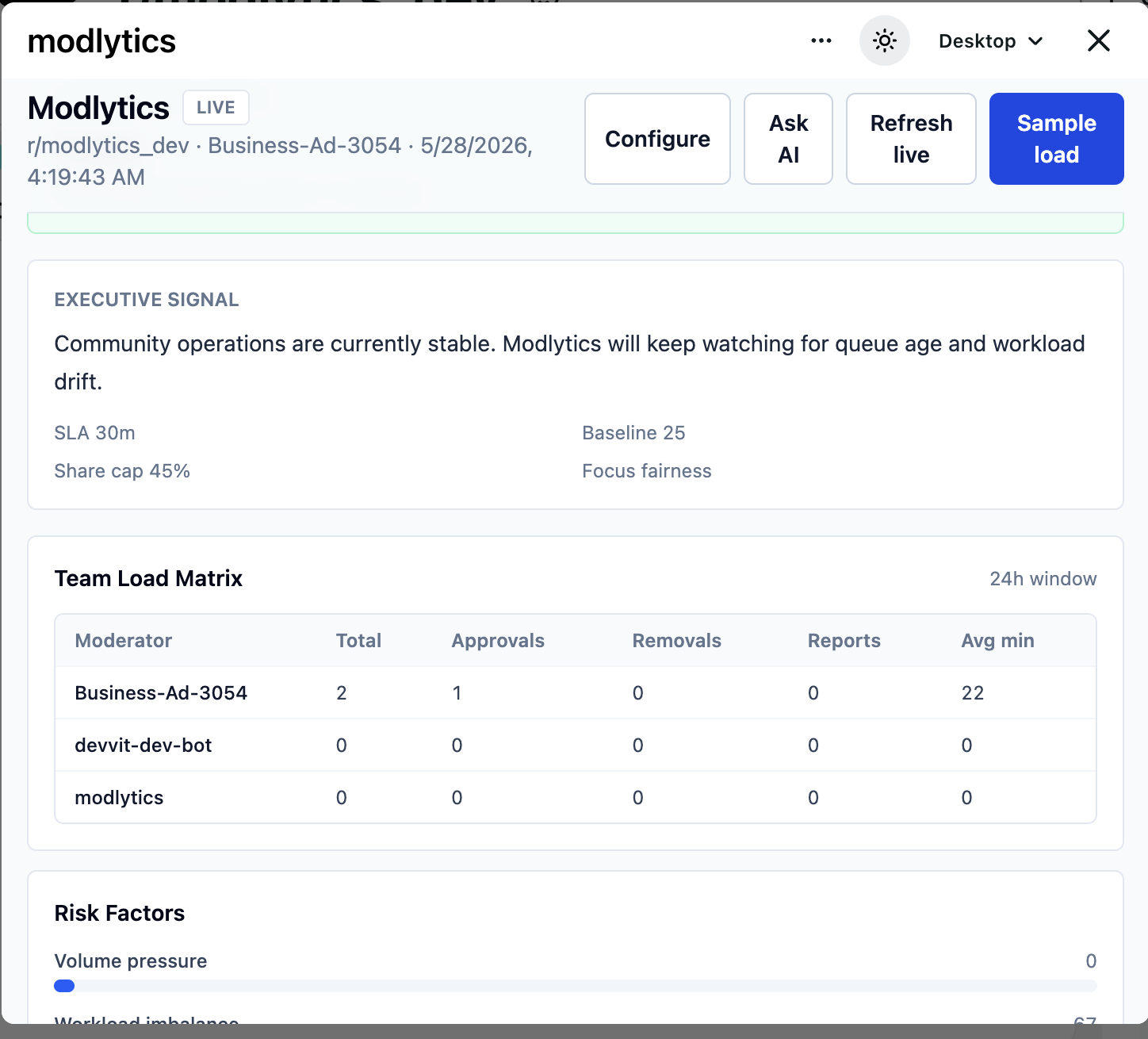
Modlytics turns live subreddit moderation signals into an operations dashboard for mod teams.
It measures:
- Burnout risk
- Queue backlog
- Average queue age
- Moderator workload distribution
- Single-moderator load concentration
- Response latency pressure
It produces:
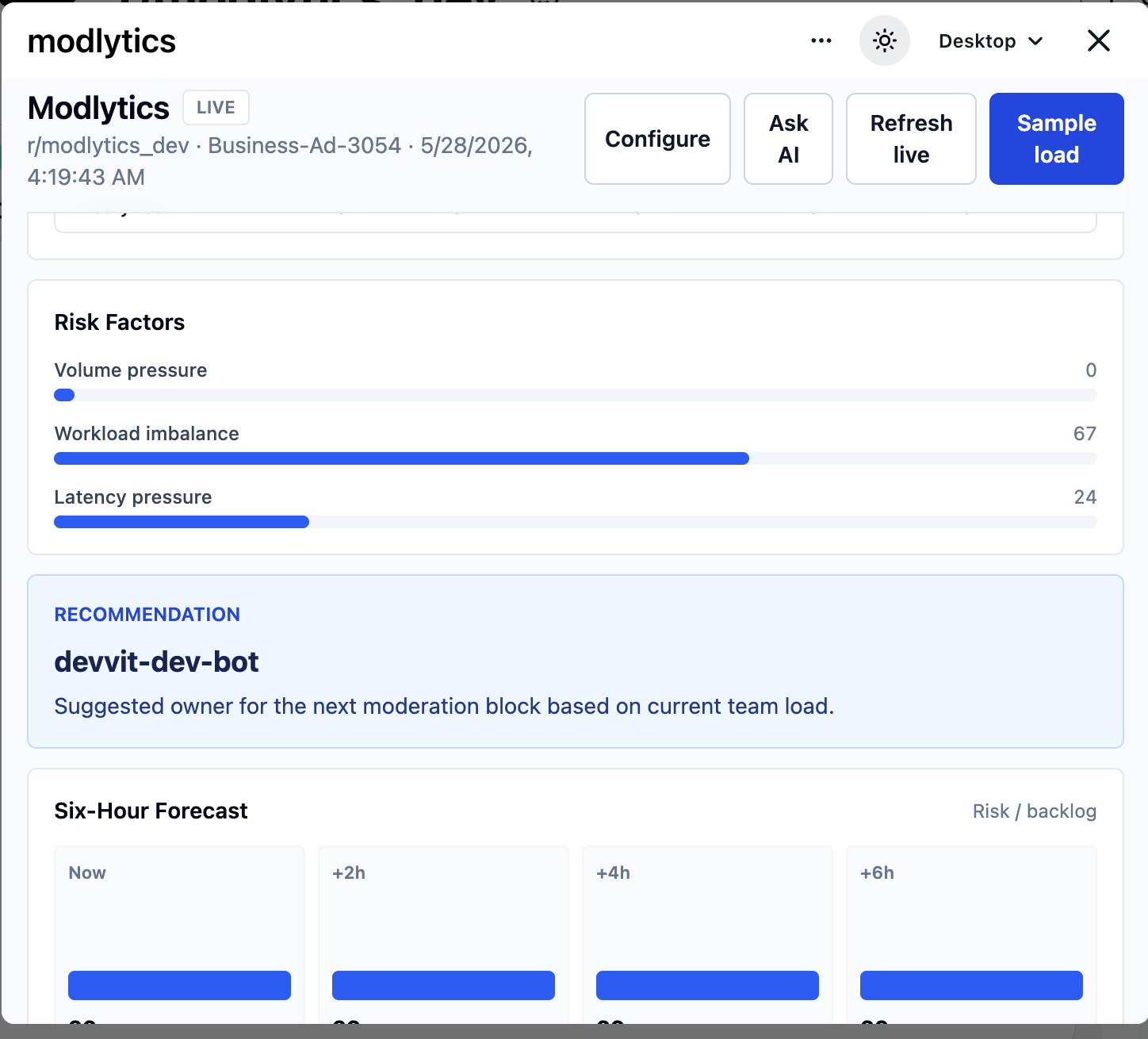
- A six-hour risk forecast
- A balance score
- A suggested owner for the next moderation block
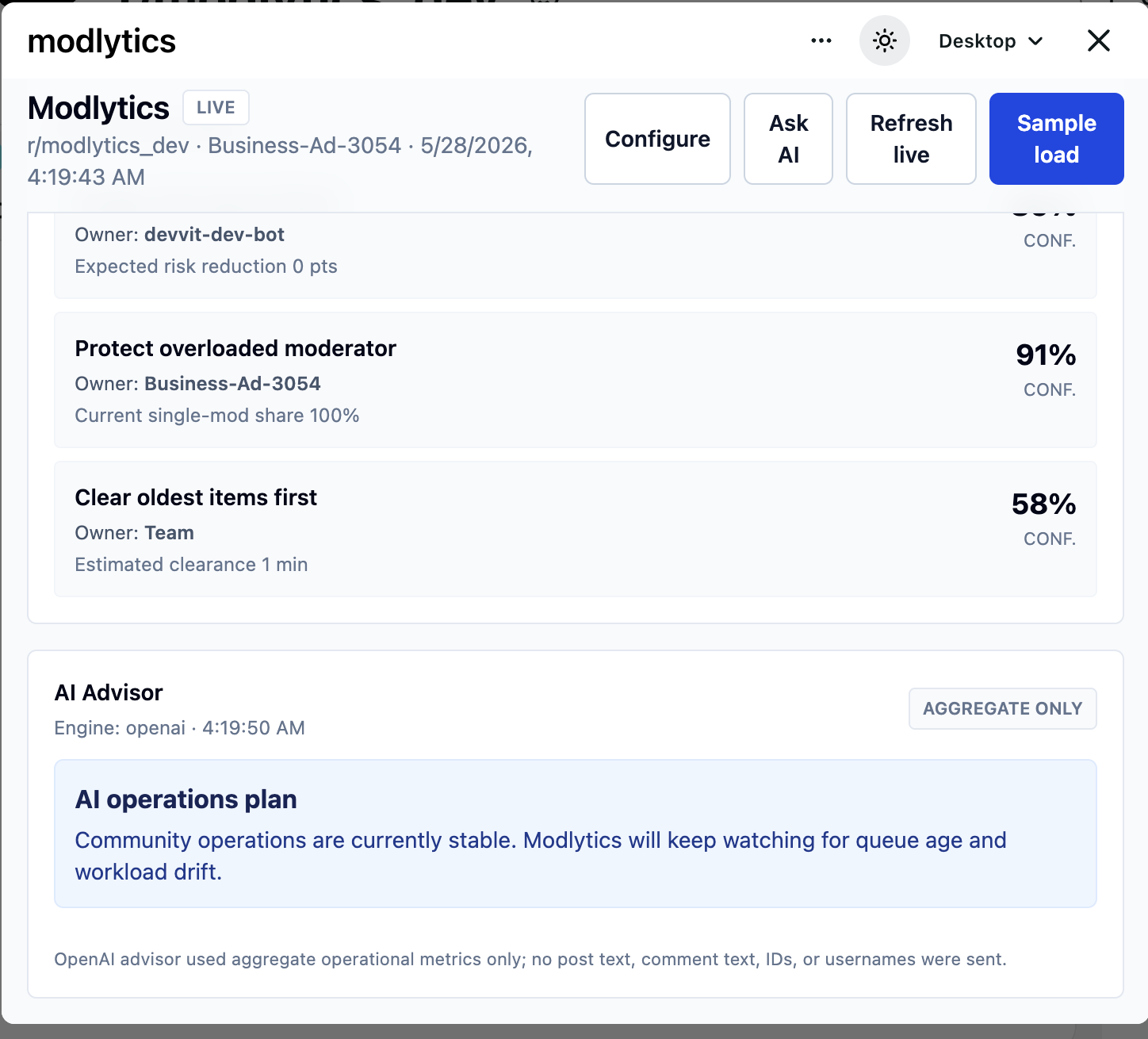
- An intervention plan with expected impact and confidence
- A configurable operations profile for each subreddit
- An optional AI advisor summary generated from aggregate metrics only
Moderators can tune Modlytics to match their community by configuring SLA targets, backlog baselines, workload caps, forecast horizon, queue goals, sensitivity, focus area, and advisor mode.
The app also includes live mode for real subreddit signals and sample scenario mode so a quiet test community can still show how Modlytics behaves under pressure.
How we built it
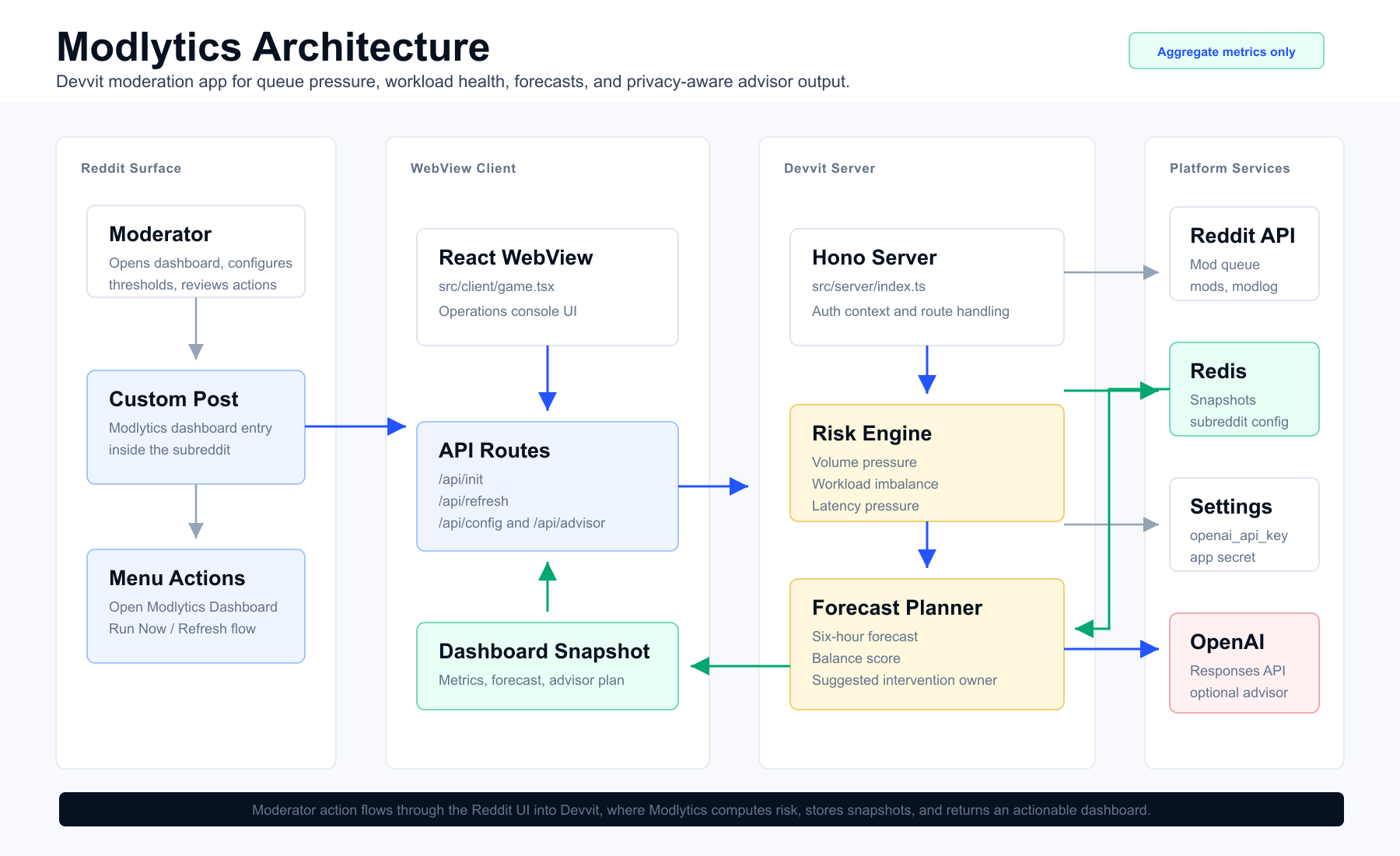
Modlytics is built on Reddit’s Developer Platform with Devvit.
Core Devvit features used:
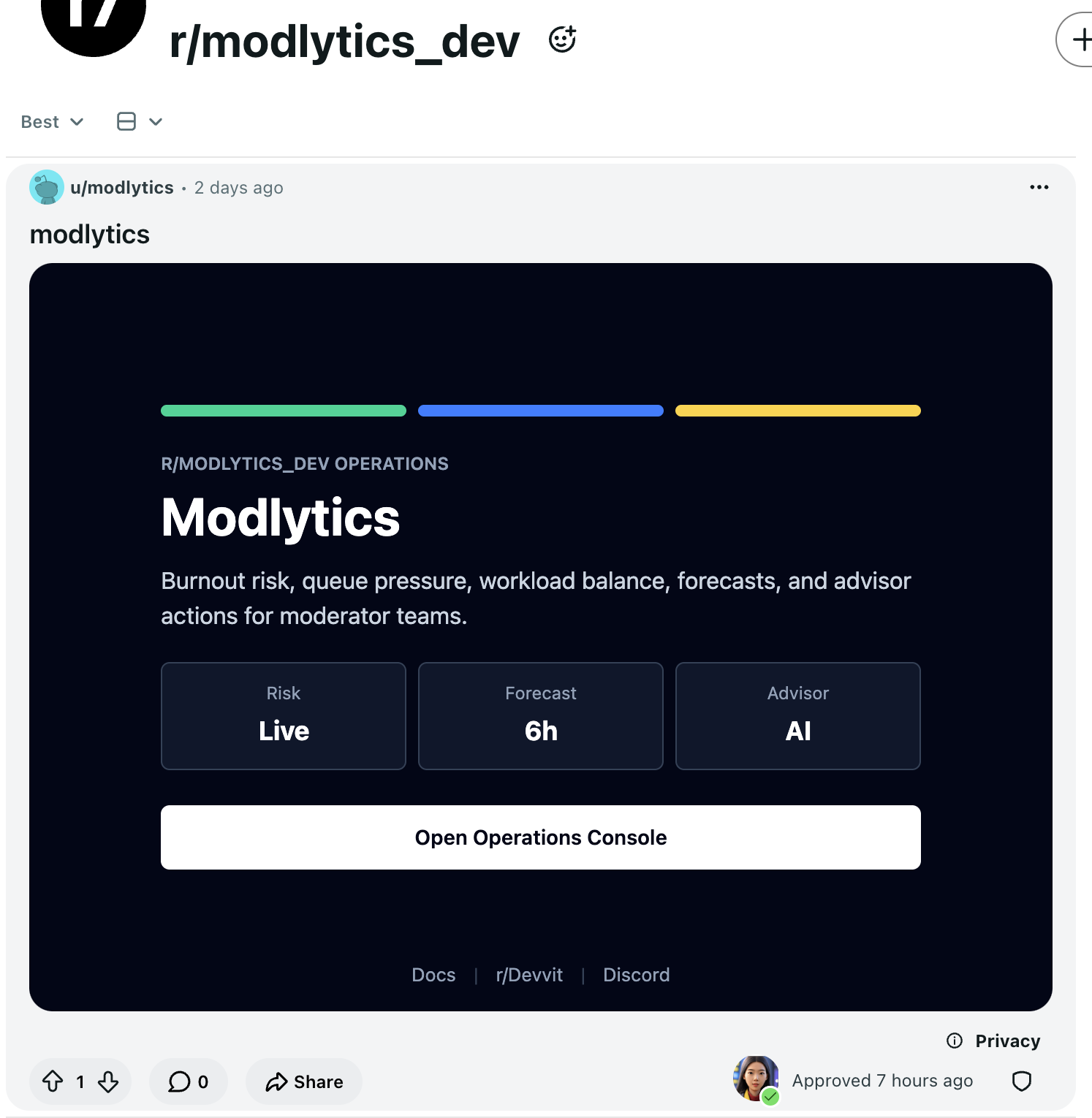
- Custom post WebView for the operations console
- Subreddit menu actions for opening Modlytics
- Reddit API access for moderator and queue signals
- Redis storage for dashboard snapshots and subreddit configuration
- Native Devvit forms for moderator-adjustable thresholds
- Devvit settings for an optional OpenAI API key
- HTTP fetch permission for optional OpenAI advisor generation
The risk model combines three signals:
- Volume pressure from queue backlog
- Workload imbalance from recent moderator activity distribution
- Latency pressure from average queue age
Those signals become a Burnout Risk Score, a Balance Score, a forecast, and a recommended intervention. The interface is designed as a practical operations console rather than a generic analytics page, so moderators can quickly move from signal to action.
Modlytics works without external AI by default. If OpenAI advisor mode is enabled, it sends only aggregate operational metrics such as risk score, backlog count, queue age, team size, balance score, workload concentration, and moderator-written community context. It does not send post text, comment text, Reddit IDs, message content, or raw usernames.
Challenges we ran into
The first challenge was making the app useful in both real and empty communities. A live subreddit may have meaningful moderation signals, but a hackathon test subreddit can be quiet. Modlytics needed a live mode for actual use and a sample scenario mode that clearly demonstrates the workflow under pressure.
The second challenge was designing AI support responsibly. A moderation app should not casually send sensitive community content to an external service. The solution was to make AI optional, keep a local deterministic advisor as the default, and limit OpenAI mode to aggregate operational metrics only.
The third challenge was turning raw metrics into something moderators can act on. A dashboard that only says “risk is high” is not enough. Modlytics needed to recommend the next operational move: who should take the next queue block, who may need protection from overload, and whether the team should prioritize oldest items first.
Accomplishments that we're proud of
I am proud that Modlytics is more than a read-only dashboard. It is configurable, installable, and built around a real moderator workflow:
- Configure the subreddit’s operating thresholds
- Refresh live moderation signals
- Review burnout risk, queue age, balance score, and forecast
- Inspect the team load matrix
- Ask the advisor for an intervention plan
- Assign the next moderation block with clearer context
I am also proud of the privacy boundary. Modlytics can use AI without exposing raw subreddit content or user-level moderation data. That makes the advisor useful while still respecting the sensitivity of moderation work.
Finally, the product is designed around a pain point that moderators actually feel: not just “what should we remove,” but “is our team still operating in a healthy way?”
What we learned
I learned that moderation tooling is not only about enforcement. It is also about operations, coordination, and sustainability.
Building Modlytics showed me that small signals can matter a lot: queue age, workload concentration, and who has been carrying the last moderation block can reveal problems before they become obvious. I also learned that AI is most useful in moderation when it is constrained, transparent, and focused on decision support rather than replacing moderator judgment.
On the technical side, I learned how to combine Devvit WebViews, server routes, Reddit API access, Redis storage, native forms, settings, and external fetch permissions into one installable moderation app.
What's next for Modlytics
Future improvements:
- Historical trend charts across multiple days
- Scheduled health checks and modmail alerts
- Configurable intervention templates
- Per-rule workload patterns
- Team handoff summaries for shift changes
- Exportable weekly moderation health reports
- App Directory polish and broader feedback from active moderator teams
Built With
- devvit
- devvit-forms
- devvit-settings
- devvit-webviews
- gpt-5-mini
- hono
- html
- openai-api
- react
- reddit-developer-platform
- redis
- typescript
- vite


Log in or sign up for Devpost to join the conversation.