-
-
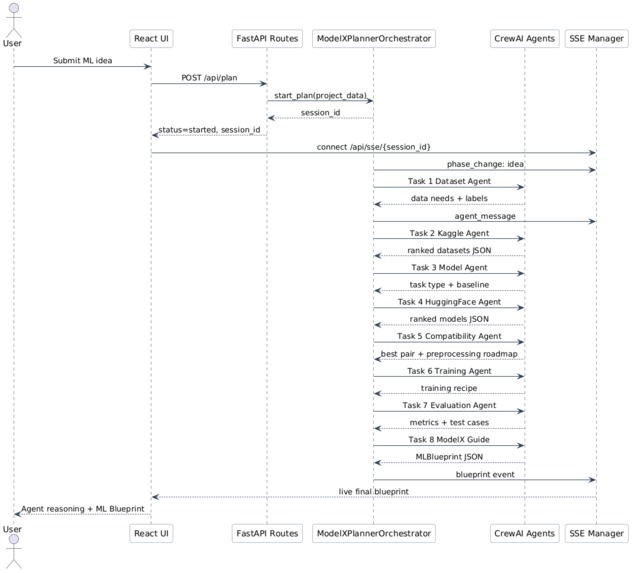
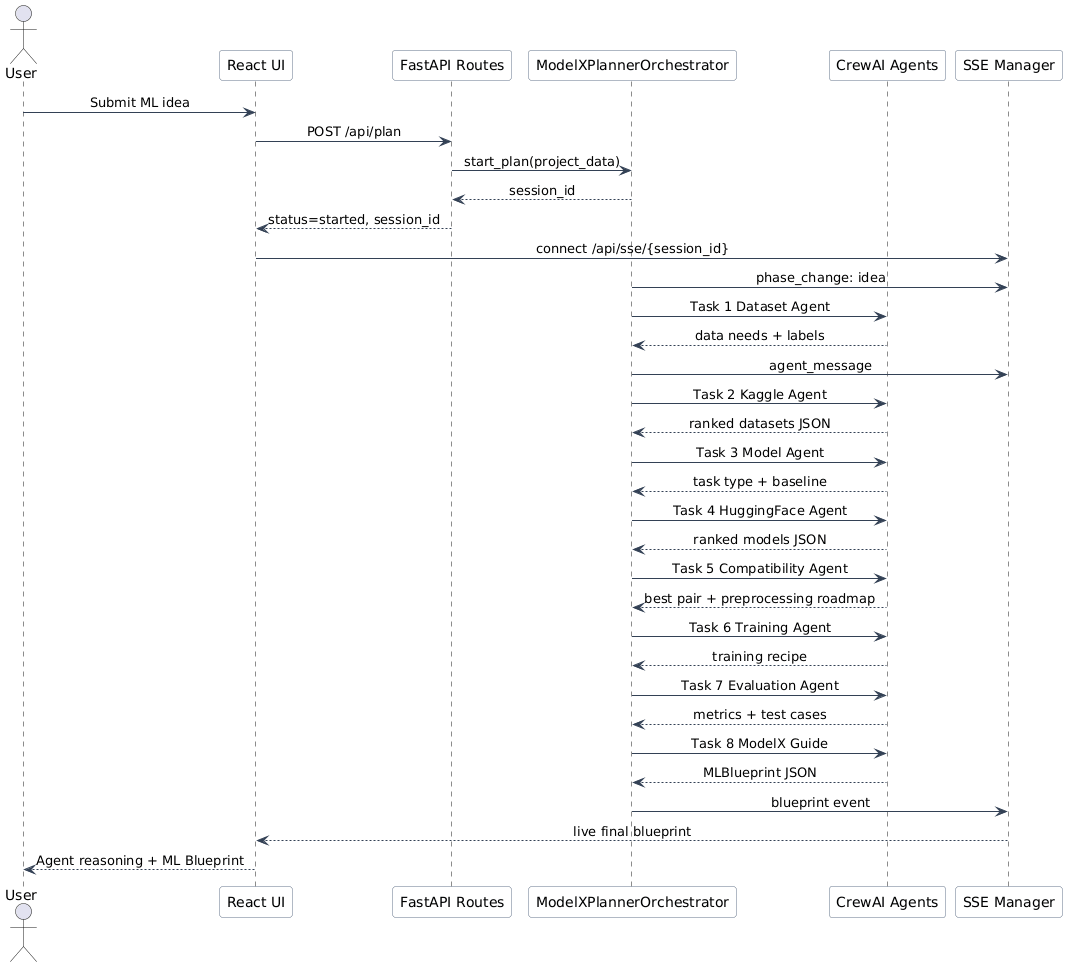
Data Flow Diagram
ModelX
Inspiration
ModelX was inspired by a common problem beginners face when they have an exciting AI idea: they know what they want to build, but they do not know how to turn that idea into a real machine learning project. Choosing the right dataset, model type, training approach, and evaluation method can feel overwhelming, especially for people who are new to ML or annoying for those who aren't.
What it does
ModelX is a multi-agent platform that helps people turn AI ideas into a fully functional LLM.
A user enters their project idea, goal, skill level, data status, and constraints. Then ModelX runs an Agent Debate Mode, where specialized agents discuss the best approach:
- Dataset Agent: decides what data is needed, what labels are required, and what privacy, bias, or quality issues to watch for.
- Kaggle Agent: searches for relevant Kaggle datasets and identifies which ones are realistic for the user’s project.
- Training Agent: plans preprocessing, train/validation splits, training steps, and ways to avoid overfitting.
- Hugging Face Agent: looks for useful Hugging Face datasets, models, and starter pipelines that match the idea.
- Compatibility Agent: checks whether the dataset, model choice, task type, and compute requirements actually fit together.
- Evaluation Agent: defines metrics, test cases, failure modes, and acceptance criteria.
- ModelX Guide: combines the agents’ reasoning into one clear beginner-friendly plan.
We do more than planning. After helping the user choose the right configuration, we train the model for them. Once training is complete, users can test the model, review its performance, and use it through a simple interface without needing to manage the full ML engineering workflow themselves.
Agentverse - Search & Discovery of Agents
ASI1 Chat Session: https://asi1.ai/invite?channelInviteKey=PfvRQ-_UVDxVdtS0fxw69skM9yMovMA1RTL6McUR6Do
Agent Profiles: https://asi1.ai/ai/agent1qga9crlmwsn2ev6xv5zyv06eexsll0qt45waxylsggvu5jyznupdujvvjed
How we built it
We built ModelX as a full-stack web application using a React and TypeScript frontend with a FastAPI backend.
The frontend provides a guided visual workflow where users enter their ML idea and watch the agents work through each stage. The backend handles request validation, session tracking, real-time updates, and multi-agent orchestration.
We used CrewAI to organize the agents into a sequential discussion. Each specialist agent contributes its own reasoning, and the final guide agent synthesizes the discussion into a structured Blueprint.
Server-Sent Events are used to stream progress updates live to the frontend, so users can see the workflow move through dataset, model, training, evaluation, and blueprint phases.
Challenges we ran into
One of the biggest challenges was figuring out how to design a useful ML planning experience without assuming the user had access to expensive compute and training experience. Many beginners do not have GPUs, cloud credits, or large datasets, so we solved the problem by offloading training jobs to GPU cloud providers like RunPod.
We also ran into challenges around making the agent debate easy to understand. The agents needed to discuss datasets, model choices, training risks, and evaluation metrics without overwhelming beginners with technical jargon. We spent time shaping the outputs so each agent explains not only what to do, but why it matters.
A final challenge was keeping the workflow fast and interactive. Since the platform uses multiple agents, we had to structure the process so users could see live progress through each phase instead of waiting on a blank screen.
What we learned
We learned how powerful multi-agent systems can be when each agent has a focused role. Instead of asking one AI assistant to solve the entire problem at once, ModelX breaks the process into smaller expert perspectives.
That structure helped us design ModelX around education and automation.
Accomplishments that we're proud of
We are proud that ModelX turns a vague AI idea into a structured, practical plan that a beginner can actually follow. We are also proud of the Agent Debate Mode because it makes the planning process transparent. Users do not just get an answer; they see how different expert agents think through the project.
What's next for ModelX
Next, we would like to add dataset upload support and eventually support different learning paths, so beginners can choose between a no-code explanation, a Python notebook path, or a more advanced ML engineering workflow.
Built With
React, TypeScript, Vite, Material UI, Emotion, Python, FastAPI, Pydantic, CrewAI, OpenAI API, Server-Sent Events, Pytest, Vitest, React Testing Library, npm, Git, GitHub

Log in or sign up for Devpost to join the conversation.