-
-
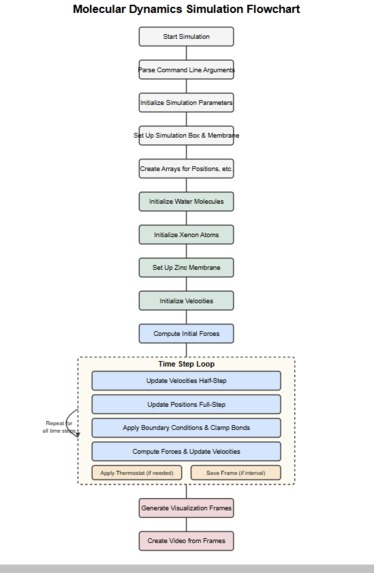
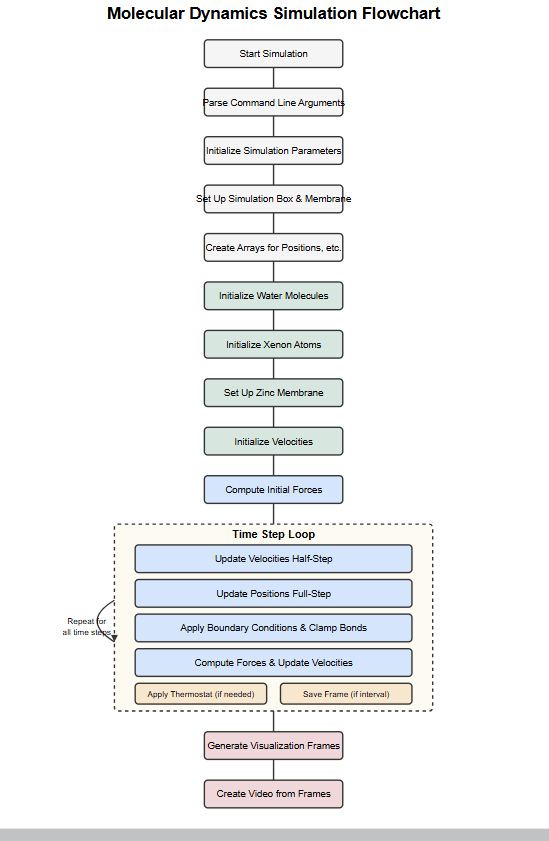
Flowchart
Inspiration - We were inspired by the idea of our future energy systems. We are motivated to live in a world where we utilize our full energy capabilities without people living in fear. Our project is here to help professionals and people realize we have safe ways to combat radioactive waste.
What it does
We want to make clear at a molecular level a simulation with real-time applied physics of solvents to get rid of potentially radioactive material using a metal organic framework. Our simulation implements the Velocity Verlet integration algorithm for particle trajectories, Coulombic interactions for charged particles, and proper bond constraints to ensure physical accuracy. The simulation is run through Python and is demonstrated in real time with a user being able to input changes in molecule amounts. This helps show that even with more radioactive material, the filter is still effective.
How we built it -
We integrated and expanded the functionalities of preexisting libraries to create a coherent simulation workflow. By leveraging AI, we were able to speed up the optimization of our code as well as beautify our UI. Due to the large amount of computing required to propagate the system in time, this was critical for our model. By utilizing numerical methods and approximations to fundamental equations, we were able to model how molecules interact with each other at the solvent-framework interface. The most time-intensive part of the development project was formulating and understanding the mathematics necessary to model these systems.
Challenges we ran into
Running the model took significant time at every iteration. Visualizing complex 3D molecular behaviors well required optimizing our workflow over several iterations. This is due to the time-intensive nature of the numeric integration algorithms and force calculations. The sequential logic implemented in our model also makes catching and fixing errors harder.
.
Accomplishments that we're proud of
We're particularly honored to create a simulation that maintains scientific accuracy while being visually accessible and interactive. We wanted to make sure our implementation could be used by a user. As Benjamin Franklin put it "Tell me and I forget, teach me and I may remember, involve me and I learn."
What we learned
This project deepened our understanding of molecular dynamics principles, and we also gained a greater understanding in the challenges of maintaining particles and their physical properties. We also gained a greater understanding in debugging and implementing physical properties in a simulation through Python.
What's Next for Modeling Radioactive Particles Through Membrane
We're interested in incorporating machine learning to optimize membrane design parameters based on simulation results. We also want to expand our library of viable elements, which proved complicated to do in a 24-hour time period due to the rendering constraints along with the dramatic differences in physics of each simulation

Log in or sign up for Devpost to join the conversation.