-
-
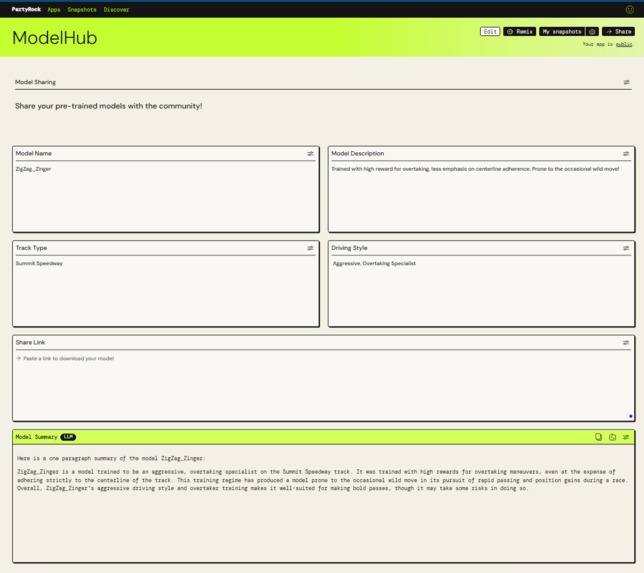
Training our model Zigzag_Zinger
Inspiration
My journey began with AWS DeepRacer, where I had the opportunity to create a model using reinforcement learning to race along a track. This experience sparked my passion for leveraging pre-trained models to accelerate AI development. Building upon this foundation, I realized that discovering and utilizing specialized models for specific use cases, like autonomous driving, could be challenging for developers. This insight led to the conception of ModelHub - a platform to foster collaboration and sharing of pre-trained models tailored to particular track types and driving styles.
What it does
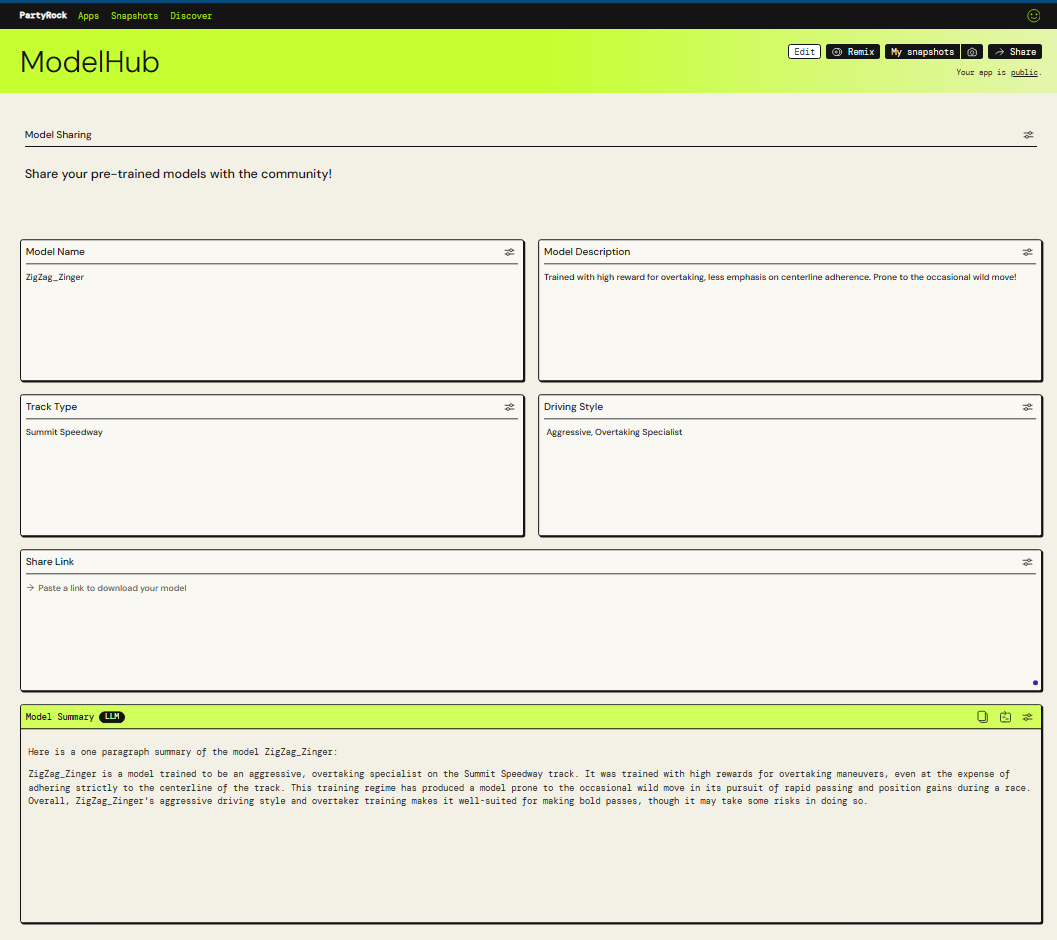
The ModelHub app takes in essential information about a model, including the Model Name, Model Description, Track Type, Driving Style, and a Share Link. Using these inputs, the app generates a comprehensive Model Summary that encapsulates the key aspects of the model.
How we built it
ModelHub came to life entirely within the AWS PartyRock ecosystem. Drawing from my experience with AWS DeepRacer, I envisioned a user journey centered around uploading a model and its associated metadata, enabling discovery based on track type and driving style. Using the PartyRock App Builder, I strategically combined user input widgets to capture these model details and AI text generation to create unique, data-driven model summaries. By chaining dynamic variables together, I ensured that each model page was informative and tailored to the specific model. To optimize the user experience, I iteratively refined the interface design, striking a balance between capturing necessary information and maintaining a simple, intuitive upload process. Leveraging my understanding of prompt engineering, I crafted carefully designed prompts to generate concise yet comprehensive model summaries.
Challenges we ran into
One of the primary challenges I encountered was determining the optimal way to categorize models meaningfully while keeping the upload process streamlined. Drawing from my experience with AWS DeepRacer, I recognized the importance of capturing key characteristics like track type and driving style. However, striking the right balance between comprehensiveness and simplicity required thoughtful iteration. Another challenge was ensuring the generated model summaries were accurate, informative, and consistent in quality. This required a deep dive into prompt engineering techniques, experimenting with different prompt structures, and fine-tuning generation parameters to achieve the desired results.
Accomplishments that we're proud of
I'm proud of the progress made in creating a platform that empowers developers to collaborate and accelerate AI innovation in the autonomous driving space. The ModelHub app, with its ability to capture essential model information and generate informative summaries, serves as a catalyst for sharing and discovering specialized pre-trained models.
What we learned
Participating in the AWS PartyRock Hackathon and bringing ModelHub to life has been an incredibly fulfilling experience. It allowed me to build upon my prior knowledge from working with AWS DeepRacer and apply it to a new domain, exploring the exciting possibilities of generative AI development.
What's next for ModelHub
Looking ahead, I'm excited to continue refining ModelHub, incorporating user feedback, and exploring new ways to enhance the platform's capabilities. With the power of AWS PartyRock and the insights gained from this hackathon, I'm confident that ModelHub has the potential to make a meaningful impact in the world of AI and autonomous systems.
Built With
- amazon-web-services
- partyrock

Log in or sign up for Devpost to join the conversation.