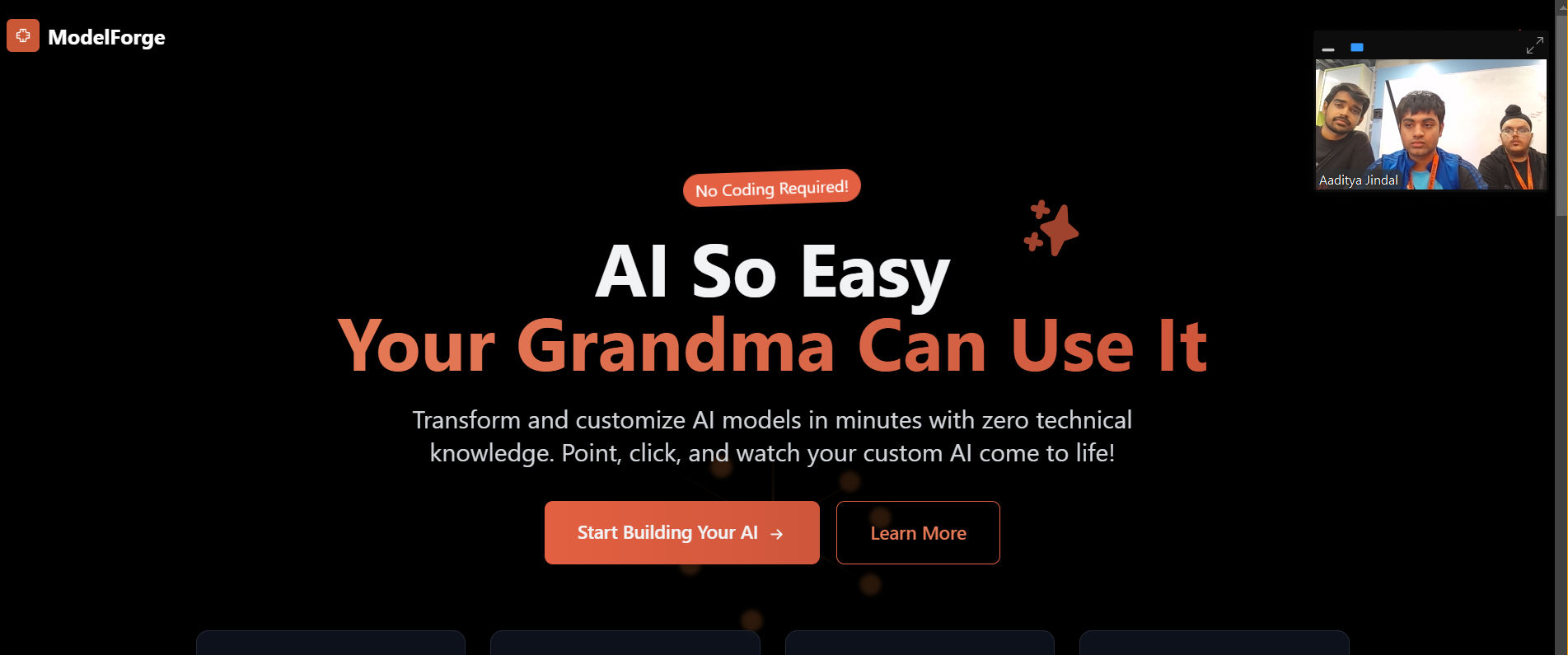
ModelForge - AI so easy; your grandma could do it!
Inspiration
The idea behind ModelForge stemmed from the growing demand for accessible AI tools that empower businesses to create tailored solutions without technical barriers to democratize the use and adoption of Generative AI. We envisioned a platform that combines the flexibility of fine-tuning large language models with the simplicity of a no-code interface. By leveraging local data processing, we sought to address concerns around data privacy and reduce dependency on costly APIs, ensuring that businesses of all sizes can harness the power of AI effectively.
What it does
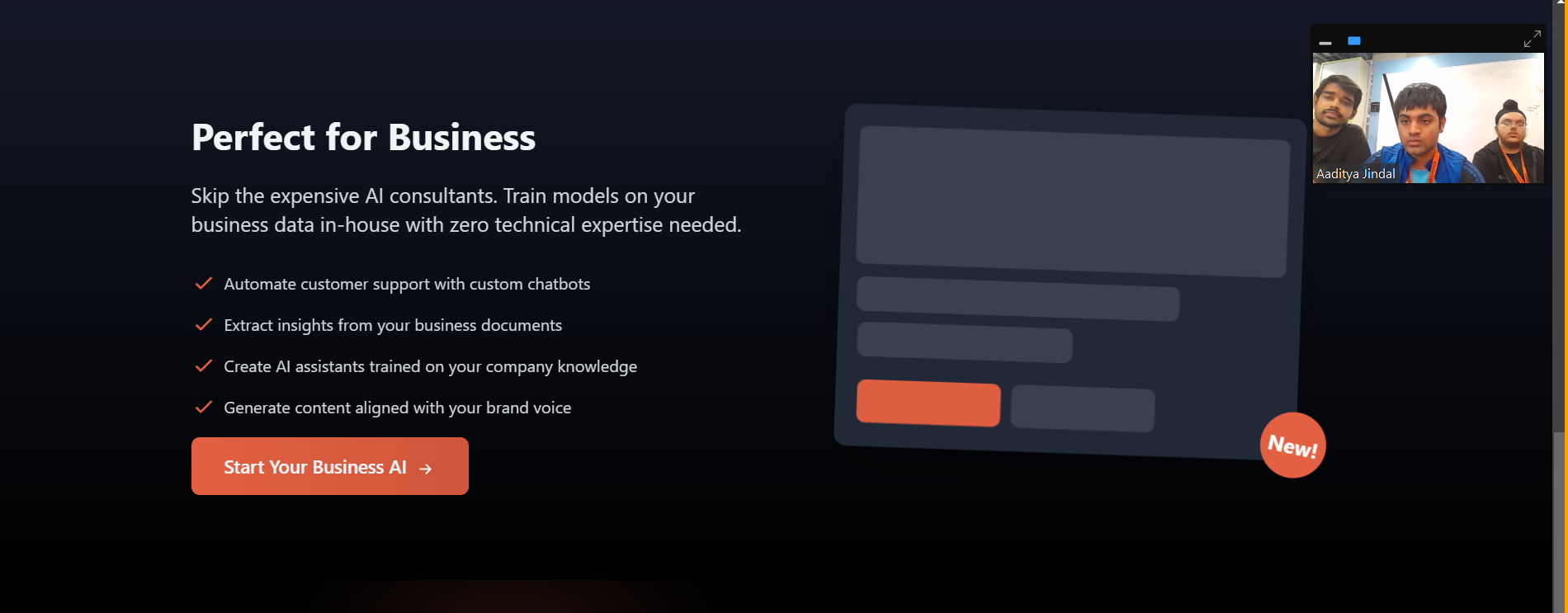
ModelForge is a groundbreaking no-code platform that allows users to customize large language models (LLMs) to fit their specific business use cases. Whether it's creating chatbots for customer support, summarizing industry-specific documents, or crafting personalized marketing strategies, ModelForge simplifies the fine-tuning process. With advanced techniques like Parameter-Efficient Fine-Tuning (PEFT) and Quantized Low-Rank Adaptation (QLoRA), the platform ensures efficient model customization while maintaining high performance, even on low-end hardware. Users can train models entirely locally on their proprietary data, protecting privacy and eliminating high API costs.
How we built it
Frontend
- Languages: JavaScript
- Frameworks: React
- Libraries: React (for UI), Tailwind (for styling)
Backend
- Languages: Python
- Frameworks: FastAPI
- Tools: Uvicorn
- Libraries: Transformers, PEFT, LoRA, PyTorch, Datasets, TrainingArguments, DataCollatorForLanguageModeling, BitsAndBytesConfig, AutoModelForCausalLM, AutoTokenizer, SFTTrainer
Challenges we ran into
Simplifying Fine-Tuning for Non-Technical Users:
One of the core objectives was to democratize the process of fine-tuning large language models. Designing an intuitive, no-code interface that simplifies advanced machine learning concepts—like PEFT and LoRA—required significant effort. We focused on reducing jargon, creating clear workflows, and incorporating helpful tooltips to make the platform accessible for users without technical expertise.Building an Embedded Chat Playground:
Developing an interactive chat playground presented a dual challenge: fully leveraging system resources for real-time performance while avoiding server overload. To achieve this, we carefully optimized resource allocation and implemented safeguards to ensure stability during intensive testing and interactions with fine-tuned models.Seamless Data Sharing Between Frontend and Backend:
Ensuring a seamless connection between the React-based frontend and the FastAPI-powered backend was another hurdle. Synchronizing data flow, managing API endpoints, and handling potential bottlenecks required rigorous planning and debugging. Special attention was given to maintaining data consistency and minimizing latency during user interactions.Preserving Detected Device Settings Across Pages:
Once hardware settings were detected, maintaining these configurations across multiple pages posed a technical challenge. We had to implement state management solutions that ensured settings were accurately retained and available throughout the user journey, avoiding unnecessary reconfigurations.Learning FastAPI from Scratch:
The team ventured into uncharted territory by using FastAPI for the first time. While its efficiency and simplicity were advantageous, mastering its intricacies, such as routing, asynchronous operations, and data validation, required a steep learning curve during the project timeline.Debugging Environment-Related Issues in the Alpha Release:
As we worked on the alpha version of ModelForge, various environment-related challenges surfaced, from version mismatches in dependencies to GPU compatibility issues. These complex problems demanded meticulous investigation and testing to ensure smooth deployment across diverse setups.
Accomplishments that we're proud of
Robust Cross-Platform Fine-Tuning:
Implemented a democratized fine-tuning pipeline that operates seamlessly across multiple operating systems and diverse hardware configurations, effectively addressing out-of-memory (OOM) challenges.Empowering No-Code Interface:
Developed an intuitive no-code solution that enables users to fine-tune large language models without any technical expertise, radically breaking down traditional barriers to AI customization.On-Time Delivery of Core Milestones:
Successfully deployed all initial checklist items within the set timelines, underscoring our team's efficiency, meticulous planning, and commitment to project deadlines.Interactive CLI-Based Chat Playground:
Integrated a command-line interface chat playground that allows users to test and interact with their custom fine-tuned models before full-scale deployment, ensuring a robust pre-deployment validation process.Seamless Frontend-Backend Integration:
Achieved smooth data sharing between the frontend and backend systems, delivering a highly responsive and cohesive user experience throughout the platform.Advanced Resource Optimization:
Implemented smart hardware detection and adaptive configuration protocols that ensure optimal performance on any device, whether on high-end GPUs or low-end hardware environments.Enhanced Community and Developer Support:
Developed comprehensive documentation and support channels, providing extensive resources that empower both technical and non-technical users to harness the full potential of ModelForge.
What we learned
What we learned
User-Centric Design Is Key:
We discovered that simplifying complex fine-tuning processes for non-technical users required a deep focus on intuitive, contextual design. User feedback drove us to streamline interactions and reduce technical jargon, ensuring that the platform remains accessible to everyone.Iterative Development Accelerates Innovation:
Continuous testing and feedback loops were invaluable. Regular iterations enabled us to quickly identify and resolve issues, refine features, and enhance overall system performance, reinforcing the importance of agile development practices.Effective Resource and State Management Matters:
Balancing real-time performance in the chat playground, maintaining seamless data exchange between components, and preserving device configurations across pages taught us critical lessons in resource optimization and robust state management.Embracing New Technologies Fuels Growth:
Adopting FastAPI and other cutting-edge tools, despite the learning curve, proved to be a catalyst for innovation. This experience underscored the value of continuous learning and flexible problem-solving in overcoming technical challenges.Resilience and Team Collaboration Lead to Success:
Facing challenges—from debugging environment issues to managing hardware constraints—reinforced the importance of collaboration and persistence. Our collective efforts allowed us to overcome hurdles and deliver a reliable product, setting the stage for future improvements.
What's next for ModelForge
We envision expanding ModelForge's capabilities to accommodate even broader use cases. Here is a peek into the upcoming future updates:
- Implement a dataset parsing tool to allow unstructured dataset uploads such as PDFs and Word documents
- Additional model support to enhance the library of choices (waiting for the next iteration of PEFT, which is promised to support additional models)
- Enable distributed computing for Multi-GPU systems to leverage an environment's resources fully
- Enable CPU-only fine-tuning for Llama-based models using llama.cpp to further democratize AI use
- Integrate advanced fine-tuning techniques like IA^3 and AdaLoRA
- Provide support for fine-tuning vision-based tasks and additional language-based tasks
Built With
- accelerate
- bitsandbytes
- datasets
- fastapi
- huggingface-hub
- javascript
- json
- jsx
- peft
- psutil
- pydantic
- pynvml
- python
- pytorch
- react
- tailwind
- transformers
- trl
- uvicorn

Log in or sign up for Devpost to join the conversation.