Inspiration
Model cards often fail for a simple reason. The author knows what the model does, but forgets a baseline, leaves out a data provenance note, writes a vague limitation or makes a broad performance claim without evidence. I wanted a small offline tool that makes those gaps visible while the card is being written.
What it does
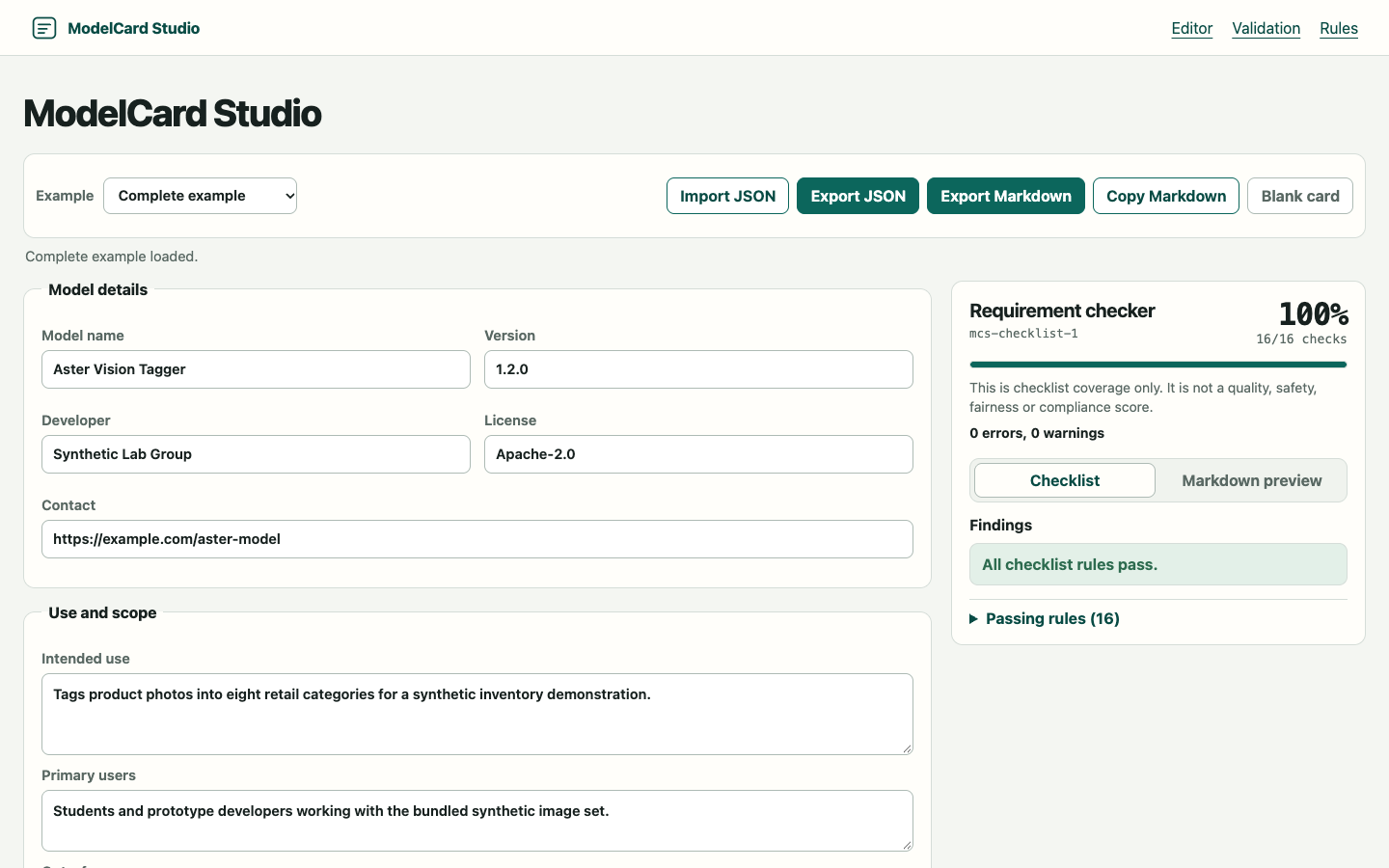
ModelCard Studio is a two-pane model-card and eval-report builder. The left pane edits the model details, intended use, out-of-scope use, training data provenance, evaluation table, examples, limitations and ethical considerations. The right pane validates every edit live against a pinned 16-rule checklist.
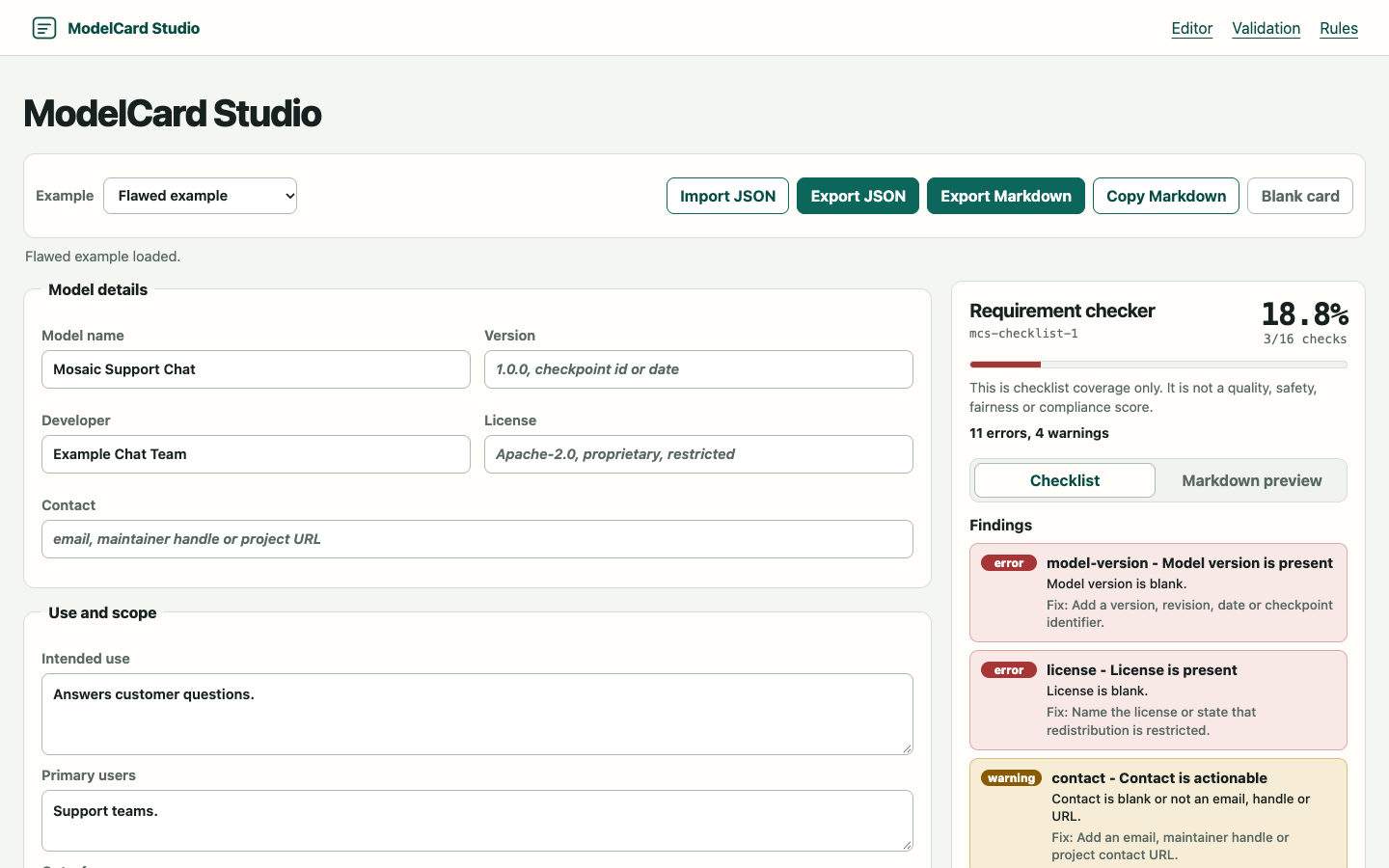
Each finding names the rule, severity and concrete fix. Evaluation rows must include a dataset, metric, value and slice. A complete baseline row is required by the checklist. Metric claims in prose must be backed by the table. The checker also flags vague limitations, unqualified superlative claims and high-risk personal-data patterns in examples.
The completeness number is unweighted checklist coverage only. It is not a quality, safety, fairness or compliance score.
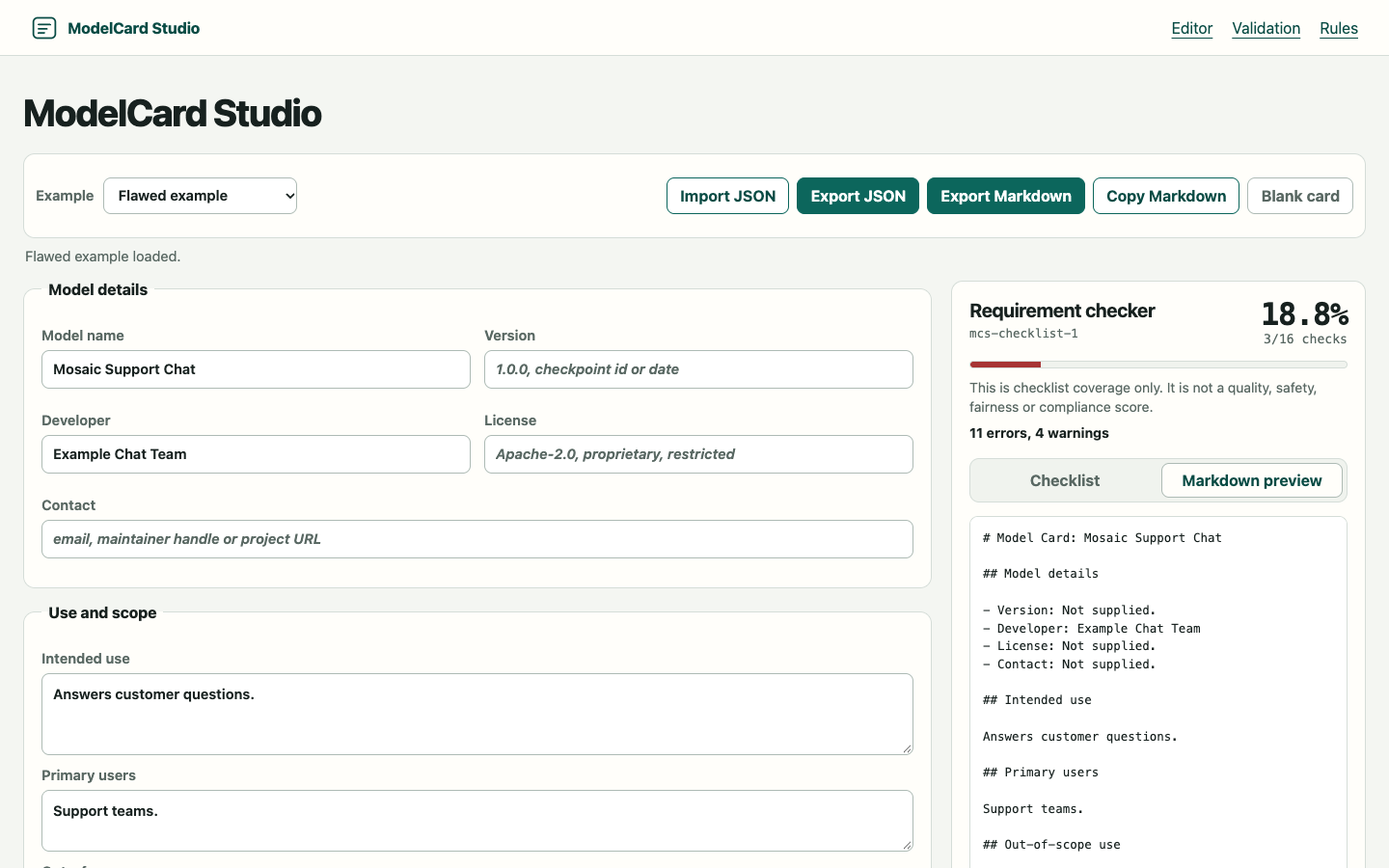
The app exports deterministic Markdown and schema-validated JSON. The JSON can be imported back into the tool and re-validated. Three synthetic cards ship with it, including one deliberately flawed card.
How I built it
The app is plain HTML, CSS and browser ES modules. There are no runtime dependencies, accounts, analytics or network calls. The validation engine is shared by the browser and Node tests. JSON Schema validation is implemented locally for the pinned schema subset so the whole tool stays offline.
The tests use the built-in Node test runner. The current suite has 84 deterministic tests covering every checklist rule, border values, evaluation-table validation, banned-claim detection, Markdown shape, JSON round-trips and malformed imports.
The screenshots are real 1440 by 900 headless-Chrome captures generated by a script in the repository. The 74.47-second demo video is a headless-Chrome capture with synthesized narration.
Challenges
The hardest part was keeping the checker honest. A documentation checklist can look like a safety certification if the language is careless. I made the score explicitly unweighted checklist coverage and documented what the heuristics cannot prove.
Another challenge was deterministic export. The JSON writer canonicalizes object keys and omits timestamps. Markdown uses a fixed section order so the same input produces the same file.
Accomplishments
The project works fully offline and still has a real validation loop. The flawed example drops to a low coverage score with visible errors and warnings, while the complete example reaches full checklist coverage. Import is strict enough to reject malformed files before replacing editor state.
What I learned
A useful requirement checker needs precise rules more than clever AI. Simple deterministic checks are easier to test, explain and trust. I also learned how important it is to separate documentation coverage from claims about model quality or safety.
What is next
I would like to add custom checklists for different organizations, optional YAML import, richer slice comparison tables and a diff view between two versions of a card. I would also like to expand the PII and claim heuristics while keeping their limits visible.
AI disclosure
AI coding assistance was used to design, implement, test and document this project. The app itself does not call an AI model at runtime. Its validation is deterministic local JavaScript, and the test suite can be inspected in the source repository.
Links
Live demo - https://aariv.me/modelcard-studio/
Source code - https://github.com/draarivpatel-ui/modelcard-studio
Demo video - video/demo.mp4 in the source repository
Built With
- ai-governance
