Inspiration
Everyone's shipping agents that can call tools. The failure mode we kept seeing is quieter: a model stays IN_SERVICE after upstream schema drift, a failing quality check, or a deprecated feature path — and nothing in the serving stack complains until revenue or trust is already gone.
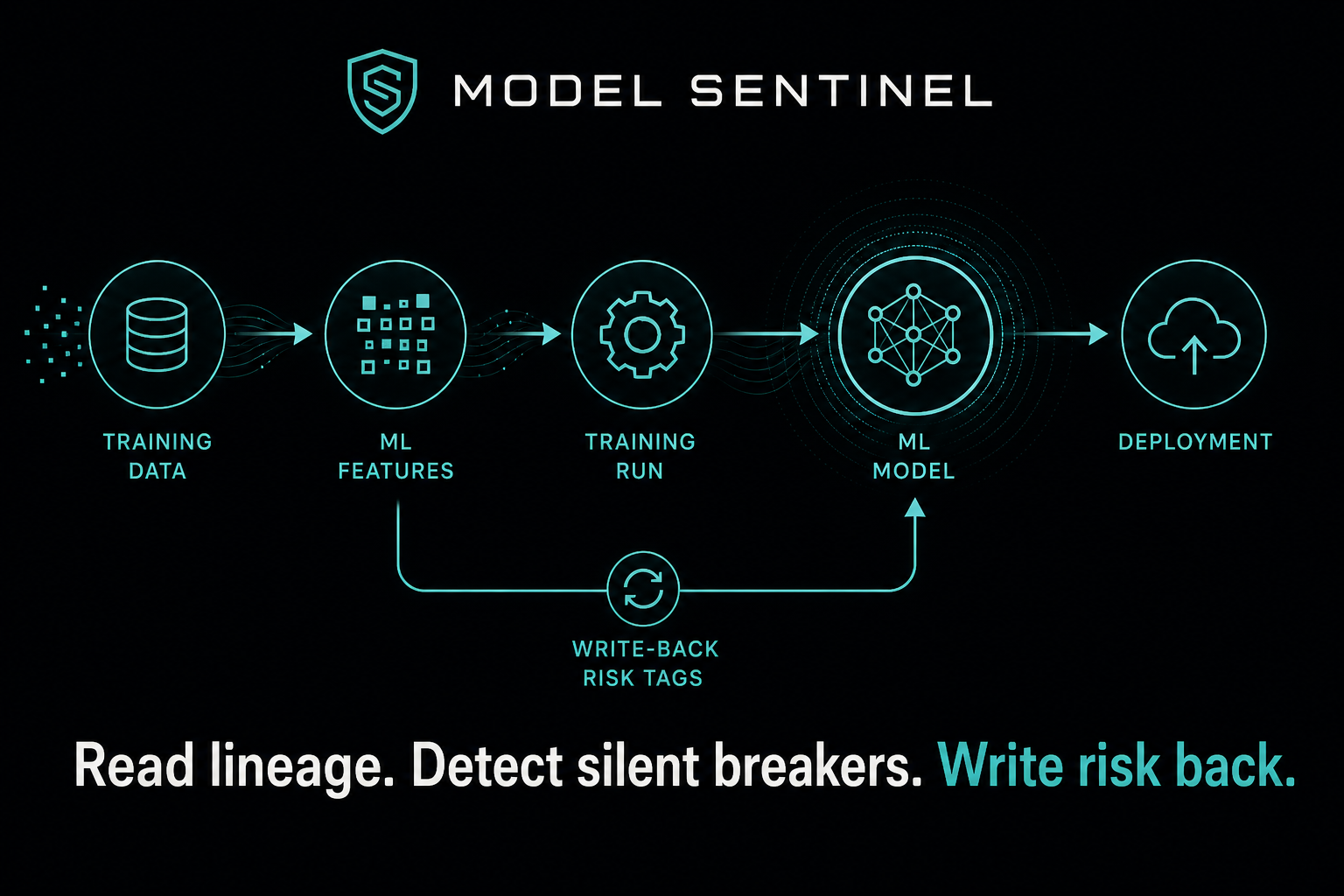
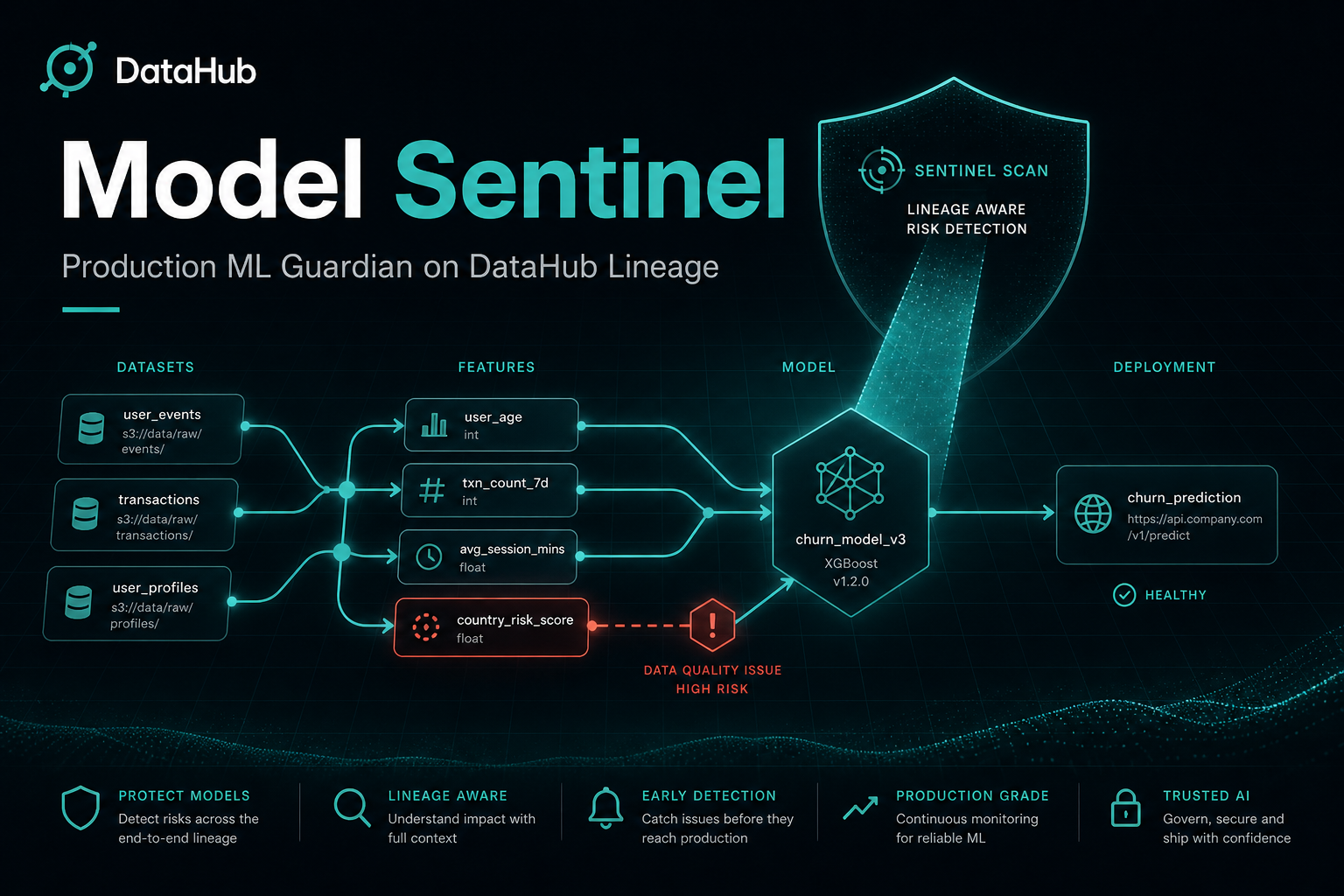
DataHub already stores the graph those failures live on — training data → features → training runs → models → deployments. The gap isn't another text-to-SQL demo. It's a closed loop: read that lineage, detect silent breakers, and write risk back so the next person or agent inherits the context.
That lined up cleanly with the Production ML Agents challenge — and deliberately away from rebuilding Analytics Agent or wrapping the shipped Skills registry.
What it does
Model Sentinel scans a production ML model's DataHub lineage and runs five deterministic detectors:
- schema drift (feature column missing upstream)
- upstream quality failures
- deprecated feature/source paths
- ownership gaps on prod-bound models / critical upstreams
- stale deployments (upstream changed after the last training run)
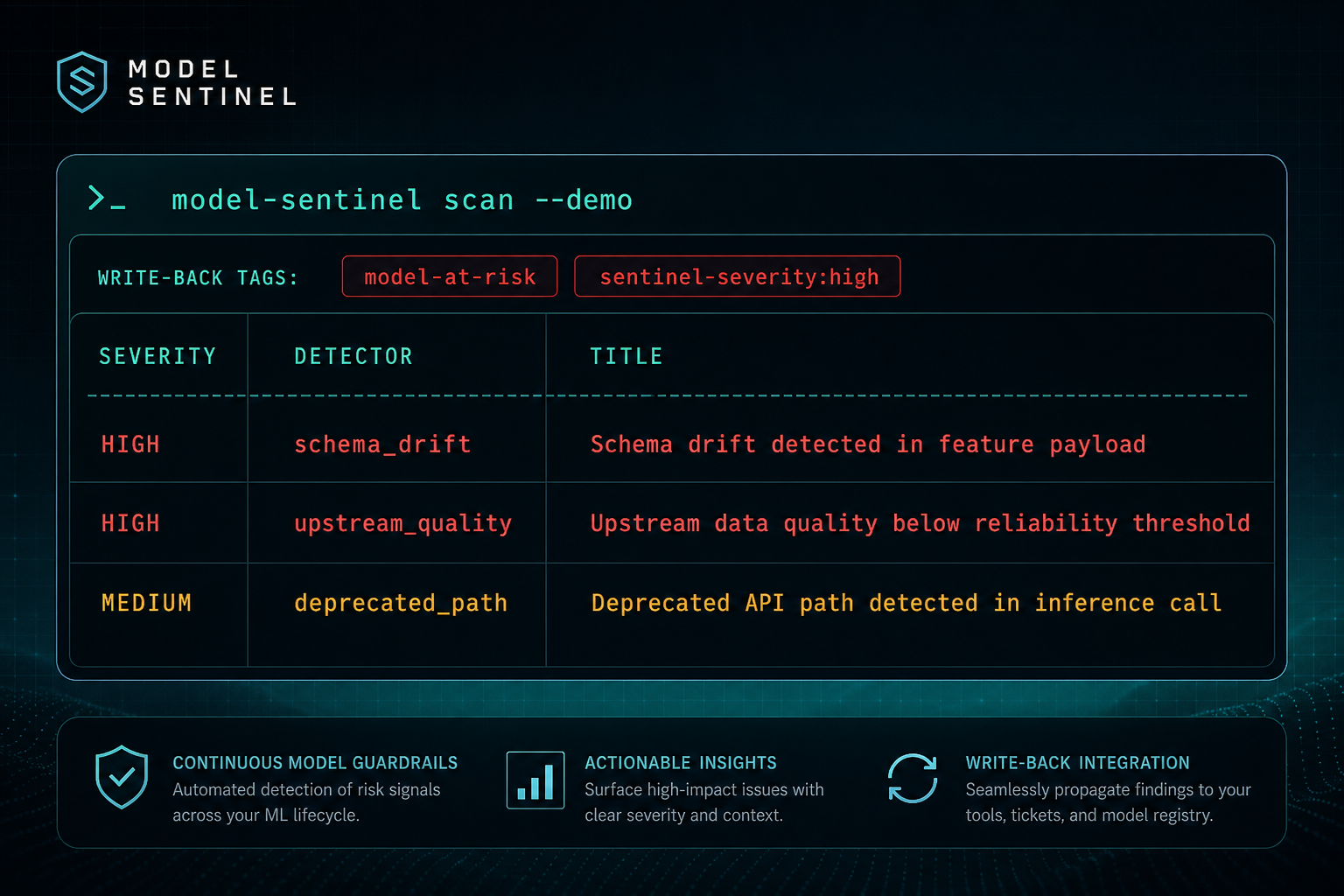
On findings it mutates the catalog (model-at-risk, sentinel-severity:*, description append) via Agent Context Kit tools, then emits a scan report and a metadata-aware Dagster retrain stub under examples/.
Judges can try it without Docker:
pip install -e ".[dev]"
model-sentinel scan --demo
uvicorn demo.app:app --port 8000
How we built it
- Protocol-first design:
GraphPortwithInMemoryGraphPort(planted fixture) andDataHubGraphPort(ACK:search,get_entities,get_lineage,add_tags,update_description). - Deterministic core, optional LLM: scan works with zero API keys;
investigateis an optional LangChain agent on the same tool surface. - Contract tests that fake ACK tool I/O so lineage + write-back are proven without a live GMS.
- Full fixture ingest script for local DataHub quickstart when Docker is available.
- Stack: Python 3.12, Pydantic, Click, FastAPI, pytest, ruff, GitHub Actions, Apache-2.0.
Repo: https://github.com/tarang-tj/model-sentinel
Challenges
- Originality under a strong platform. DataHub already ships powerful agent surfaces. We had to kill “thin Skills wrapper” and “Analytics Agent clone” early and stay in the ML-guardian gap.
- Demo vs live truth. No Docker on the build machine meant the default path couldn't pretend to be live GMS. We shipped an honest dual mode: offline fixture for judges, ACK adapter + ingest for real instances, and contract tests that exercise the real tool call shapes.
- Python / dependency reality. Live extras (
acryl-datahub) needed ≤3.12 on our toolchain — so we pinned the judge path and documented it loudly instead of papering over wheel failures. - Write-back that judges can see. Reading lineage scores points; mutating the graph is what matches the hackathon brief. Tags + description blocks were non-negotiable, including in the demo UI.
What we learned
- For production ML risk, deterministic graph checks beat embedding retrieval — the breakers are structural (missing columns, tags, timestamps), not semantic similarity.
- “Agent” for this problem means tools + judgment + inheritance: the valuable part is leaving the catalog smarter than you found it.
- Submission quality is part of the product:
examples/, a click-through UI, CI that runsscan --demo, and a honest README matter as much as the detector logic.
What's next
- Record the <3 min demo with live DataHub write-back visible in the UI.
- Upstream
skills/datahub-ml-sentinelto the DataHub Skills registry. - Wire real assertion aspects and richer deployment metadata on the live path.

Log in or sign up for Devpost to join the conversation.