-
-
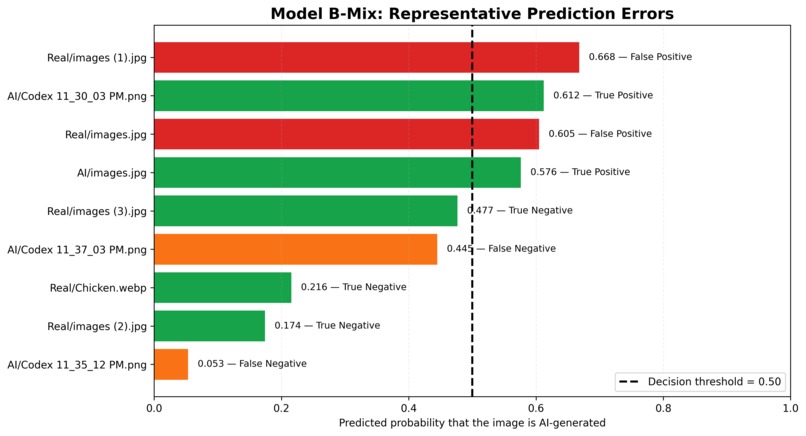
Error Analysis Note
-
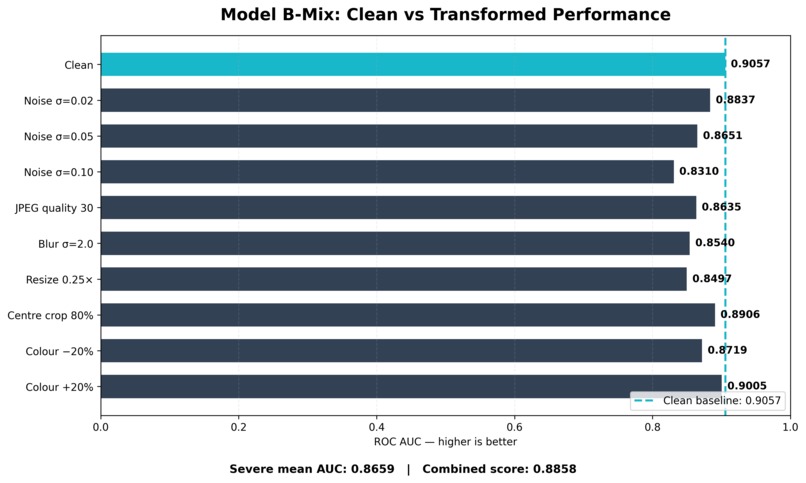
Robustness Evaluation Summary
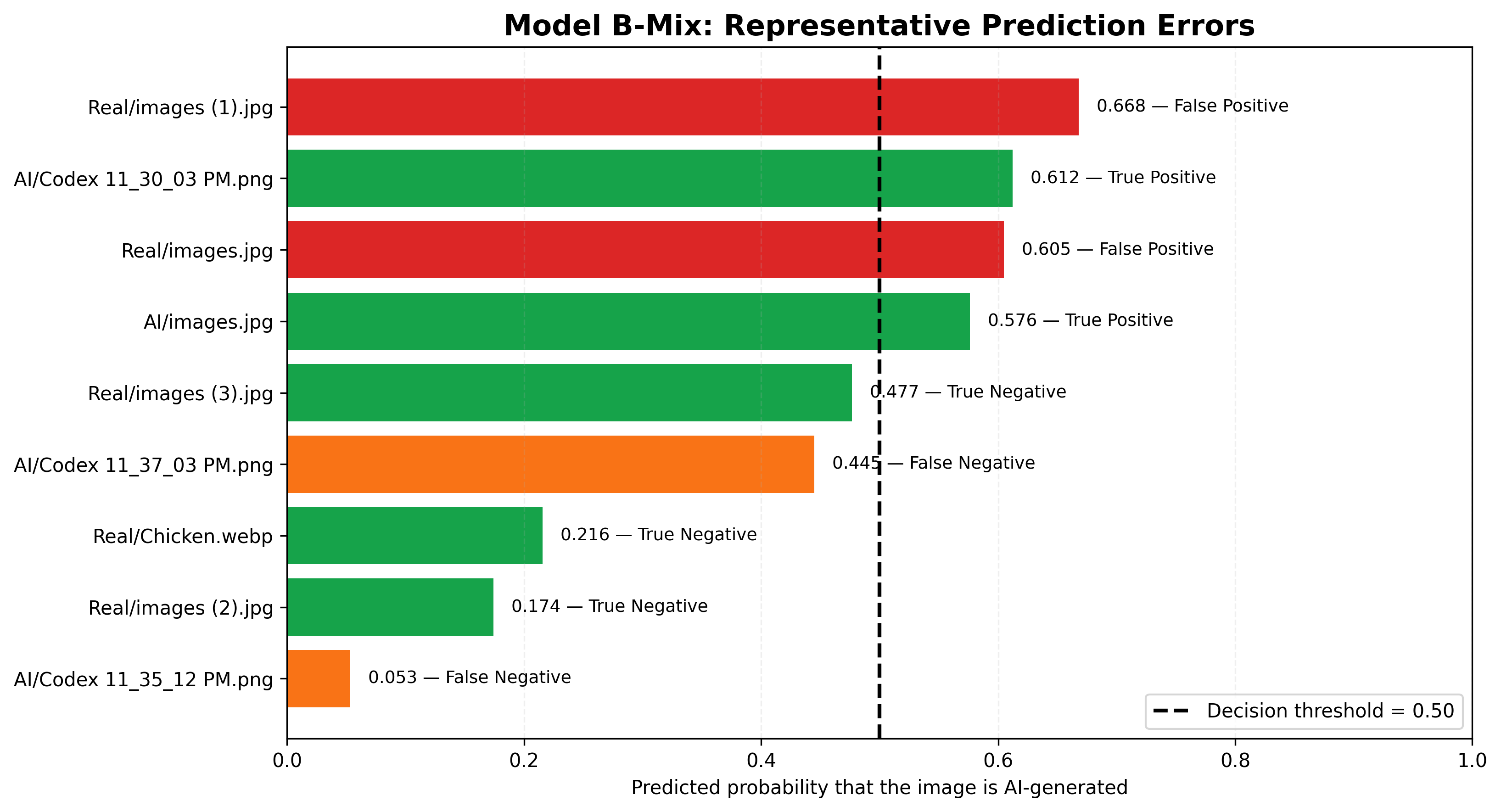
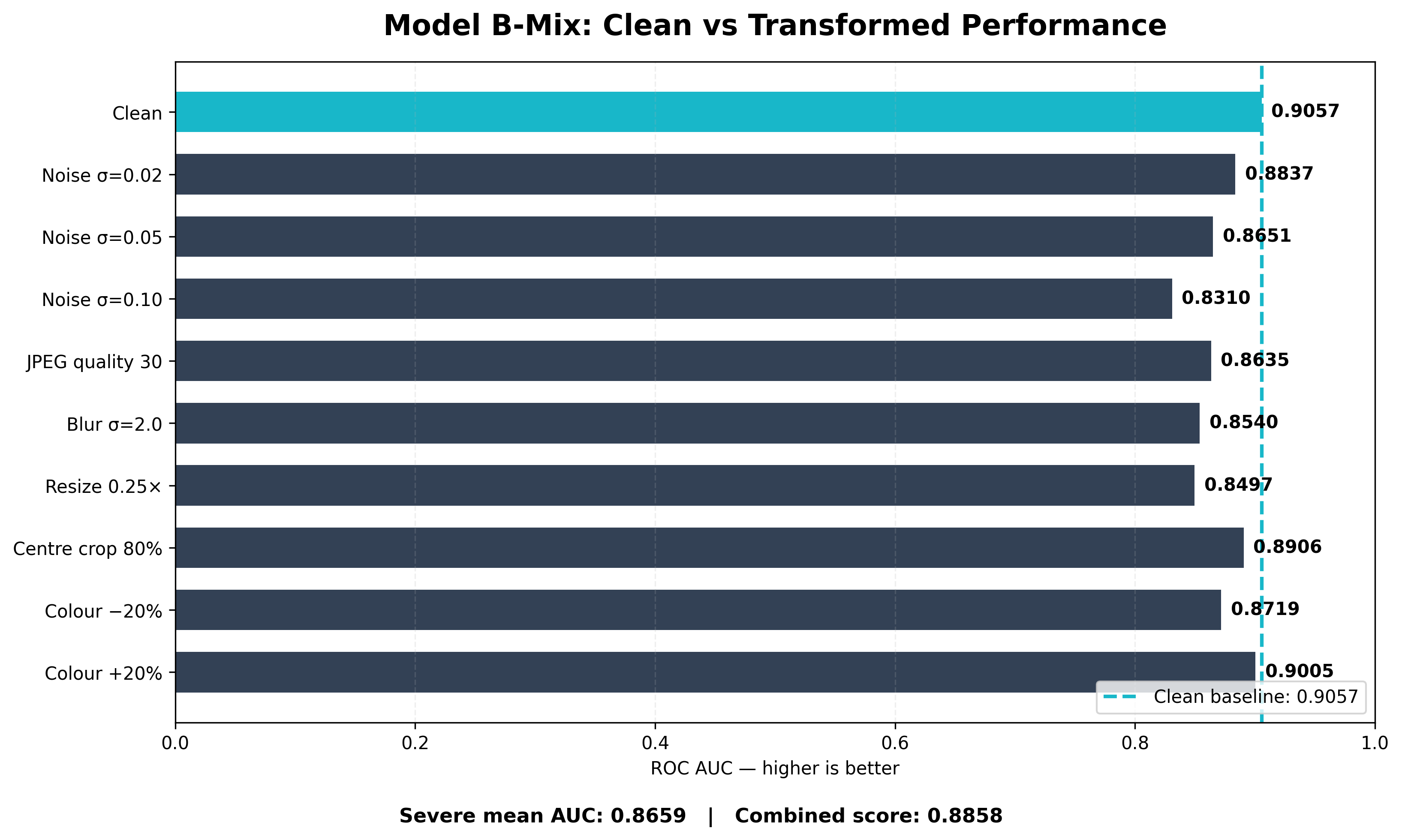
Inspiration
What it does# Model B-Mix: Robust AI-Generated Image Detection
Inspiration
AI-generated images are becoming increasingly realistic, inexpensive and easy to distribute. However, images rarely remain unchanged after being uploaded online. They may be compressed, resized, cropped, blurred, colour-adjusted or screenshotted before reaching another user.
These transformations can damage the visual artifacts used by AI-image detectors, causing a model that performs well on clean benchmark data to fail in realistic conditions.
We therefore wanted to answer a harder question:
Can an AI-image detector retain useful performance after realistic transformations and when tested on images from a different dataset?
This led us to develop Model B-Mix, a transformation-aware, mixed-domain AI-image detector built using ResNet50.
What It Does
Model B-Mix performs image-level binary classification. Given an uploaded image, it estimates whether the image is:
- AI-generated
- An authentic photograph
Instead of returning only a label, the system displays:
- AI-generated probability
- Authentic-image probability
- Final prediction
- A warning when the result is close to the decision threshold
The probabilities are presented as estimates rather than definitive proof of an image's origin.
How We Built It
Stage 1: Establishing a Baseline
We began with an ImageNet-pretrained ResNet50 and replaced its final classification layer with two outputs:
- Output index 0: AI-generated
- Output index 1: Real
We trained the initial model using CIFAKE, which contains 120,000 balanced real and synthetic images.
We combined the original CIFAKE folders and created a stratified 70/15/15 split:
| Split | Real | AI-generated | Total |
|---|---|---|---|
| Training | 42,000 | 42,000 | 84,000 |
| Validation | 9,000 | 9,000 | 18,000 |
| Test | 9,000 | 9,000 | 18,000 |
The baseline achieved a clean validation ROC AUC of 0.9955. However, its performance deteriorated severely under Gaussian noise:
| Condition | Baseline ROC AUC |
|---|---|
| Clean | 0.9955 |
| Noise (\sigma=0.02) | 0.8821 |
| Noise (\sigma=0.05) | 0.6642 |
| Noise (\sigma=0.10) | 0.5434 |
This demonstrated that excellent clean performance did not guarantee real-world robustness.
Stage 2: Training for Transformations
We introduced realistic augmentations during training:
- Gaussian noise
- JPEG compression
- Gaussian blur
- Downscaling followed by upscaling
- Centre cropping
- Colour adjustments
- Random resized cropping
- Horizontal flipping
After robustness training, ROC AUC under Gaussian noise (\sigma=0.10) improved from 0.5434 to 0.9919, while clean AUC decreased by only 0.0022.
This showed that targeted data augmentation could substantially improve robustness without sacrificing much clean performance.
Stage 3: Mixed-Domain Rehearsal
We next evaluated the model using the higher-resolution saberzl/SID_Set_description dataset.
The CIFAKE-trained model achieved a SID AUC of 0.8114, but its fixed-threshold accuracy was only 0.505 because it classified nearly every SID image as AI-generated. This revealed a major domain-shift and calibration problem.
Fine-tuning exclusively on SID improved SID performance but reduced CIFAKE performance, demonstrating catastrophic forgetting.
To address this, we created Model B-Mix using mixed-domain rehearsal:
- 900 real SID images
- 900 fully synthetic SID images
- 900 real CIFAKE replay images
- 900 synthetic CIFAKE replay images
The final fine-tuning set therefore contained:
| Source | Real | AI-generated | Total |
|---|---|---|---|
| SID_Set_description | 900 | 900 | 1,800 |
| CIFAKE replay | 900 | 900 | 1,800 |
| Combined | 1,800 | 1,800 | 3,600 |
The SID:CIFAKE sampling ratio was 1:1, and the overall real-to-fake ratio was also 1:1.
Model B-Mix was fine-tuned for three additional epochs with a batch size of 64. We selected the best checkpoint using the mean of SID and CIFAKE validation AUC:
$$
\text{Selection Score}
\frac{ AUC_{\text{SID}} + AUC_{\text{CIFAKE}} }{2} $$
This prevented CIFAKE's much larger validation set from dominating model selection.
Results
Model B-Mix achieved:
| Dataset | Clean ROC AUC |
|---|---|
| CIFAKE | 0.9912 |
| SID_Set | 0.9057 |
We also evaluated the model under seven severe SID transformations:
| Transformation | ROC AUC |
|---|---|
| Gaussian noise (\sigma=0.10) | 0.8310 |
| JPEG quality 30 | 0.8635 |
| Gaussian blur (\sigma=2.0) | 0.8540 |
| Downscale 0.25x and upscale | 0.8497 |
| Centre crop retaining 80% | 0.8906 |
| Colour intensity -20% | 0.8719 |
| Colour intensity +20% | 0.9005 |
The mean AUC across these transformations was approximately 0.8659.
Using equal weighting for clean and transformed performance:
$$
S
0.5 \times AUC_{\text{clean}} + 0.5 \times AUC_{\text{robust}} $$
$$
S
0.5(0.9057) + 0.5(0.8659) \approx 0.8858 $$
Challenges We Faced
Clean Performance Was Misleading
Our first model appeared extremely strong because it achieved an AUC above 0.99 on clean CIFAKE data. Robustness testing revealed that it depended on fragile signals that Gaussian noise could destroy.
Transformation Severity Depended on Resolution
CIFAKE images have a native resolution of only 32x32 pixels. Applying blur before resizing caused AUC to fall to 0.6085, while applying the same blur after resizing to 224x224 produced an AUC of 0.9957.
This taught us that transformation order and image resolution must be defined carefully for a reproducible evaluation.
Cross-Dataset Generalization Was Difficult
A detector can learn shortcuts associated with a particular dataset instead of learning universal evidence of AI generation. SID_Set exposed generalization and calibration problems that were invisible during CIFAKE evaluation.
Fine-Tuning Caused Catastrophic Forgetting
Fine-tuning only on SID improved SID performance but reduced CIFAKE performance. Mixed-domain rehearsal allowed us to improve SID AUC while retaining a CIFAKE AUC above 0.99.
Consistency Did Not Guarantee Correctness
We tested transformation-consensus inference by classifying seven transformed views of each image. The views agreed 90.48% of the time, but the final performance did not improve.
This showed that consistency measures stability, not correctness. A model can make the same incorrect prediction across every transformation.
Limited Compute
We developed the project using a free Google Colab GPU runtime. Runtime resets repeatedly removed variables, extracted datasets and model state. Reproducible notebook cells and frequent checkpoint downloads became essential to completing the project.
What We Learned
The most important lesson was that AI-image detection is not solved by achieving a high score on one clean dataset.
We learned that:
- ROC AUC and fixed-threshold accuracy measure different behaviours.
- Strong clean performance can hide transformation weaknesses.
- Data diversity can matter more than architectural complexity.
- Robust augmentation should simulate realistic redistribution pipelines.
- Cross-dataset evaluation is necessary to expose dataset shortcuts.
- Threshold adjustment cannot repair poor ranking performance.
- High confidence does not guarantee a correct prediction.
- A responsible detector should communicate uncertainty.
Limitations
Model B-Mix is not a universal AI-image detector. Its performance can vary across generator families, image sources, resolutions and processing histories.
A small manual evaluation using five real and four newly generated images revealed two false positives and two false negatives. Because this test contained only nine images, we used it as qualitative error analysis rather than a formal benchmark.
This result highlighted an important distinction:
Transformation robustness does not automatically provide unseen-generator generalization.
What's Next
Given more time, we would:
- Train using a wider range of generator families
- Reserve complete generators for unseen-generator evaluation
- Add more independent authentic-image sources
- Calibrate probabilities using a separate validation set
- Return an uncertain result for borderline predictions
- Evaluate screenshots and combined transformations
- Investigate a complementary semantic model branch
- Build a larger generator-labelled real-world test suite
Model B-Mix is therefore both a working detector and an investigation into what robust AI-image detection actually requires: transformation-aware training, cross-domain evaluation and honest uncertainty reporting.
Built With
- Python
- PyTorch
- torchvision
- ResNet50
- Hugging Face Datasets
- scikit-learn
- pandas
- NumPy
- Pillow
- Google Colab
- Jupyter
- VS Code
- GitHub
- Gradio
The final detector runs locally and does not require a paid external inference API.
Datasets and References
Built With
- github
- google-colab
- jupyter
- numpy
- pandas
- pillow
- pytorch
- restnet50
- scikit-learn
- torchvision
- vsc


Log in or sign up for Devpost to join the conversation.