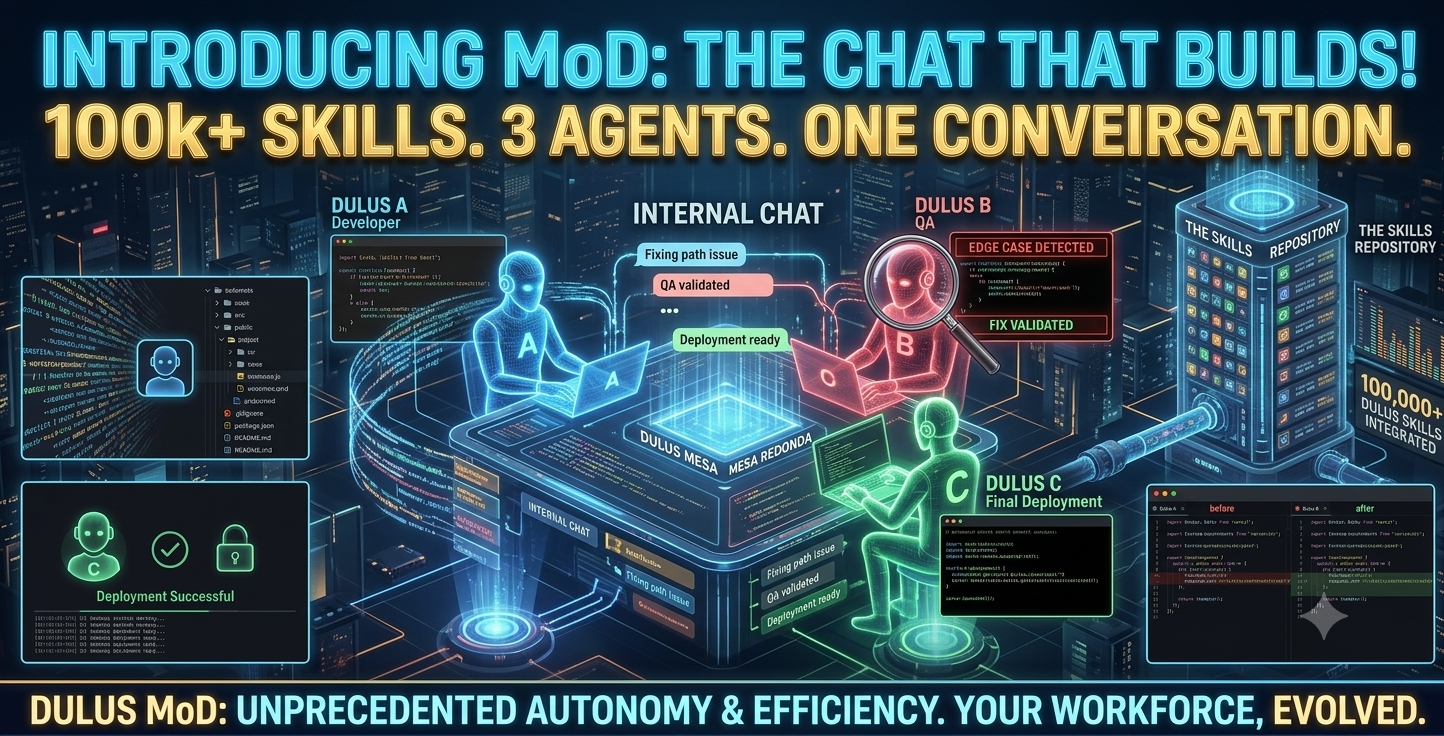
Inspiration Dulus already talks to Claude, GPT, Gemini, Kimi, and DeepSeek — whichever one the user picks. But picking one model means betting the whole answer on that model's blind spots. We kept seeing the same failure mode: a model would confidently ship a wrong architecture decision, a wrong cost estimate, a wrong "this is safe" — not because it was a bad model, but because no single model catches its own mistakes. Humans don't solve hard tradeoffs alone in a room. We put people with different training in front of a whiteboard and let them disagree. Every "multi-model" AI product we looked at does the opposite: fan a prompt out to N models, run them in total isolation, average or vote on the output. GPT never sees what Claude said. Nobody in the ensemble can say "wait, that's wrong" to anybody else. That's not deliberation, that's just five isolated guesses with extra steps — and we already had the beginning of the real thing sitting half-used in our own codebase as "Mesa Redonda." MOD is what happens when you stop treating that as a side feature. What it does MOD (Mixture of Dulus) puts 3–5 frontier models — Claude, GPT, Gemini, Kimi, DeepSeek, whatever the session picks — into one shared conversation as full agents, not text-completion calls. Each one: Runs inside Dulus's real agent loop, with real tool access (file read/write, shell, web search) — they're working the problem, not just answering a prompt. Sees every other member's last message before its own next turn, injected as live context — so a model can literally say "I think [gpt-5] is underweighting operational cost here." Can message any other member directly and asynchronously through a native inter-agent mailbox (AgentChat — post / inbox), independent of what the user typed, so a model can flag another's mistake mid-round without being asked. Runs under a shared "Dulus Mode" toggle so five different vendors' safety-refusal behavior doesn't turn the debate into five different flavors of "I can't help with that." You ask one hard question with a real tradeoff in it. The models argue, reference each other by name, correct each other, and by round 3–5 either converge on a real answer or fork cleanly into labeled positions instead of quietly hallucinating consensus. How we built it MOD is built entirely on Dulus's existing multi-provider agent runtime — no new inference layer, no new model wrapper. Each roundtable member is a RoundtableAgent: its own AgentState, its own model string, running through the same agent.run() loop every solo Dulus session already uses, so every member gets the full 27-tool surface (not a stripped-down "debate mode"). The peer-visibility mechanism is a prompt-construction step (_build_roundtable_prompt in webchat_server.py) that takes the last message from every other member and injects it as a [Mesa Redonda] context block before the next model's turn — so the model is reasoning with its peers' actual output in front of it, not blind. The inter-agent mailbox is a real native tool (AgentChat), not a fake — a model calling AgentChat(action='post', member='gpt-5', content=...) writes to an actual inbox another member reads on its next turn. Underneath, Dulus itself is ~19K+ lines of readable Python, GPLv3, multi-provider by design (11 native adapters plus 100+ more through LiteLLM), so adding a new model to a MOD session is a config string, not an integration project. Challenges we ran into Getting five different vendors' models to behave like they're in the same room, not five parallel monologues, was the real fight. Early rounds just had every model re-answering the user from scratch, ignoring the peer context entirely — that took real prompt-engineering discipline (explicit instructions to acknowledge and respond to the internal chat, not just skim it) to fix. Different providers have different tool-calling conventions, different context limits, and wildly different default refusal postures — running them in the same deliberation without one vendor's caution collapsing the whole round into hedging took the shared Dulus Mode toggle. And doing all of this as a single developer, on top of an already-shipping open-source project with real users, meant every change to the roundtable mechanism had to not break the plain single-model REPL that most Dulus users actually run day to day. Accomplishments that we're proud of This isn't a hackathon mockup — the roundtable mechanism (RoundtableAgent, AgentChat, _build_roundtable_prompt) is real, shipped code, live in the same repo that's already done ~19K+ PyPI downloads. We're proud that MOD isn't ensembling wearing a new name — the inter-agent mailbox is a genuine primitive nobody else in the space seems to have shipped: models messaging each other directly, asynchronously, unprompted by the user. And we're proud it was built by one person, in the open, GPLv3, with the debate mechanism sitting right next to the 12-tool solo agent loop it shares — not a separate product bolted on. What we learned Frontier models have stopped being noisy samples of each other and started having real, different taste — the same hard tradeoff question genuinely gets different angles from Claude, GPT, and Kimi now, not different phrasings of the same angle. That means heterogeneous-model deliberation is worth more today than it would have been a generation of models ago, because you're no longer paying a "worse model tax" to get diversity of perspective. We also learned that agentic tool-use makes multi-model orchestration a much harder problem than plain-text ensembling ever had to be — coordinating who's allowed to touch what, and making sure five agents don't collide over the same file, is a real distributed-systems problem hiding inside what looks like a chat feature. What's next for MOD - Mixture Of Dulus More members per round, and letting the group itself decide when it's actually converged instead of running a fixed number of rounds. Tighter inter-agent protocols — structured disagreement markers, not just free-text messages, so a UI can visually diff where the models actually split. A published benchmark: MOD vs. best single frontier model, specifically on ambiguous, tradeoff-heavy engineering and business questions where there usually isn't one clean right answer — the exact case single-model answers are worst at and least likely to flag their own uncertainty on. Promoting MOD from a mode you opt into (/roundtable) to a first-class answer path Dulus can reach for on its own when a question smells like it has a real tradeoff in it. Dulus AI — Santo Domingo, Dominican Republic. Built by one person. GPLv3. pip install dulus.
MOD - Mixture Of Dulus
MOD runs 3-5 frontier models -- Claude, GPT, Gemini, Kimi -- as tool-using agents in one live session. They read each other's answers, message each other, and converge. Not sampling. Deliberation. <3
Updates

Leave feedback in the comments!
Log in or sign up for Devpost to join the conversation.