What is Chuseok?
Chuseok is Korea's harvest moon festival. On the night of the brightest full moon of the year, families gather, share rice cakes and make a wish to the Moon. And when Koreans look at that moon, they see a rabbit pounding rice cakes.
Inspiration
We asked: what if one year, on Chuseok night, the Moon never rose? No full moon, no wishes, no festival. Someone would have to go up there and pound the mochi to light it again.
Mochitsuki, the traditional pounding, is a real two-person rhythm: one person swings the mallet, the other turns the dough between strikes, trusting each other's timing. That felt made for VR and hand tracking, and it fit the theme, "Take Me To The Moon", literally.
The story
A hanji scroll unrolls in front of you, line by line:
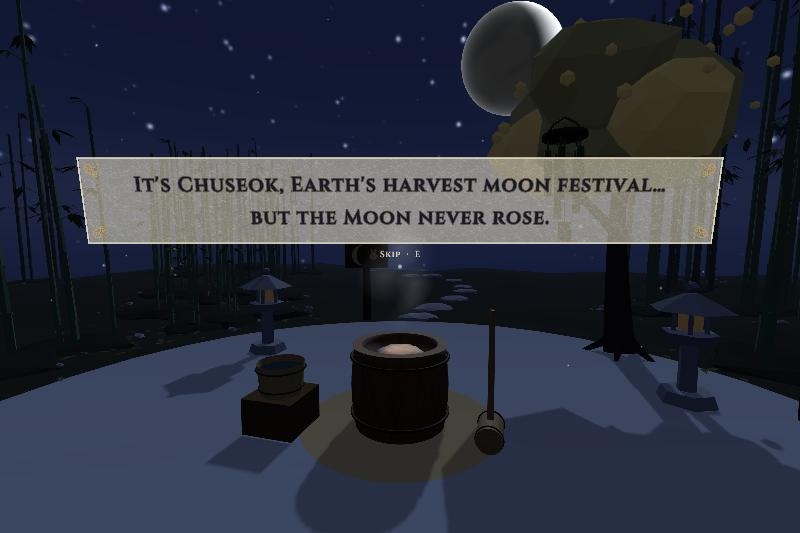
It's Chuseok, Earth's harvest moon festival… but the Moon never rose.
No wishes. No mochi. No festival.
In the sky garden between Earth and Moon, the Moon Rabbits pick up the mallet.
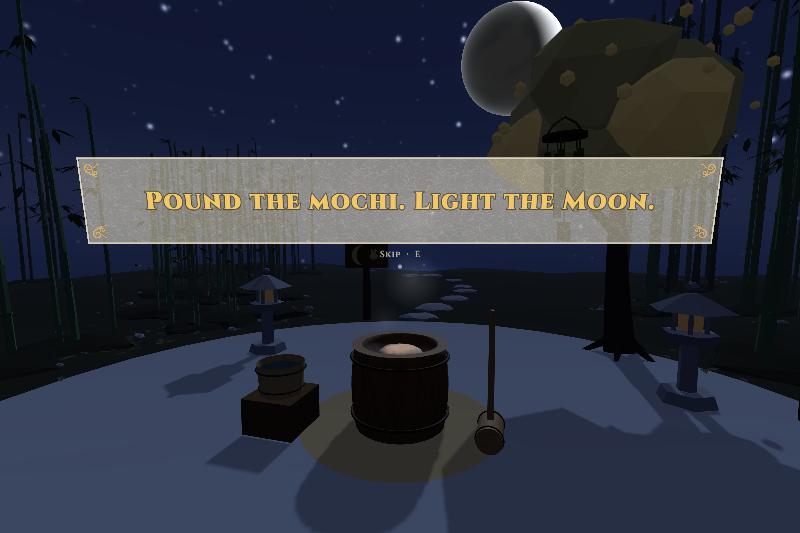
Pound the mochi. Light the Moon.
Every good strike brings the Moon closer to full. When the mochi is done, it flies down to Earth: Happy Chuseok, Earth!
What it does
- A story in 15 seconds. A hanji (Korean mulberry paper) scroll unrolls and tells the story line by line, with a soft wind-chime shimmer. In VR you start in a dark starry void, and a golden portal opens from the mortar onto the Moon.
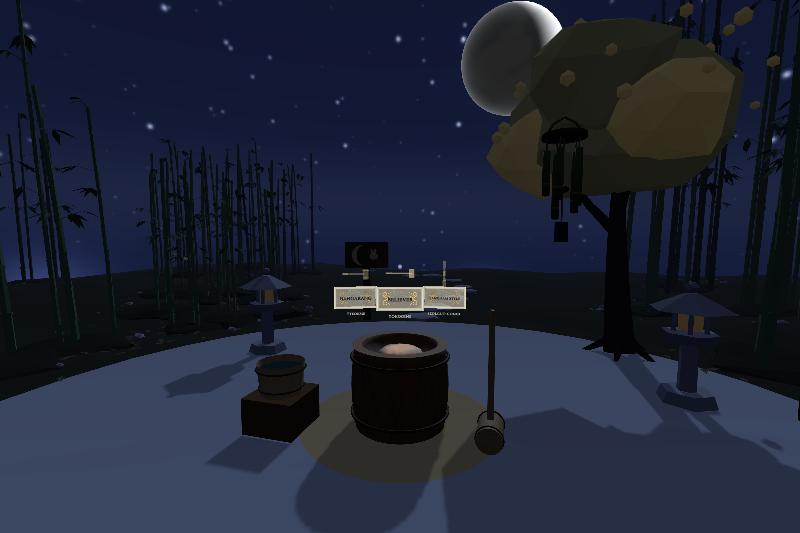
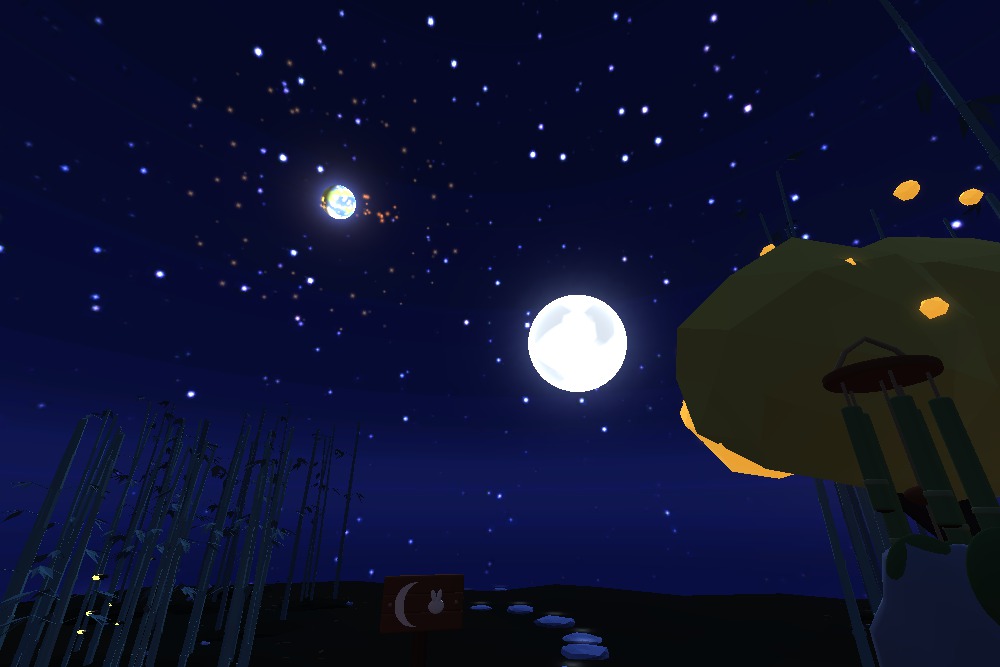
- The Moon Rabbits' sky garden. A floating island with a bamboo forest, a cassia tree, stone and paper lanterns, wind chimes and fireflies, with the Moon and the Earth in the sky.
- Pick a song, get a mallet. Each song is a paper scroll; choosing it hands you a different traditional mallet.
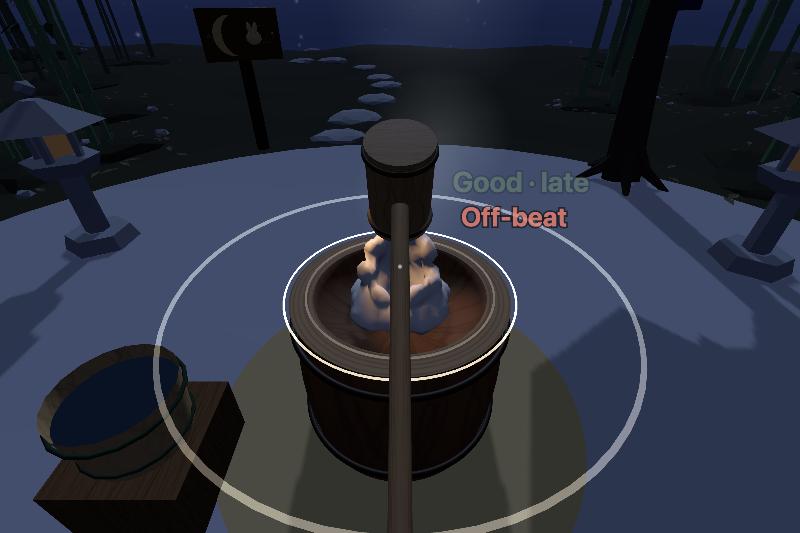
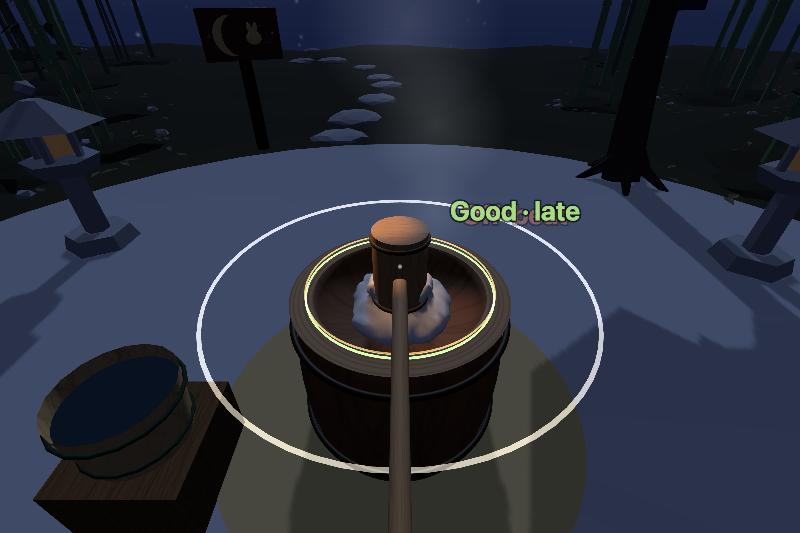
- Pound to the beat. The game finds the song's tempo and beats by itself. A ring closes onto the mortar's rim on each beat and turns green for a good hit, yellow for an okay one and red for a miss, with combos.
- Make the mochi, for real. The dough starts out stiff, like freshly steamed rice. Every good strike and every good fold makes it softer and stretchier, shown by an elasticity bar floating above the mortar.
- Keep it moist. A moisture bar slowly drains. The kneader has to keep adding water to hold it above the line; if it drops too low, the mochi starts stiffening again. The two players have to work together to finish it.
- Real dough, real hands. The mochi is a live physics simulation: it squashes under the mallet, stretches and sticks. With hand tracking, the second player kneads and turns it with their bare hands.
- Two headsets, one mortar, two Moon Rabbits. One Quest hosts and one joins. Either player can take the mallet or the kneading role, both hear the music in sync, and each player appears to the other as a rigged Moon Rabbit (white or red) that follows their head and hands.
- Send it to Earth. When a batch of mochi is done, it flies to the Earth, the Earth lights up, and the story begins again.
How we built it
- three.js + WebXR in the Quest Browser, so it runs on a Quest 3 with no install and on a laptop for testing.
- Mochi physics: an elastoplastic MLS-MPM solver (Neo-Hookean elasticity, von Mises plasticity) ported to JavaScript from VR-Doh (SIGGRAPH 2025). It runs in a Web Worker, retuned to run in real time on a CPU instead of a desktop GPU, and is drawn with marching cubes. The mallet head and every tracked hand joint are colliders in it.
- Mochi that matures: a single stiffness parameter of the solver is swept from stiff to elastic as the team lands strikes and folds, and a moisture value pulls it back if it runs low, so one number ties the game loop to the physics.
- Hands: WebXR hand input; each hand is drawn and collides from its tracked joints at the radii the headset reports, so what you see is what touches the dough.
- Rhythm: our own beat tracker (onset detection, autocorrelation tempo, dynamic-programming beats), audio-clock scheduling and a timing-offset calibration.
- Multiplayer: a small message relay over the dev server's WebSocket links two headsets. The host runs the simulation and shares it; mallet ownership is handed over on request; music state is led by the host and clock-synced on both.
- Audio: spatial sound by Satie for strikes, knocks and dough slaps; procedurally synthesized wind chimes, paper rustle and a singing-bowl swell for the story.
- The world: first built procedurally in Unity (every mesh, material and the sky generated from one settings asset), then ported to three.js with matched colors and lighting.
- Where we started: our first version was a Unity 6 Meta Quest app with a GPU compute-shader port of the same solver and a mixed-reality intro in your real room. Two-headset networking was faster to get right on the web, so we moved the final build to WebXR overnight.
Challenges we ran into
- Continuum physics in real time on a headset. The original solver needed a desktop GPU and ran in slow motion. We cut the grid and particle count, retuned the material, and faked what matters to the eye (tack, grip) so dough stretches and releases instead of tearing.
- Dough slipping through fingers. Thin hand colliders let particles pass through; we added hand friction and a small padding so the dough sticks to your hands.
- Two players, one simulation. Deciding who owns the mallet, keeping one authoritative dough, and keeping music in sync across two headsets.
- Changing engines mid-hackathon. We ported the garden, the story, the scroll intro and the ending from Unity to three.js in a few hours.
Accomplishments that we're proud of
- Believable, stretchy mochi you can pound and knead with your real hands, in a browser.
- Two people pounding together on two headsets, either one in either role.
- A story you read in 15 seconds that takes you to the Moon.
- Colocation, so both players share one real mortar position in the same room.
- A world built from a real tradition and a real two-person rhythm.
What we learned
- For feel, believable beats correct: the dough's "tent and release" mattered more than its exact material model.
- Small shared hooks (one progress value, one event) let separately built parts click together late at night.
- The web is a fast path to multi-user XR.
What's next for Mochi Mochi Moon
- More songs and festivals (Lunar New Year, Mid-Autumn Festival).
- Sending your finished mochi to friends on Earth.
Credits
- Dough simulation ported from VR-Doh (Luo, Cui, Luo, Chu, Li; ACM TOG / SIGGRAPH 2025), Apache-2.0.
- Spatial sound by Satie (https://www.satie.world).
- Fonts: Cinzel and Baloo 2 (SIL Open Font License).
- Team: Nasif (simulation, multiplayer, integration), Arin (rhythm, audio, three.js scene), Tianjun (characters, props, video), Jihyeon (environment, story, intro, ending).
Built With
- c#
- hand-tracking
- hlsl
- javascript
- meta-quest-3
- satie
- three.js
- unity
- vite
- web-audio
- web-workers
- webxr


