-
-
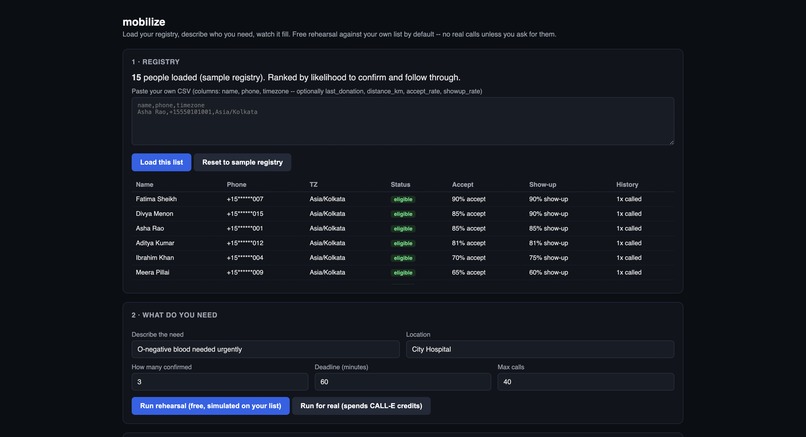
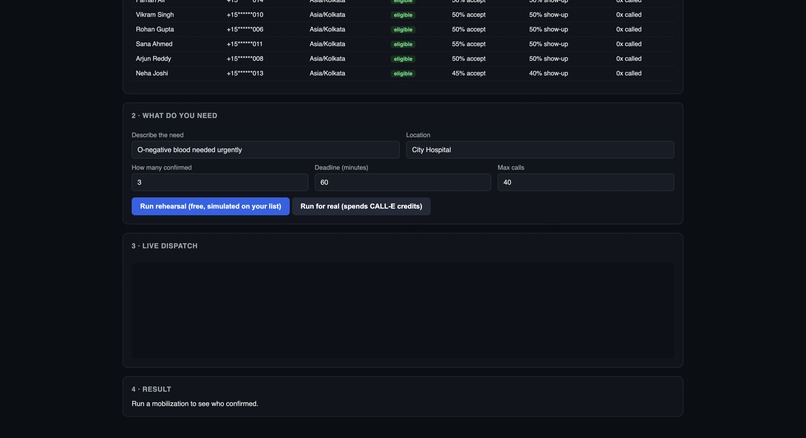
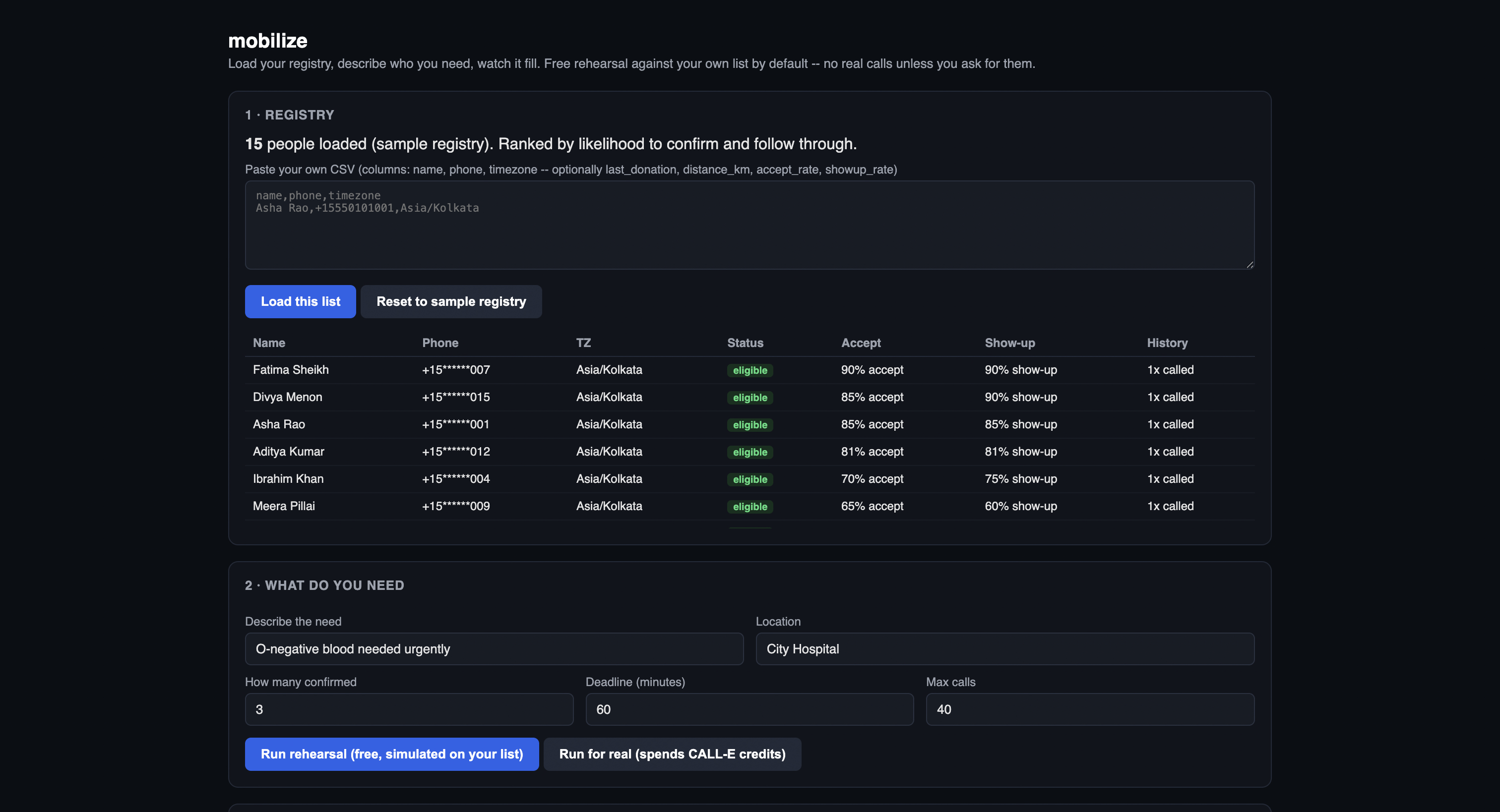
The sample donor registry loaded and ranked by likelihood to confirm and follow through, with the need form below it.
-
The full dashboard mid-run: live dispatch map on the left, confirmed roster and handoff panel on the right.
Inspiration
When a hospital needs three O-negative donors in the next hour, someone picks up a phone and starts working down a registry — one number at a time. Most don't answer. Many are ineligible. And the ones who say "yeah, I'll try to swing by" often never arrive.
The bottleneck isn't the registry. It's that a human coordinator can only hold one conversation at a time. Industry guidance puts a full manual call tree at up to three and a half hours to propagate, with roughly a third of people missed on the first pass.
CALL-E removes that constraint entirely — software can hold multiple conversations at once instead of one. But once you're calling several people in parallel, a second problem shows up: a stated "yes" is not a confirmation. People agree to be polite and then don't show up. Acquiescence bias is real and measured in volunteer and donor recruitment. If you just count stated yeses, you fill your quota with people who never arrive.
That's the actual problem I wanted to solve: not "make calls faster," but "get N people who will genuinely turn up, before a deadline, without over-calling a registry into fatigue."
What it does
mobilize takes a need — 3 confirmed donors, within 60 minutes, from this
consented registry — and:
- Ranks the pool by eligibility window, distance, and historical follow-through.
- Dispatches a wave in parallel (real concurrent
asynciodispatch, not a loop), sized so expected confirmations clear the need with a margin. - Scores how firm each "yes" is from the call's own evidence text — "I'm leaving now, ten minutes" outranks "yeah, I'll try" — blended with that person's historical show-up rate.
- Stops the moment the need is met. No further wave is dispatched; everyone else in the registry is simply never called.
- Survives crashes — a write-ahead ledger plus CALL-E's own idempotency keys mean a process killed mid-dispatch never double-dials anyone on restart.
It ships as a Python library, a CLI, a live WebSocket dashboard, an MCP server (so any agent can trigger a mobilization as a tool), and a reusable CALL-E Agent Skill.
How I built it
Day one was reading, not writing. Before designing anything I pulled
CALL-E's OpenAPI spec and found something that changed the architecture:
there is no endpoint to cancel an in-flight call. POST /v1/calls,
GET /v1/calls/{id}, GET /v1/calls/{id}/events is the entire surface.
That killed my original design ("fire 25 calls, cancel the rest the instant we have 3"). So the system became wave-based instead: dispatch a sized wave, wait, and only dispatch another if still short. It's honest about what the platform can actually do, and the README and Skill both explicitly warn against describing it as cancellation.
The engine talks to a Transport interface with two implementations: the
real CALL-E transport (async REST — the SDK's create_and_wait blocks,
which makes true parallel dispatch impossible), and a simulator with a
synthetic population whose true show-up probability is known but hidden
from the system. Identical code path either way.
That simulator is what made rigorous validation possible on a 20-free-call budget: 200 simulated mobilizations, zero cost, reproducible with one command.
Challenges I ran into
The 20-call budget. You cannot validate a policy on 20 calls. Rather than hand-wave it, I built the evaluation harness with known ground truth and spent real calls only where they were irreplaceable — proving the integration works, and demo footage.
A stated yes is a noisy signal, and I had to prove that mattered. It would have been easy to assert commitment scoring helps. Instead the harness measures it against baselines:
| Policy | Confirmation accuracy | Calls used |
|---|---|---|
| Calibrated (mobilize) | 93.7% | 10.62 |
| Trust every stated yes | 86.3% | 7.04 |
| Call the entire pool | 80.0% | 40.00 |
Confirmation accuracy = of the people the system believed were confirmed,
what fraction would actually show up. The naive policy fills just as
reliably — it just fills with people who don't come. Measured over 200
trials (python -m mobilize.sim.harness); see
mobilize/artifacts/benchmark_audit_b0.md for the full methodology.
Three rounds of external code review. A contributor on CALL-E's repository reviewed my PR and found real bugs — three separate times. Among them: my wave dispatch was awaiting each call sequentially, silently serializing the exact parallelism the project is named for; my idempotency fix was undermined by a non-deterministic mobilization ID; and my timezone-aware calling-hours check was never actually wired into the live entry points, so every real recipient silently defaulted to UTC. All fixed, each with a dedicated test. I also audited my own fixes between rounds and caught two more myself.
Accomplishments that I'm proud of
The crash-safety proof is real, not claimed. A test SIGKILLs an actual
subprocess mid-dispatch, restarts it against the same ledger, and asserts
zero duplicate dials and zero lost confirmations.
The second real call landed at 0.54 — just under the 0.55 threshold. The
system correctly refused to count it as confirmed. That's the calibration
model discriminating at a genuine decision boundary on a real conversation.
Correction (12 September 2026 review): this section previously claimed the
transcript for that call "is committed in the repo." That was false —
mobilize/artifacts/smoketest_2_result.json records only the mobilization
outcome (outcome, commitment_score, a note), not a transcript, call_id,
or raw status. No transcript for this call is currently in the repo.
Consent is enforced in code, not promised in a doc. Do-not-call, cooldowns, contact-fatigue limits, and per-recipient-timezone calling windows all run before dispatch, on by default, persisted across invocations. A mid-call "don't contact me again" is detected and written to a permanent do-not-call list immediately. A second round of real calls (five, scripted against a pre-declared answer key committed before any call was placed) caught a genuine commitment-scoring gap: a concrete ETA ("I'll be there in 10 minutes") matched none of the language markers the scorer looked for and landed at a neutral 0.50, just under threshold, even though CALL-E's own extraction confidently read it as confirmed. Fixed and re-verified on the same call.
315 tests collect (310 pass, 3 documented as known gaps via xfail, 2 xpass) from a clean install (.venv/bin/python -m pytest mobilize/tests/ -q).
What I learned
That the interesting problems in agent-driven calling aren't in the calling — they're in everything around it. Reading the OpenAPI spec before designing saved me from building on an assumption that was simply false. And having a sharp external reviewer find bugs three times running was the most valuable part of the whole build; several of those were failures where the mechanism existed but nothing actually invoked it, which is the exact class of bug that passes a casual read.
What's next
The engine is domain-agnostic — the same wave dispatch, commitment calibration, and governance apply to emergency shift coverage, volunteer disaster mobilization, and on-call escalation. Next steps: validating the commitment-calibration curve against a larger set of real calls (it's currently tuned against the simulator's generative assumptions), a Prometheus exporter, and a learned rather than hand-tuned ranking model.
Built With
- asyncio
- call-e
- fastapi
- hypothesis
- mcp
- pytest
- python
- websockets

Log in or sign up for Devpost to join the conversation.