-
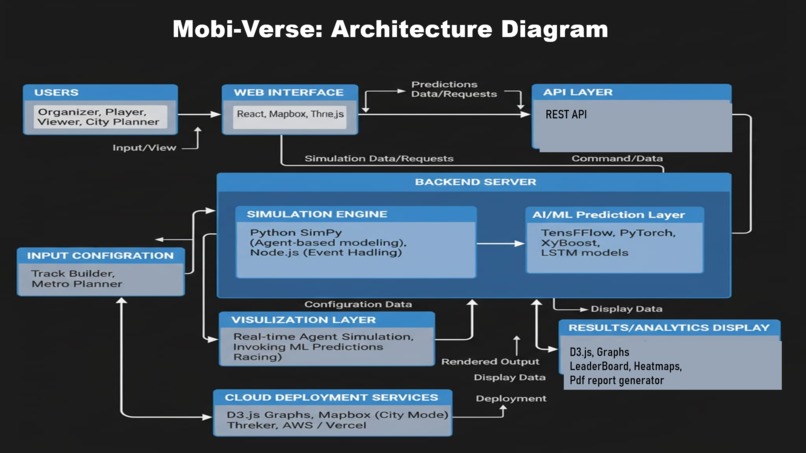
Workflow diagram

Mobi-Verse: One verse for every move
Inspiration
The idea started with a simple “what if”
What if there existed a single platform that could simulate vehicle mobility -- be it a Formula racing event or a city’s metro planning project -- not just as static data, but as something interactive, predictive, and experimental?
In Formula racing, data dashboards are static and reactive. This platform makes streaming interactive and predictive, letting organizers and viewers see what could happen next.
In City Planning, for instance metro expansion or traffic analysis relies on limited forecasts. Mobi-verse predicts construction time, congestion reduction, and even factors like “Rain can increase metro usage by 22% today.”
Our platform aims to be that Best Planning Manager --simulating mobility before decisions are made.
What It Does
Mobi-Verse operates in two intelligent modes powered by one adaptive simulation engine. In Formula Racing Mode, it acts as a live decision-support tool. Organizers can create tracks and stream events dynamically; players can tune driving parameters and train against AI opponents; and viewers can experience data-driven race broadcasting, compete with live win probabilities, pit-stop predictions, and interactive overlays that explain what’s happening.
In City Planning Mode, it becomes a digital twin for transport systems. City planners can upload metro routes, simulate congestion, and forecast how a new route affects travel behavior or pollution levels. The system predicts how traffic evolves during and after construction-- estimating reduced congestion, increased metro adoption, and even daily CO₂ savings-- using historical traffic and weather data. Example Simulations (i) Formula track visualization with live leaderboards, AI drivers, predictive pit-stop success ratios. (ii) City digital twin showing how adding one metro route reduces congestion by 34% and CO₂ emissions by 10,000 tons/year.
How We Built It
The stack is lightweight yet technical:
- Frontend: _ React + Three.js_ for visuals, Mapbox for urban heatmaps.
- Simulation Core: SimPy (Python) + Node.js for agent-based event handling.
- AI Layer:
- Racing: LSTM predicts win probability, pit window success, or crash likelihood.
- City: _ XGBoost_ estimates metro timeline, Random Forest models adoption trend, LSTM predicts congestion.
- Racing: LSTM predicts win probability, pit window success, or crash likelihood.
- Backend: FastAPI, PostgreSQL, Redis.
- Live Updates: WebSocket <100 ms latency for seamless leaderboard sync.
Challenges & Solutions
Dual-Mode Architecture – Two domains needed different motion models.
Fix: Unified “mobility agent” abstraction for both cars & commuters.Urban Data Gaps – Traffic APIs were incomplete.
Fix: Synthetic dataset creation using OpenStreetMap and Uber Movement trends.
What We Learned
- Interactivity > Data: Turning movement into simulations would improve understanding and engagement for all users.
- For Racing: Organizers gain intelligent streams, players gain training analytics, viewers gain predictive excitement.
- For City Planners: Instant “before vs after” visualization helps justify infrastructure investment, reduce congestion, and plan green corridors.
Next Steps
- Add Autonomous Vehicle simulation: training AI agents to learn driving tactics.
Mobi-Verse unites two worlds — competitive velocity and urban sustainability — through one predictive mobility engine.
Built With
- html5
- javascript
- lstm
- mapbox.js
- postgresql
- react.js
- redis
- simpy
- tensorflow
- xgboost

Log in or sign up for Devpost to join the conversation.