-
-
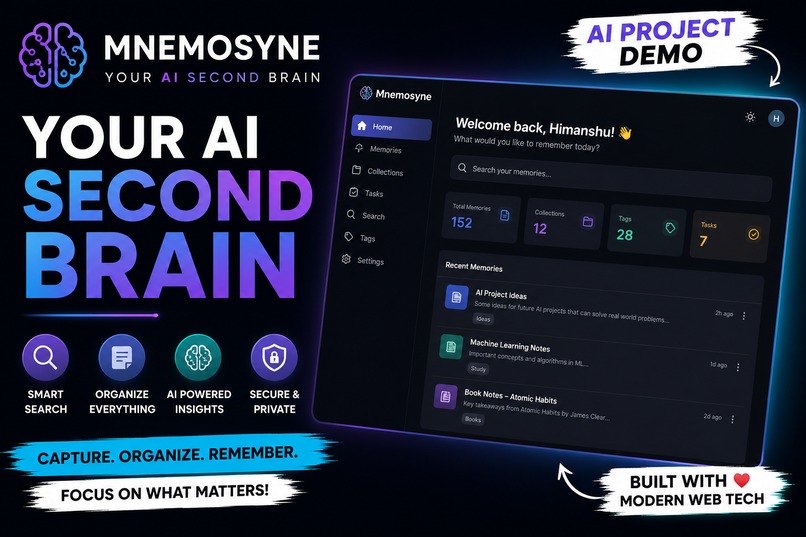
Mnemosyne: Your AI-powered second brain for smarter knowledge management.
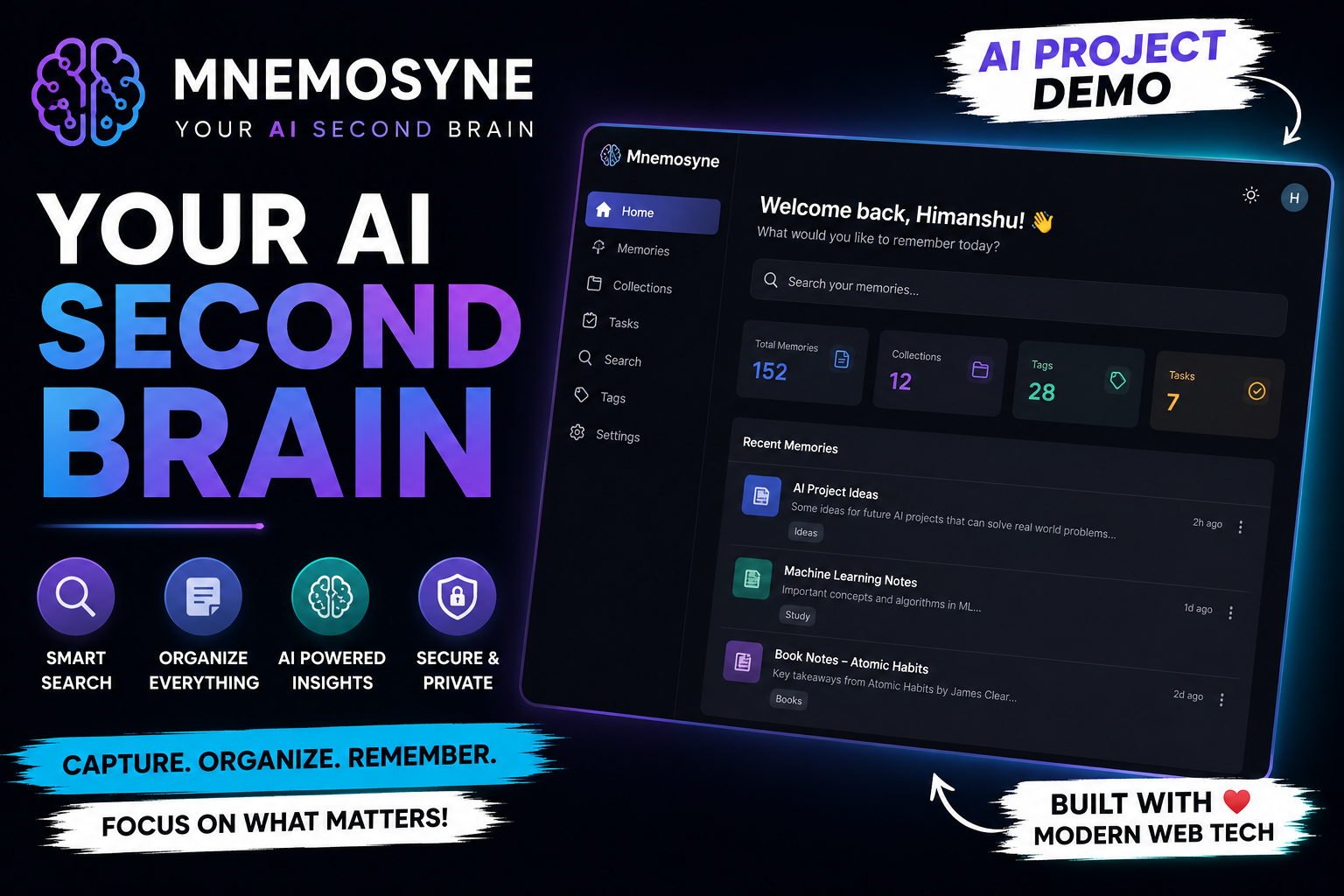
🧠 Mnemosyne – AI-Powered Second Brain
Inspiration
In today's digital world, information is scattered across notes, documents, chats, bookmarks, and task managers. Finding important information later is often frustrating and time-consuming. We wanted to build an AI-powered memory assistant that allows users to capture knowledge naturally and retrieve it instantly using conversational search. This idea inspired Mnemosyne, a personal "second brain" that helps users remember everything without relying on folders or keywords.
What it does
Mnemosyne intelligently stores notes, ideas, conversations, and documents in a centralized workspace. Using AI-powered semantic search, users can ask questions in natural language and instantly retrieve relevant information. The platform organizes knowledge, reduces information overload, and improves productivity through intelligent memory management.
How we built it
The application was developed as a modern full-stack web application using React/Next.js for the frontend and a backend API to manage AI workflows and data processing. CockroachDB provides scalable cloud storage and distributed vector indexing for semantic search, while AWS AI services power intelligent understanding and retrieval. Modern development tools, open-source libraries, and AI-assisted coding accelerated development while all application logic, user experience, and system integration were built during the hackathon.
Challenges we ran into
The biggest challenges included designing an efficient semantic search pipeline, integrating vector search with structured application data, managing AI context effectively, and creating a responsive user experience. Balancing retrieval accuracy, scalability, and performance while keeping the interface simple required multiple iterations and continuous testing.
Accomplishments that we're proud of
- Built a fully functional AI-powered second brain.
- Implemented intelligent semantic memory retrieval.
- Designed a clean and intuitive user interface.
- Successfully integrated CockroachDB and AWS AI capabilities.
- Created a scalable architecture suitable for future expansion.
What we learned
This project strengthened our understanding of AI-powered applications, vector databases, semantic search, cloud-native architectures, and full-stack development. We also gained valuable experience integrating distributed databases with AI services to build practical, real-world productivity tools.
What's next for Mnemosyne
Future improvements include multi-modal memory support for images and audio, browser extensions, mobile applications, collaborative workspaces, personalized AI agents, real-time synchronization, stronger privacy controls, and deeper integrations with productivity platforms to create a truly intelligent digital memory assistant.
Built With
- ai
- authentication
- clouddeployment
- css3
- docker
- fastapi
- genai
- git
- github
- html5
- huggingface
- javascript
- langchain
- llm
- natural-language-processing
- openai
- postgresql
- python
- rag
- react.js
- responsivedesgin
- restapi
- talwind
- typescript
- vectordb

Log in or sign up for Devpost to join the conversation.