-
-
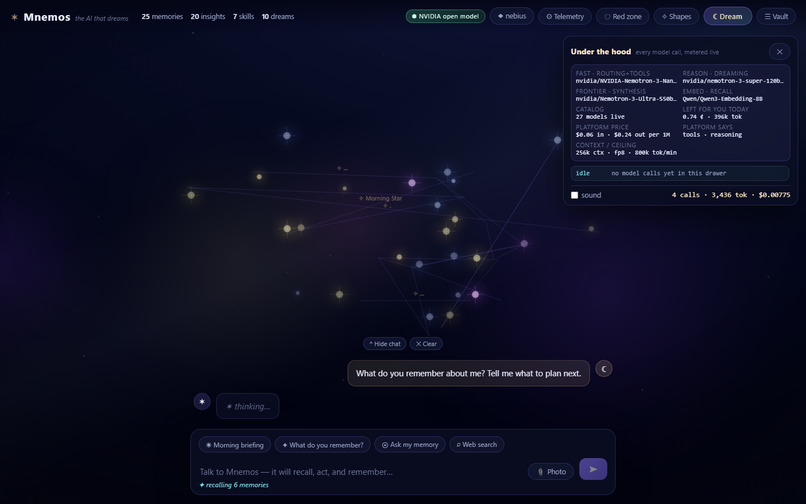
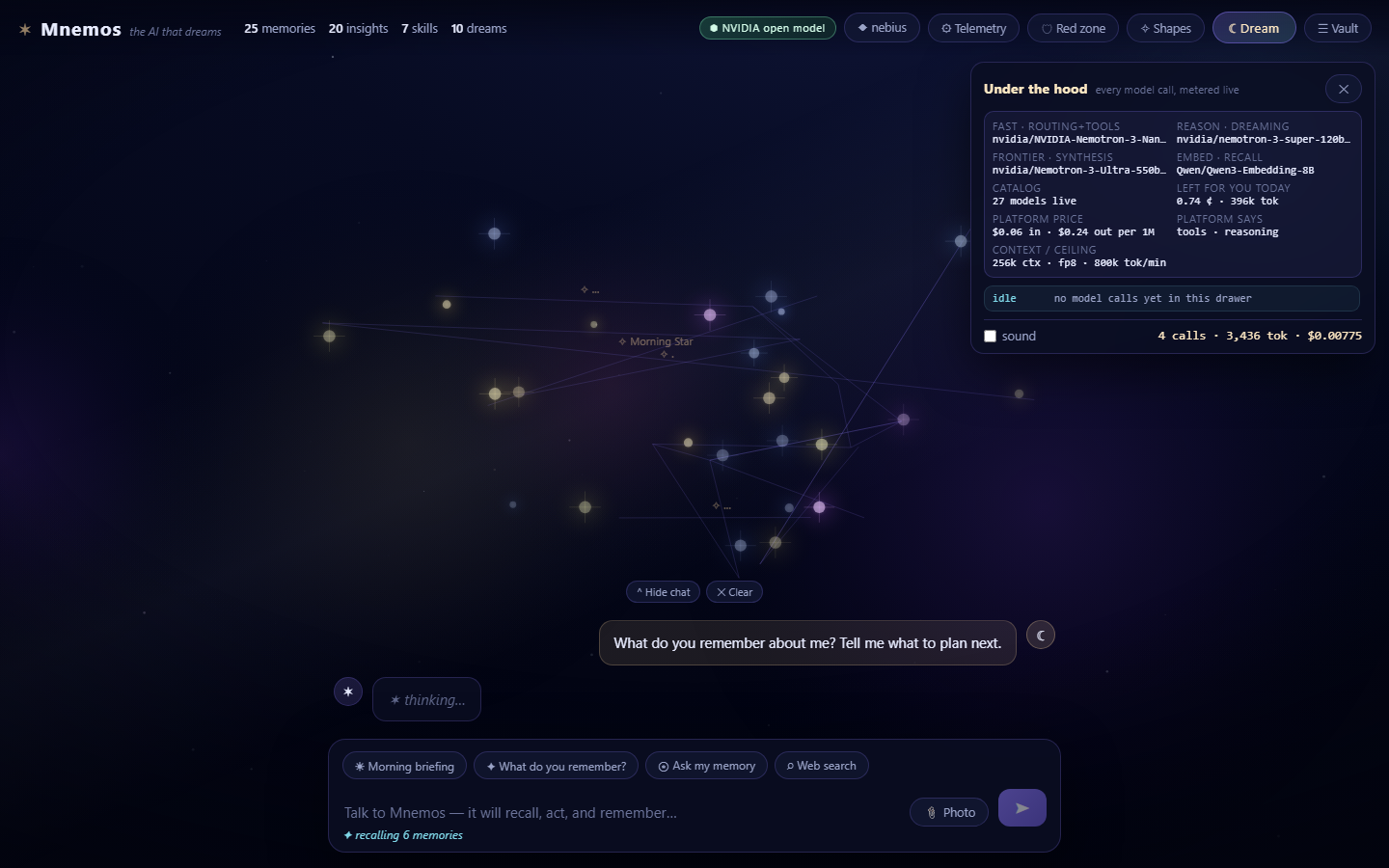
The memory sky with live telemetry: model, tokens, latency and USD per call, from Token Fa
-
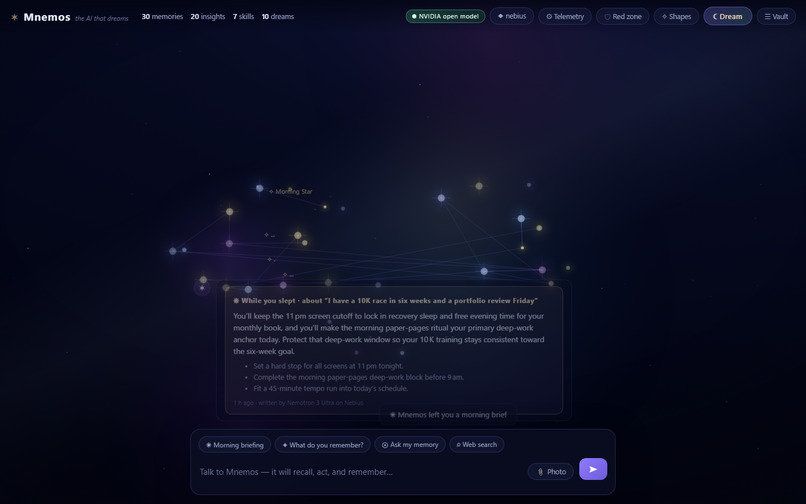
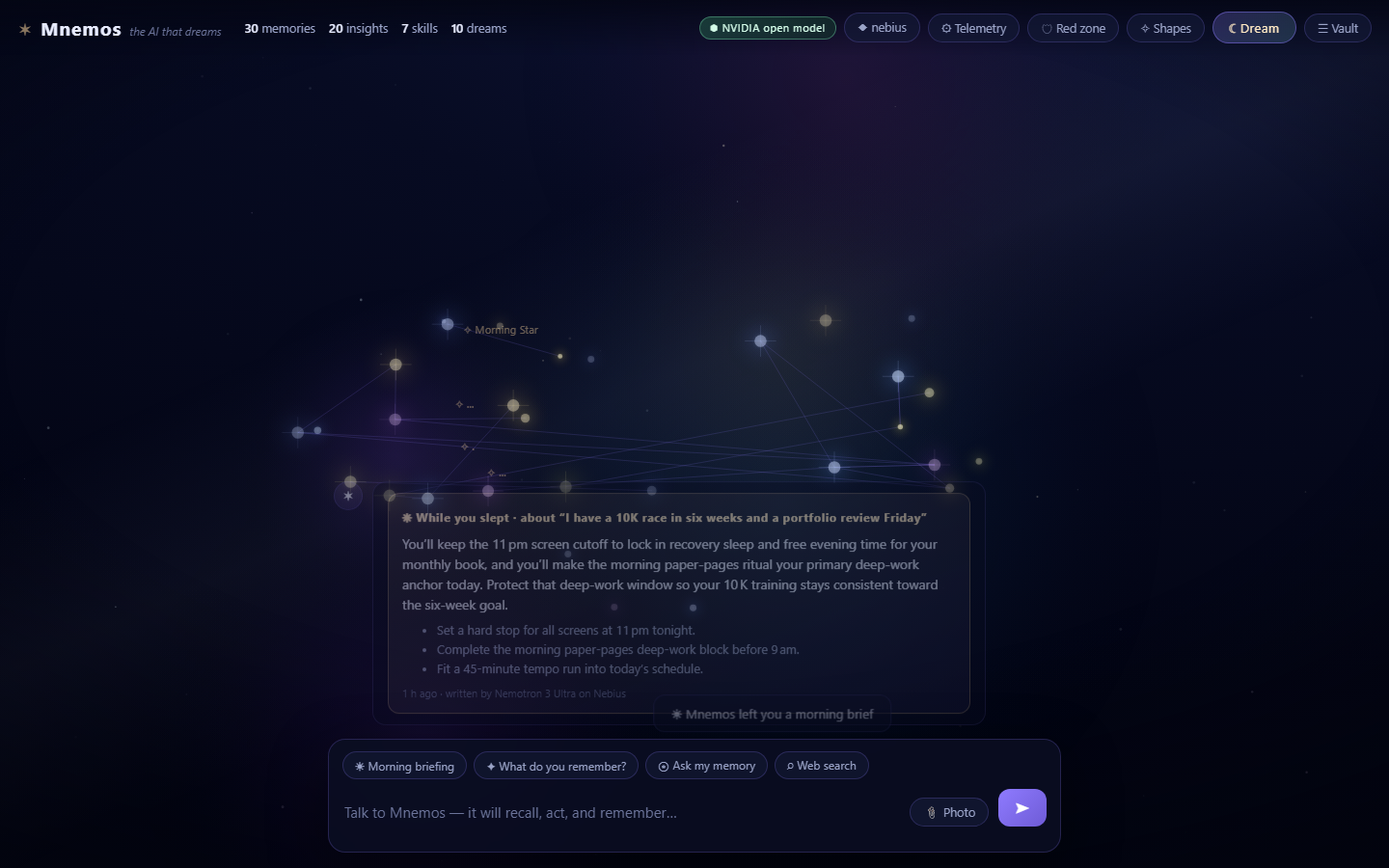
It dreams while you sleep: overnight replay distills insights and leaves a morning brief you can read, act on, or dismiss.
-
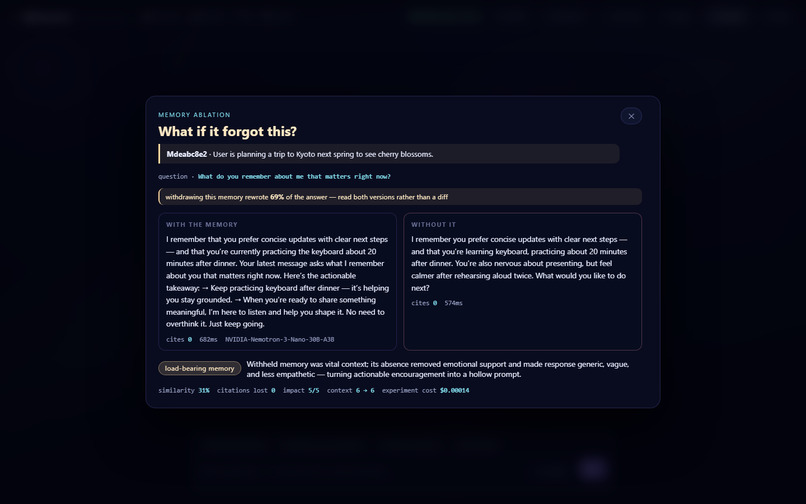
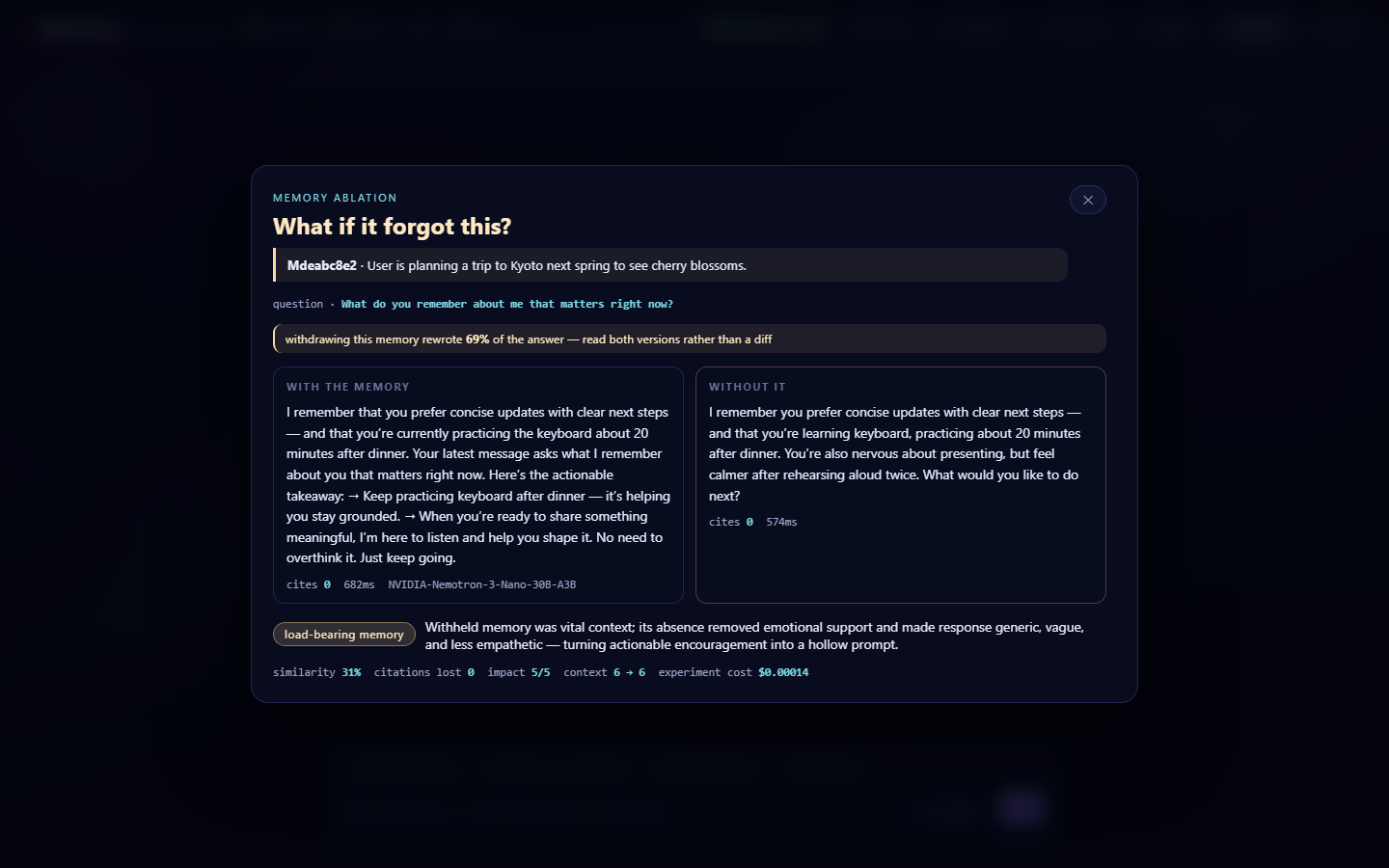
Test any memory: answer with one star in context and again without it, then see how much changed and whether it was load-bearing.
-
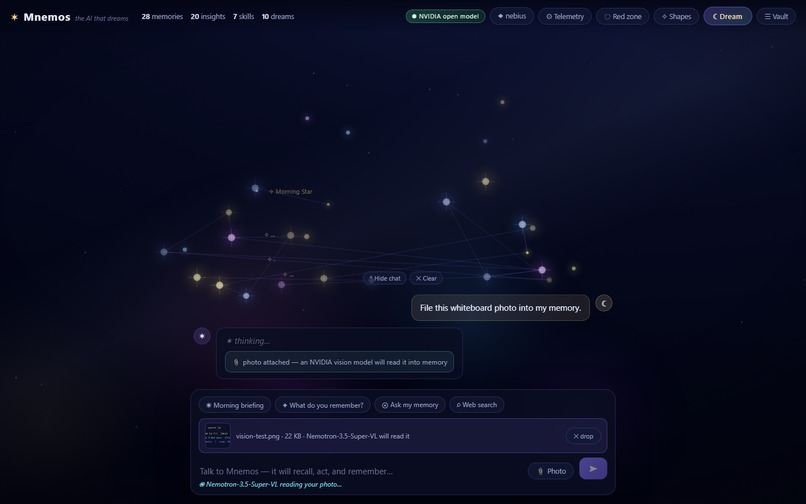
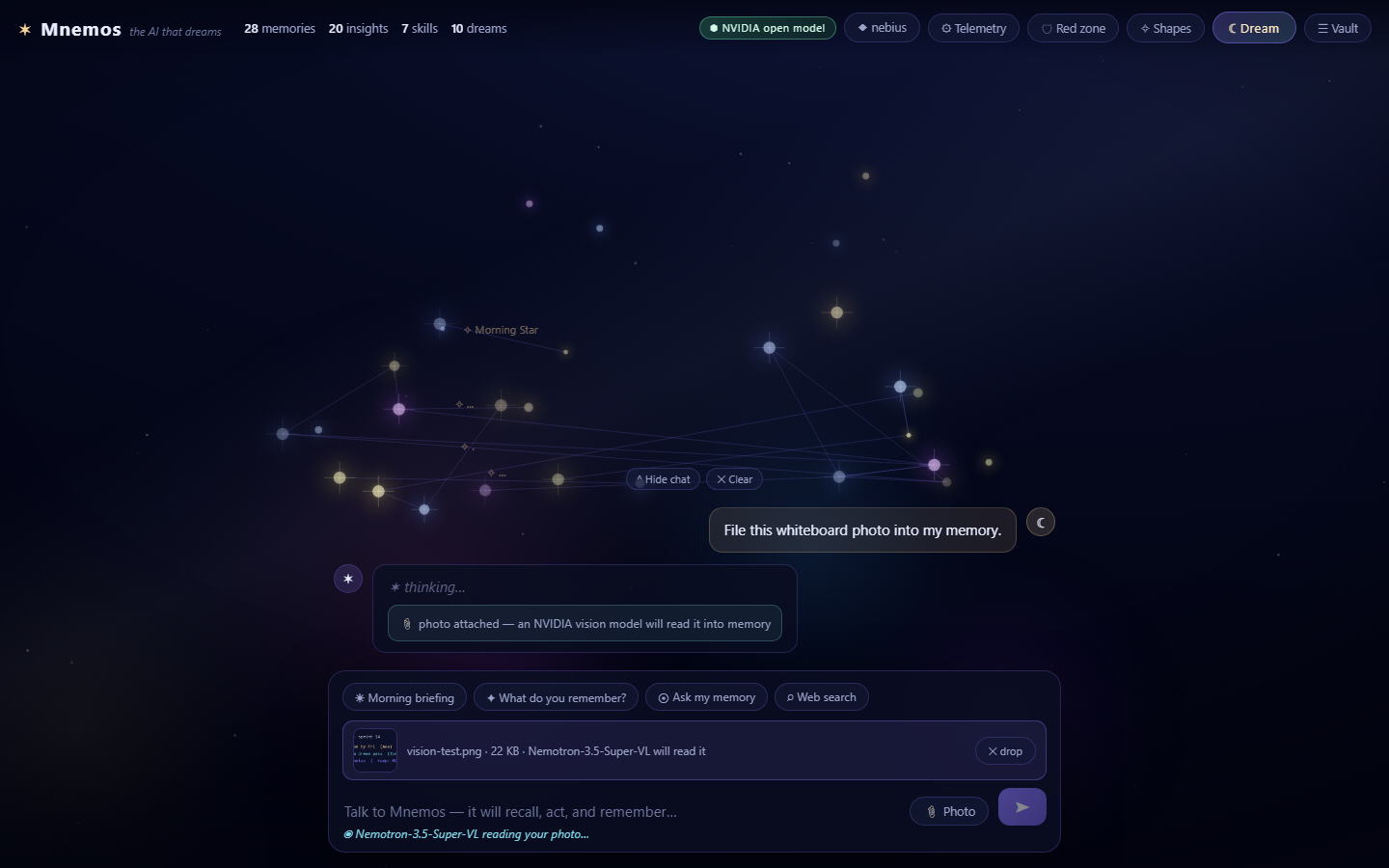
Attach a whiteboard photo and an NVIDIA vision model reads it into memory — then cites that exact star later.
The problem
Every assistant you use either forgets you when the tab closes, or remembers you in a box you cannot open. ChatGPT and Claude now consolidate your memories in the background and call it dreaming. You never see it, you cannot check which memory produced a sentence, and you cannot find out whether that memory mattered. Memory became a black box with a friendly name.
What we built
Mnemos is an always-on private AI whose memory is a sky you can watch. Every memory is a star: bright while it is being used, dimming toward forgetting on a 21-day half-life. Three things you can do with it that you cannot do elsewhere:
Watch it think. Ask a question and the retrieval happens in front of you: the stars it reads pulse in sequence, native tool calls stream past (
memory_search,web_search,sky_shape), and the answer arrives with[Mxxxx]citation chips. Click one and that exact star flares. A citation that cannot be resolved renders red, so you see the model overreach instead of trusting it. And because models are not perfectly disciplined about receipts, the app audits its own bookkeeping: a memory that overlaps the answer but was never cited shows up as a dashed amber matched but not cited chip. Three distinct states, and it never upgrades a guess into a citation.Test it. Click any star and ask "What if it forgot this?" Mnemos answers the same question twice: once with that memory in context, once without. It diffs the two answers, counts the citations lost, and scores whether the difference is material. Trust stops being a claim and becomes an experiment you can run in four seconds. (Measured on our own demo: a memory came back load-bearing at 20% answer similarity, 4 citations down to 2, for $0.00041.)
Own it. One vault per visitor, isolated by cookie and expiring on its own; export or import it as one readable JSON file; burn it with a typed confirmation. Attach a whiteboard photo and an NVIDIA vision model reads it into new stars. And your memory is not trapped here: a zero-dependency MCP server exposes it to any agent (NVIDIA Hermes, Claude Code), and skills learned while dreaming export as SKILL.md, the same convention self-evolving agents use.
It also works while you sleep: give the Dream Engine an intention ("10K race in six weeks, portfolio review Friday") and the replay biases toward it, cross-memory insights are drawn as constellations, a reusable skill is distilled, and you wake to a morning brief with three concrete actions.
How it works
Zero-dependency Node.js, no build step, streaming over SSE. On boot the app reads GET /v1/models?verbose=true and capability-gates its own router from the catalog's supported_features, then heals any model ID the provider stops serving: we learned that lesson the hard way when a model was deprecated mid-hackathon and silently broke our public demo.
| Tier | NVIDIA open model on Nebius Token Factory | Used for | Published price / 1M |
|---|---|---|---|
| fast | Nemotron 3 Nano 30B-A3B | tool routing, extraction, answers | $0.06 / $0.24 |
| reason | Nemotron 3 Super 120B-A12B | dream consolidation | $0.30 / $0.90 |
| frontier | Nemotron 3 Ultra 550B-A55B | one deep-thought pass + morning brief per dream | $1.00 / $3.00 |
| vision | Nemotron 3.5 Super-VL | photos and screenshots into memories | $0.30 / $0.90 |
| embed | Qwen3-Embedding-8B | hybrid BM25 + vector recall | $0.01 / - |
Tavily is a first-class agent tool and the world model the dream tests memories against (the outward web-dream), so it is called at runtime, not mentioned.
A Under the hood drawer shows every call: model, tier, tokens, KV-cache hits, latency and USD computed from the platform's own published rates. One cited turn with a web search is about $0.0004; a whole dream on Ultra is about $0.012. Every visitor is capped by a three-layer spend gate (per IP, per session, per host).
Retrieval, measured rather than asserted
eval/ ships a reproducible benchmark: 59 seeded memories across 9 sessions and 40 questions built on the LongMemEval ability taxonomy (single-session, multi-hop, temporal, knowledge-update and abstention). The live run on Nemotron 3 Nano gives the shipped hybrid arm 97.0% hit@6, 83-86% of citations resolving across two independent runs (retrieval metrics are deterministic; answer metrics are a range, because the model is sampled and fake precision would be its own hallucination), and the lowest stale-answer rate of any arm at 11-22%.
The benchmark also caught us: the first run showed the system answered unanswerable questions 86-100% of the time, because retrieval returned six recent memories whenever nothing matched. We added a relevance floor and a low-relevance instruction, fixed an abstention detector that only understood contracted English, and re-ran it. The shipped arm now declines 43-57% of unanswerable questions (up from 0-43%, where part of that gap was the detector itself), and marking a replaced memory superseded holds stale-fact assertions to 11-22%. What is still weak is published too: the full agent-loop arm is less careful about declining than the single-shot path.
Privacy is the architecture
No accounts, no telemetry, no analytics script. Your data leaves the browser only to the inference API and the search API you chose, and deploy/openshell/policy.yaml makes that default-deny egress kernel-enforceable in an NVIDIA OpenShell sandbox. A user-defined red zone is injected server-side, so topics you rule out are not something a prompt can talk the model back into. SSRF guards, body caps, and images accepted only as data URLs close the rest.
Why this matters now
Memory is becoming the differentiator for personal AI, and right now it is something vendors do to you. Mnemos is a working demonstration that it can be something you inspect, argue with, and walk away from: a sky you can see, receipts you can test, and a file you can carry. 37 tests, strict type-checking with zero errors, MIT licensed.
Built With
- ai-agents
- explainability
- html5
- javascript
- local-first
- memory
- model-context-protocol-(mcp)
- nebius
- nebius-token-factory
- nemotron
- node.js
- nvidia
- nvidia-nemotron-3-nano
- nvidia-nemotron-3-super
- nvidia-nemotron-3-ultra
- nvidia-nemotron-3.5-super-vl
- personal-ai
- privacy
- qwen3-embedding
- render
- server-sent-events
- tavily


Log in or sign up for Devpost to join the conversation.