-
-
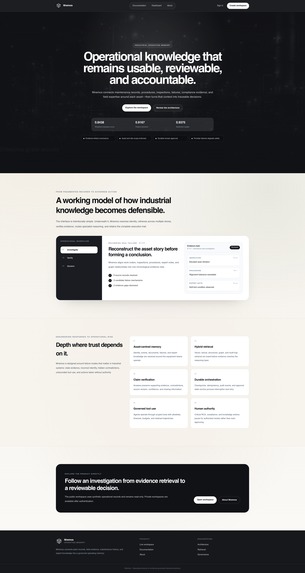
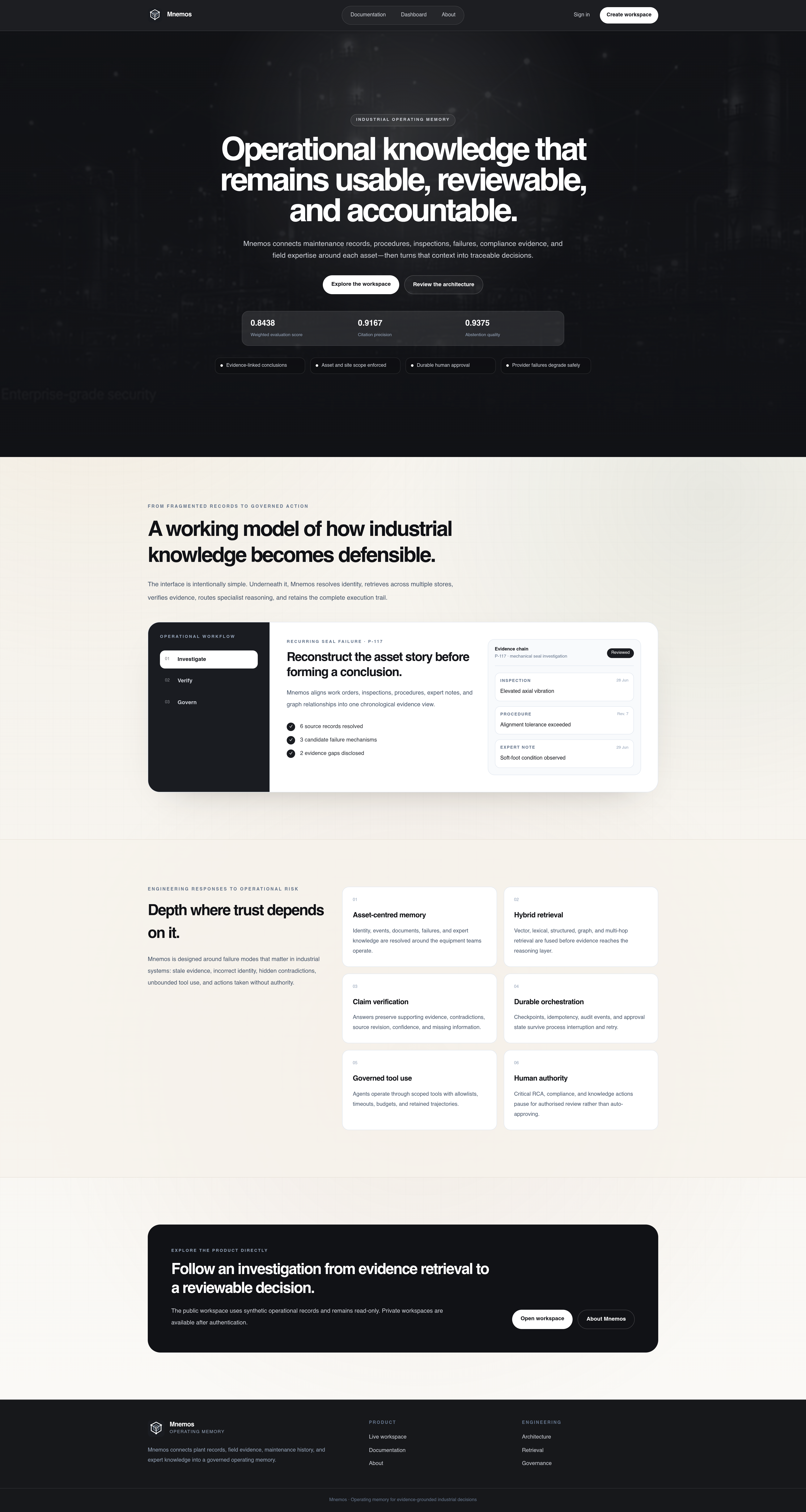
Landing Page
-
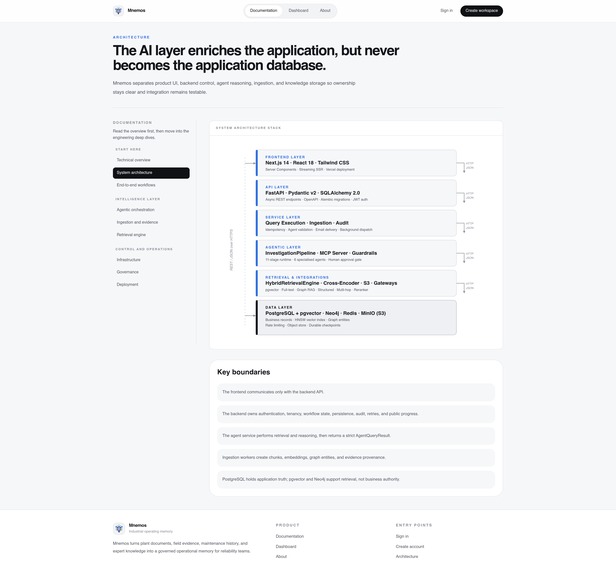
System Architecture
-
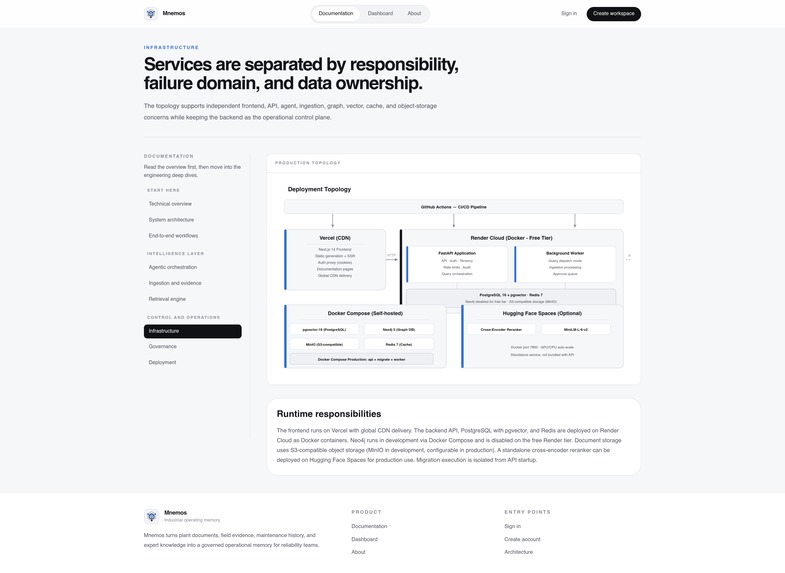
Governance
-
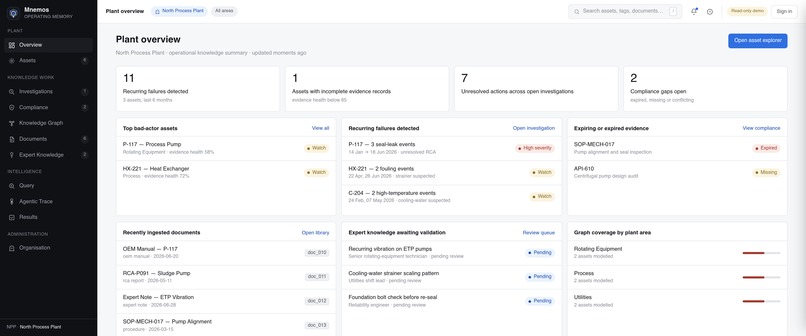
Dashboard Overview
-
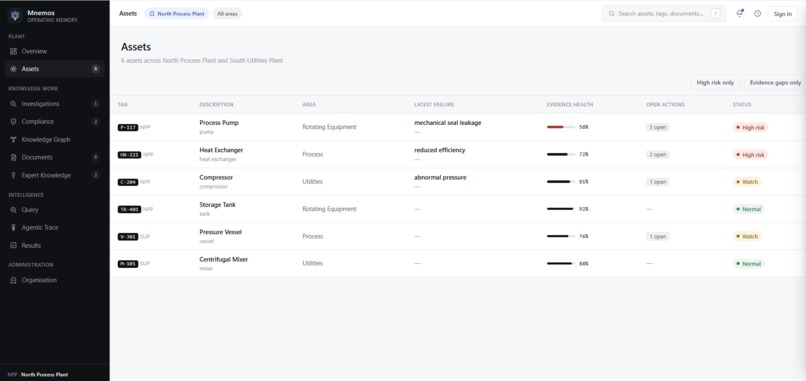
Assets Page
-
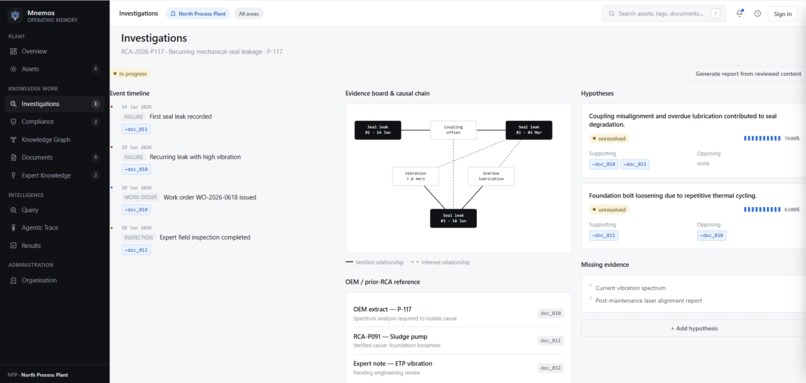
Investigations
-
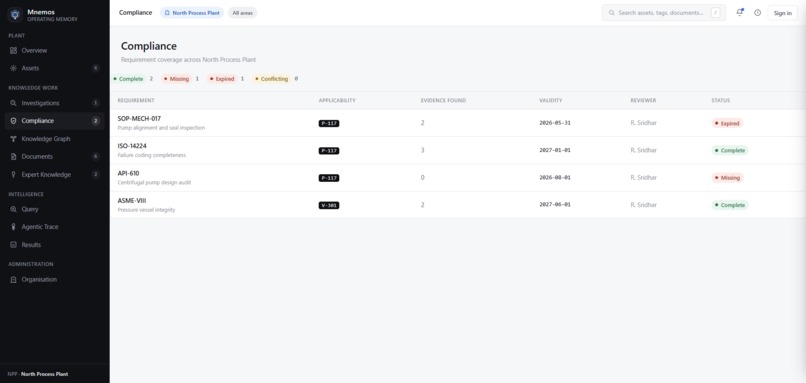
Compliance
-
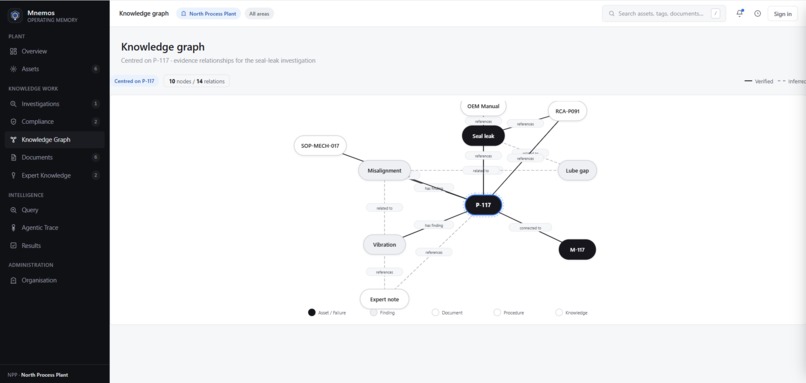
Knowledge Graph
-
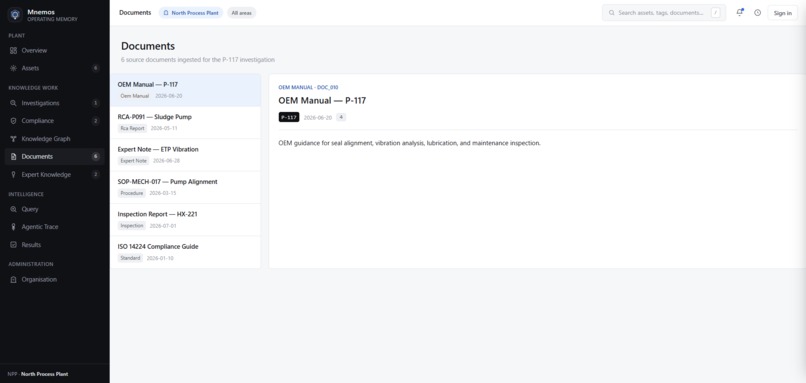
Documents Database
-
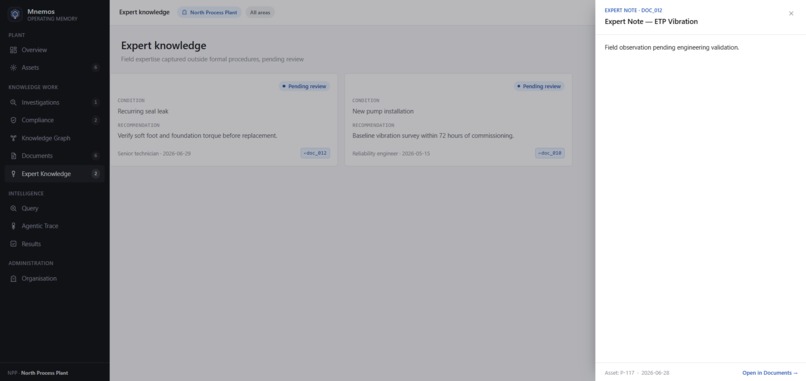
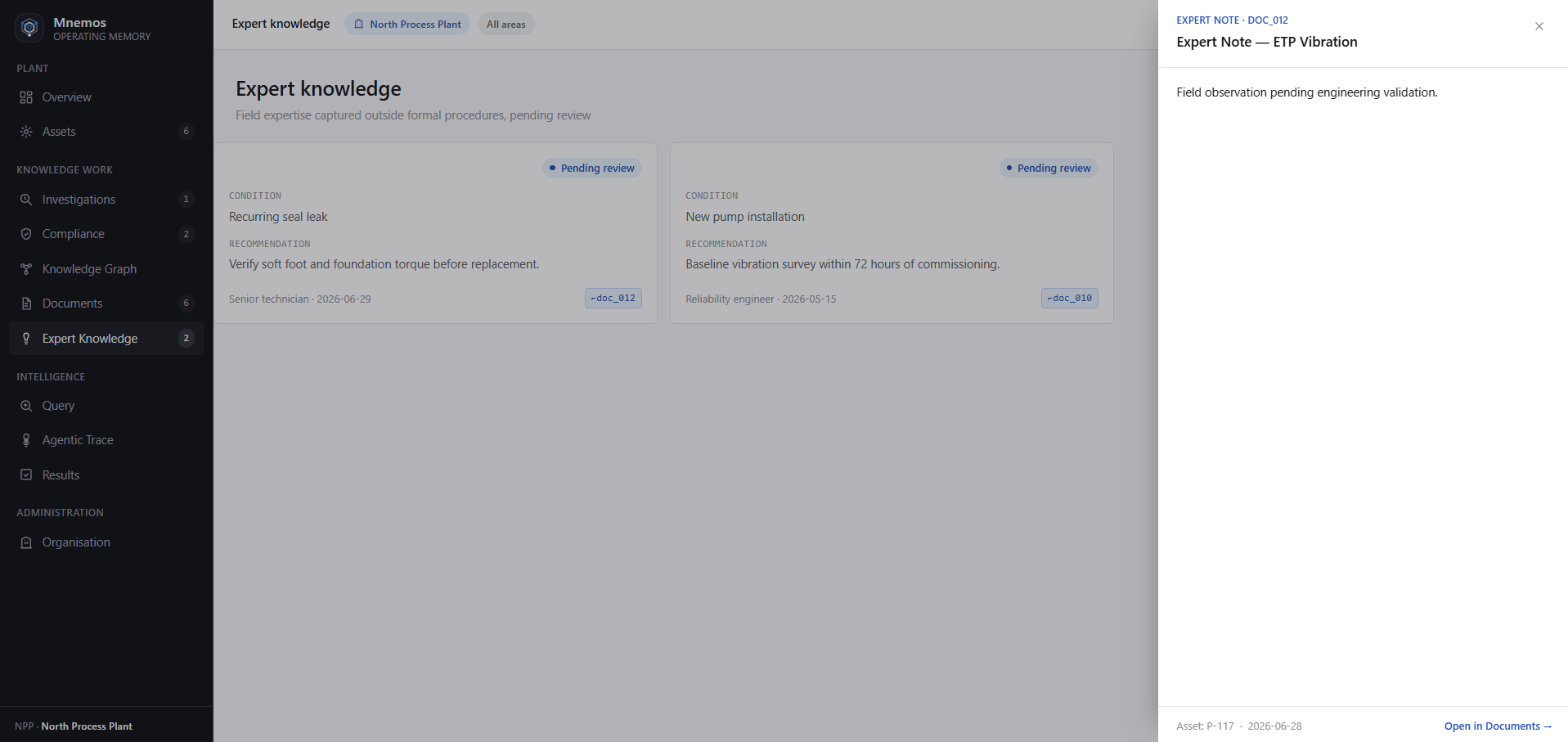
Expert Knowledge
-
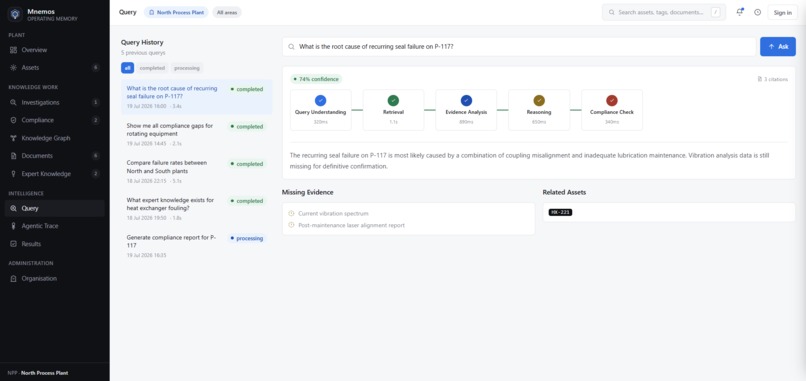
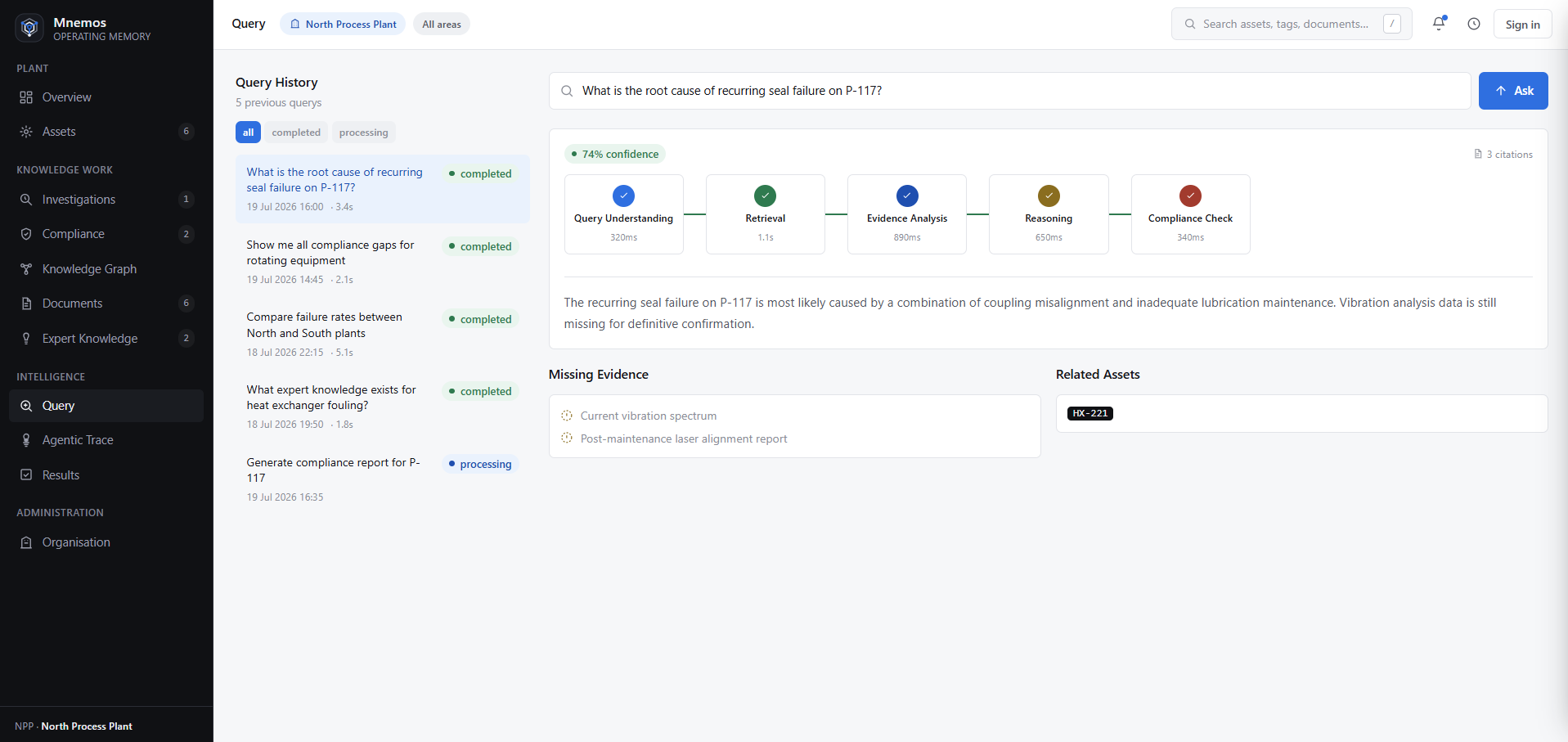
Query corner
-
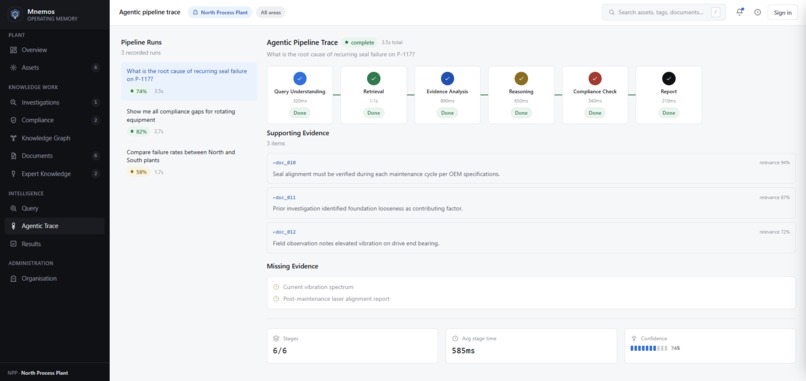
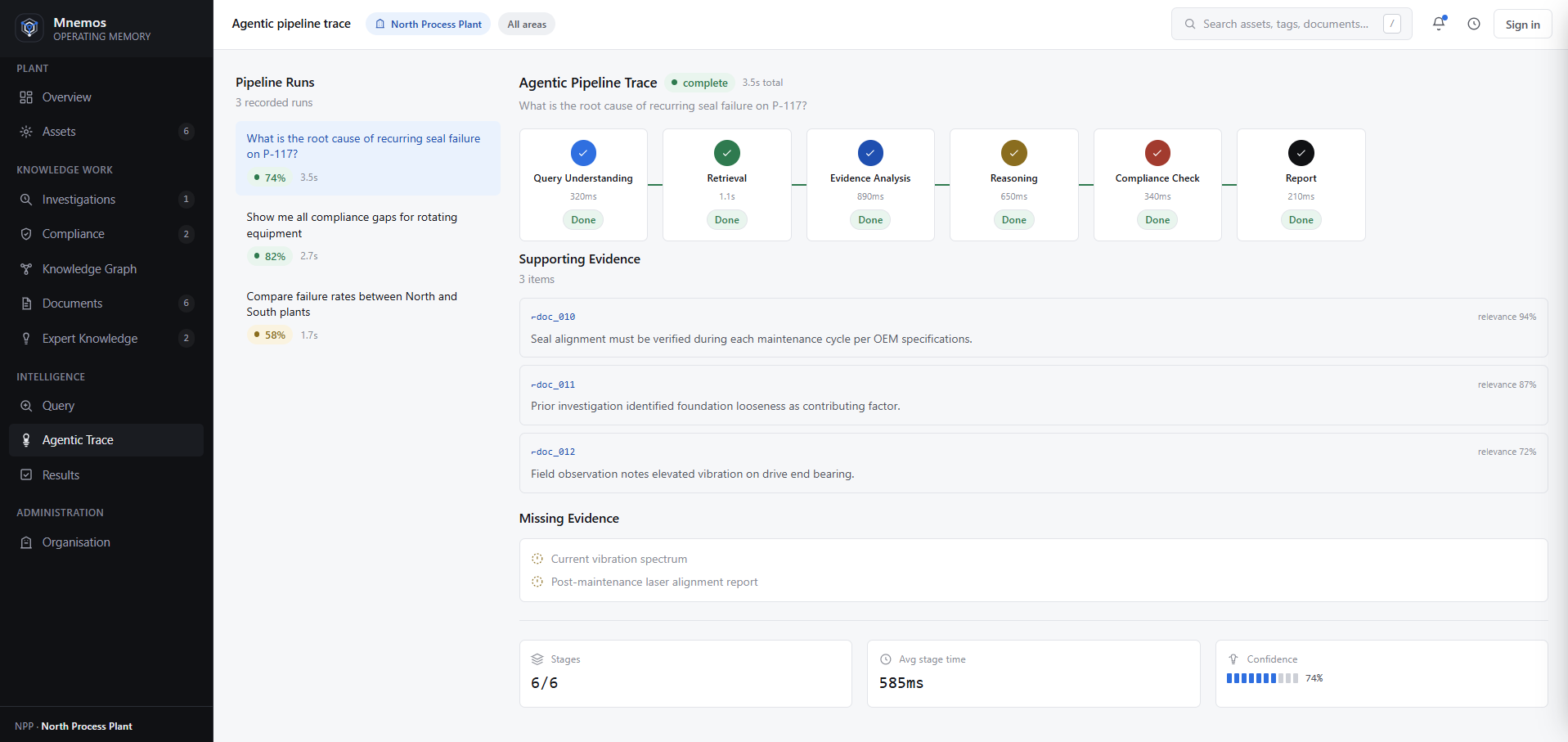
Agentic Trace
-
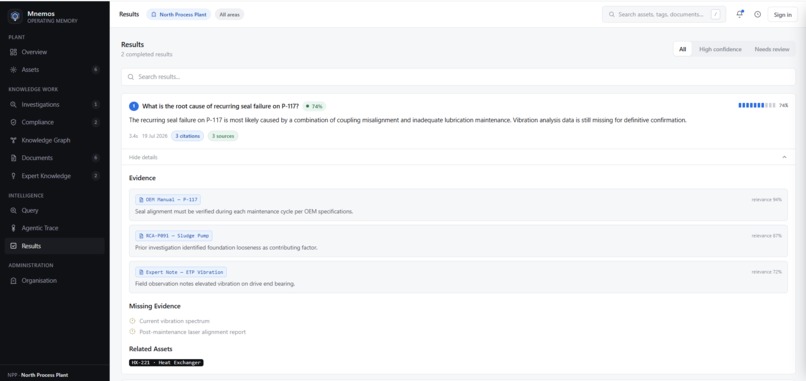
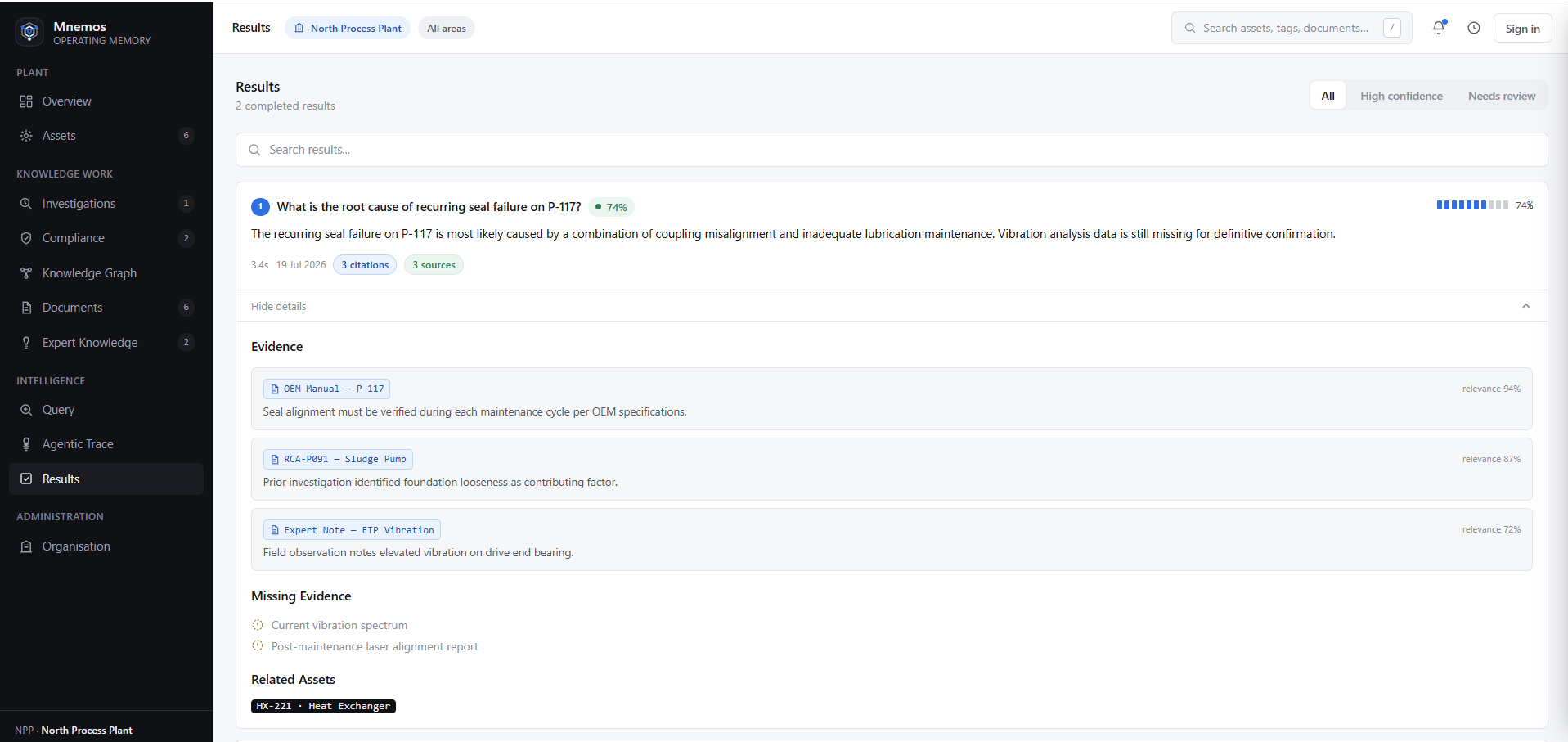
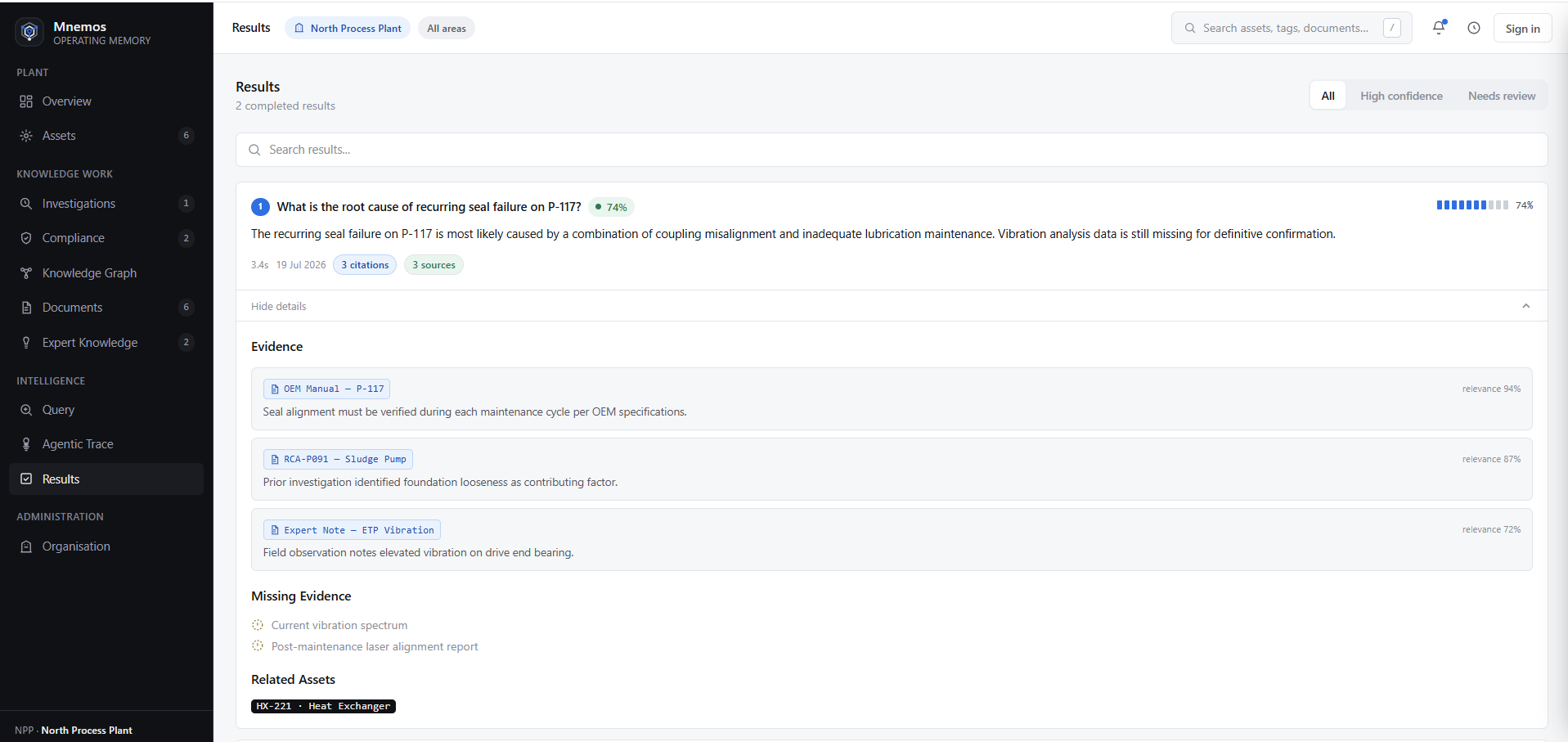
Results Page
-
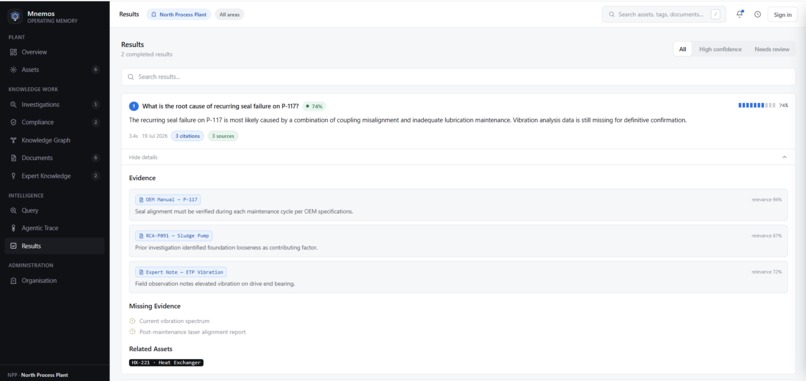
Organisation Management Page
-
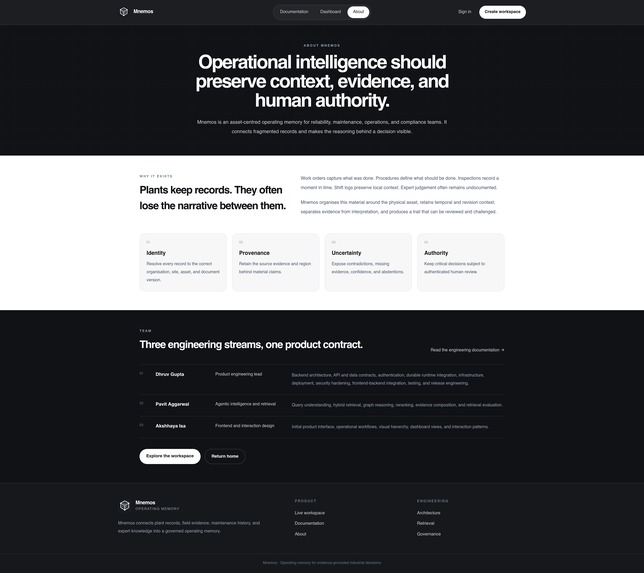
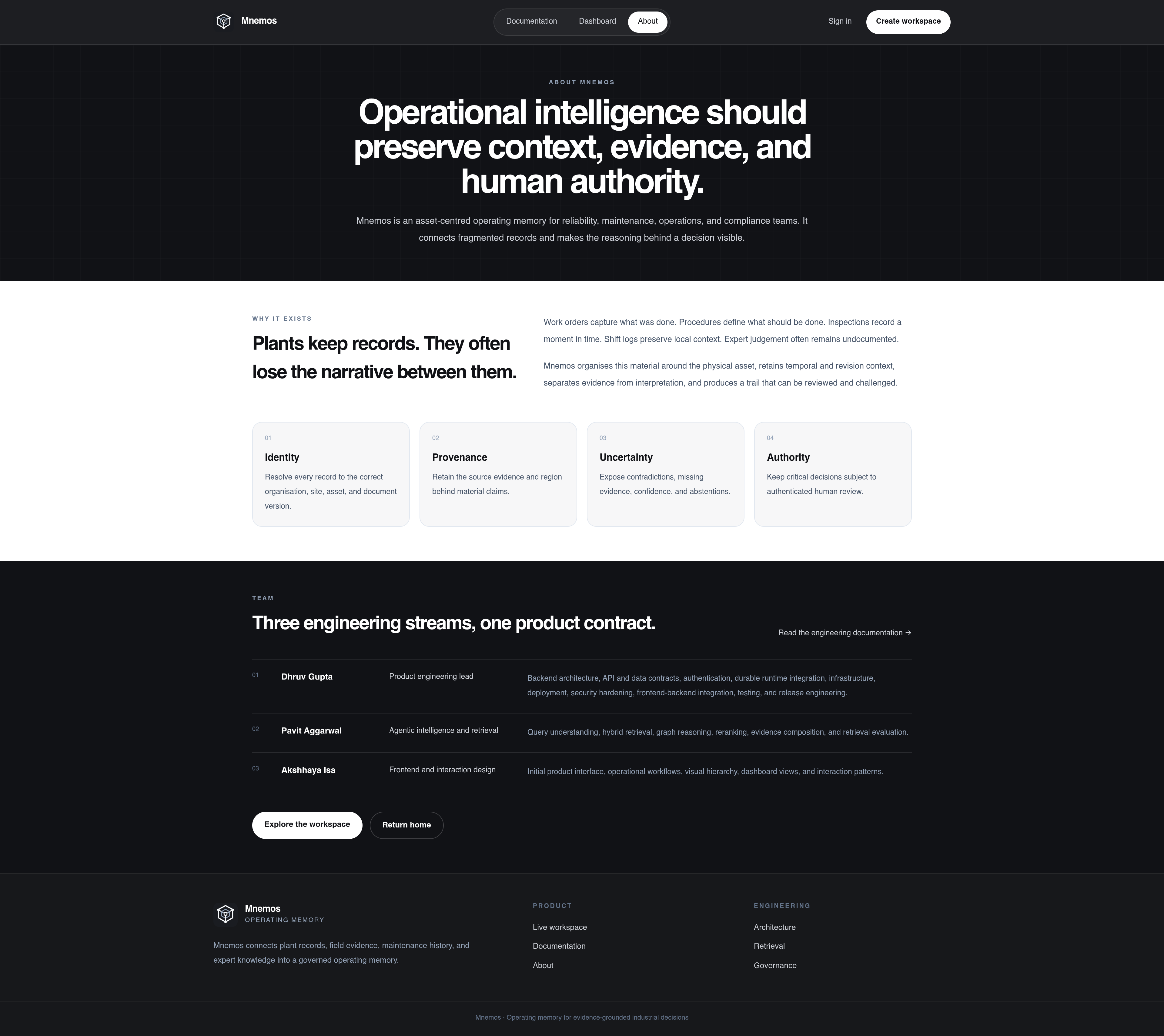
About Page
Inspiration
Industrial organisations rarely suffer from a complete lack of information. The real problem is that their knowledge is fragmented across maintenance records, inspection reports, procedures, work orders, compliance documents, and the experience of field experts.
When an asset fails repeatedly, engineers may spend hours reconstructing its history before they can even begin analysing the cause. Important relationships between failures, procedures, inspections, and previous decisions are often buried across disconnected systems.
We built Mnemos to create an industrial operating memory: a system that connects operational evidence around physical assets and helps teams investigate problems without losing provenance, uncertainty, or human oversight.
What it does
Mnemos is an asset-centred industrial knowledge intelligence platform for maintenance, reliability, safety, quality, and compliance teams.
It allows users to:
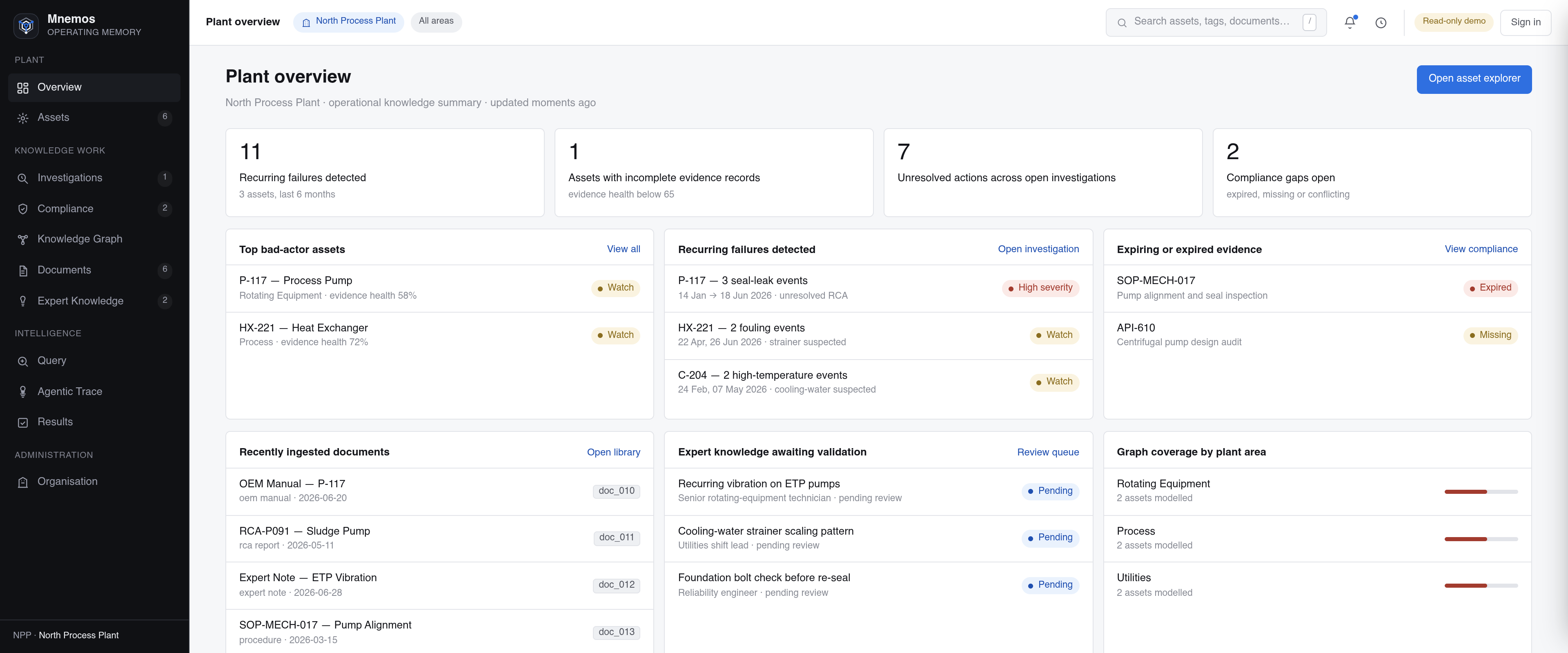
- explore plant-level risks, open investigations, evidence gaps, and compliance exposure;
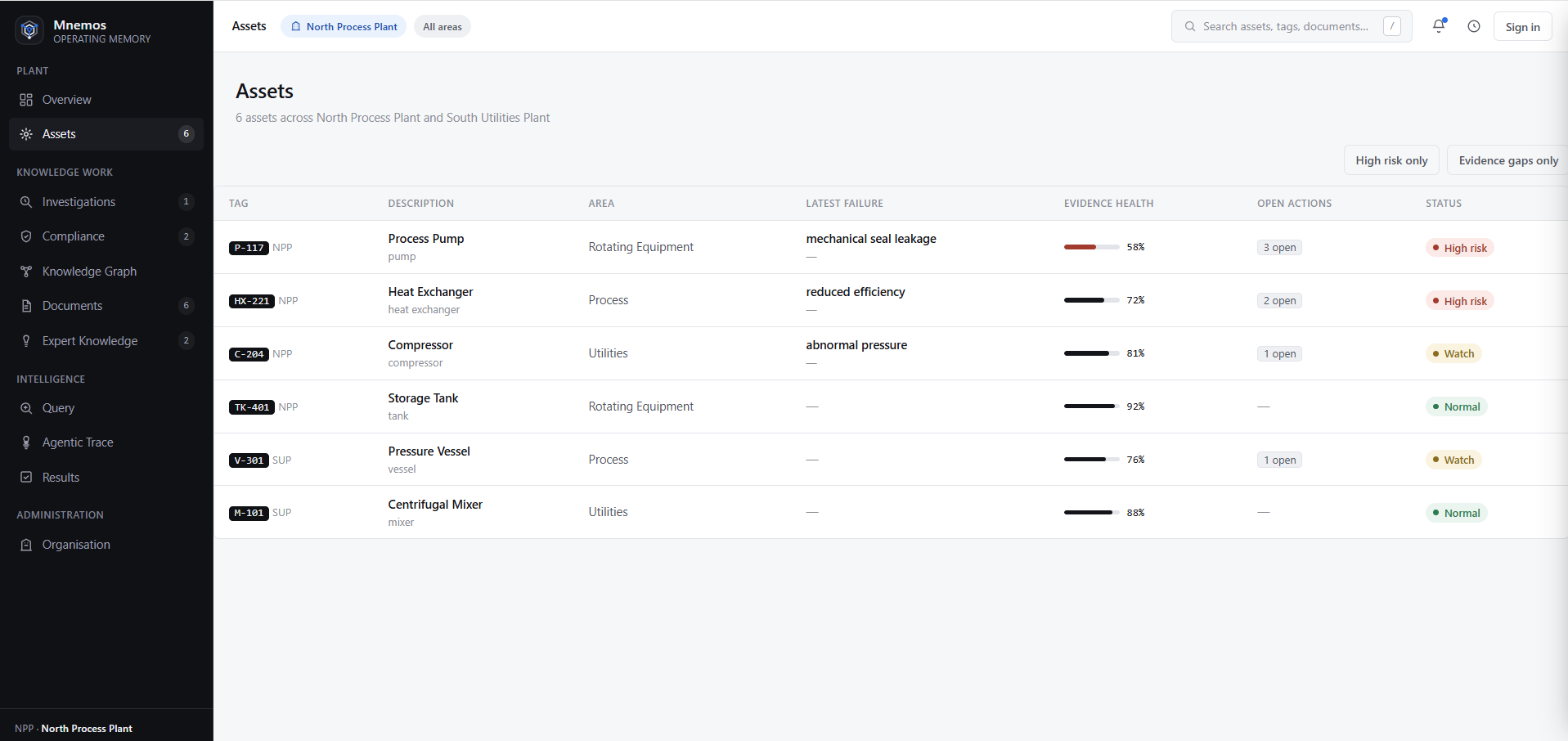
- view an asset passport containing its timeline, procedures, hazards, evidence health, and unresolved actions;
- ask natural-language questions across operational documents and asset records;
- retrieve evidence using semantic, lexical, structured, and graph-based search;
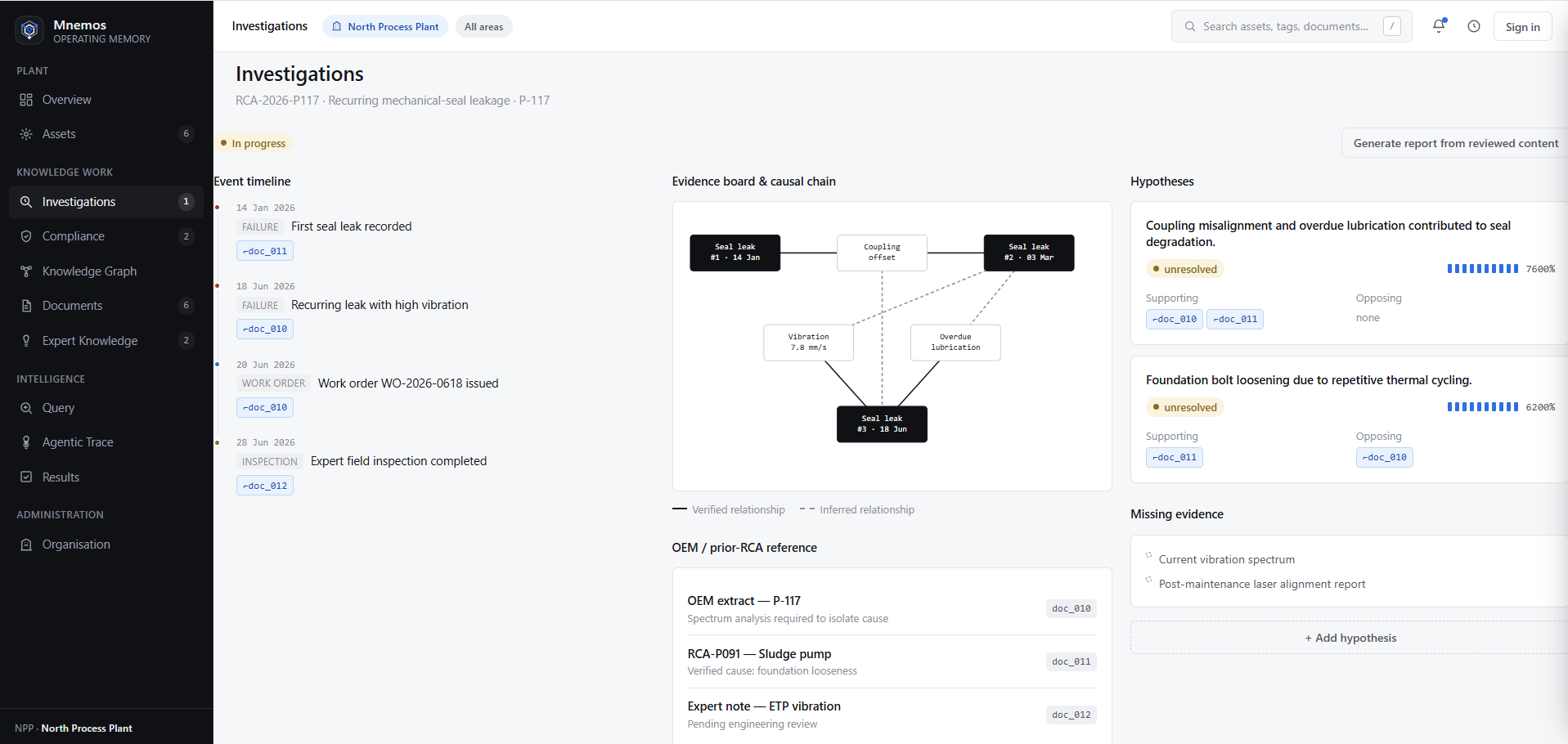
- reconstruct failure histories from work orders, inspections, reports, and procedures;
- compare competing root-cause hypotheses;
- inspect the evidence supporting or contradicting each conclusion;
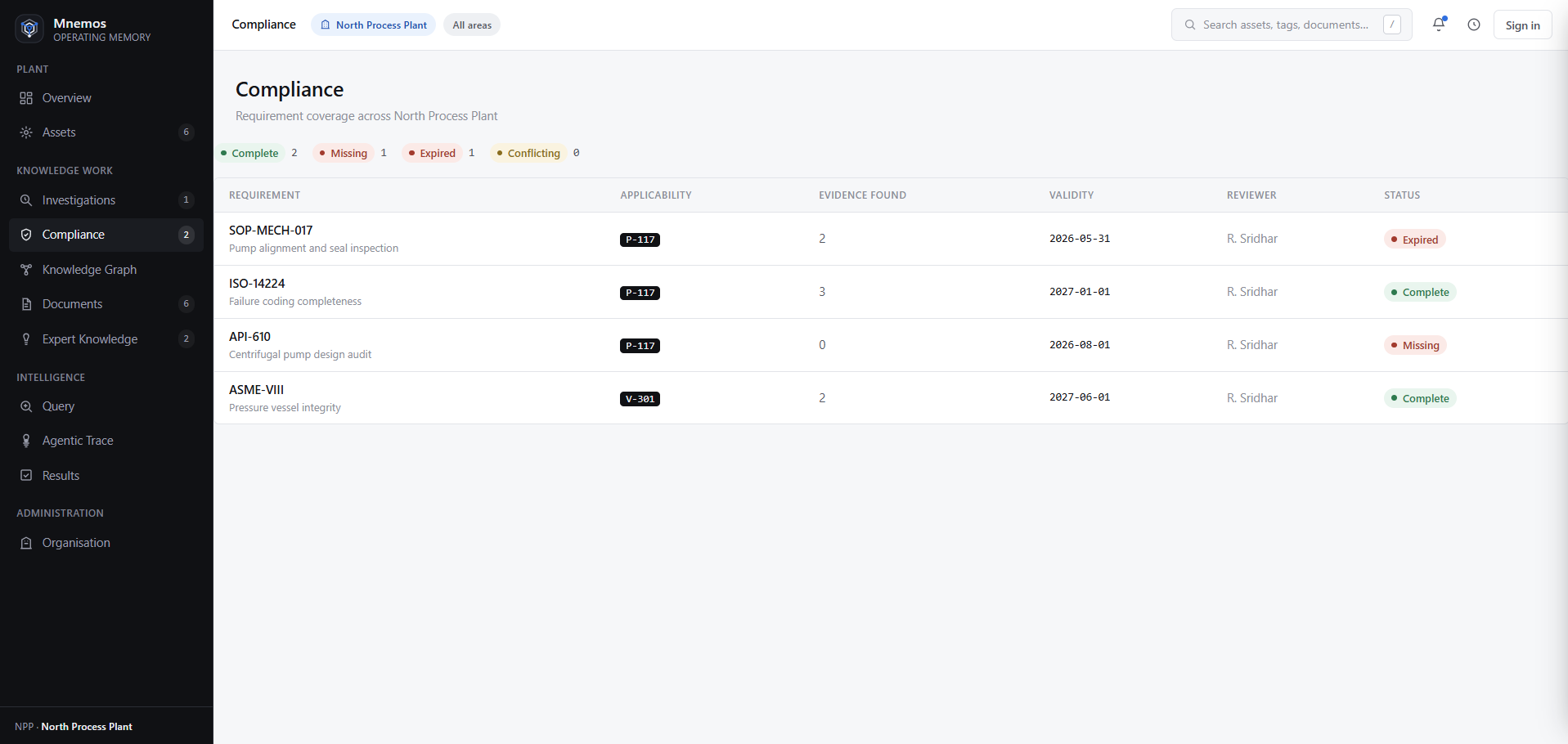
- identify missing, expired, or insufficient evidence;
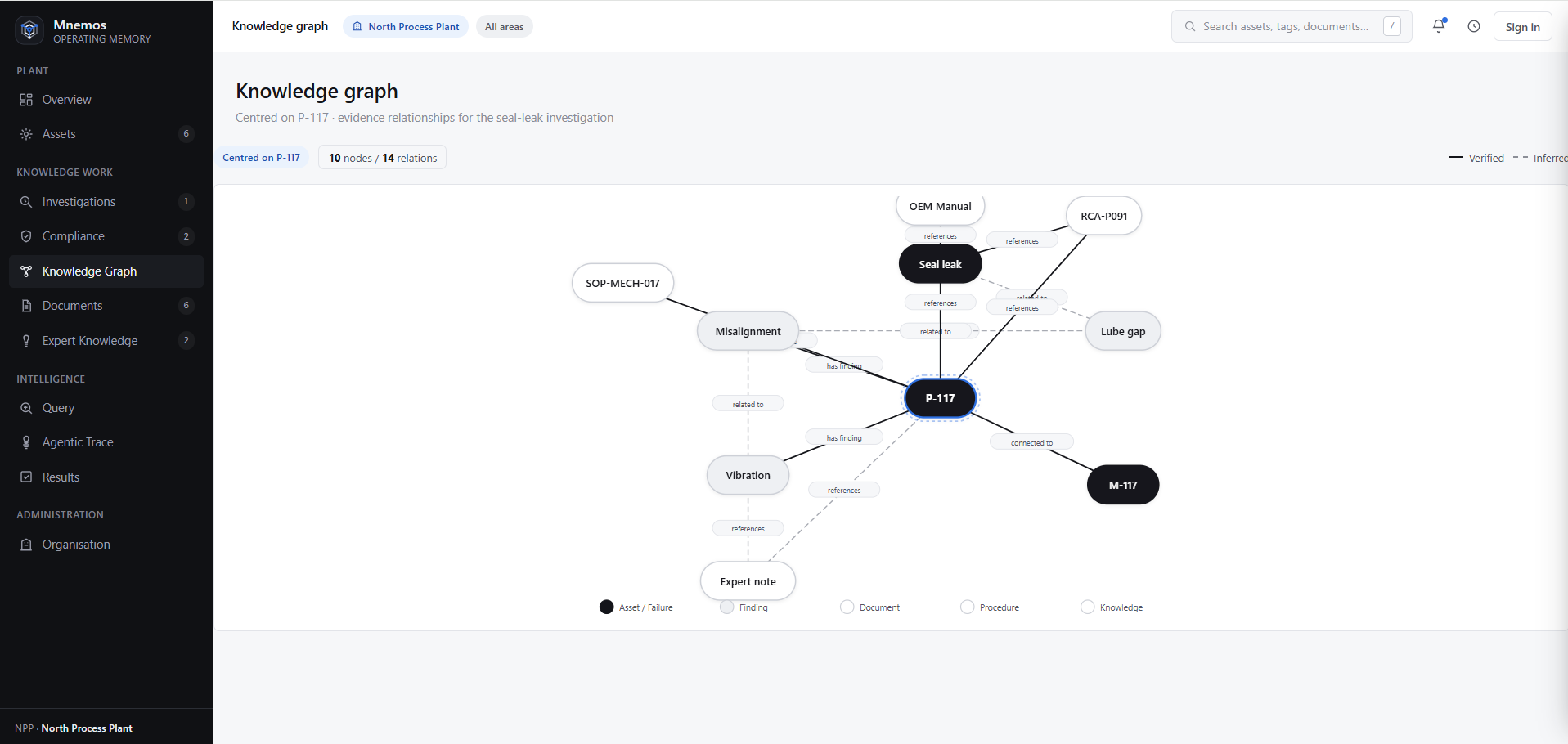
- visualise relationships through an interactive knowledge graph;
- capture expert knowledge with review and approval controls;
- track agent execution, confidence, citations, and evidence gaps;
- retain a durable record of investigations and human decisions.
Mnemos is not intended to replace CMMS, EAM, QMS, or document-management platforms. It acts as an evidence and reasoning layer across those operational systems.
The public deployment contains a synthetic, read-only demonstration workspace. Private workspaces use authenticated and tenant-scoped backend data.
How I built it
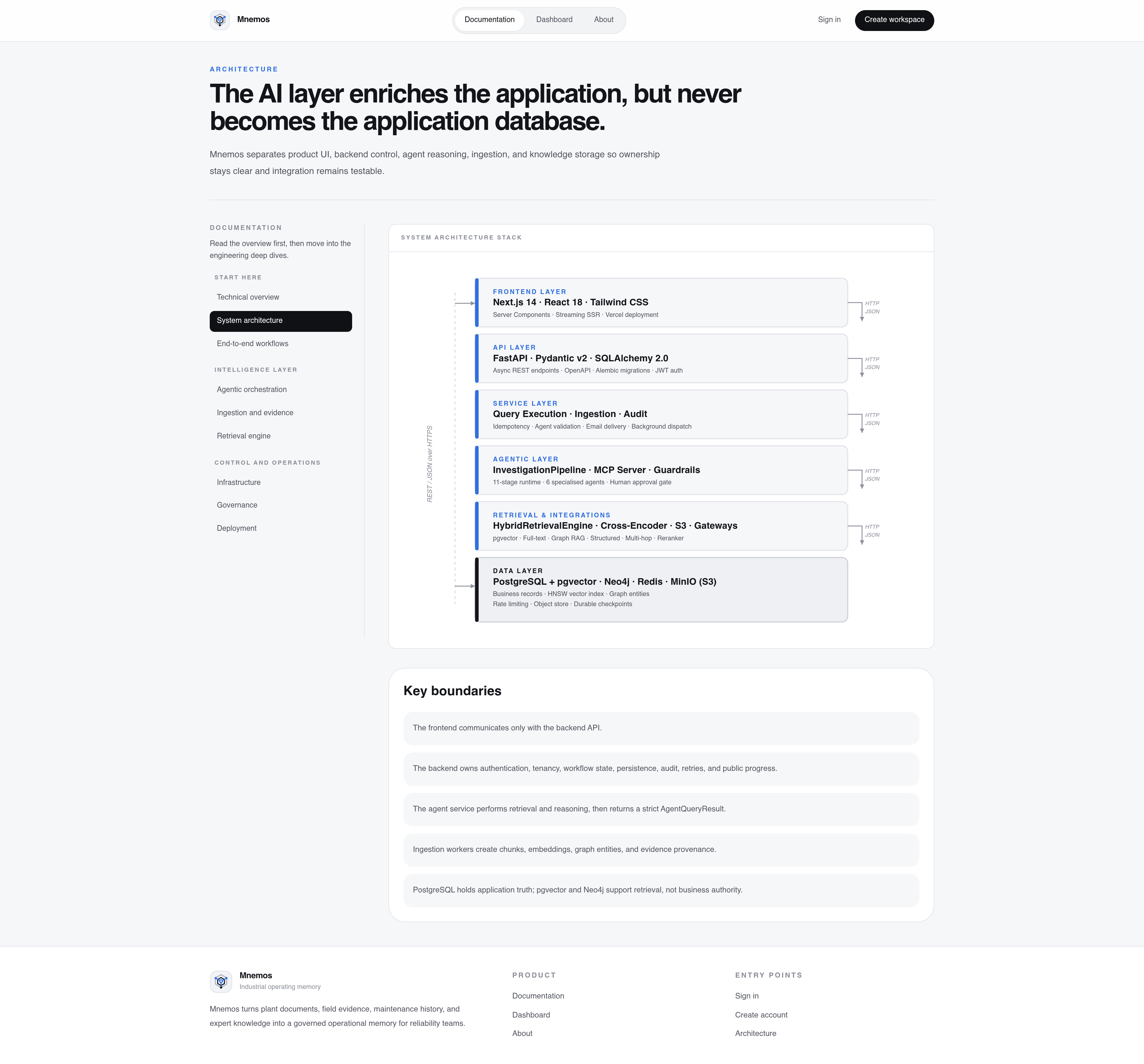
Mnemos uses a full-stack architecture designed around evidence provenance, scoped access, durable workflows, and graceful provider degradation.
The frontend is built with Next.js and React. It includes the plant overview, asset passports, investigations, compliance matrices, document management, expert knowledge, query execution, agentic traces, results, organisation management, and technical documentation.
The backend is built with FastAPI, Pydantic, SQLAlchemy, and PostgreSQL. PostgreSQL stores application state, asset records, evidence regions, document chunks, investigations, audit records, checkpoints, approvals, and tenant-scoped data.
Retrieval combines:
- vector retrieval through pgvector;
- lexical retrieval for exact asset tags, procedure codes, and part numbers;
- structured filtering for time, status, site, and asset constraints;
- Neo4j graph traversal for connected operational context;
- reranking, deduplication, and bounded context construction;
- evidence verification and citation mapping.
The agentic runtime uses LangGraph-based orchestration. Queries are classified, scoped, planned, retrieved, verified, analysed by relevant specialist agents, and composed into a final evidence-aware response.
The system also includes:
- JWT authentication and role-based access;
- tenant and site isolation;
- guarded document uploads;
- checksum-based duplicate detection;
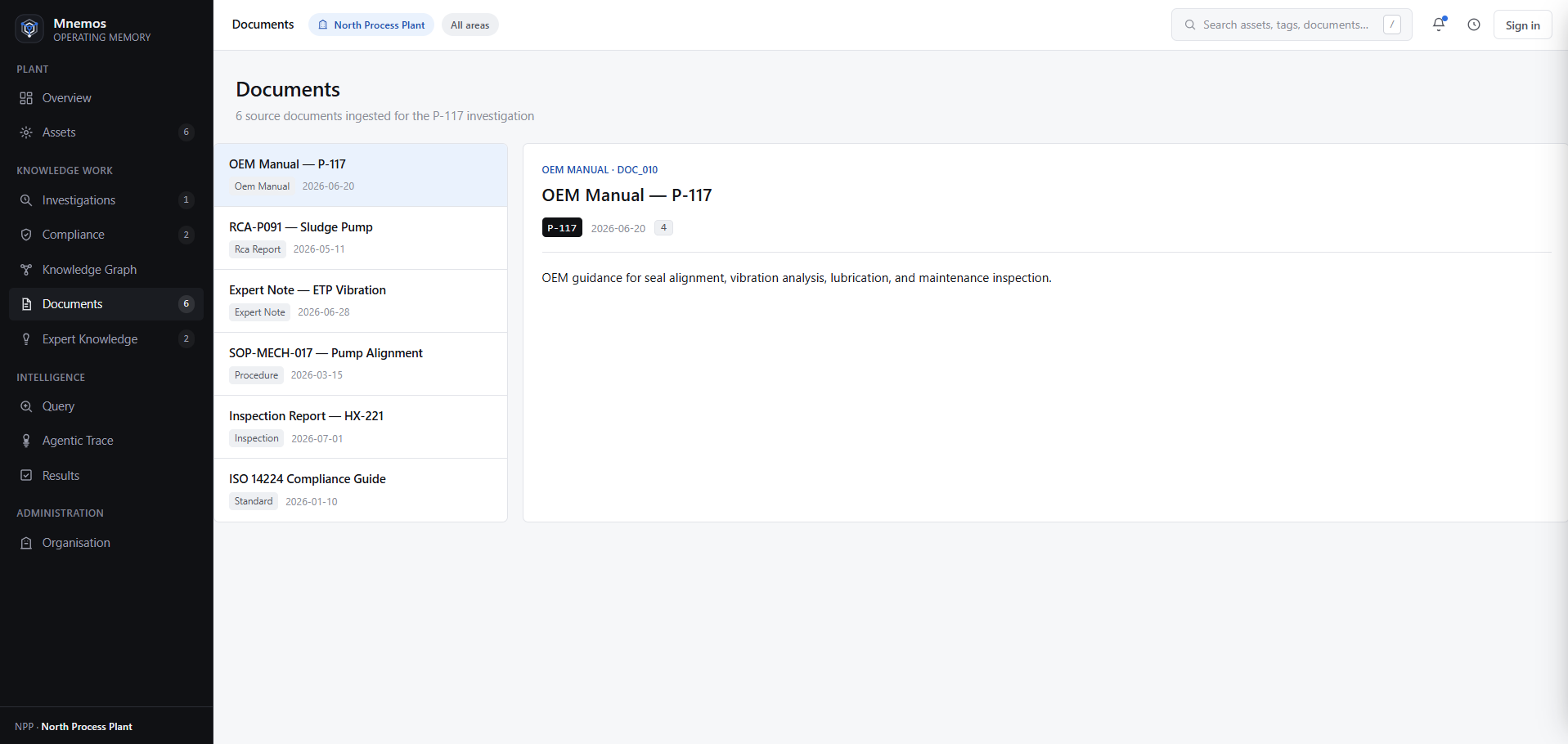
- bounded PDF, TXT, Markdown, CSV, DOCX, and XLSX extraction;
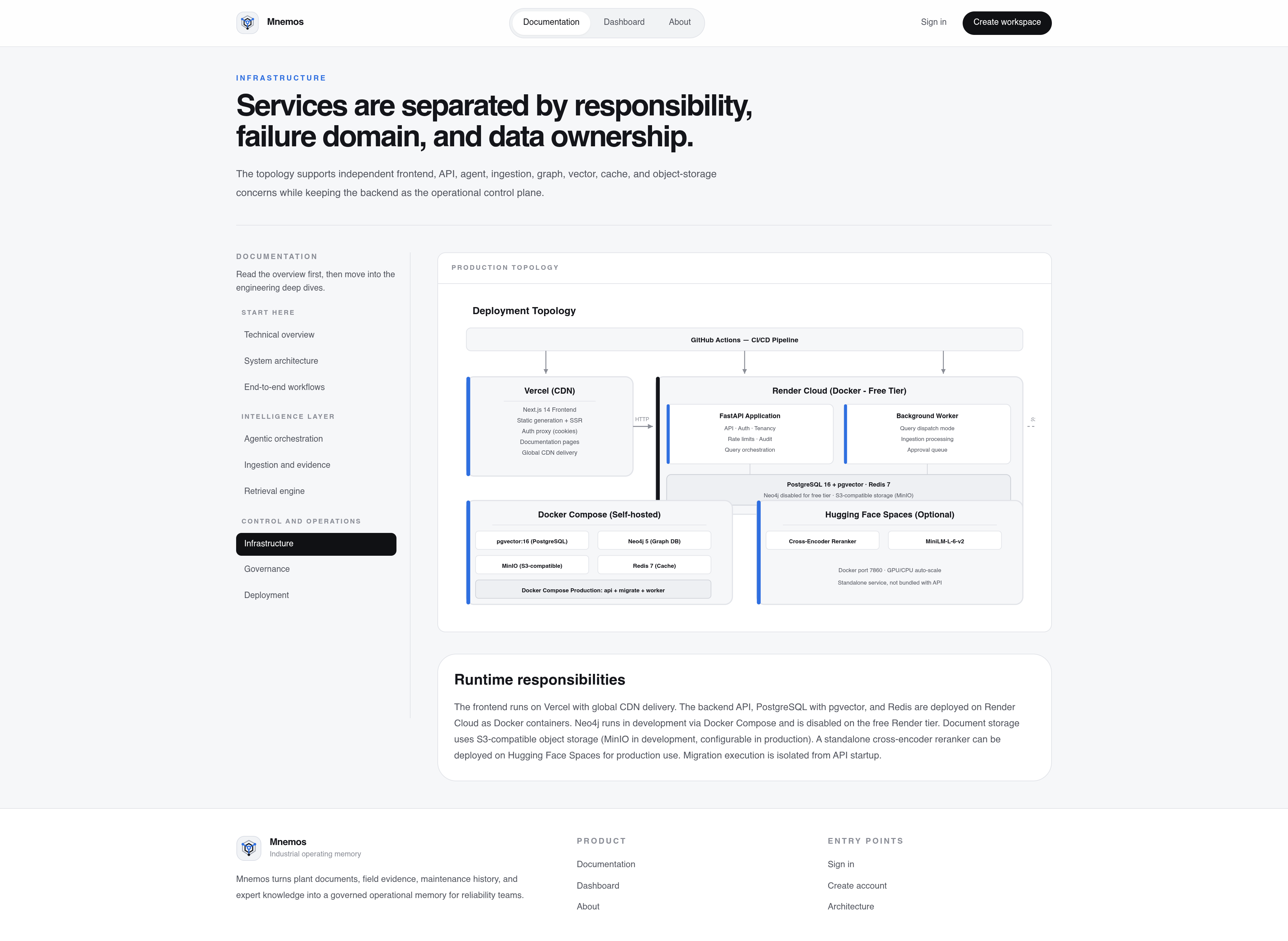
- S3-compatible object storage;
- Redis-backed infrastructure;
- structured logging and observability hooks;
- human review and approval gates;
- durable workflow checkpoints;
- deterministic evaluation and regression testing;
- Vercel frontend deployment and Render backend deployment.
Challenges I ran into
One of the hardest challenges was avoiding the behaviour of a generic document chatbot.
Industrial questions depend on asset identity, time, revision history, site scope, and source authority. A procedure can be semantically relevant but operationally invalid because it has been superseded. A field observation can be useful while still requiring expert review before it influences a formal decision.
Another challenge was handling insufficient evidence correctly. The system needed to distinguish between:
- a vague question;
- a question with no relevant evidence;
- conflicting evidence;
- incomplete evidence;
- provider or retrieval failure.
Instead of producing confident but unsupported answers, Mnemos has to abstain clearly, explain what is missing, and recommend the next useful source or query.
Multi-agent orchestration also introduced engineering challenges. Parallel specialists required isolated execution state, bounded tool access, output deduplication, timeout handling, and a controlled final composer so internal agent traces were not exposed as the user-facing answer.
We also had to design graceful degradation. Neo4j, the reranker, embedding services, and the language-model provider may not always be available. The application therefore retains lexical evidence and deterministic fallback behaviour rather than treating every external dependency failure as a total system failure.
Accomplishments that I'm proud of
We built an end-to-end industrial knowledge intelligence platform rather than a standalone chat interface.
The completed system includes:
- an asset-centred operational data model;
- guarded multi-format document ingestion;
- source-located evidence and document chunks;
- hybrid retrieval across relational, vector, lexical, and graph sources;
- evidence-backed natural-language answers;
- contradiction and missing-evidence disclosure;
- root-cause investigation workflows;
- interactive knowledge-graph exploration;
- compliance evidence tracking;
- governed expert-knowledge capture;
- durable execution and approval workflows;
- role-based tenant isolation;
- structured agentic traces and observability;
- deterministic evaluation gates;
- a complete public demonstration and technical documentation experience.
The evaluation framework tracks citation precision, abstention quality, retrieval behaviour, grounding, scope isolation, provider degradation, and workflow durability without presenting deterministic regression results as production model accuracy.
What I learned
The most important lesson was that trustworthy AI systems depend less on how fluent the model sounds and more on how carefully evidence, scope, uncertainty, and authority are controlled.
We learned that:
- provenance must be part of the data model rather than added after answer generation;
- abstention is a product feature, not simply a model failure;
- retrieval success and evidence sufficiency are different conditions;
- graph context is valuable only when it maps back to source evidence;
- specialist agents need strict tool, scope, retry, and execution boundaries;
- operational workflows require durable state beyond the lifetime of one API request;
- human approval must be represented explicitly in both the backend and user interface;
- graceful degradation is essential when several AI and infrastructure providers are involved;
- the interface must reveal confidence and evidence gaps without exposing confusing internal pipeline details.
What's next for Mnemos
The next phase is focused on making Mnemos easier to integrate with real industrial environments.
Planned improvements include:
- OCR support for scanned maintenance and inspection documents;
- connectors for CMMS, EAM, QMS, historian, and document-management systems;
- stronger asset and document identity resolution;
- richer temporal and revision-aware reasoning;
- expanded contradiction and stale-evidence detection;
- configurable industrial taxonomies and site-specific schemas;
- larger pinned evaluation corpora with retained run artefacts;
- deeper runtime observability and cost monitoring;
- more granular reviewer and approval workflows;
- pilot deployments with maintenance and reliability teams.
The long-term objective is to make every operational conclusion traceable: what is known, where it came from, what contradicts it, what is still missing, and who has the authority to act on it.
Built With
- alembic
- css
- cytoscape.js
- docker
- fastapi
- groq
- javascript
- jwt
- langgraph
- neo4j
- next.js
- opentelemetry
- pgvector
- postgresql
- pydantic
- python
- rag
- react
- redis
- render
- s3
- sqlalchemy
- tailwind
- vercel


Log in or sign up for Devpost to join the conversation.