-
-
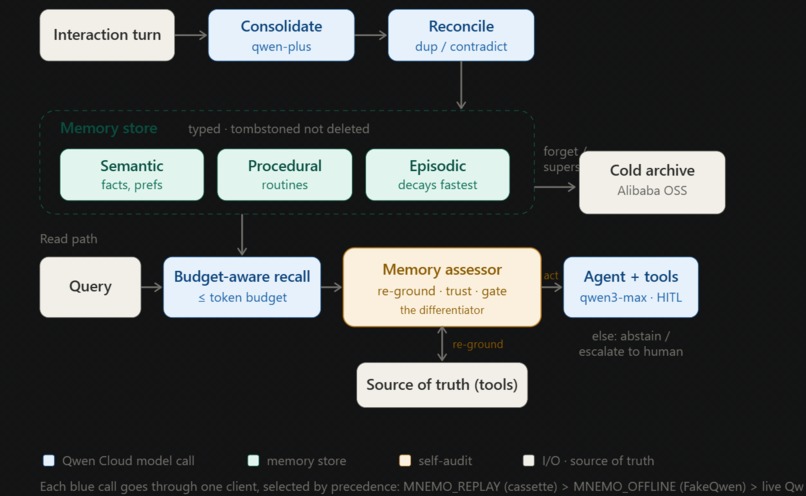
Architecture
Inspiration
AI agents are becoming better at reasoning, tool use, and long-running workflows, but their memory is still fragile.
Most agent-memory implementations focus on storing more information. In practice, an enterprise agent also needs to decide:
- What is worth remembering?
- Which facts are still current?
- What should happen when new information contradicts old information?
- How can a user inspect why a memory was retained, replaced, or forgotten?
- How can memory behaviour be tested rather than treated as a black box?
This motivated Mnemo, a self-auditing memory layer for AI agents. The goal is not simply to create a larger vector store, but to create a memory system that is selective, correctable, explainable, and testable.
What Mnemo does
Mnemo observes conversations or agent events and extracts candidate memories such as:
- User preferences
- Operational facts
- Decisions
- Procedures
- Entity relationships
- Time-sensitive updates
Each candidate is assessed before storage. Mnemo records attributes such as memory type, importance, confidence, entities, provenance, and verification status.
When new information arrives, Mnemo can:
- Detect that it relates to an existing memory.
- Identify possible contradictions.
- Decide whether the new information should coexist with, supersede, or invalidate the older memory.
- Preserve an audit trail of the decision.
- Return the most relevant and current memory during recall.
The system also supports explicit forgetting. A memory can be removed from active recall while the reason and related audit event remain available for inspection.
How I built it
Mnemo is implemented as a modular Python application with a FastAPI service layer.
The main workflow is:
Conversation or event
        ↓
Candidate-memory extraction
        ↓
Memory assessment
        ↓
Duplicate and contradiction detection
        ↓
Store, update, supersede, or reject
        ↓
Semantic recall with provenance
        ↓
Auditable forgetting and replay


Log in or sign up for Devpost to join the conversation.