Inspiration
Every Slack bot has amnesia. You tell it your deadline on Monday and it's a stranger by Thursday. The obvious fix — replay the whole conversation history into every prompt — makes the bot slower, costlier, and noisier the longer you use it. Human memory doesn't work that way: we keep what's important, we compress experiences into knowledge while we sleep, and we forget the rest. Mnemo brings that lifecycle to a Slack workspace.
What it does
Mnemo is a Slack-native memory teammate:
- AI Assistant pane — chat naturally; Mnemo recalls relevant memories under a hard token budget, answers from them, and writes new facts back. Every reply includes its accounting: memories used, context tokens spent, and % smaller than dumping full history.
- /remember, /recall, /sleep — explicit controls: store a fact, inspect exactly what the agent would recall about a topic, and trigger a "sleep" pass.
- "Remember this" message shortcut — save any teammate's message to memory in two clicks.
- @mnemo in channels — channels get their own shared memory, fully separate from each user's private memory.
- /mnemo-token + MCP — mint a personal token and add Mnemo as an MCP server in Claude Desktop or Claude Code; it reads and writes the exact same memory Slack sees.
The differentiator is the memory lifecycle, not just storage:
- Budget-aware recall — memories are ranked by embedding relevance x importance and greedy-packed into a token budget, so context stays small and cheap forever.
- Salience-scored write-back — identity, preferences, deadlines, and numbers score higher than chit-chat.
- Sleep-time consolidation — related episodic memories are clustered; agreeing ones are LLM-summarized into durable semantic facts and the raw events are demoted.
- Conflict detection — clusters that disagree (a time, date, or decision with two different values) are flagged back to the channel instead of silently merged — a feature that only makes sense for shared team memory, not a personal notes app.
- Forgetting — memories decay on a half-life curve and low-value ones are pruned, so the store never grows without bound.
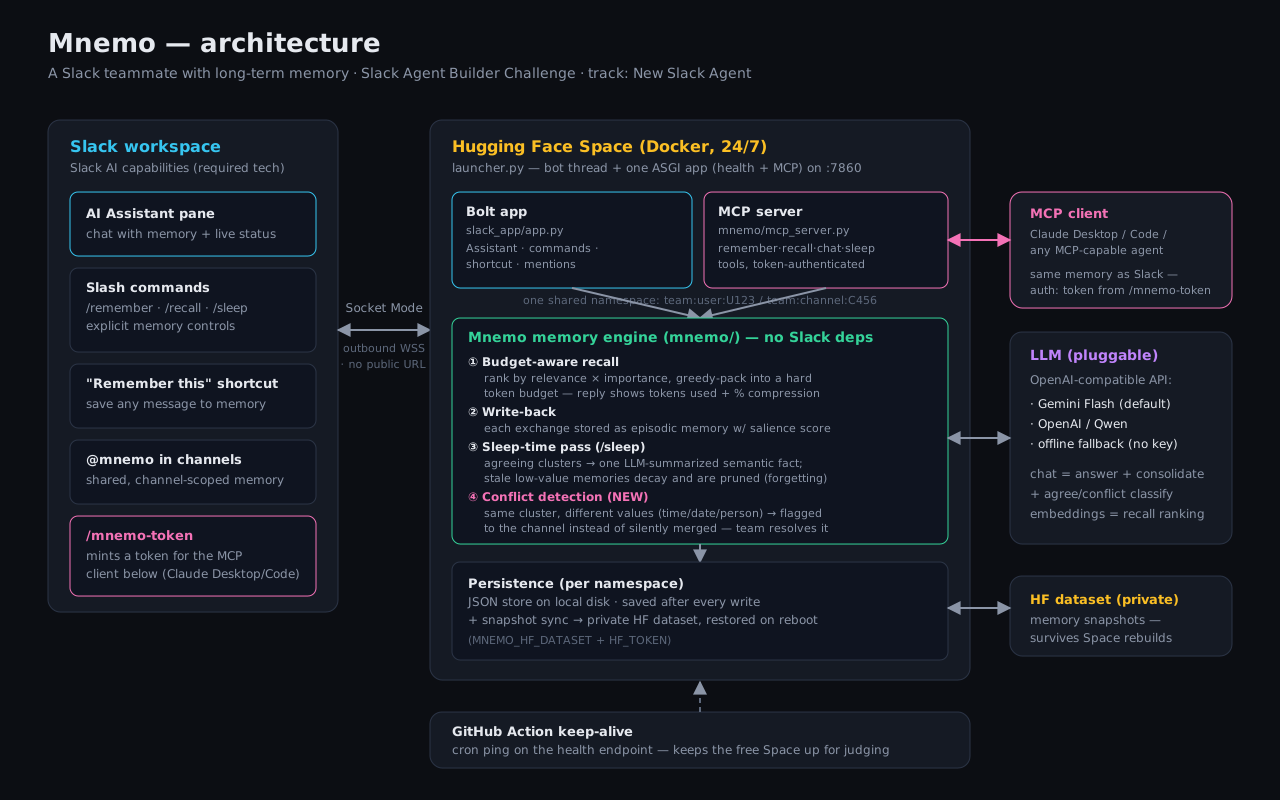
Architecture
How we built it
- Slack layer: Bolt for Python + the Assistant class (AI Assistant pane, suggested prompts, live status), slash commands, message shortcut, and app_mention events — all over Socket Mode, so no public endpoint is needed. App defined by a checked-in manifest for one-paste reproduction.
- Memory engine: pure Python, zero Slack imports: a memory store with episodic/semantic kinds, cosine retrieval modulated by importance and access frequency, greedy budget packing, clustering + LLM summarization for consolidation, agree/conflict classification, and time-decay pruning.
- MCP surface: mnemo/mcp_server.py exposes the same engine over streamable-HTTP, mounted alongside the health check in one ASGI app. Auth is a stateless HMAC token binding a caller to their Slack team:user namespace — no token database, and it resolves to the exact namespace string the Slack side uses, verified end-to-end so a Slack-written memory shows up over MCP and vice versa.
- LLM: provider-agnostic OpenAI-compatible client — Hugging Face Inference Providers by default (Llama 3.1 8B Instruct, free tier), Gemini/OpenAI/Qwen via env, and a deterministic offline fallback (including for conflict classification) so the whole system runs and self-tests with zero API keys.
- Deployment: Docker on a Hugging Face Space running 24/7, with a scheduled GitHub Action keep-alive and memory snapshots synced to a private HF dataset so memory survives container rebuilds.
Challenges we ran into
- Making recall provably cheap: we return the full accounting (tokens used vs. full-history tokens) from the store so the UI can show real compression numbers instead of vibes.
- Telling disagreement from paraphrase: cosine similarity alone can't distinguish "standup is at 9am" from "standup is at 9:30am" — they're topically identical. We added an LLM (and offline heuristic) classification pass specifically for that.
- Keeping two independent surfaces (Slack, MCP) from caching two different views of the same memory in one process — solved with a process-wide router singleton, and caught by an end-to-end test that writes through one surface and reads through the other.
- Free-tier hosting for a bot that must run for a 3-week judging window: Socket Mode + health-endpoint keep-alive + snapshot restore on reboot.
Accomplishments we're proud of
- A memory lifecycle (remember, recall, consolidate, flag conflicts, forget), not just a vector dump.
- The same memory follows you off Slack — teach Mnemo something in Slack, ask Claude Desktop about it a minute later.
- Visible token accounting in every reply — you can watch the budget work.
- The engine runs, demos, and self-tests entirely offline, including conflict detection; the LLM is a plug-in, not a dependency.
What we learned
Slack's Assistant APIs make an agent feel native for very little code — the hard part, and the differentiator, is what your agent does between messages, and how far its memory reaches beyond the one app that wrote it.
What's next for Mnemo
- Automatic nightly sleep passes per namespace (no /sleep needed).
- Push conflict alerts and consolidated digests as scheduled channel messages, not just /sleep output.
- More MCP tools: search across a whole channel's semantic memory, not just one namespace at a time.


Log in or sign up for Devpost to join the conversation.