-
-
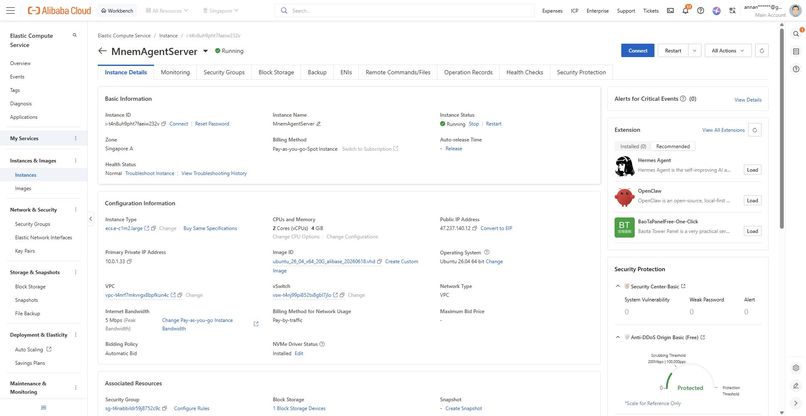
Alibaba ECS proof: running Singapore spot instance
-
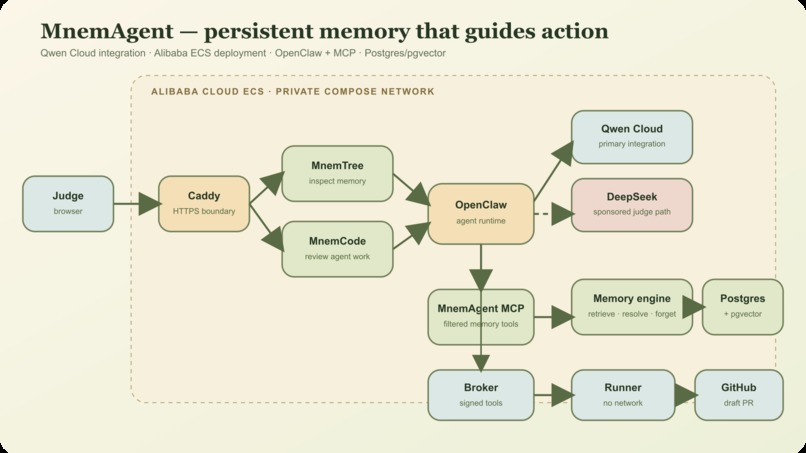
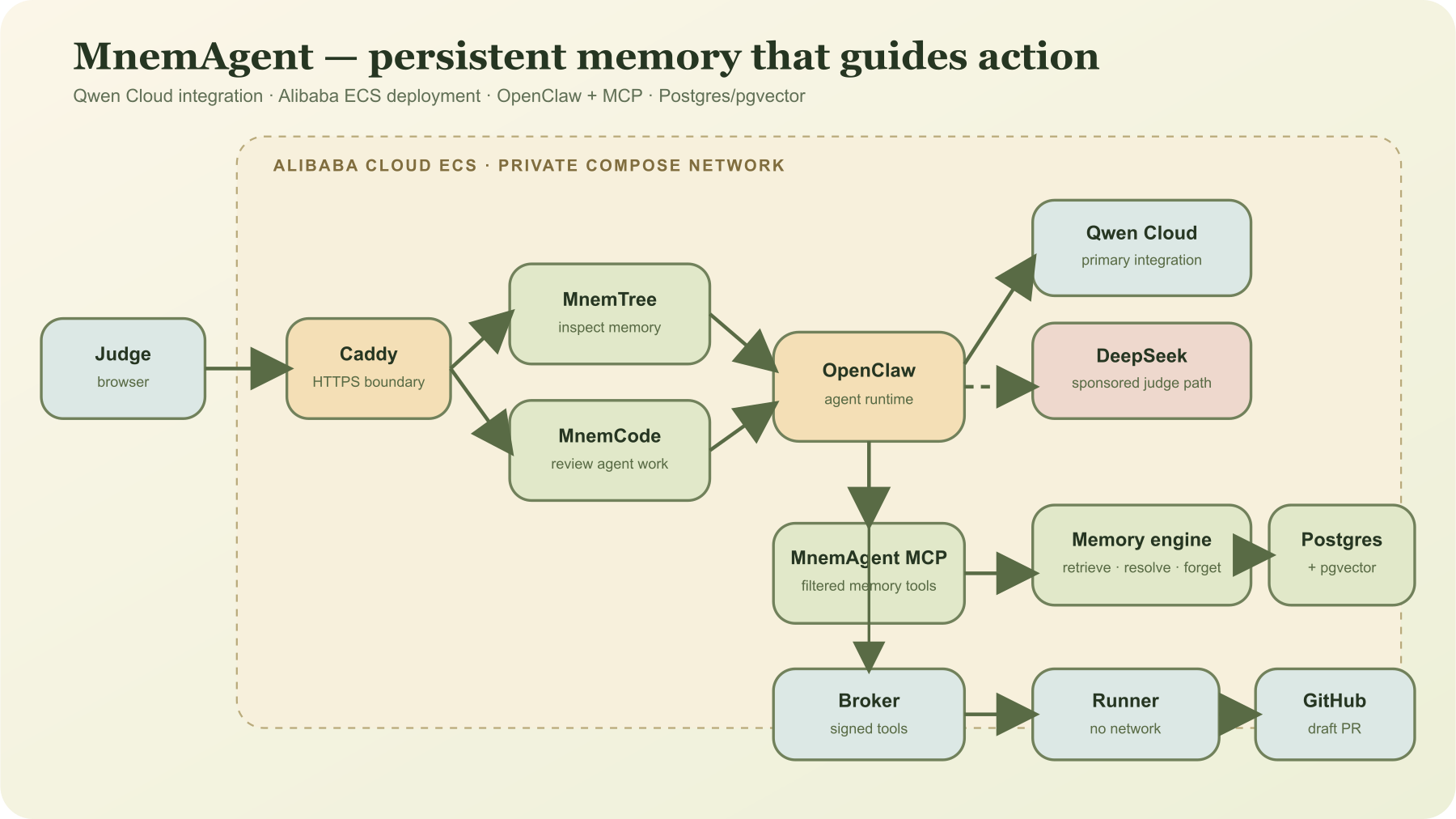
Architecture: Qwen Cloud, OpenClaw/MCP, Postgres, and MnemCode
-

MnemAgent — selective, living memory for OpenClaw
-
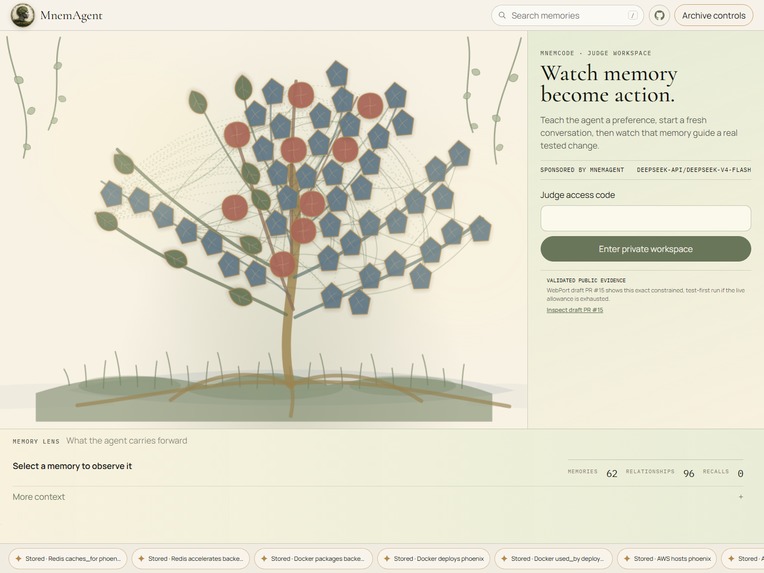
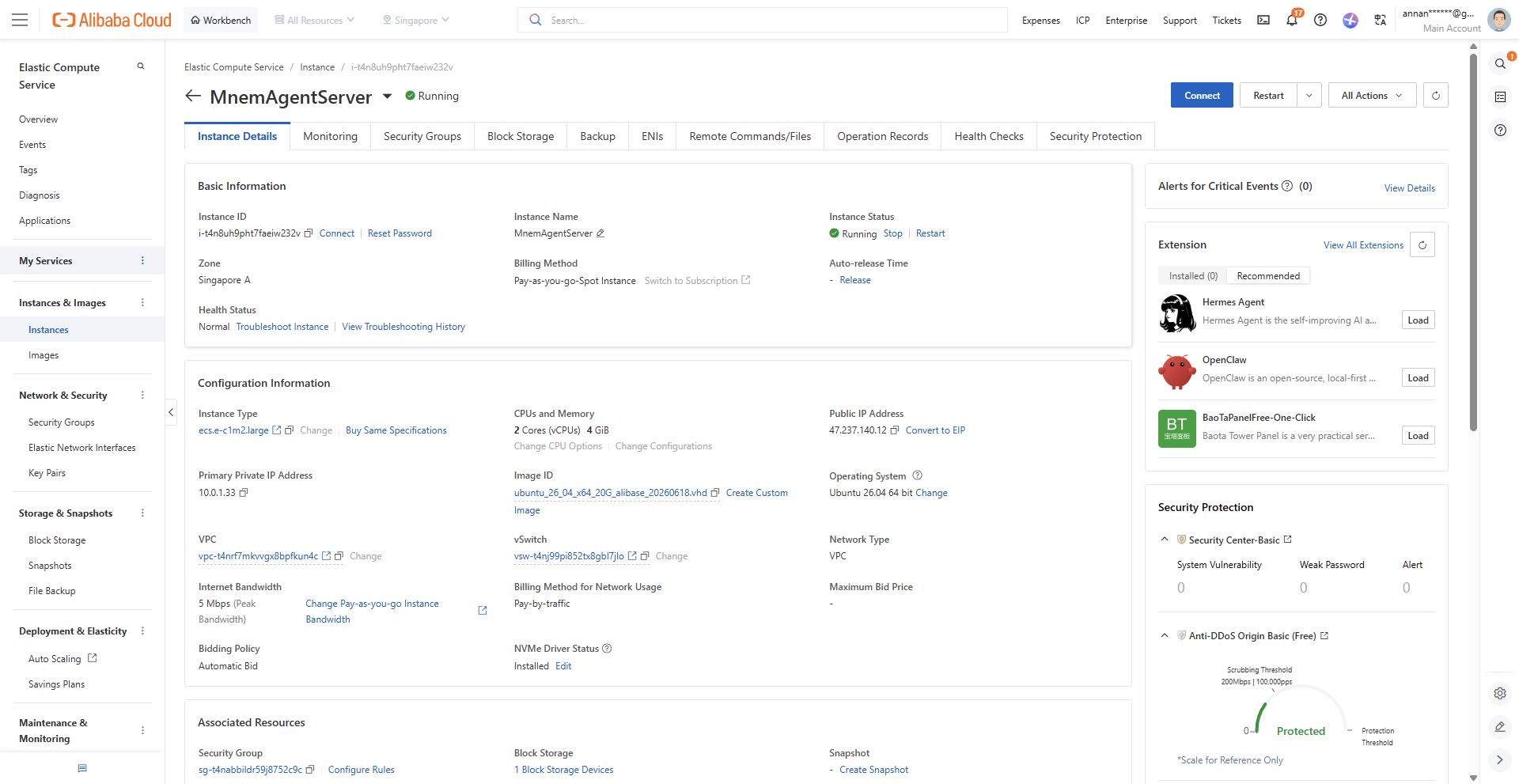
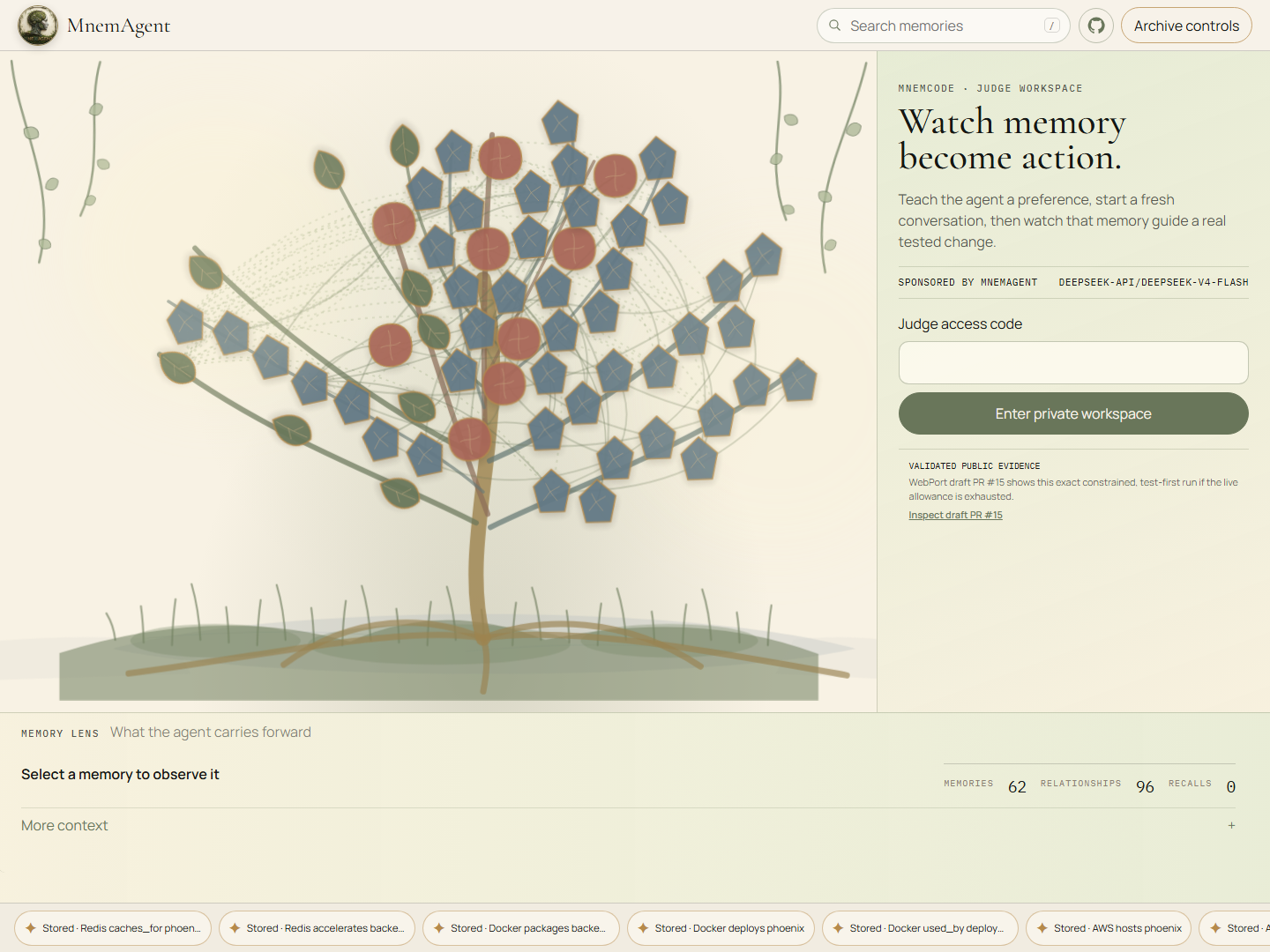
MnemTree: 62 searchable memories and 96 live relationships

Track 1: MemoryAgent
Agents are good at a turn and bad at a relationship. They either forget the decision made last week, or they keep every transcript fragment until stale facts and casual guesses crowd out the preference that actually matters.
MnemAgent is a persistent memory control plane for OpenClaw. A belief must earn storage, earn retrieval, and survive decay. The agent carries useful experience across sessions, replaces a stale belief only inside the correct scope, recalls at most six memories per turn, and makes every memory lifecycle event inspectable.
One story, three proof surfaces
MnemTree — inspect it. The living archive turns memories, relationships, confidence, recall activity, revisions, and fading beliefs into a searchable visual tree. MnemBench — measure it. Multi-session scenarios test preference retention, contradiction handling, bounded context, interference, and project continuity against a stateless baseline. MnemCode — see the consequence. A judge teaches the agent a coding preference, starts a fresh conversation, and asks for a repository change. The isolated agent retrieves that preference, explains its plan, runs tests, shows a diff, and can publish a draft PR only after explicit approval.
This is deliberately more than a memory dashboard. The memorable choice changes what the agent does.
Five-minute judge path
Open the live Alibaba Cloud deployment. It lands on a populated 62-memory archive so the system is legible immediately. Search the tree or select a leaf to inspect what the agent remembers and how memories relate. Enter the private judge access code from the testing instructions. Each signed workspace lasts seven days and includes 30 sponsored chat turns, 5 coding runs, and 5 draft-PR publications. Tell the agent a durable rule, for example: “For this repository, preserve backward compatibility and add a regression test before changing behavior.” Start a fresh conversation, ask it to recall the rule, then open the prepared WebPort issue #14 coding scenario. Run the constrained coding task. Review the recalled memory, tool trace, tests, and diff. Publication remains a separate approval. If the live allowance is busy or exhausted, inspect validated WebPort draft PR #15, produced by this same test-first workflow.
The memory engine
The synchronous waking path embeds the query, retrieves semantic and associative candidates, applies scope and decay, ranks them with an Upper Confidence Bound-style utility score, injects no more than six memories, and calls the model.
The asynchronous dreaming path parses structured memory updates, applies salience gates, atomically resolves contradictions, writes semantic and episodic records to PostgreSQL/pgvector, updates recall utility, emits lifecycle events, and prunes sufficiently weak memories.
That design addresses the track directly:
Efficient storage and retrieval: salience-gated writes, vector candidates, graph hops, bounded recall. Timely forgetting: time decay, confidence/usefulness thresholds, and pruning. Critical recall in limited context: scope-aware UCB ranking with a hard six-memory prompt cap. Cross-session improvement: recall outcomes update utility, while corrections replace only the matching user/project belief.
Agentic depth and safety
OpenClaw is the agent runtime and MnemAgent is mounted through MCP tools. MnemCode adds a narrow, defensible cloud-coding workflow: signed/HMAC-bound sessions, per-judge namespaces, quotas, at most 12 active workspaces, no-network non-root runners, repository allowlists, time/output limits, and an explicit approval boundary before a draft PR.
MnemBench and MnemCode are optional proof layers. Developers can discard either and use OpenClaw directly with the memory MCP servers in place, retaining OpenClaw’s broader tool and integration ecosystem. Broader one-click MnemCode task packs are in progress; this submission keeps one end-to-end workflow reliable instead of pretending every cloud-agent use case is already finished.
Evidence, without inflated claims
The latest stable PostgreSQL MnemBench v2 report scores MnemAgent 66.7 vs 23.7 on mean probe score and 76.9% vs 38.5% on pass rate. That report does not preserve a trustworthy model identifier, so we do not label it as Qwen.
A separate live OpenClaw + Qwen qwen-plus run scored 91.7 vs 8.3 on project continuity. Its overall 79.2 vs 64.6 result was driven by that scenario; preference retention and temporal decay tied, and salience filtering remained weak. The full tables and limitations are in the benchmark evidence.
The public sponsored runtime uses DeepSeek V4 Flash so judges can test without supplying a model key. Qwen results are never attributed to DeepSeek, or vice versa.
Qwen Cloud and Alibaba Cloud
Qwen Cloud is the primary integration and evaluation path. The repository contains Alibaba Cloud Model Studio’s accepted international endpoint:
https://dashscope-intl.aliyuncs.com/compatible-mode/v1
The backend is live on an Alibaba Cloud ECS spot instance in Singapore behind Caddy/HTTPS, with PostgreSQL/pgvector, the memory API, MCP server, OpenClaw harness, workspace broker, and isolated runner packaged in Docker Compose. Optional Alibaba OSS snapshot support is included.
Source repository Alibaba Cloud and Qwen endpoint proof Architecture diagram and boundaries Judge guide Security model
Why it matters
Persistent memory is infrastructure for any agent expected to improve rather than reset: coding assistants, support agents, research partners, personal workflows, and long-running business processes. MnemAgent makes that infrastructure selective, bounded, correctable, portable through MCP, and visible enough for a human to trust.
Built With
- alibaba-cloud-ecs
- deepseek
- docker
- fastapi
- model-context-protocol-(mcp)
- node.js
- openclaw
- pgvector
- postgresql
- python
- qwen-cloud


Log in or sign up for Devpost to join the conversation.