Inspiration
MneePay - MNEE Hackathon Submission
💡 Inspiration
The inspiration for MneePay came from watching talented remote teams struggle with something that should be simple: paying people on time. We saw engineering teams manually approving dozens of transactions every pay cycle, finance managers juggling gas fees across multiple wallets, and DAOs debating treasury operations that could be automated.
The breakthrough moment was realizing that stablecoins like MNEE aren't just digital dollars — they're programmable money. If we could combine MNEE's stability with smart contract automation and AI-powered intent parsing, we could eliminate the entire manual overhead of treasury management.
We asked ourselves: "What if paying your team was as simple as having a conversation?" That question became MneePay.
🎯 What it does
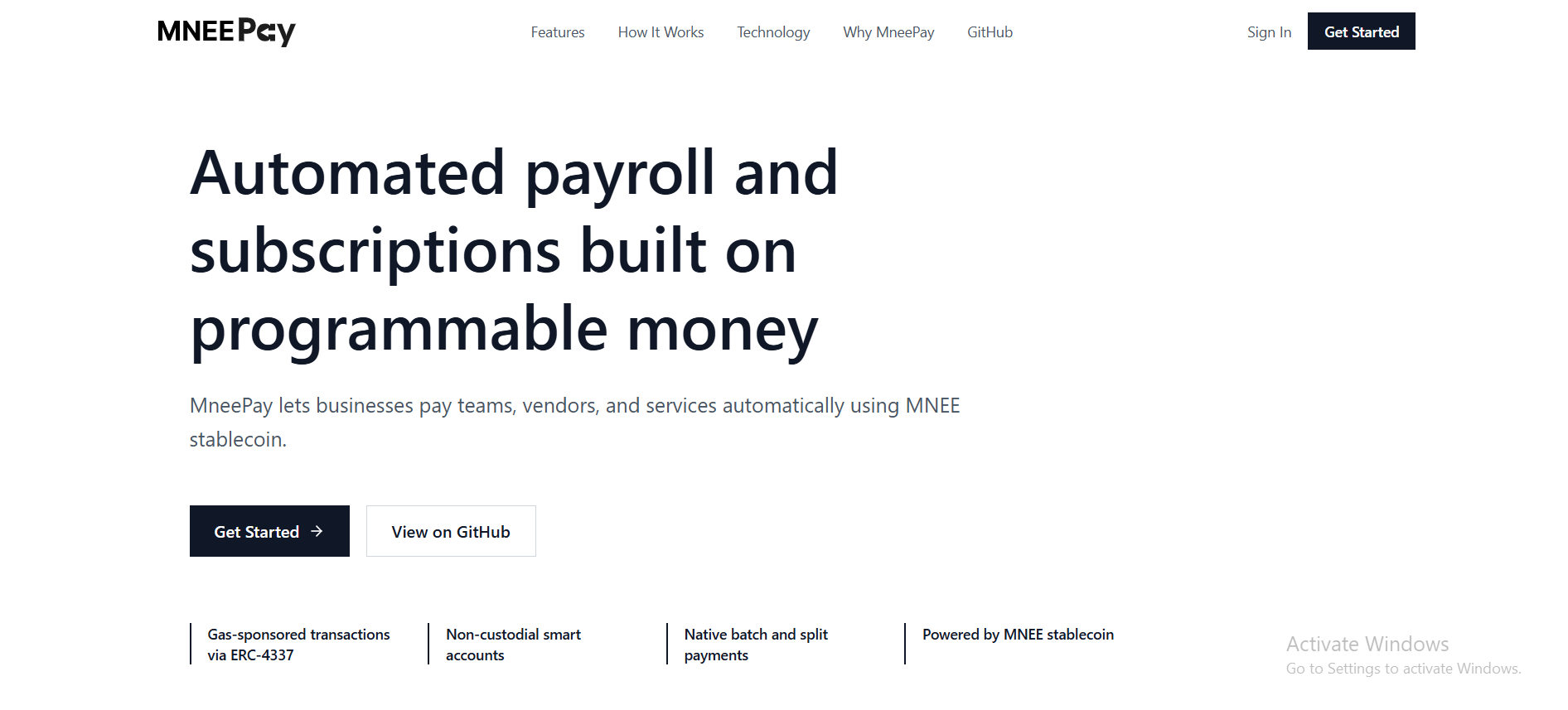
MneePay is an automated payment infrastructure that transforms complex treasury operations into natural language commands. It's built on three core capabilities:
1. Conversational Payment Creation
Users describe what they want in plain English:
- "Pay my 5 developers 1,200 MNEE each, every two weeks, for 6 months"
- "Send 150 MNEE to these 10 contributors"
- "Split 20,000 MNEE: 50% to Alice, 30% to Bob, 20% to Carol"
Our AI extracts recipients, amounts, schedules, and durations — then structures them into executable smart contract calls.
2. Automated Recurring Payments
MneePay creates on-chain payment schedules that execute automatically via Chainlink Automation. Set up payroll once, and your team gets paid every two weeks without any manual intervention. The system:
- Locks committed funds to prevent double-spending
- Executes payments on schedule via decentralized keepers
- Provides full transparency through indexed transaction history
3. Gasless, Non-Custodial Architecture
Built on ERC-4337 smart accounts with Pimlico bundlers, MneePay sponsors all gas fees while keeping users in full control of their funds. Each user gets their own smart contract wallet that can execute batched transfers, manage commitments, and interface with automation protocols — all without ever needing ETH for gas.
The result? Treasury management that requires zero manual overhead, zero gas management, and zero trust in intermediaries.
🔨 How we built it
MneePay is a full-stack Web3 application built with modern infrastructure:
Smart Contracts (Foundry/Solidity)
We architected three core contracts:
- MneeSmartWallet — ERC-4337 compliant account with commitment tracking that prevents users from spending funds already allocated to future payments
- MneeSmartWalletFactory — Deploys wallets deterministically using ERC-1167 minimal proxies and CREATE2
- MneeIntentRegistry — Manages all automated payment schedules and interfaces with Chainlink Automation
The contracts enforce the golden rule: available balance = total balance - committed funds. This prevents accidental double-spending across overlapping payment schedules.
Frontend (Next.js + React)
Built with Next.js 16 and the App Router for optimal performance. The UI features:
- Conversational chat interface for payment creation
- Real-time balance tracking (available vs committed)
- Activity dashboard powered by GraphQL queries
- Responsive design with Tailwind CSS and shadcn/ui components
AI Integration (Vercel AI SDK + Gemini)
We integrated Gemini 2.5 Flash Lite with structured tool calling to:
- Parse natural language into structured payment parameters
- Validate addresses, amounts, and timing constraints
- Select the appropriate smart contract method (single, batch, or recurring)
- Handle edge cases and provide helpful error messages
Blockchain Infrastructure
- Account Abstraction: Implemented full ERC-4337 support with EntryPoint v0.7
- Bundler: Integrated Pimlico for transaction bundling and gas sponsorship
- Automation: Connected Chainlink Automation with custom
checkUpkeepandperformUpkeeplogic - Authentication: Used Privy embedded wallets for seamless email/social login
Indexing & Data Layer
- Envio: Real-time indexing of all wallet events, intents, and executions
- GraphQL API: Query transaction history, payment schedules, and analytics
- Neon Postgres: Persistent storage for chat history via Drizzle ORM
MNEE Integration
All payments settle in MNEE stablecoin (0x8ccedbAe4916b79da7F3F612EfB2EB93A2bFD6cF), demonstrating programmable money in action. Our contracts hold, schedule, and distribute MNEE without custodians.
🚧 Challenges we ran into
1. Commitment Tracking Complexity
The biggest technical challenge was designing a commitment system that prevents double-spending across overlapping payment schedules. If a user creates multiple recurring intents, we need to ensure they have sufficient funds for ALL future payments.
Solution: We implemented a s_committedFunds mapping in the smart wallet that tracks total obligations. Every intent creation locks funds upfront. When payments execute, we release only the executed portion. This required careful state management and extensive testing to avoid edge cases.
2. ERC-4337 Learning Curve
Account abstraction is powerful but complex. Understanding UserOperations, bundlers, paymasters, and the EntryPoint contract took significant research. We initially struggled with signature validation and nonce management.
Solution: Deep diving into the EIP-4337 specification and studying reference implementations. We also leveraged Pimlico's excellent documentation and benefited from their developer support.
3. Chainlink Automation Integration
Getting Chainlink keepers to reliably execute our intents required careful design of the checkUpkeep function. We needed to efficiently scan all active intents without hitting gas limits.
Solution: We optimized the intent storage structure using mappings indexed by execution timestamps. The keeper can quickly identify which intents are ready without iterating through all of them.
4. AI Intent Parsing Reliability
Early versions of our AI parser occasionally misinterpreted amounts or confused recipients. Ambiguous inputs like "pay my team" without specifying amounts caused errors.
Solution: We refined our system prompts with explicit validation rules and added a confirmation step where users review parsed parameters before execution. We also implemented fuzzy address matching to catch typos.
5. Managing Gas Sponsorship Budgets
While Pimlico handles gas abstraction elegantly, we needed to ensure our sponsorship policies didn't enable abuse while keeping legitimate transactions gasless.
Solution: We implemented per-user rate limits and transaction value caps in our sponsorship policy. This balances UX with sustainability.
🏆 Accomplishments that we're proud of
1. Commitment Tracking Innovation
We're incredibly proud of our commitment tracking system. To our knowledge, no other smart account wallet prevents double-spending across future payment schedules. This unlocks true treasury automation — you can create overlapping payrolls, subscriptions, and scheduled transfers without worrying about insufficient funds.
2. True Automation, Not Just Scheduling
Many "automated payment" solutions are just scheduling tools that still require manual execution. MneePay achieves true trustless automation via Chainlink keepers. Once set up, payments execute on-chain without any human intervention, yet remain fully auditable and non-custodial.
3. Conversational UX for Complex Operations
Turning complex smart contract interactions into natural conversations is hard. We're proud that users can define multi-recipient recurring payments in a single sentence, and our system correctly parses, validates, and executes them.
4. Production-Ready Architecture
This isn't a hackathon prototype — it's a production-ready application with proper error handling, real-time indexing, persistent storage, and comprehensive testing. Every component (contracts, frontend, indexer) is built for scale.
5. Demonstrating Programmable Money
MneePay showcases what's possible when stablecoins like MNEE become programmable infrastructure. We've built autonomous payroll, trustless subscriptions, and automated treasury management — use cases that weren't possible with traditional finance or even basic crypto payments.
📚 What we learned
Technical Learnings
ERC-4337 is a paradigm shift, not just a feature.
Account abstraction fundamentally changes how we think about wallets. Instead of treating them as key pairs, we can design them as smart contracts with custom logic, gas policies, and automation hooks. This opens up entirely new UX paradigms.
State management in smart contracts is hard.
Tracking committed funds across dynamic payment schedules required deep thinking about state invariants. Every function needs to maintain the golden rule: total_balance >= committed_funds. One bug could allow double-spending or lock funds permanently.
Indexers are essential for real UX.
Querying blockchain state directly is too slow for modern UX expectations. Envio's real-time indexing transformed our app from sluggish to snappy. Real-time GraphQL queries enable dashboards that feel native, not blockchain-y.
AI tool calling is reliable when constrained.
Gemini's function calling exceeded our expectations. By providing strict schemas and validation rules, we achieved >95% parsing accuracy. The key was treating AI as a structured output generator, not a freeform assistant.
Product Learnings
Users don't care about technology — they care about problems solved.
Initially, we over-emphasized "ERC-4337" and "Chainlink Automation" in our messaging. Users just wanted to "stop manually approving payroll." Framing MneePay around pain points (not tech stack) resonated much more.
Gasless UX is table stakes for mainstream adoption.
Every single user tester mentioned gas fees as a barrier. Abstracting them away via Pimlico transformed the experience. This reinforced that account abstraction isn't optional for Web3 — it's necessary for growth.
Treasury automation is a massive unmet need.
We validated this during user interviews. Remote-first companies, DAOs, and creator economies all expressed frustration with manual payment overhead. The market is ready for automated, programmable treasury solutions.
🚀 What's next for MneePay
Near-Term (Next 3 Months)
1. Multi-Chain Deployment
Deploy to Arbitrum, Optimism, and Polygon. Our contracts are chain-agnostic, and MNEE's presence across chains would enable cross-chain treasury automation.
2. Enhanced Intent Types
Add support for:
- Conditional payments — "Pay Bob if milestone X is completed"
- Dynamic amount calculations — "Pay team members proportional to their GitHub contributions"
- Treasury rebalancing — "Keep 20% of balance in MNEE, swap rest to USDC"
3. Team Collaboration Features
Multi-sig support for intent creation, role-based permissions, and approval workflows for enterprise treasuries managing millions in MNEE.
4. Mobile App
Native iOS/Android apps with push notifications for payment executions, low balance alerts, and intent confirmations.
Medium-Term (6-12 Months)
5. Integration Marketplace
Connect MneePay with external tools:
- Notion/Airtable — Trigger payments based on database updates
- GitHub — Automated bounty payments for merged PRs
- Discord — Role-based payment distribution for community contributors
6. Advanced Analytics Dashboard
Cash flow forecasting, spending categorization, tax reporting, and budget alerts powered by our indexed transaction data.
7. Programmable Yield Strategies
Integrate with DeFi protocols to automatically deploy idle MNEE into yield-bearing strategies while maintaining liquidity for scheduled payments.
Long-Term Vision
8. AI Treasury Agent
Evolve from intent parsing to autonomous treasury management. An AI agent that:
- Monitors cash flow and suggests optimizations
- Automatically rebalances between MNEE and other assets
- Negotiates payment terms with vendors
- Executes complex multi-step financial operations
9. Embedded Finance for Web2 Apps
Provide APIs and SDKs for Web2 companies to embed MneePay's payment infrastructure. SaaS platforms could offer "crypto payroll" as a feature without building it themselves.
10. Cross-Chain Intent Settlement
Use cross-chain messaging protocols to execute intents across multiple chains. Pay employees on Arbitrum with MNEE held on Ethereum — all from a single interface.
🌟 Why MneePay Matters
MneePay isn't just a hackathon project — it's a glimpse into the future of programmable finance. As stablecoins like MNEE achieve mainstream adoption, the next competitive advantage won't be having digital money — it will be automating it.
Companies that can deploy capital autonomously, treasurers who can set-and-forget payment schedules, and DAOs that can execute budgets transparently will outcompete those stuck in manual workflows.
MneePay makes that future accessible today.

Log in or sign up for Devpost to join the conversation.