-
-
Thumbnail
Inspiration Global supply chains run on paper, but a single data mismatch between an inbound Commercial Invoice and a Bill of Lading can completely paralyze a logistics pipeline. Traditional automated parsers easily break down when dealing with unstructured text schemas, leaving teams to perform slow, manual, line-by-line document cross-referencing. We wanted to build a secure, industrial-grade solution capable of executing instant, ironclad verification at the tactical edge without relying on brittle, hardcoded rulesets.
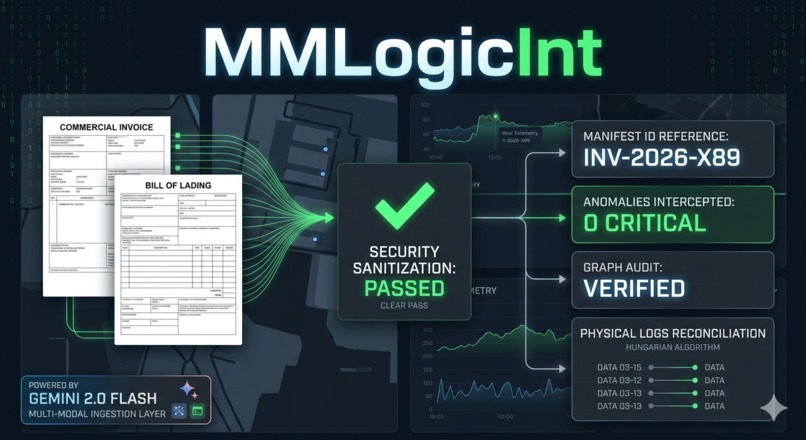
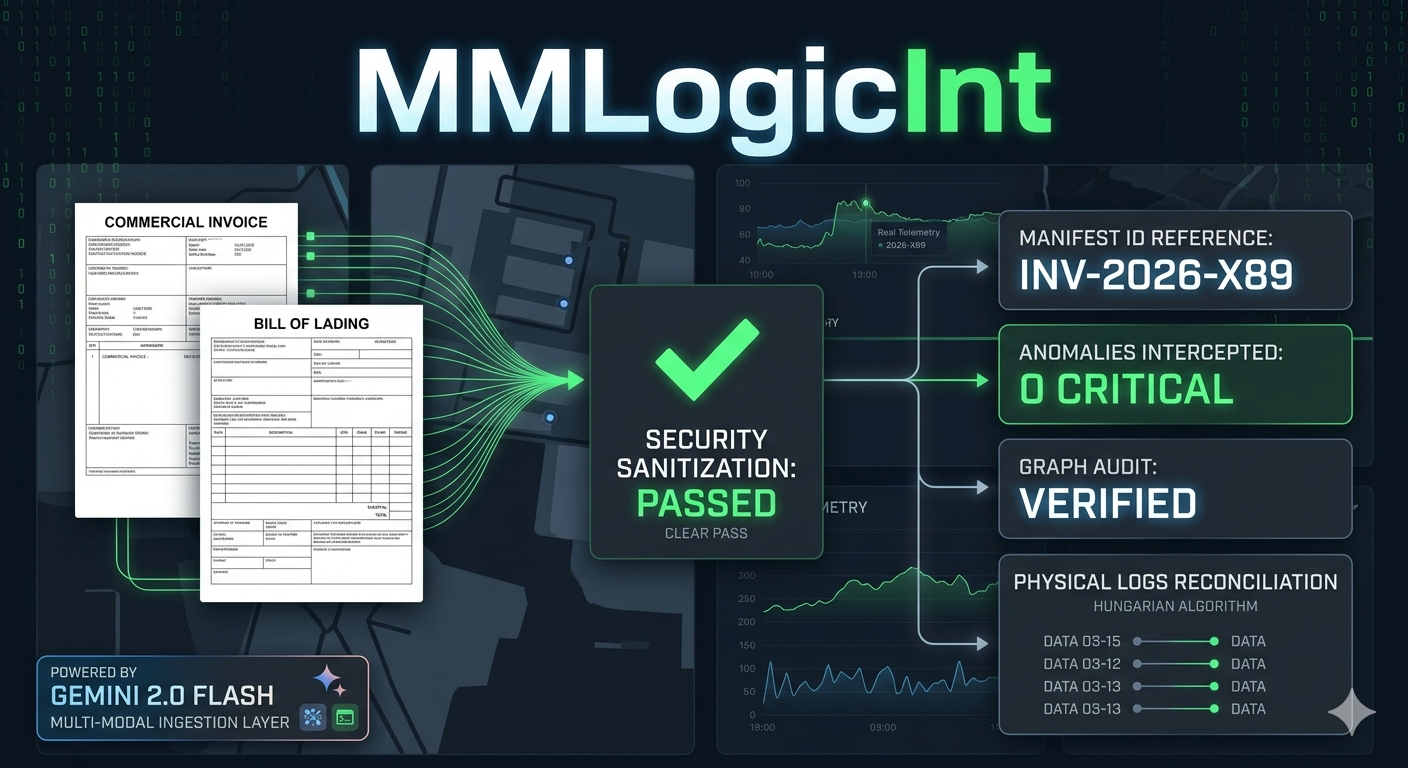
What it does MMLogicInt (Multimodal Manifest Logic Integration) is a high-performance, automated shipment graph verification and audit system. It ingests complex, multi-page PDFs, automatically splits and identifies documents, and extracts critical logistical metadata. The platform maps item structures, matches physical data vectors like weight tolerances, validates international customs data, and flags operational discrepancies inside a real-time, responsive technical command terminal.
How we built it The project is built on a specialized, multi-layered python stack architected for speed and deep context parsing:
Multimodal Ingestion Layer: Powered by Gemini 2.0 Flash to automatically isolate document boundaries inside a single combined PDF, cleanly separating and outputting structured JSON for both Commercial Invoices and Bills of Lading.
Analytical Match Engine: Uses the Hungarian Algorithm to mathematically cross-reference document topologies and map declared elements to actual manifest payloads, instantaneously tracking weight deviations.
Trie-Enriched Substring Engine: Evaluates text string vectors against a 1.2-megabyte local tariff database utilizing a custom Trie structure to resolve and validate international HS codes at lightning speed.
Technical Control Terminal: Built natively using Streamlit, featuring real-time telemetry card matrices, customized CSS, and deep-injected styling designed for data-heavy industrial operations.
Challenges we ran into One major hurdle was building the flexible graph alignment capture. Python's inspect.signature patterns caught a few strict positional argument mismatches between the unstructured data inputs and our core matching engine requirements early on. Overcoming this required standardizing the inbound JSON text streams down to tightly typed Pandas DataFrames so that the underlying rendering layers read array shapes perfectly without runtime exceptions. Managing complex multiline HTML string formatting and Streamlit layout nesting also pushed us to ensure our layout code remained completely clean, legible, and maintainable.
Accomplishments that we're proud of Zero-Failure Boundary Isolation: Developing an asynchronous AI parsing routine that handles raw multi-page PDF ingestion and splits distinct legal logistics logs perfectly on the first pass.
Mathematical Precision: Successfully implementing a robust implementation of the Hungarian Algorithm to replace generic, error-prone string lookups with exact mass and weight reconciliation matrices.
High-Fidelity UI Execution: Creating a fully responsive, dark-themed command interface that streams live telemetry and clear-pass status signals without introducing front-end layout friction.
What we learned We gained deep technical insights into handling non-deterministic AI outputs by anchoring them to deterministic computer science structures like Tries and bipartite matching graphs. We also discovered how incredibly versatile Gemini 2.0 Flash is at conducting complex document extraction pipelines when given precise structural instructions, allowing us to ditch traditional regex-heavy processing strategies completely.
What's next for MMLogicInt The immediate roadmap focuses on bringing the engine into an entirely offline, containerized edge-AI deployment environment to allow localized logistics nodes to function without external internet dependencies. We also plan to integrate a predictive risk-scoring index that tracks historical supplier deviation patterns, alongside expanding the local Trie engine to house international customs databases spanning multiple global trade jurisdictions.


Log in or sign up for Devpost to join the conversation.