-
-
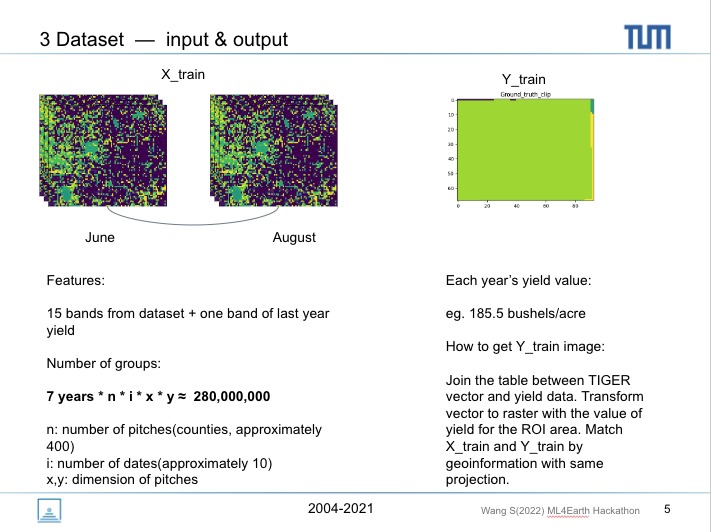
overview
-
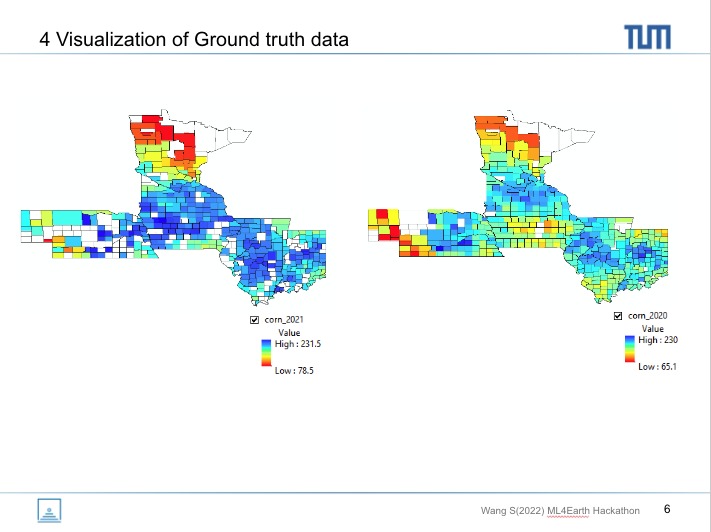
validation
-
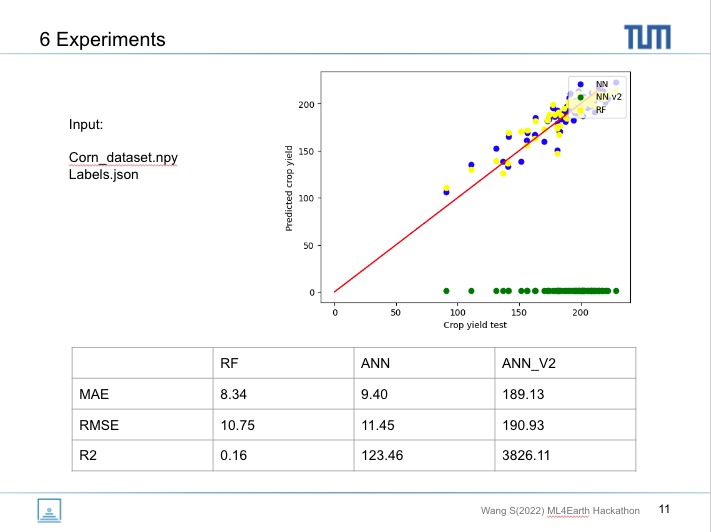
accuracy
-
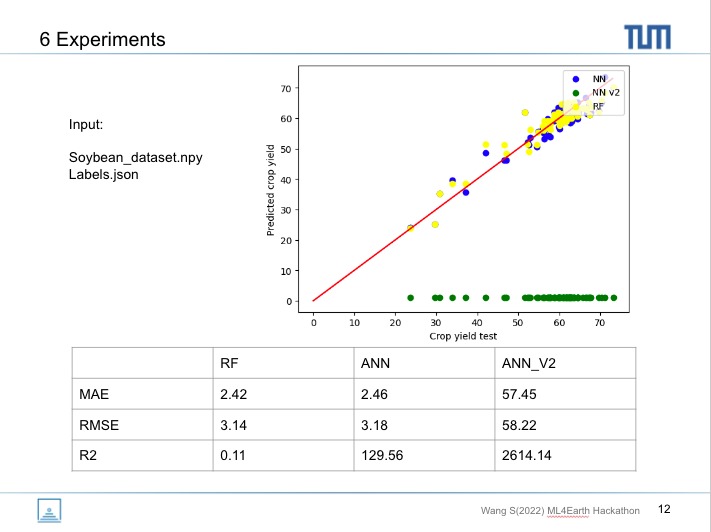
accuracy


Inspiration
Crop yield prediction is one of the challenging problems in precision agriculture, and many models have been proposed and validated so far. This problem requires the use of several datasets since crop yield depends on many different factors such as climate, weather, soil, use of fertilizer, and seed variety. [Feng et al., 2021]
How we built it
Random forest A random forest regressor is a meta estimator that fits a number of classifying regression trees on various sub-samples of the dataset and uses ‘averaging’ to improve the regression performance and control over-fitting.
Artificial Neural Networks (ANN) Artificial Neural Networks (ANN) is the most used algorithm for crop yield prediction. Recently, deep learning, which is a sub-branch of machine learning, has provided state-of-the-art results in many different domains, such as face recognition and image classification. These Deep Neural Networks (DNN) algorithms use similar concepts of ANN algorithms; however, they include different hidden layer types such as convolutional layer and pooling layer and consist of many hidden layers instead of a single hidden layer. [Klompenburg et al., 2020]
In the experiment part, changing activation method and adding layers or changing the number of epochs can improve the accuracy of model.
Challenges we ran into
Nowadays, crop yield prediction models can estimate the actual yield reasonably, but a better performance in yield prediction is still desirable
Not enough ground truth data Use each pixel as input training data instead of counties. This method can significantly increase the number of samples. And avoid the influence of pre-processing method like averaging yield value based on counties. Can’t represent human activity as the features Use history yield value as one of the input features. The farming ability of farmers is very important. Farmers' planting methods will vary from city to city. For example, the development of mechanization is different. Most machine and deep learning models are black boxes Random forest can give us the importance of each factor in the model. We can see which factor influence the result clearly by library SHAP.
Key steps in this project:
Dataset selection Features selection Model selection
Accomplishments that we're proud of
Achievement:
Random forest model and ANN model by .npy file. Reading and preprocessing of .tif dataset and ground truth data. Detailed plan of image based neural network training.
Difficulties:
Time limitation Computer memory limitation Working solo
What we learned
Machine learning method is one of the most efficient way to build models for crop yield prediction. When we don’t have enough data groups, random forest performs better than neural networks. With the hundreds groups of samples, neural network have overfitting problem. But random forest can help us analysis the importance of each factor.
In order to get enough dataset, we can use each pixel as a training sample. But the training speed will be low.
What's next for ML4Earth Hackathon 2022
Really thank you for offerring me this oppotunity. I will continue this project as my future research!
Built With
- jupiter
- python
- tensorflow
