-
-
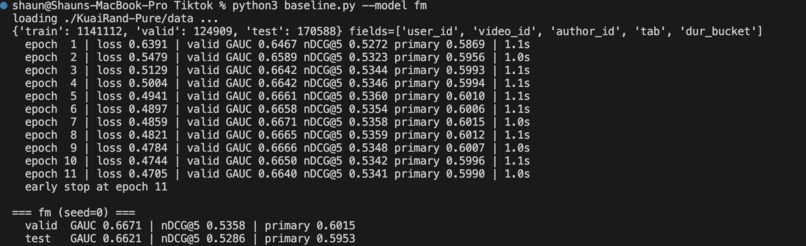
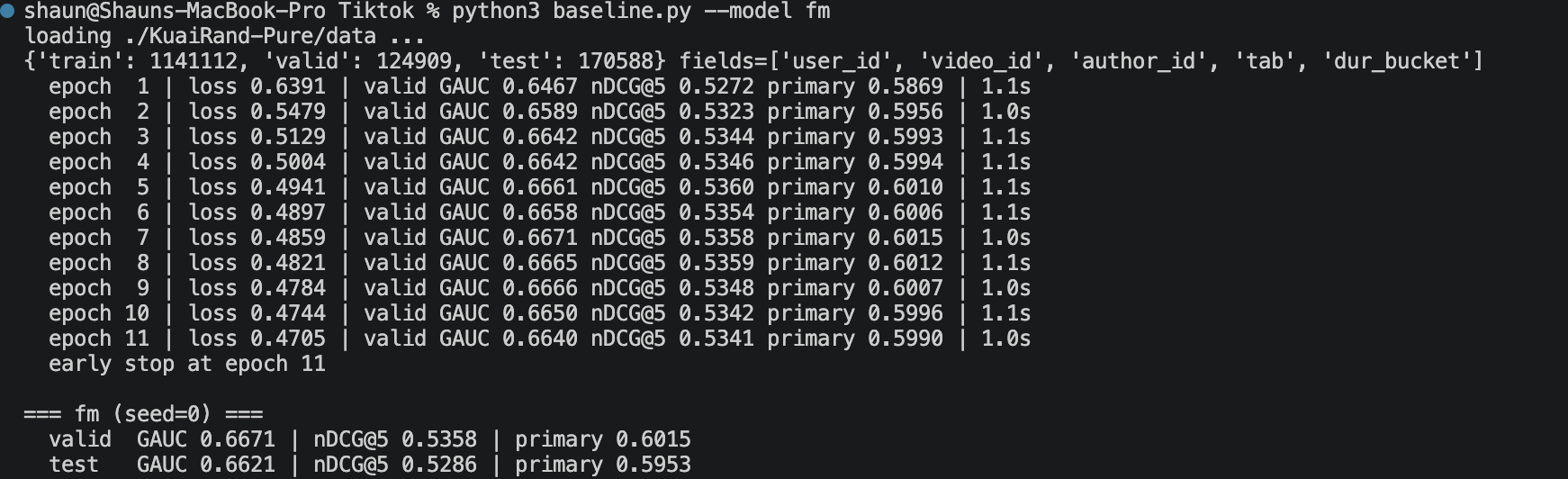
reproducing the baseline
Inspiration# An Autonomous ML Research Agent for KuaiRand-Pure
The problem, and how this addresses it
Challenge 2 asks for an agent that autonomously iterates the ML engineering loop on a recommender benchmark — read the problem, explore the data, engineer features, train, tune, evaluate, reflect, repeat — and pushes the score above the official Factorization Machine baseline on KuaiRand-Pure. It is scored on two things at once: a real ML result, and the agent that produced it.
The result. The agent beat the baseline and designated its own final submission.
| GAUC | nDCG@5 | Primary | Δ vs FM | |
|---|---|---|---|---|
| FM — official baseline | 0.6674 | 0.5357 | 0.6016 | — |
| Final submission (10-member ensemble) | 0.6729 | 0.5383 | 0.6056 | +0.0040 |
Validation split; the hidden test split was never read during development. +0.0040 is ≈5σ against the baseline's 0.0008 seed noise, and two independent selection runs reproduced it (0.6054, 0.6056).
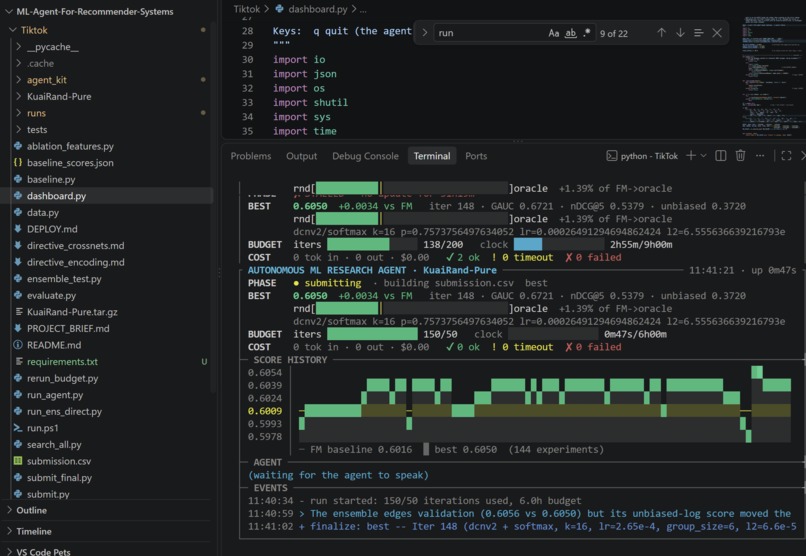
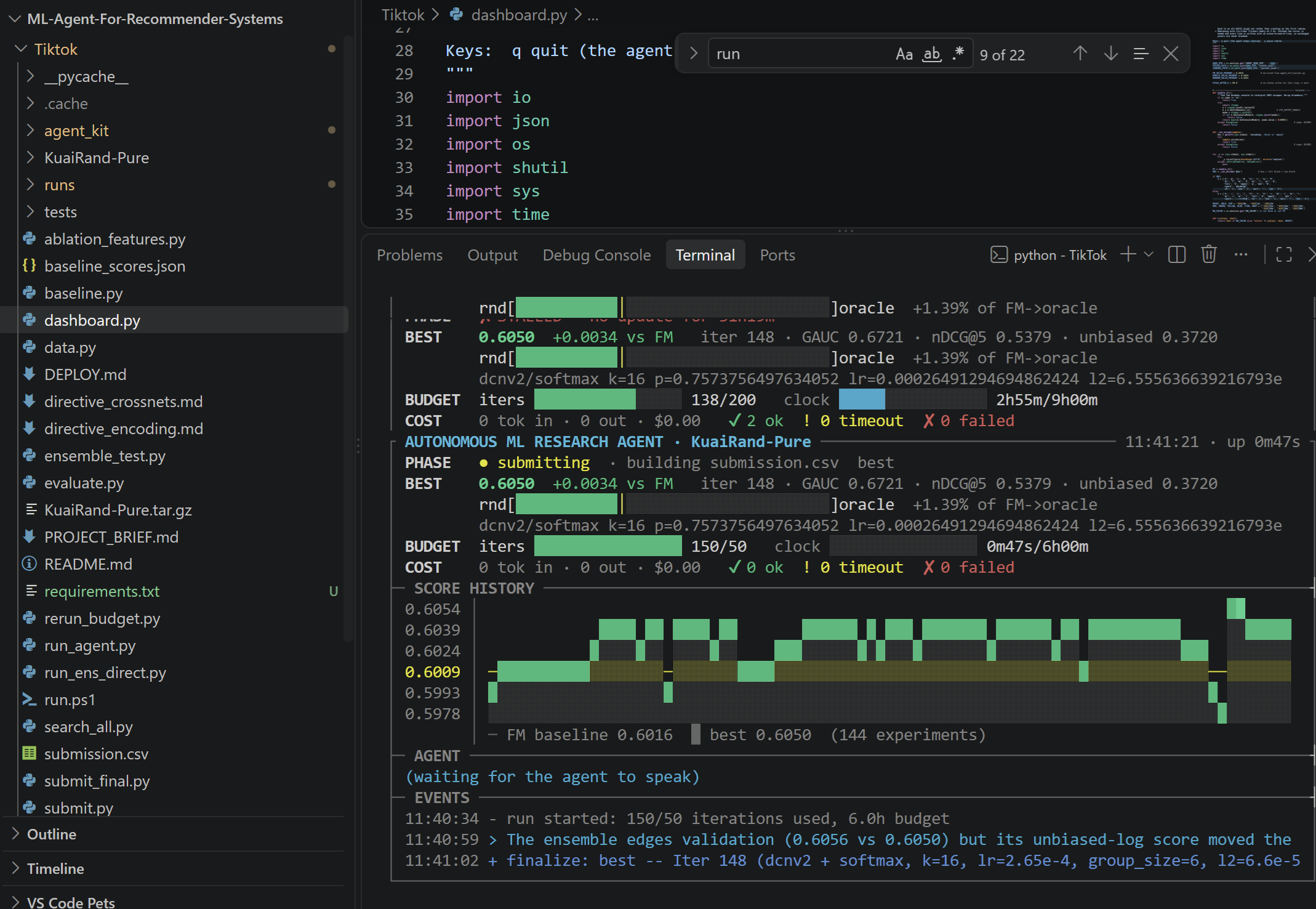
The agent. 45 iterations, 153 journalled experiments, 0 manual interventions, 13.5 h wall-clock, 11.2M LLM tokens, 0 GPU-hours — the entire run was a single CPU core.
Four design decisions do most of the work:
1. The agent's edit surface is a config, not a codebase. Every experiment is
train_once(config, prepared, seed) over four pluggable slots — features, model, loss,
train. The agent proposes a config; the harness trains it and returns structured metrics. A bad
idea fails in seconds instead of corrupting a pipeline, and every iteration's diff is a small
readable object rather than a patch that has to be reviewed. When the agent genuinely needs a new
function class it writes a registered nn.Module into agent_kit/models.py — it added DIN
target-attention, DCN-V2 and CIN heads this way, after fetching the papers' actual formulations
with web search rather than reciting them from memory.
2. The research journal is memory, reflection, and evidence in one file. Every experiment —
successful, failed, or abandoned — appends {hypothesis, rationale, config diff, metrics, error,
recovery} to an append-only journal.jsonl. The agent reads back a compact digest rather than
its full history, which is why 87% of its input tokens are prompt-cache reads and the whole run
cost 11M tokens instead of ~100M. The same file renders directly to the required per-iteration
run log.
3. Test-label integrity is enforced, not promised. The hidden test labels ship inside the
Starter Kit's own CSVs. An agent that writes its own model code could read them and post a
wonderful, worthless score, and nothing downstream would notice. Two mechanisms prevent it: an
eval-access lock that blocks the validation/test frames during model construction and training,
and a PreToolUse hook that refuses the agent's writes to the files defining the metric and the
split. A unit test builds a deliberately cheating model and asserts that training it raises rather
than scores.
4. Robustness is designed for, because a 6-hour run will hit errors. Every experiment runs under
a timeout and a try/except; a failure returns the traceback plus a suggested recovery to the agent
as a normal tool result, so the loop routes around it instead of crashing. Across the run, 20
timeouts and 3 hard errors (a UnicodeEncodeError, an unknown model type, an index-out-of-bounds)
were all recovered by the agent with no human involvement. Timeouts are explicitly labelled
"under-trained lower bound, not a verdict on this config" so the agent does not draw a false
negative from a starved run — it re-ran several with a bigger budget, and one of those became the
regularisation finding that produced most of the run's gains.
What it found. The Starter Kit's top-ranked suggestion was to swap the pointwise loss for a ranking loss. The agent tried that first — BCE 0.6017, BPR 0.6021, softmax 0.6023, LambdaRank 0.6017 — and concluded the axis was inside the noise band and closed it. The real lever turned out to be regularisation: embedding dropout plus 100× l2 let the model train past epoch 1 instead of peaking there, worth more than every loss change combined. It then diagnosed its own DeepFM negative as one-epoch memorisation rather than "deep models don't work", which is why re-opening the family later under proper regularisation produced the best single model of the run (DCN-V2, 0.6050). The final submission is a portfolio: four objectives plus a history-based DIN head make decorrelated per-user rank errors, and averaging them beat every individual member.
It also declined a tempting result: fm_aux (per-video engagement priors) produced the run's best
unbiased score but was validation-negative, so the agent recorded it as a finding and excluded it
from the submission rather than optimise a metric the task is not scored on.
Full detail: README.md · RESULTS.md ·
Tiktok/runs/RUN_LOG.md · Tiktok/runs/FINAL.json
Development tools used
| Tool | Use |
|---|---|
| Claude Code (VS Code extension + CLI) | Primary development environment for building the harness and the agent loop |
| Visual Studio Code | Editor |
| Windows PowerShell | Deployment (run.ps1), detached process management, live monitoring |
| Python 3.12.5 | Everything |
| Git / GitHub | Version control |
Custom terminal dashboard (dashboard.py) |
Live view of a running agent — reads runs/status.json as a separate process, so closing it can never kill a 6-hour run |
Platform: Windows 11, single CPU core, no GPU.
APIs used
| API | Use |
|---|---|
Claude API — claude-opus-5, via the Claude Agent SDK (claude-agent-sdk 0.2.148) |
The agent's reasoning: hypothesis formation, code authoring, result interpretation, and the decision of what to try next. Run on the Claude Code CLI transport against a Claude Pro subscription, so no metered API spend. |
Claude Agent SDK — in-process MCP server (create_sdk_mcp_server) |
The agent's tools are exposed as an MCP server defined in the same process: run_experiment, tune, ensemble_search, read_journal, get_search_space, record_finding, finalize. |
Claude Agent SDK — PreToolUse hooks (HookMatcher) |
The leak guard: refuses agent writes to evaluate.py, data.py, baseline.py, submit.py. |
| WebSearch / WebFetch (Claude Code built-in tools) | The agent fetched the actual formulations of DCN-V2 (Wang et al., 2021) and xDeepFM/CIN (Lian et al., KDD'18) before implementing them, rather than reconstructing them from memory. |
No other external APIs. No external services, no hosted inference, no third-party data.
Libraries and frameworks used
| Library | Version | Use |
|---|---|---|
| PyTorch | 2.13.0 (CPU) | All models: FM, FM+dropout, DeepFM, DIN target attention, DCN-V2 (CrossNetV2), CIN, fm_aux — and all four losses (BCE, BPR, listwise softmax, LambdaRank) |
| NumPy | 2.3.2 | Feature encoding, the fast GAUC/nDCG@5 implementation, rank averaging |
| claude-agent-sdk | 0.2.148 | The autonomous loop, its MCP tool server, and the hook system |
| pandas | ≥2.0 | Used by the Starter Kit's own data loader |
Deliberately no RecBole, LightGBM, Optuna, Ray Tune, or scikit-learn. Bayesian optimisation
with ASHA early stopping, greedy ensemble selection with replacement, and the metric implementation
are all written directly against NumPy — roughly 700 lines in agent_kit/ — because the search
space is small, the dependency surface stays trivially reproducible, and the tuner needed to share
the same timeout-and-recover semantics as the rest of the harness.
One notable piece of engineering: agent_kit/metrics.py reimplements GAUC and nDCG@5 to run 4×
faster than the official evaluate.py, and tests/test_metrics.py asserts agreement to 1e-14
across adversarial cases (heavy ties, all-identical scores, all-positive and all-negative users,
singleton users, oracle and adversarial orderings). The speedup is what made 153 experiments fit in
the budget; the equivalence test is what makes it safe to rely on. The official evaluate.py
remains the scoring authority and is unmodified.
Datasets and assets used
| Asset | Source | Use |
|---|---|---|
| KuaiRand-Pure | Zenodo record 10439422 (official, no registration) | The required benchmark. Official date-based split: train 20220408–20220421 (1,141,112 rows) / valid 20220422–20220428 (124,909) / test 20220429–20220508 (170,588). Label long_view. |
log_random_4_22_to_5_08_pure.csv |
Within KuaiRand-Pure | Unbiased validation. 1.18M randomised-exposure rows, never trained on, used as a secondary off-policy check that a gain was not just fitting the logging policy. This is what caught fm_aux as interesting-but-not-submittable. |
| Auxiliary log columns | Within KuaiRand-Pure | is_click, is_like, is_follow, is_comment, is_forward, is_hate, play_time_ms — used to build smoothed per-video engagement priors for the fm_aux model family. |
| User watch history | Derived from the train split | Reconstructed per-user sequences of previously long-viewed videos, for the DIN target-attention head. Built from train rows only. |
| Starter Kit | Organisers | evaluate.py, data.py, baseline.py, submit.py, ablation_features.py, baseline_scores.json — used unmodified; evaluate.py is the scoring authority. |
No external training data, no pretrained weights, no data outside the benchmark. KuaiRand-1k and KuaiRand-27k (the bonus benchmarks) were not attempted.


Log in or sign up for Devpost to join the conversation.