-
-

INSURA Home page
-
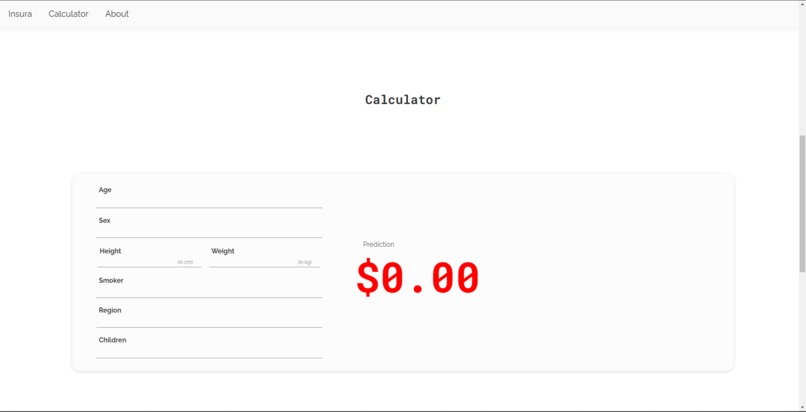
INSURA Calculator page
-
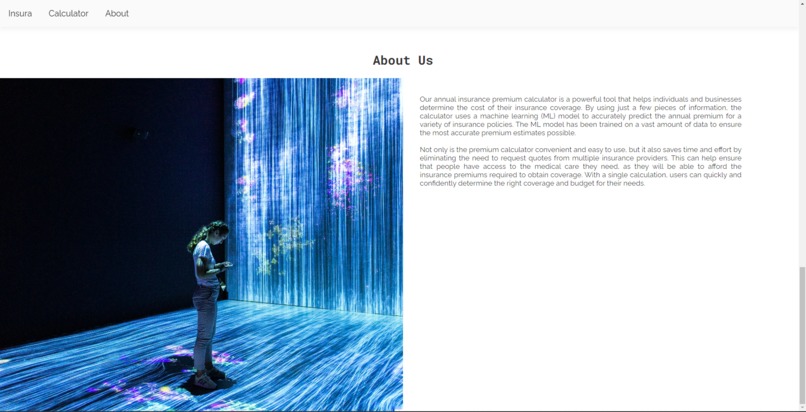
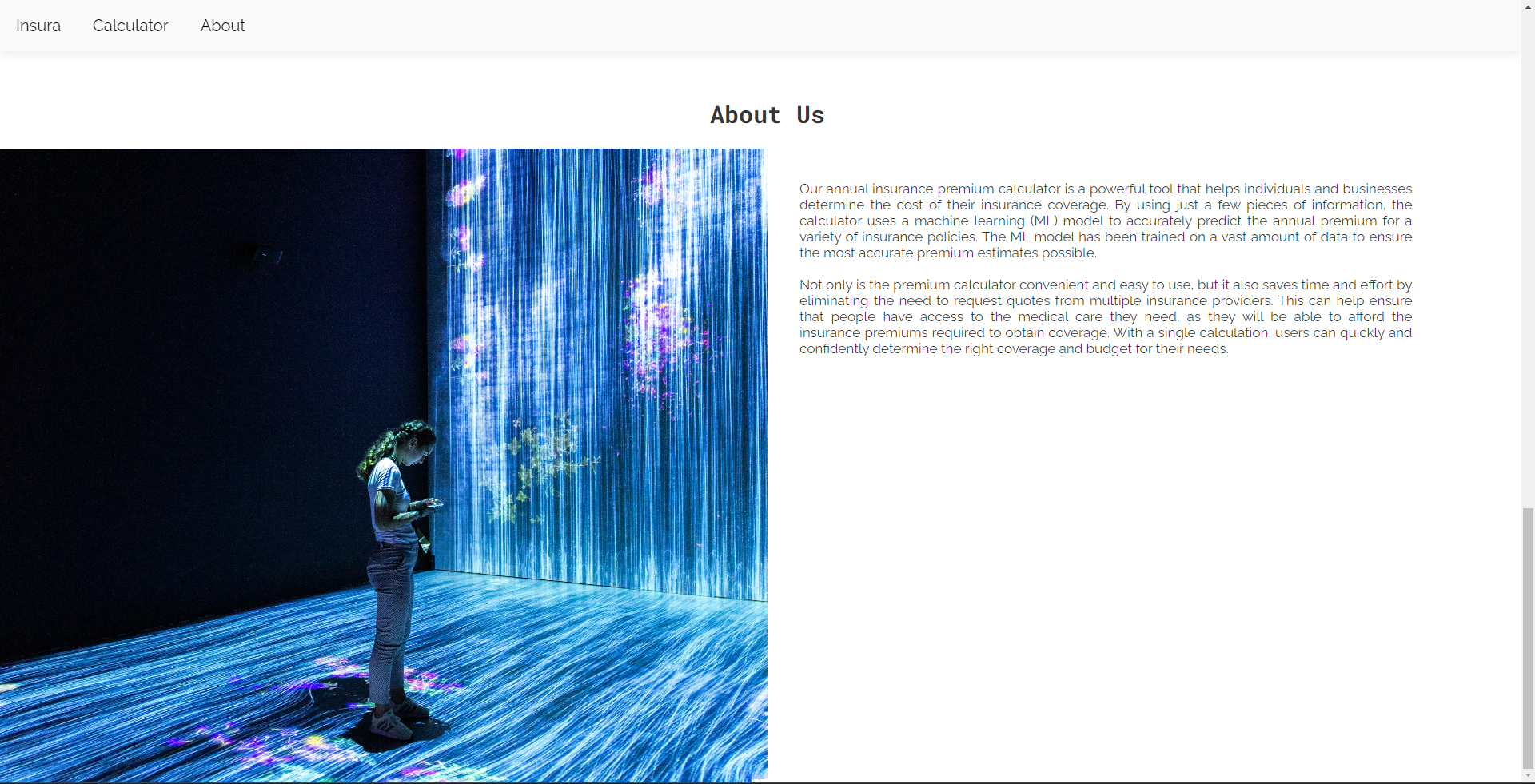
INSURA About Us page

Inspiration
The idea behind Insura was to provide a simple and quick method for individuals and businesses to estimate the cost of their health insurance coverage. We wanted to save users time and effort by eliminating the need to request quotes from numerous insurance providers. Furthermore, we wanted to aid users in making informed insurance coverage decisions by providing accurate and personalized premium estimates. With these objectives in mind, we set out to develop an annual insurance premium calculator that utilizes a machine learning model to provide users with quick and precise estimates.
What it does
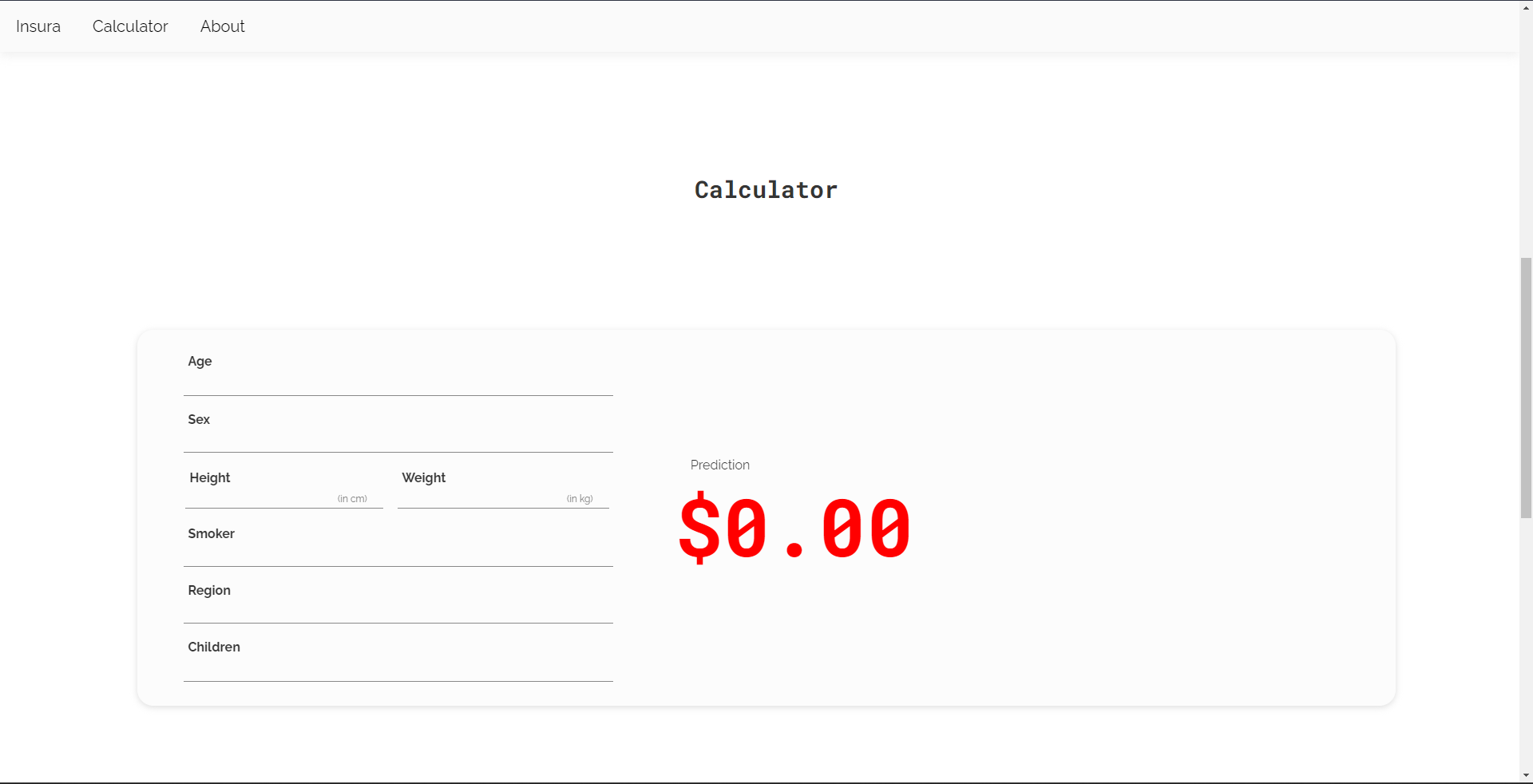
Insura is an annual insurance premium calculator that employs a machine learning model to predict premiums for a wide range of health insurance policies. The calculator is designed to be user-friendly and convenient, and it eliminates the need for users to obtain quotes from various insurance providers. The calculator collects information from users such as their age, gender, their height(in cm), their weight(in kg), whether they are or were previously a smoker, what region they reside in, as well as the number of children/dependents they hold under their care. The calculator assists the user in determining the appropriate coverage and budget for their needs and making informed decisions about their health insurance by providing quick and personalized premium estimates.
How we built it
Our annual insurance premium calculator was built using a custom stack of technologies. The backend, which includes the machine learning model and API, was programmed in Python. The machine learning model was trained and tested using a dataset from Kaggle and the 'scikit-learn' library's Gradient Boosting Regressor. We used the 'FastAPI' library to convert the trained model into an API, and 'uvicorn' to host it locally. Other utility modules, such as 'pandas', 'numpy', and 'pickle', were also used. For the frontend, we used React.js with SCSS styling and the fetch API to connect to our API and retrieve data. We used Git and GitHub for source control and collaboration, and deployed the frontend using GitHub and Vercel for maximum uptime and scalability. The API/ML model combo was deployed using DETA, a deployment service advocated by FastAPI, and we used a middleware to allow cross-origin requests from the frontend and ensure smooth communication between components.
Challenges we ran into
During the development of Insura, we faced several challenges. One of the main issues was obtaining sufficient and diverse data to train the machine learning model. This is crucial for accurate premium predictions, as the model needs to be trained on a wide range of insurance premiums from various policies, locations, and other relevant factors. However, since most insurance data is privately held by companies, we had to make do with what we could find. As a result, the data was not as diverse and vast as we had hoped it would be. Another challenge was creating a user-friendly and easy-to-use interface for the calculator. With so many variables to consider, it was difficult to design an interface that was intuitive and straightforward for users. To solve this, we modeled our interface after other online calculators, with input slots and constantly updating predictions based on changes to those values.
Accomplishments that we're proud of
We are proud of several accomplishments related to the development of Insura. One of our biggest achievements was developing a machine learning model that can accurately predict insurance premiums for a wide range of policies. This required extensive data gathering, analysis, and training, and the fact that it can make such accurate predictions is a testament to our expertise and hard work. Additionally, we are proud of the user-friendly and easy-to-use interface we designed for the calculator. It is intuitive and straightforward for users, making it easy for them to obtain premium estimates and make informed decisions about their insurance coverage. We also worked hard to gather and train the calculator's machine learning model on a diverse and representative dataset of insurance premiums, which has contributed to its accuracy and reliability. Finally, we are proud of the fact that we were able to successfully launch the calculator application. All of these accomplishments are a result of our dedication and effort, and we are proud of the value we can provide to our users.
What we learned
We learned how to build and train a machine learning model that can make accurate predictions based on a large and diverse dataset, as well as how to design and develop a user-friendly and easy-to-use web application interface. This involved identifying the problem the model will solve, gathering a representative dataset of relevant data, cleaning and preparing the data for training, training the model using a suitable algorithm, optimizing it through techniques like hyperparameter tuning, and evaluating its performance on a separate test dataset. We also learned how to consider the needs and goals of the user, create wireframes or prototypes, iterate on the design based on user feedback, and consider the interface's aesthetics and how it will be used on different devices. We utilized tools and libraries like React.js, Python, and 'scikit-learn' to build and deploy the application, and used collaboration and project management tools like Git and GitHub to track changes and coordinate work. We also learned how to troubleshoot and debug issues that may arise during development and deployment.
What's next for INSURA, an ML-Powered Insurance Premium Calculator
In the future, we plan to add several new features to our annual insurance premium calculator, Insura. One of these features is integration with insurance providers, which would allow users to purchase insurance directly from the application. This would save users time and effort by eliminating the need to shop around for quotes from multiple providers. Another feature we are considering is a comparison tool that allows users to compare different insurance policies and premiums side by side. This would make it easier for users to find the right coverage at the right price. We also plan to add personalized recommendations to the application, using machine learning to suggest policies that are tailored to a user's specific health conditions or lifestyle. To make the calculator more convenient for users on the go, we are also considering developing a mobile app version of the tool. Additionally, we plan to integrate the calculator with other financial tools, such as budgeting or investment apps, to provide a more holistic view of a user's financial situation and help them make informed decisions about their insurance coverage. Finally, we would like to improve the accuracy of the machine learning model by using better, more accurate data. To make the application more user-friendly, we also plan to add features such as international use, easy regional selection, and the ability to select the units in which the inputs for height and weight are written.
Built With
- batchfile
- deta
- fastapi
- git
- github
- html
- javascript
- numpy
- pandas
- pickle
- powershell
- python
- react.js
- scikit-learn
- scss
- uvicorn
- vercel

Log in or sign up for Devpost to join the conversation.