
Inspiration
Breast cancer continues to affect millions of women across the globe, and early detection significantly improves survival rates. This reality inspired me to create a machine learning application that could assist in identifying the likelihood of a tumor being malignant or benign. I wanted to build something simple, effective, and accessible, especially for those who may not have technical expertise but are curious about how machine learning can support healthcare.
What it does
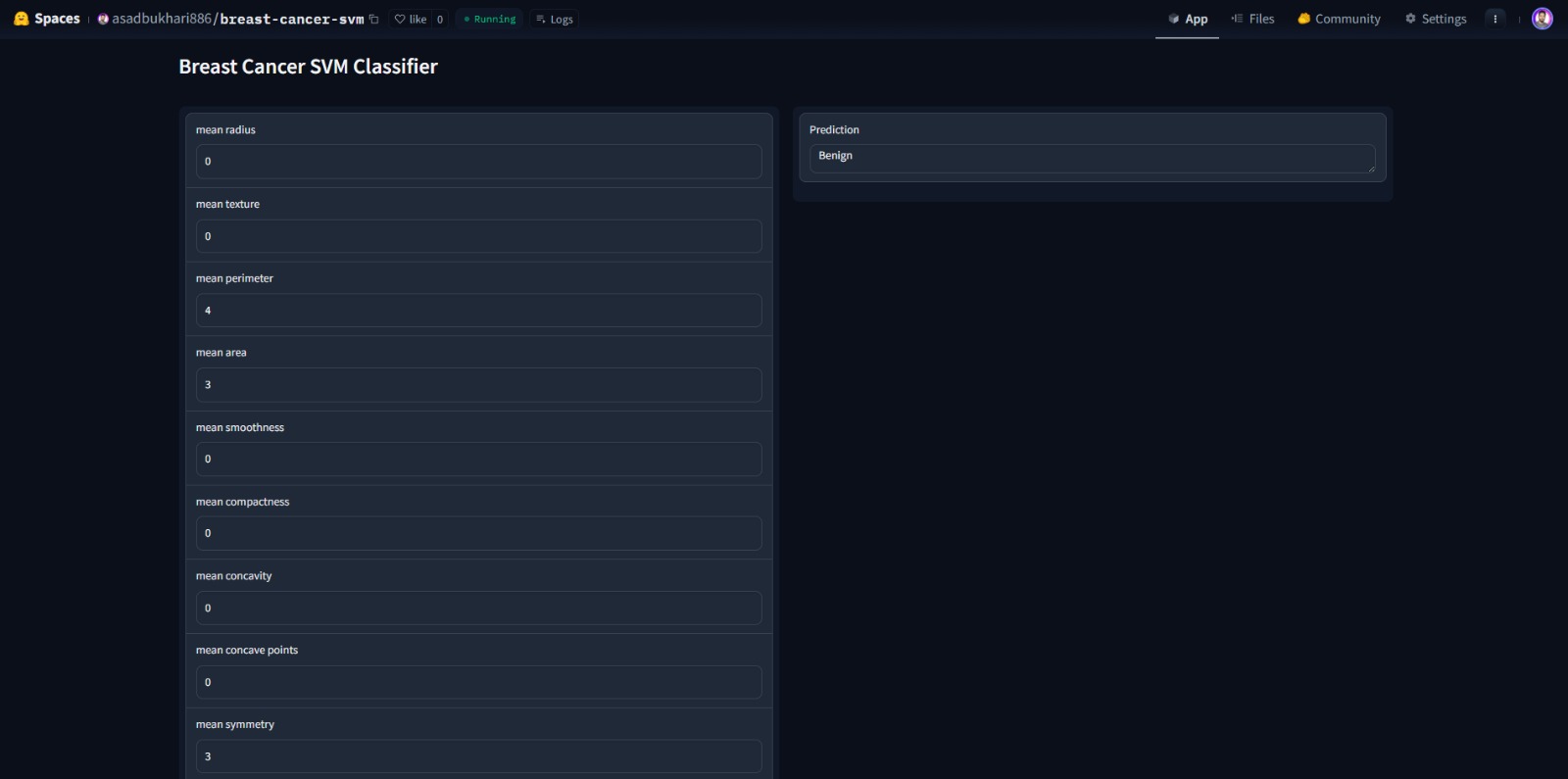
This project is a web-based application that allows users to input features of a breast tumor and receive a prediction on whether the tumor is likely to be malignant or benign. It uses a machine learning model trained on real-world data and provides quick, clear results based on user input. The app is hosted on Hugging Face Spaces and offers a clean, interactive interface powered by Gradio.
How we built it
The application was built using Python, with Scikit-learn used for training a logistic regression model. I used Pandas and NumPy for data handling and preprocessing. The breast cancer dataset from the UCI Machine Learning Repository served as the foundation. After training the model and normalizing the data, I saved the model and scaler using Joblib. Gradio was used to create the user interface, and the app was deployed on Hugging Face Spaces. Key files included app.py, requirements.txt, the trained model, and a README with configuration details.
Challenges we ran into
One of the first challenges was understanding which features were most relevant for training an accurate model. During deployment, I encountered configuration issues with the README file and environment setup on Hugging Face Spaces. Ensuring that all dependencies were properly listed and all paths were correctly referenced required attention to detail. I also had to troubleshoot file structure and version compatibility to ensure the app ran smoothly on the platform.
Accomplishments that we're proud of
I am proud of turning a concept into a working machine learning web application. The model achieved strong performance on test data, and the interface is user-friendly and intuitive. Deploying the app on Hugging Face Spaces gave the project a wider reach, and it feels rewarding to have created something that blends technology and social impact.
What we learned
Throughout this project, I gained hands-on experience in the full machine learning workflow—from data preprocessing and feature selection to model training and evaluation. I learned how to use Gradio to turn a script into a usable application and how to manage deployment using Hugging Face Spaces. Debugging configuration errors also improved my understanding of environment management and documentation practices.
What's next for ML-Powered Breast Cancer Checker
In the future, I plan to improve the model by incorporating more advanced algorithms and tuning hyperparameters for better accuracy. I also hope to expand the interface to support batch predictions and multilingual input to make it more inclusive. Collaborating with medical professionals to refine the app’s usefulness and ethical considerations is also on my roadmap. Eventually, I want to deploy it in real-world educational or healthcare settings where it can serve as a helpful tool for awareness and early screening support.
Built With
- face
- gradio
- hugging
- joblib
- numpy
- pandas
- python
- scikit-learn
- spaces


Log in or sign up for Devpost to join the conversation.