Inspiration
Facial recognition and landmark mapping are the backbone of modern AR, avatar tracking, and emotion recognition. I wanted to build a reliable, future-proof face processing service that could accurately detect human faces and map out complex 3D facial geometry without buckling under heavy dependencies.
What it does
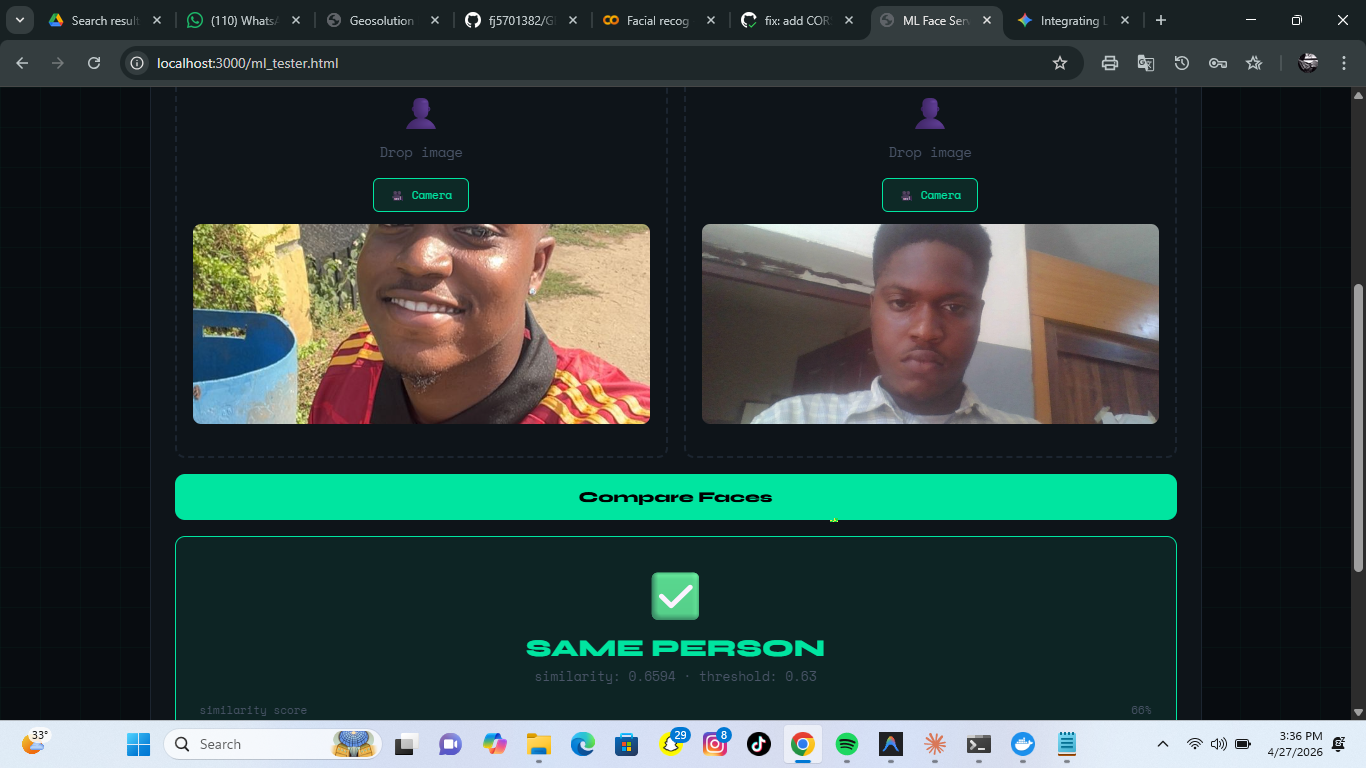
ML Face Landmarker Service takes input images and instantly detects human faces, generating a highly accurate 478-point 3D face mesh. It extracts precise coordinates (x, y, z) for critical facial features—like the tip of the nose, eyes, and mouth contours—which can be piped into downstream applications like filters or biometric analysis.
How I built it
The core engine is built in Python, utilizing OpenCV for image ingestion and preprocessing. The heavy lifting is done by Google's MediaPipe Tasks API. Instead of relying on deprecated legacy modules, the service downloads and initializes a dedicated face_landmarker.task model asset, processing images natively through MediaPipe's Image and vision.FaceLandmarker pipeline for maximum performance.
Challenges I ran into
Dependency hell! During development, I originally attempted to use legacy frameworks like InsightFace and older versions of MediaPipe (mp.solutions). This triggered massive version conflicts across numpy, protobuf, and opencv.
Instead of trying to patch a broken environment, I pivoted to the absolute newest architecture. I refactored the codebase to completely abandon the legacy solutions API and adopted Google's modern, future-proof Tasks API.
What I learned
- Dependency Management: How to navigate catastrophic version conflicts and the importance of using modern, actively supported APIs.
- MediaPipe Architecture: The difference between legacy
mp.solutionsand the modernvision.FaceLandmarkerAPI, including how to handle.taskfiles and memory management. - Graceful Error Handling: Implementing safety checks to catch silent OpenCV failures (like bad image downloads returning
None) before they crash the ML model.
What's next for ML Face Service
- Blendshapes Integration: Enabling the
output_face_blendshapesparameter to detect specific facial expressions (blinking, smiling, raising eyebrows) in real-time. - Video Stream Support: Upgrading the pipeline from static image processing to live webcam feeds.
Built With
- dockerfile
- machine-learning
- mediapipe
- opencv
- python

Log in or sign up for Devpost to join the conversation.