Inspiration
The inspiration for the ML-Based Smart Shopping Cart came from the frustration that many of us experience during grocery shopping, especially the time-consuming checkout process. Long lines, slow scanning, and manual errors can turn a quick shopping trip into a tedious chore. I wanted to create a solution that could make shopping more efficient and enjoyable by eliminating these pain points.
What it does
The ML-Based Smart Shopping Cart revolutionizes the shopping experience by automatically identifying and tracking products as they are placed in the cart. Utilizing computer vision and machine learning, the system recognizes each item in real-time, updates the total cost, and keeps track of quantities. Customers can see the cart's contents and total on a display attached to the cart, making the checkout process seamless and eliminating the need for manual scanning.
How I built it
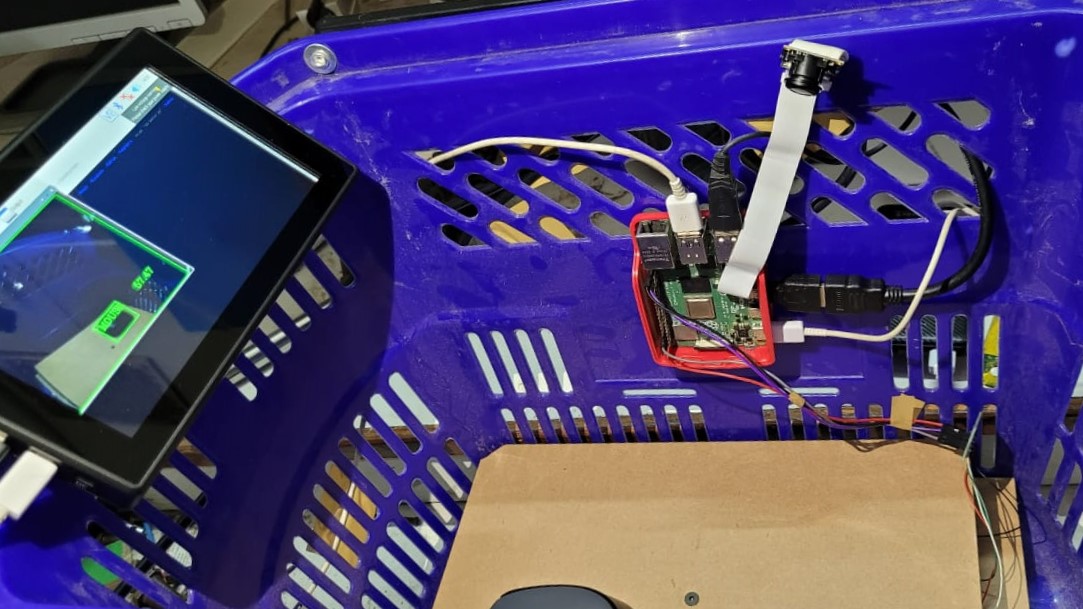
I built the Smart Shopping Cart using a combination of computer vision and machine learning techniques. The cart is equipped with a camera and a processing unit that runs a trained model for real-time object recognition. I used Python and OpenCV for image processing, while TensorFlow was used to develop and train the machine learning model. The hardware setup includes a compact computer like a Raspberry Pi, interfaced with a display and a payment gateway for a complete solution.
Challenges I ran into
One of the biggest challenges was ensuring the accuracy and speed of the object recognition system in real-world conditions. Dealing with different lighting, occlusions, and varying product appearances required extensive data collection and model training. Another challenge was optimizing the system to run efficiently on a low-power device, ensuring it could operate in real-time without delays.
Accomplishments that I'm proud of
I am proud of successfully implementing a real-time object recognition system that works accurately in a dynamic environment like a supermarket. Another significant achievement was integrating the system with a user-friendly interface that simplifies the checkout process for customers. The project also provided me with a deep understanding of computer vision and machine learning, which I am proud to have applied in a practical solution.
What I learned
This project taught me a great deal about the intricacies of computer vision and machine learning, particularly in real-time applications. I learned how to collect and preprocess data, train models, and deploy them in a constrained environment. Additionally, I gained experience in optimizing software for hardware limitations, and the importance of user experience in technology design.
What's next for ML-Based Smart Shopping Cart
Moving forward, I plan to enhance the ML-Based Smart Shopping Cart by incorporating more advanced features like automatic inventory updates and personalized shopping recommendations. I also aim to improve the model's accuracy further by expanding the dataset and experimenting with more sophisticated algorithms. Eventually, I would like to pilot the system in a real supermarket environment and explore potential partnerships for commercialization.
Built With
- edgeai
- loadcell
- opencv
- picamera
- python
- raspberry-pi
- ultrasonic

Log in or sign up for Devpost to join the conversation.