-
-

Introduction
-
Problem Statement
-
Solution
-
Building Proof
-
Results
-
Architecture
-
Uniqueness
-

Gratitude


Inspiration
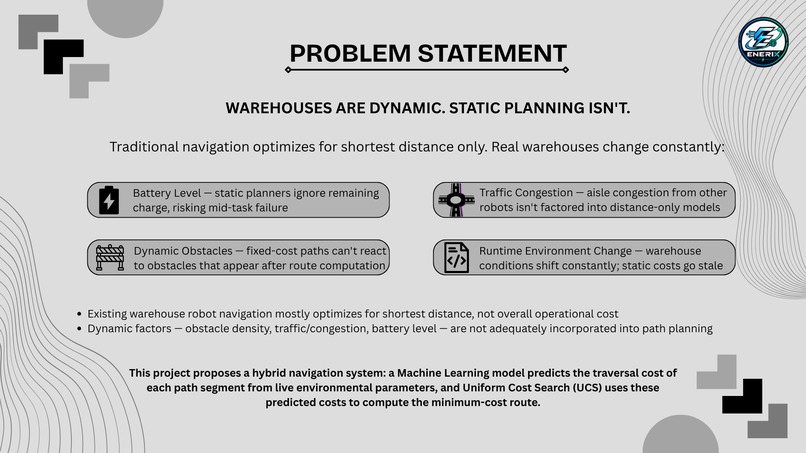
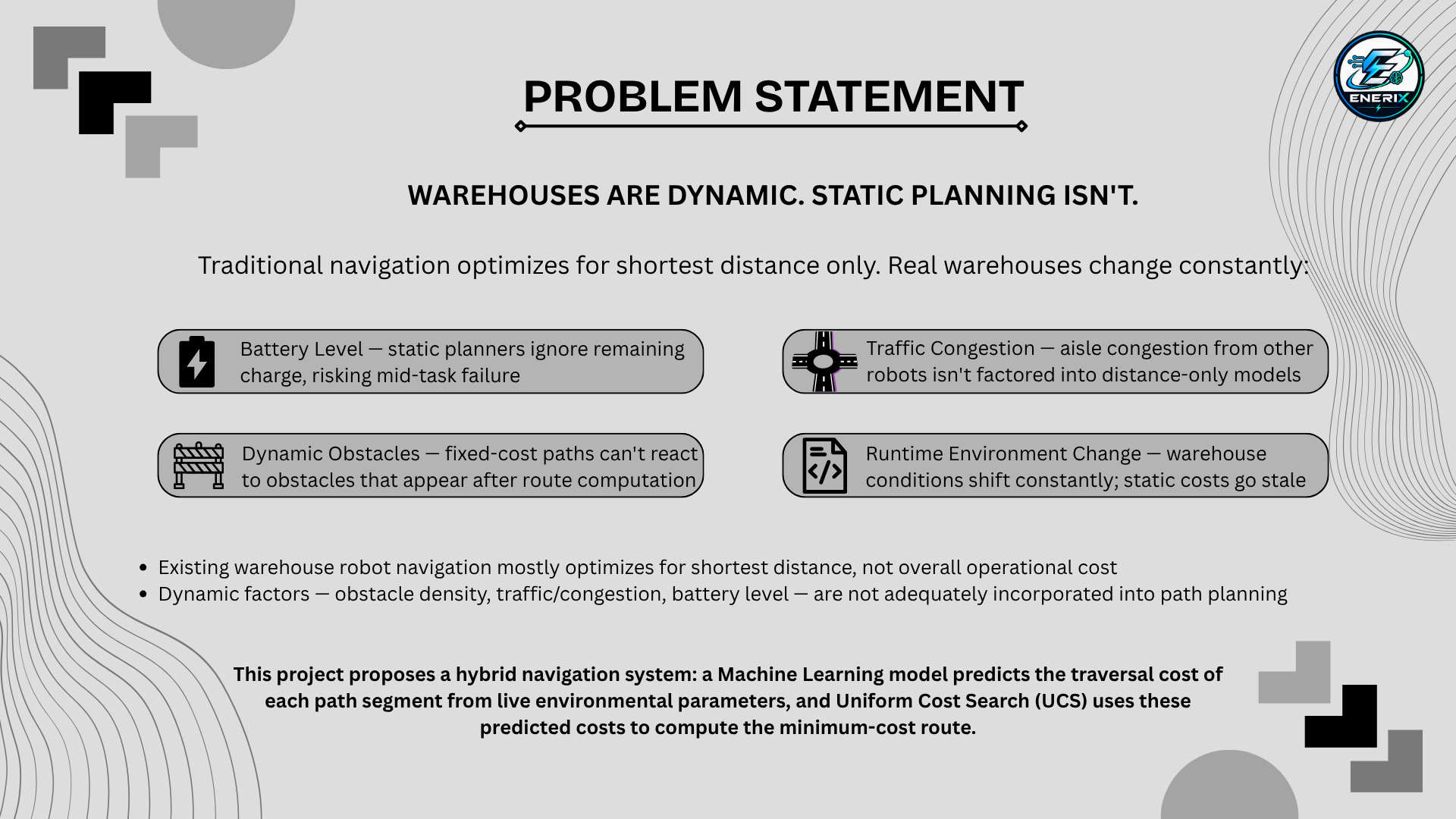
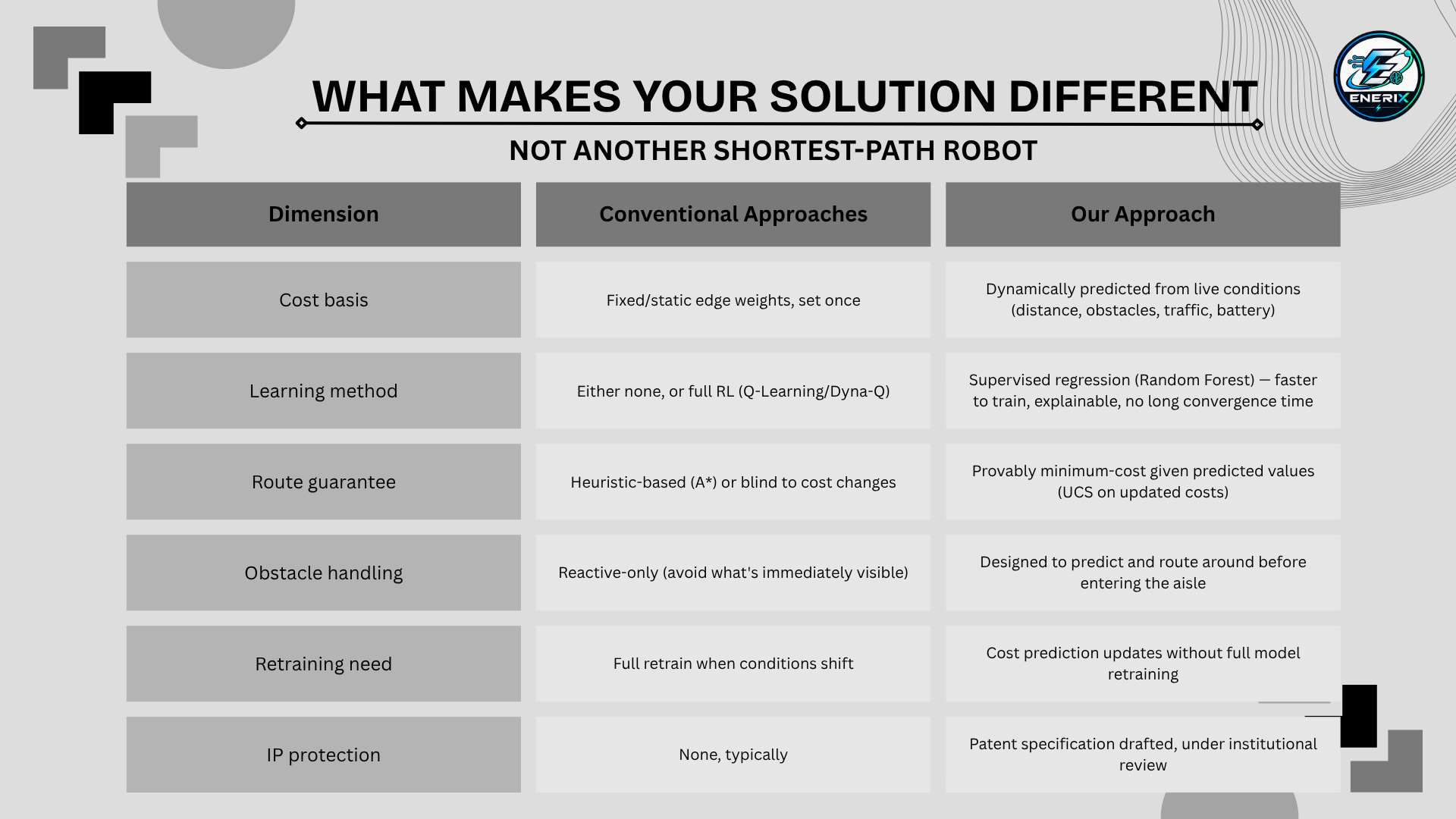
Most warehouse robots are still routed using the shortest physical path — but in a real warehouse, the shortest path isn't always the smartest one. Traffic congestion, obstacle density, and battery level constantly change, and a route that looks optimal on paper can become inefficient seconds after the robot starts moving. We wanted to build a navigation system that predicts how costly a route will actually be before committing to it, instead of just measuring distance.
What it does
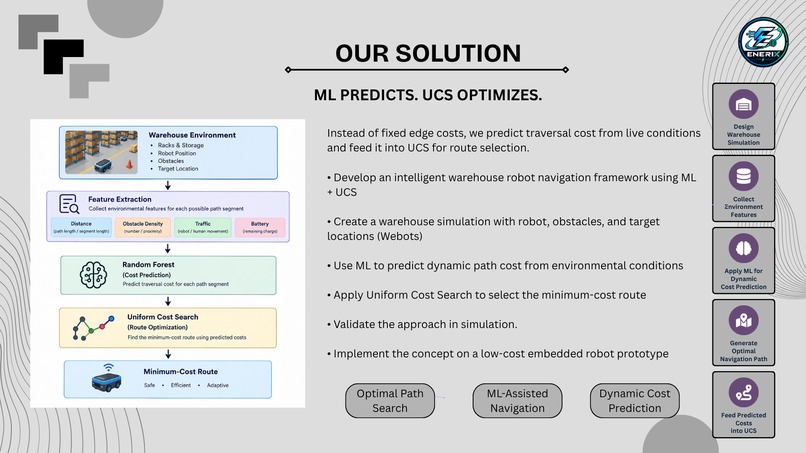
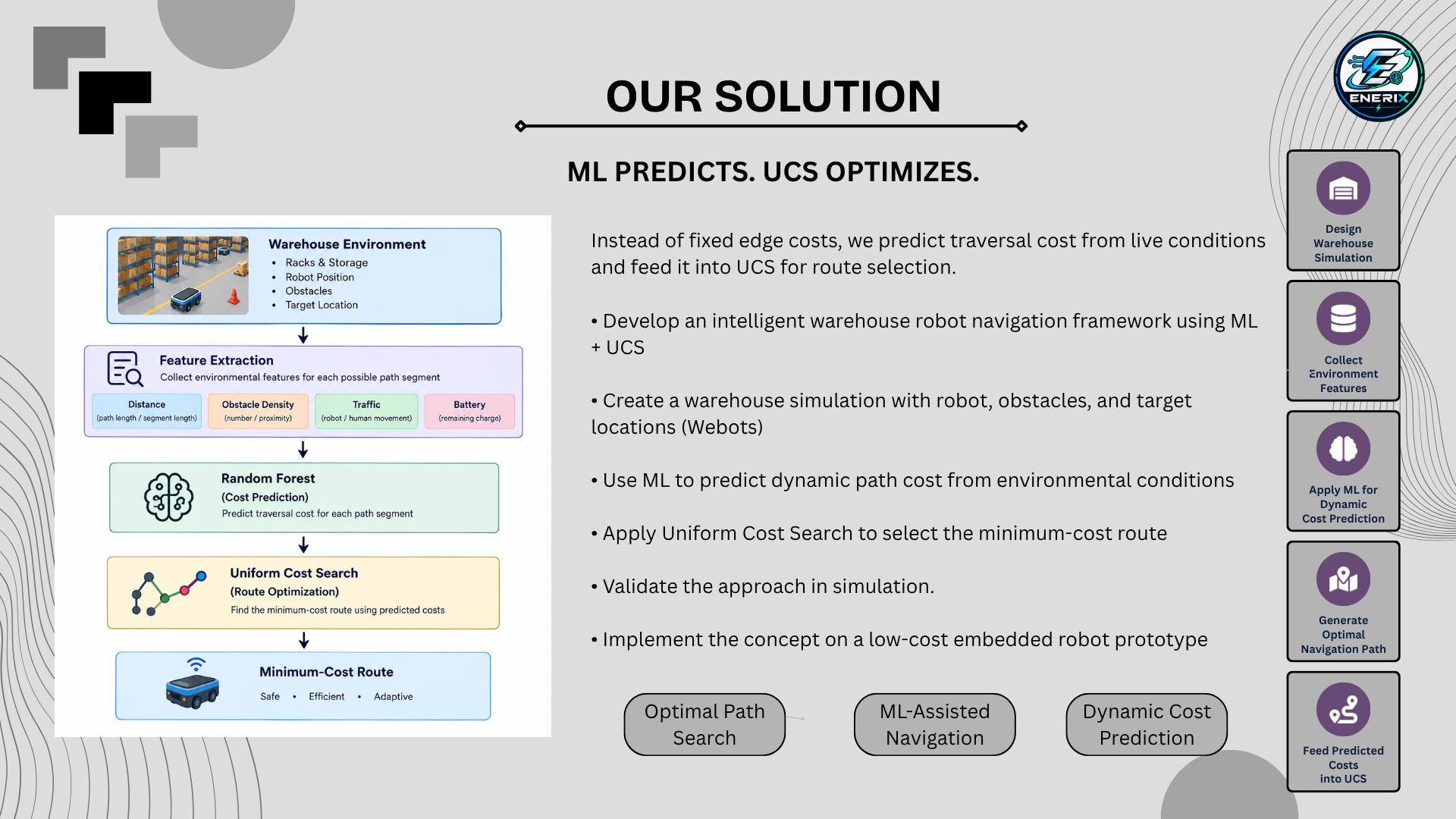
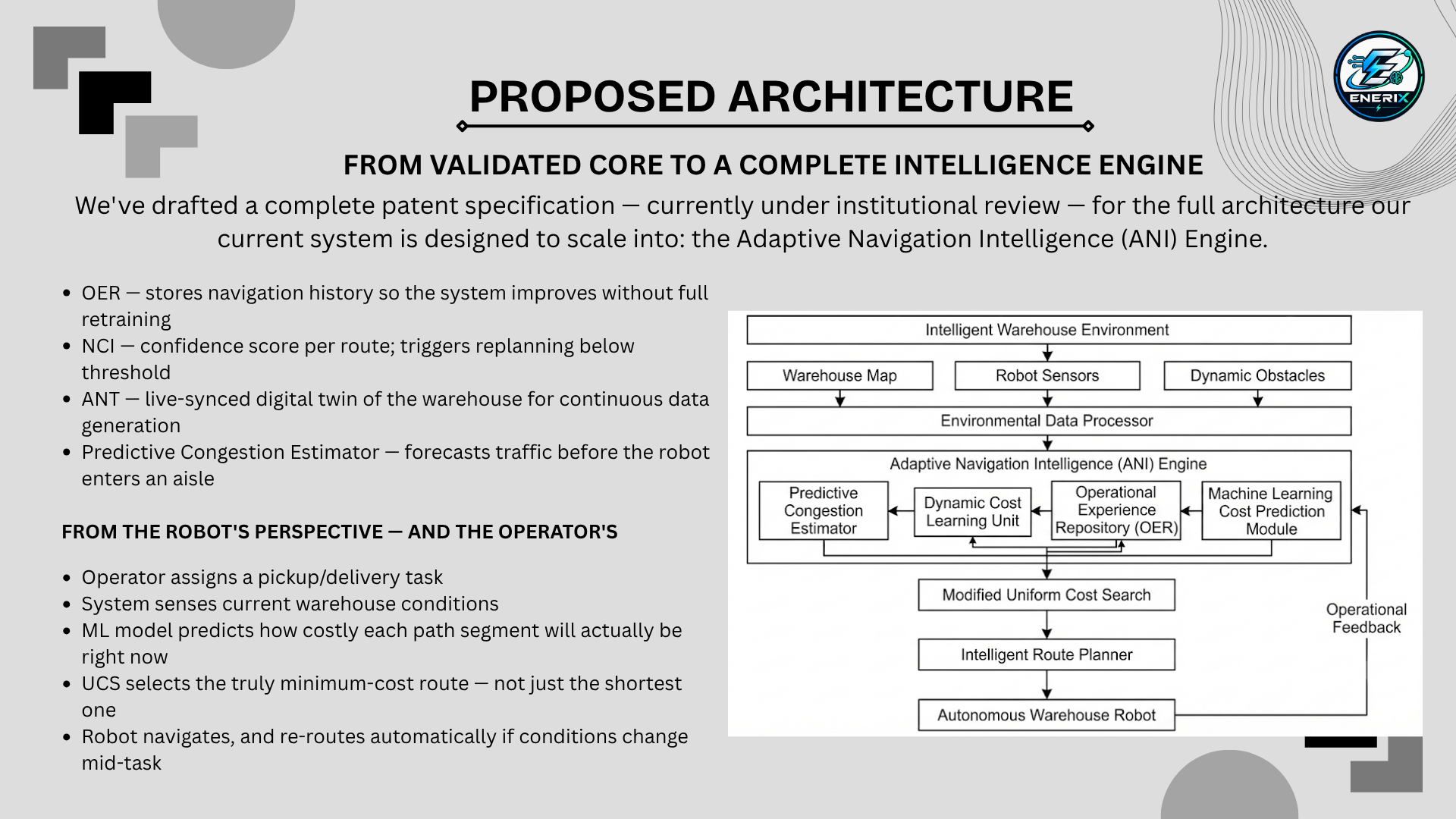
Our system combines a Machine Learning cost-prediction model with Uniform Cost Search (UCS) path planning. Instead of relying on fixed edge costs, a Random Forest model predicts the traversal cost of each path segment using four live features — distance, obstacle density, traffic, and battery level. These predicted costs are fed into UCS, which computes the actual minimum-cost route rather than the shortest-distance one. The system is designed to re-route adaptively as warehouse conditions change.
How we built it
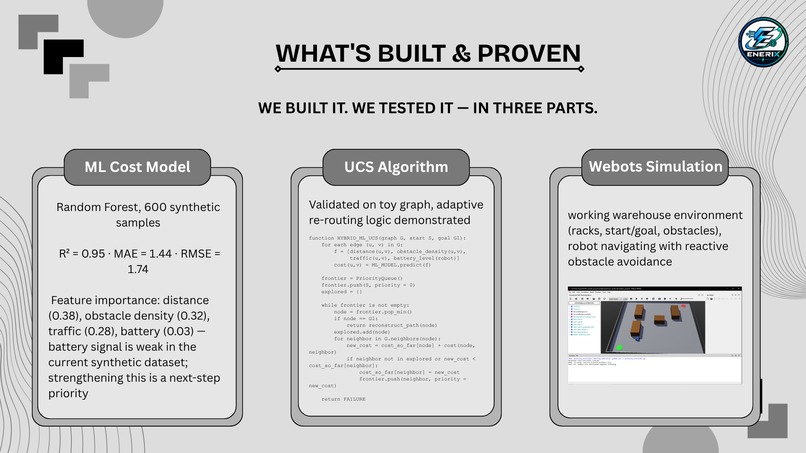
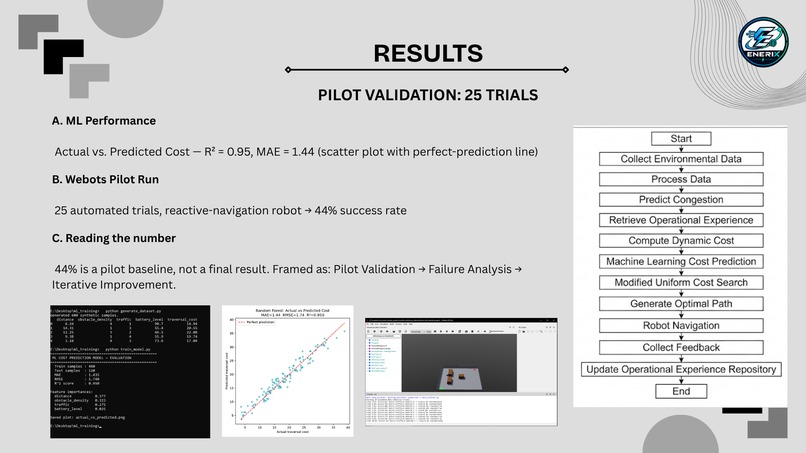
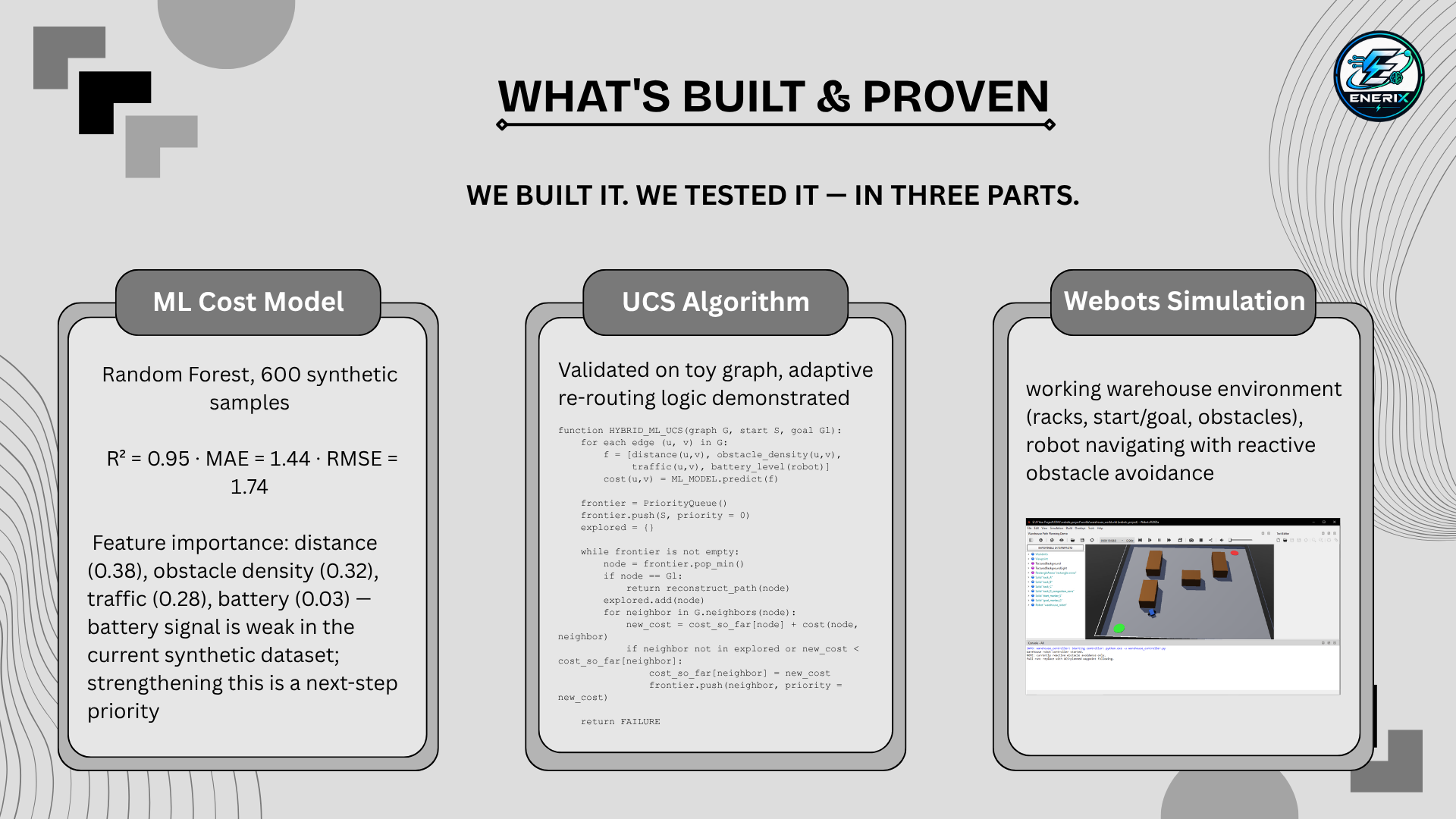
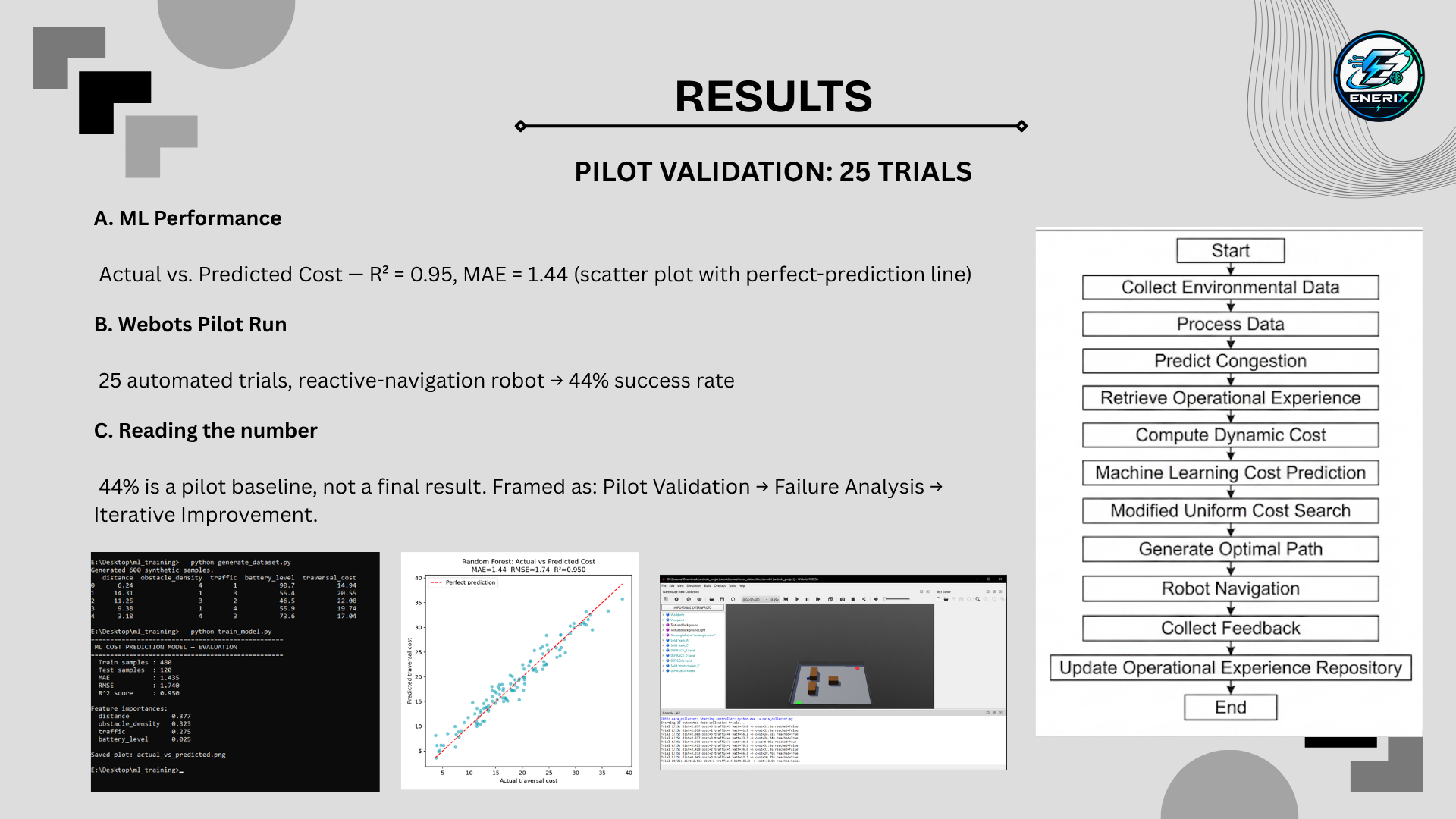
- ML Cost Model: Random Forest Regression trained on 600 synthetic samples (R² = 0.95, MAE = 1.44, RMSE = 1.74)
- Path Planning: Uniform Cost Search implemented and validated on a toy graph, with adaptive re-routing logic
- Simulation Environment: A Webots warehouse environment with racks, start/goal markers, and dynamic obstacles, running an autonomous robot with reactive obstacle avoidance
- Pilot Validation: 25 automated Webots trials to establish a baseline success rate for the current build
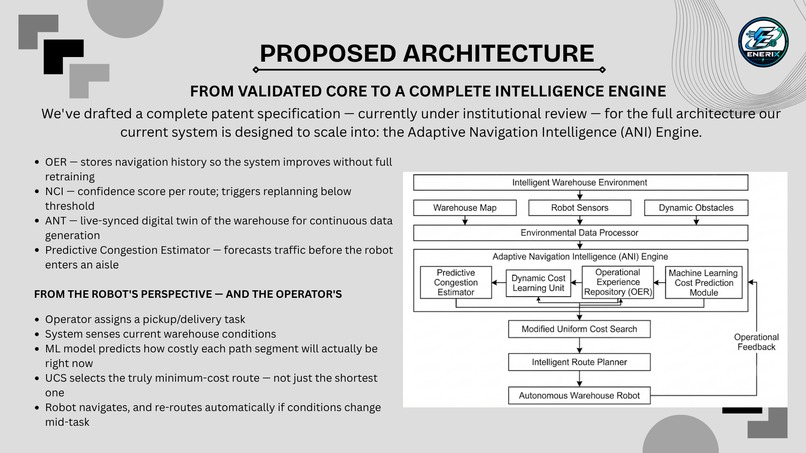
- IP: We've drafted a full patent specification for the extended architecture this system is designed to scale into — an Adaptive Navigation Intelligence (ANI) Engine incorporating an Operational Experience Repository, Navigation Confidence Index, and Predictive Congestion Estimator. It's currently under institutional review.
Challenges we ran into
- Our ML model's feature importance showed battery level contributing very little (0.03) compared to distance, obstacle density, and traffic — weaker than we expected, and something we're actively working to strengthen in the training data
- Fusing the ML-predicted costs directly into live UCS-driven robot navigation in Webots (rather than running each component independently) turned out to be more involved than validating them separately
- Our 25-trial pilot run, using the current reactive-navigation build, returned a 44% success rate — a useful baseline, but a clear signal of where the system still needs work before the full ML+UCS pipeline is fused end-to-end
Accomplishments that we're proud of
- Built and validated three independent components of the pipeline: the ML cost model, the UCS algorithm, and the Webots simulation environment
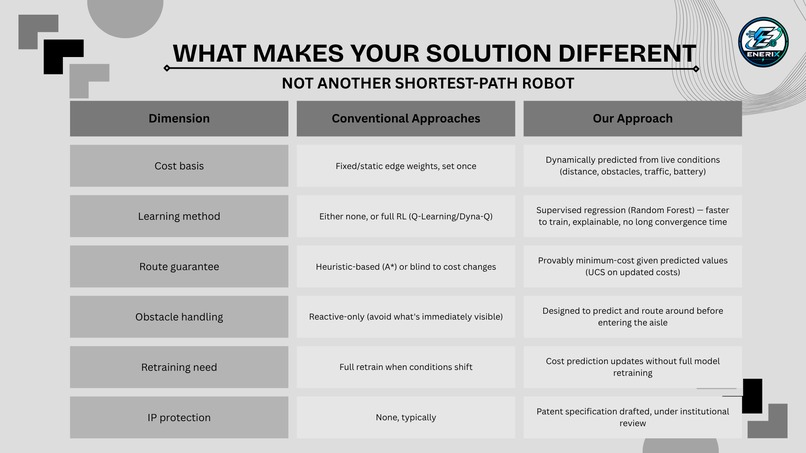
- Achieved a high-accuracy cost prediction model (R² = 0.95) using an explainable, fast-to-train approach instead of a slower reinforcement-learning method
- Drafted a complete patent specification for the broader system architecture
What we learned
- Supervised regression + classical search can match the adaptivity goals of reinforcement learning approaches while staying faster to train and easier to explain
- Validating components independently is a useful first step, but true end-to-end system behavior only shows up once everything is fused and tested together
- Being transparent about a weak pilot result (44%) is more valuable for real engineering progress than hiding it
What's next
- Fuse ML-predicted costs into live UCS-driven waypoint navigation in Webots, replacing the current reactive-only mode
- Strengthen the battery-cost signal in the ML model
- Deploy on an ESP32-based hardware prototype
- File the patent specification once institutional review clears
- Implement the extended ANI Engine modules: Operational Experience Repository, Navigation Confidence Index, and Predictive Congestion Estimator
- Scale from single-robot validation to multi-robot fleet coordination
Built With
- cost
- forest
- learning
- machine
- numpy
- pandas
- python
- random
- robotics
- scikit-learn
- search
- simulation
- uniform
- webots

Log in or sign up for Devpost to join the conversation.