-
-
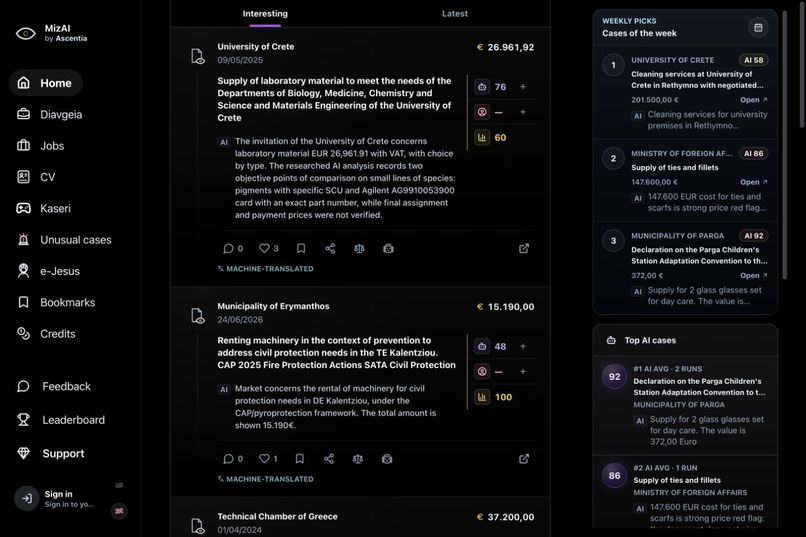
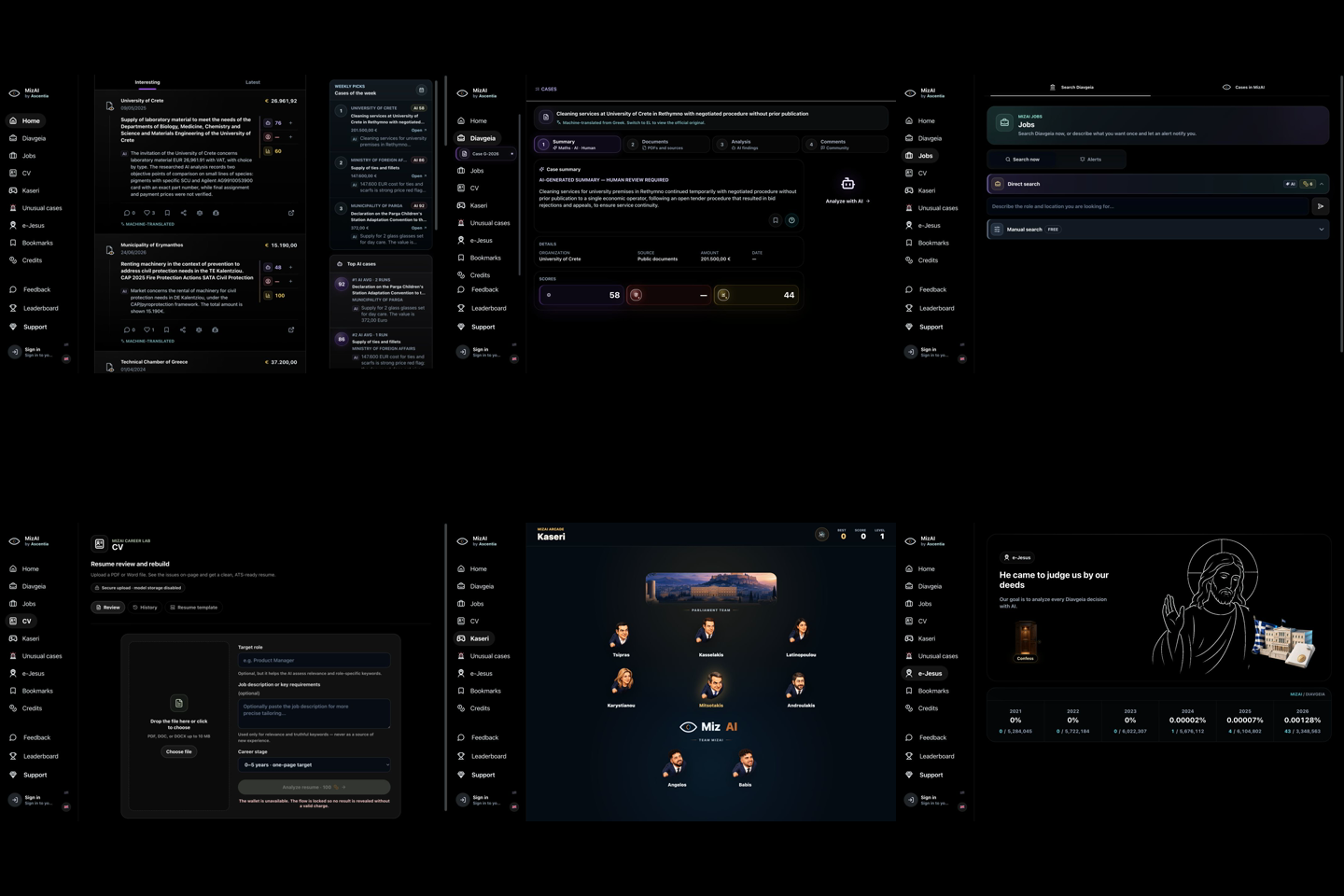
MizAI platform overview: investigations, jobs, CV tools, Kaseri, and e-Jesus.
-
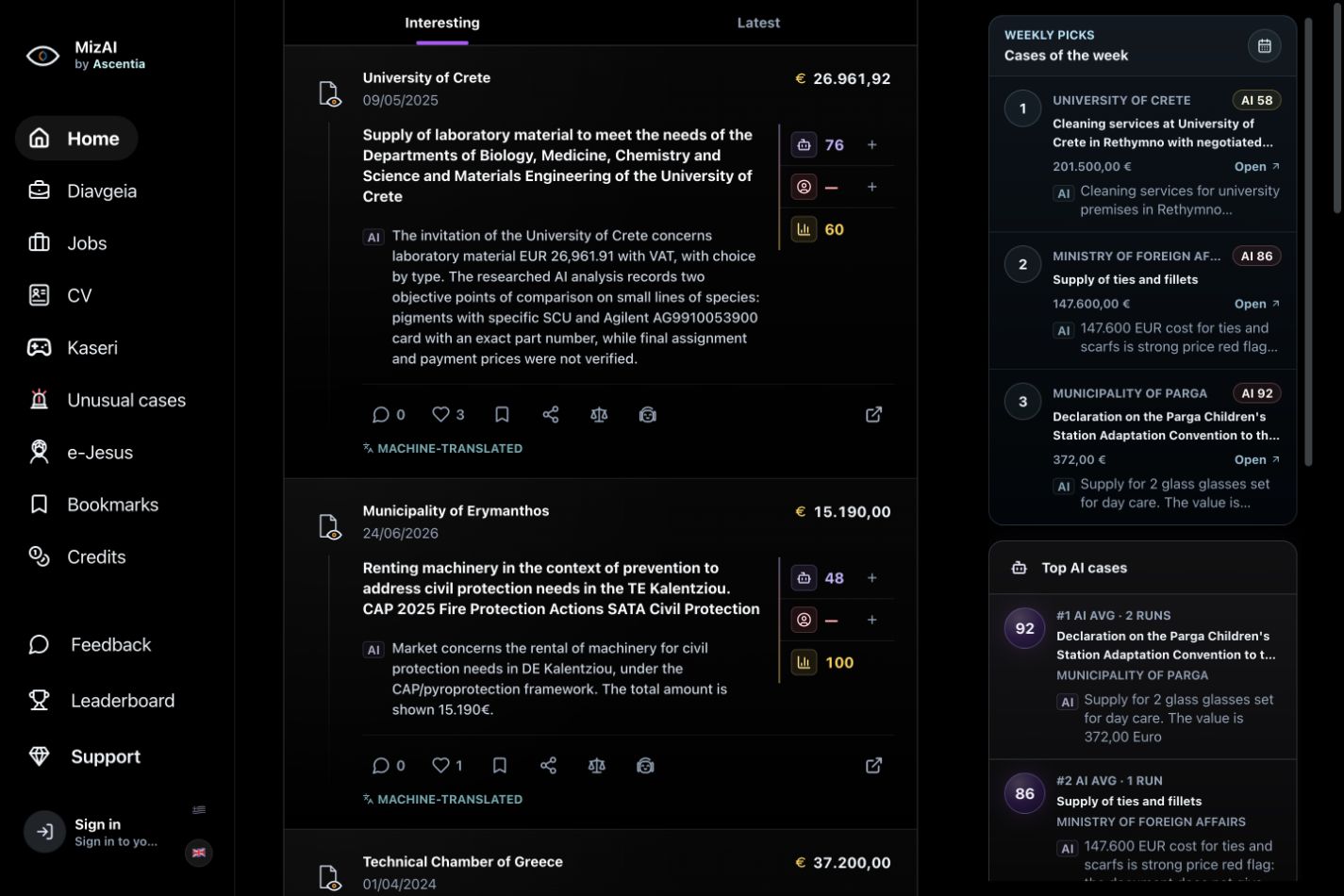
English public case feed with separate scores, comments, likes, and bookmarks.
-
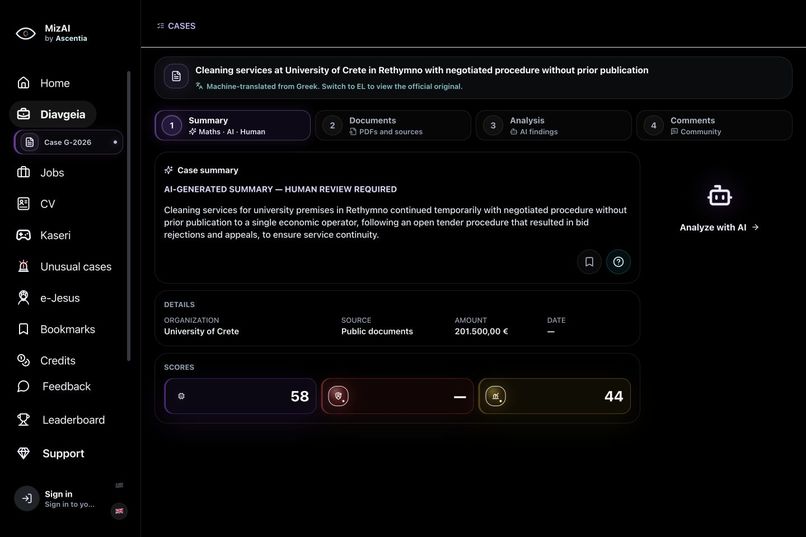
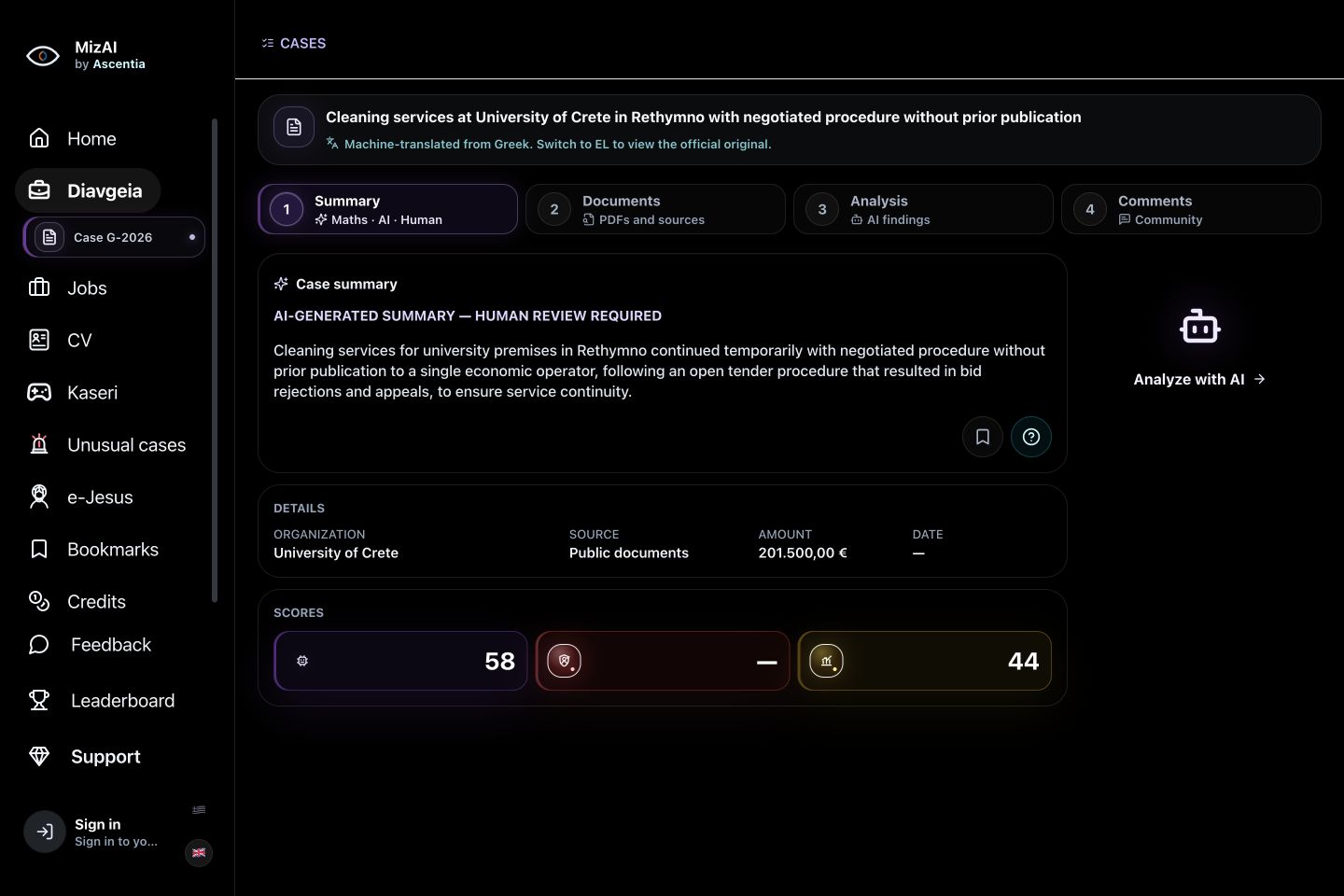
University of Crete case summary with Maths, AI, and Human scores kept distinct.
-
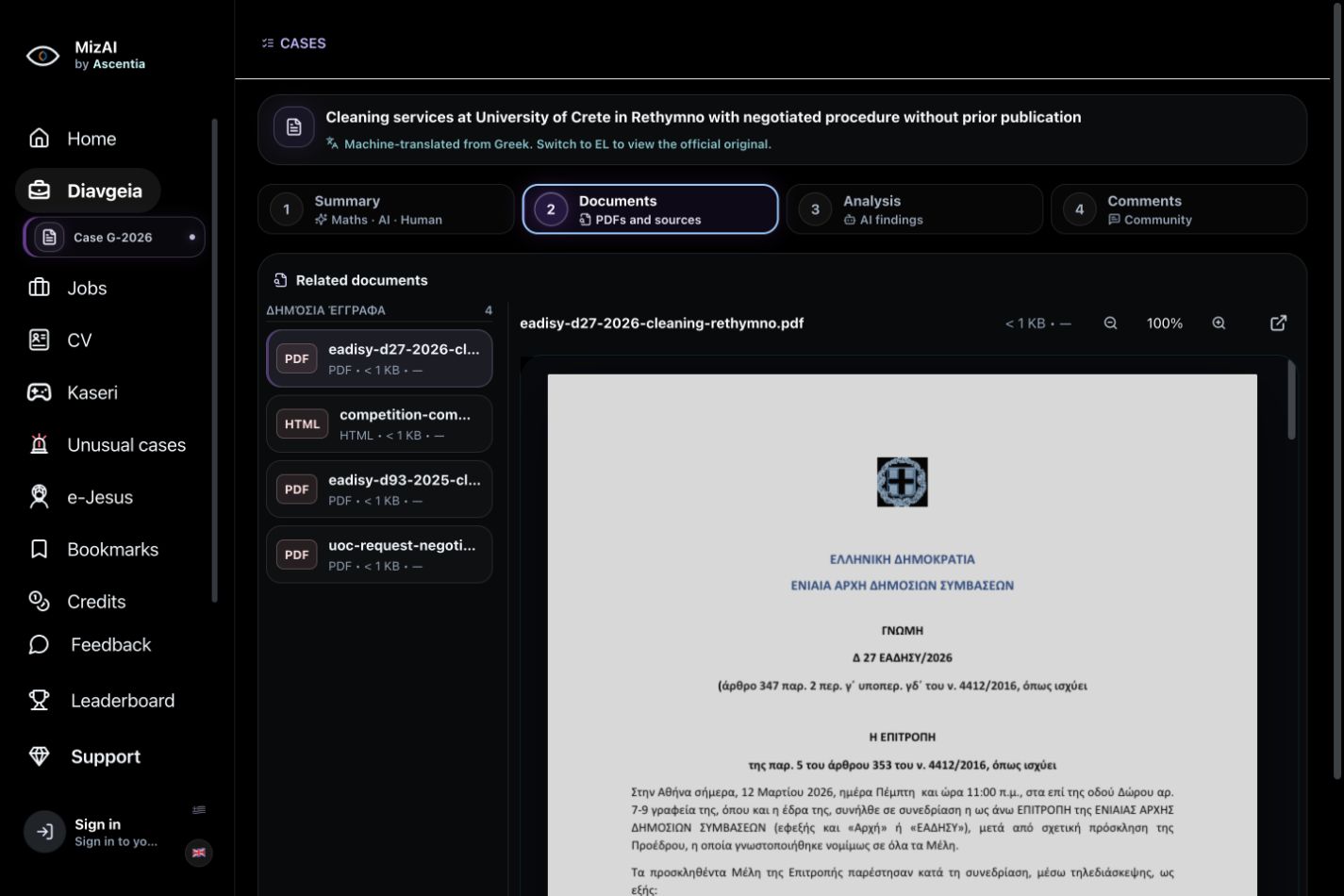
Official documents and source provenance preserved for every reviewable claim.
-
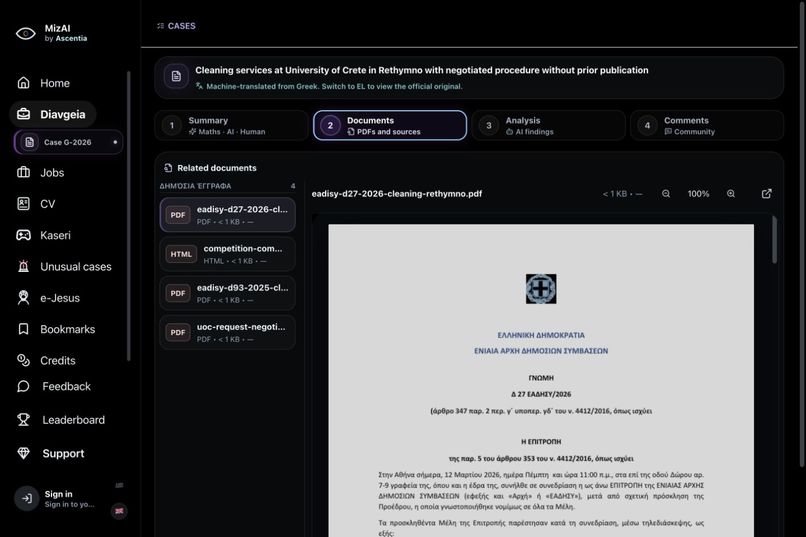
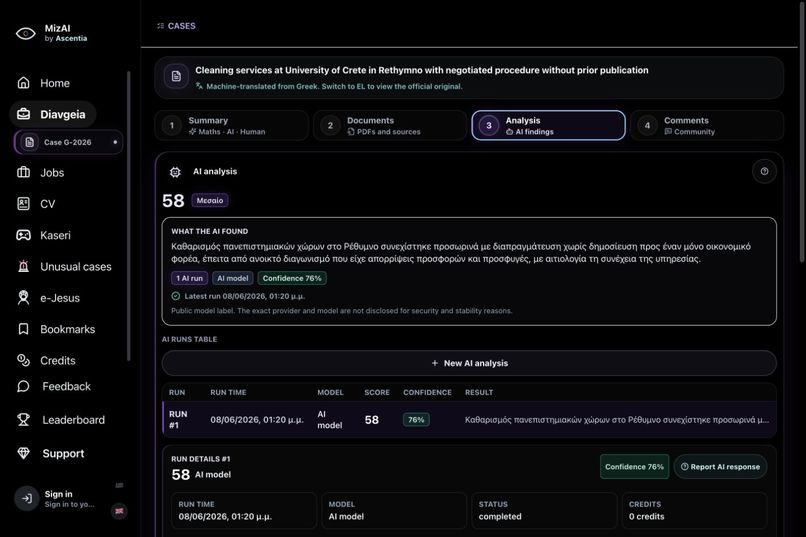
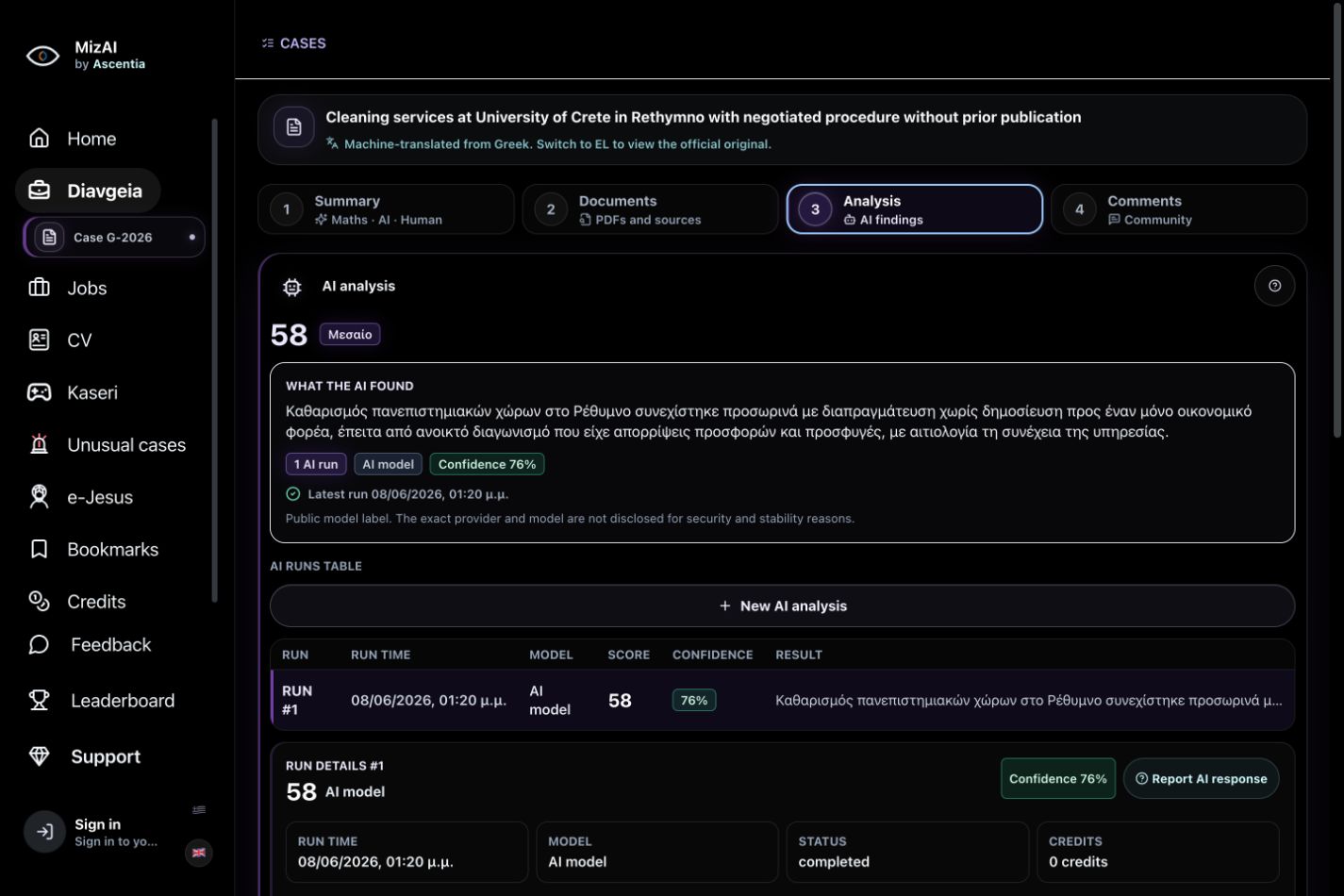
Evidence-first analysis with explicit findings, confidence, and missing evidence.
-
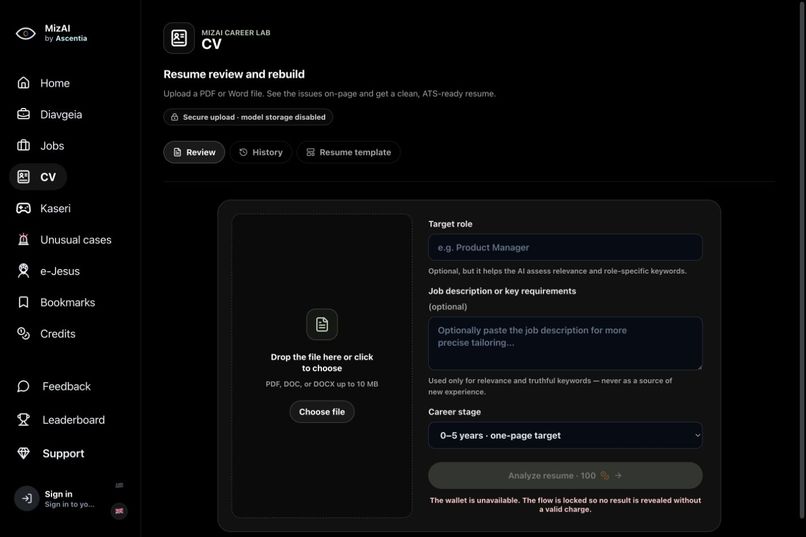
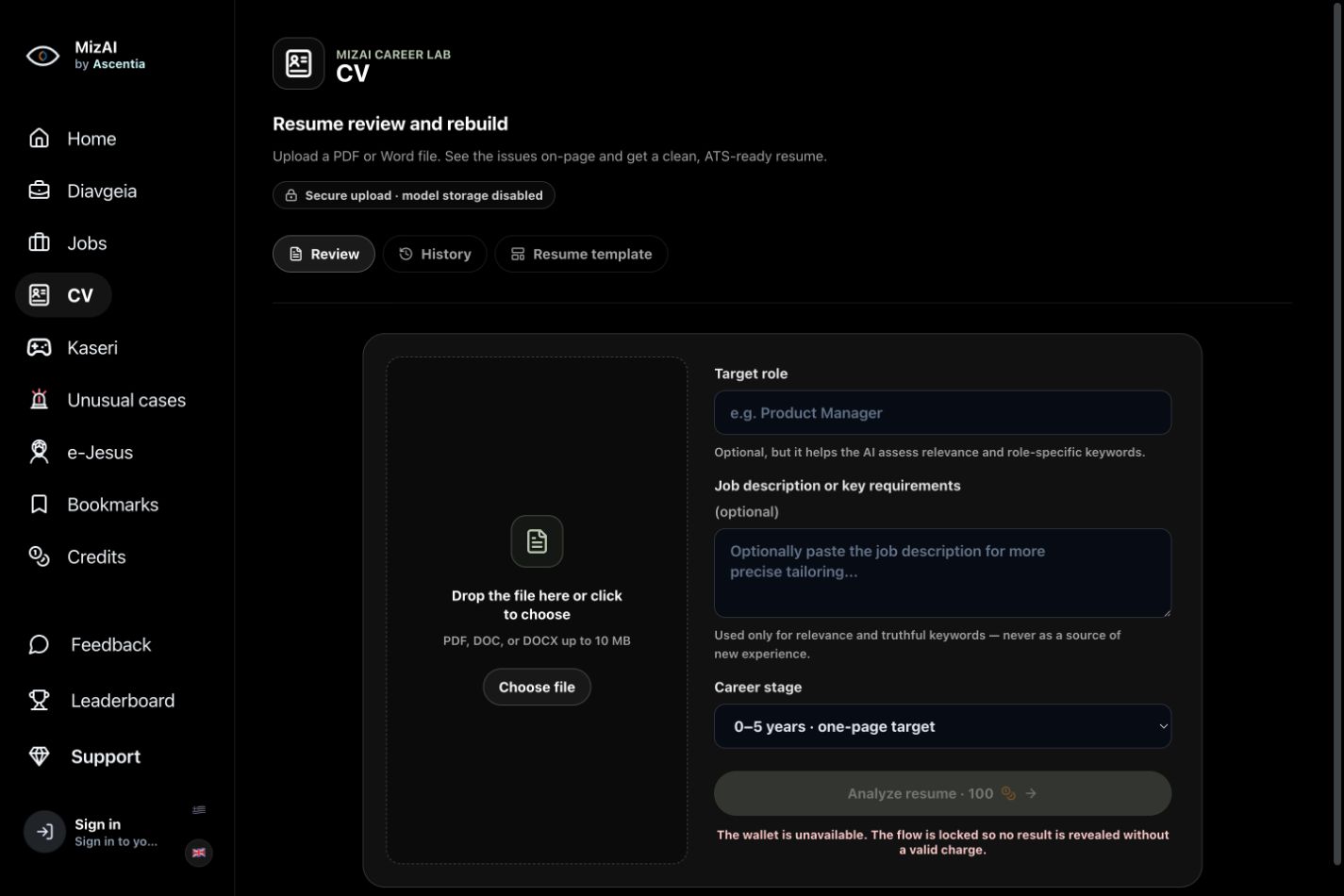
Career Lab CV review and grounded ATS-ready rebuild workflow.
-
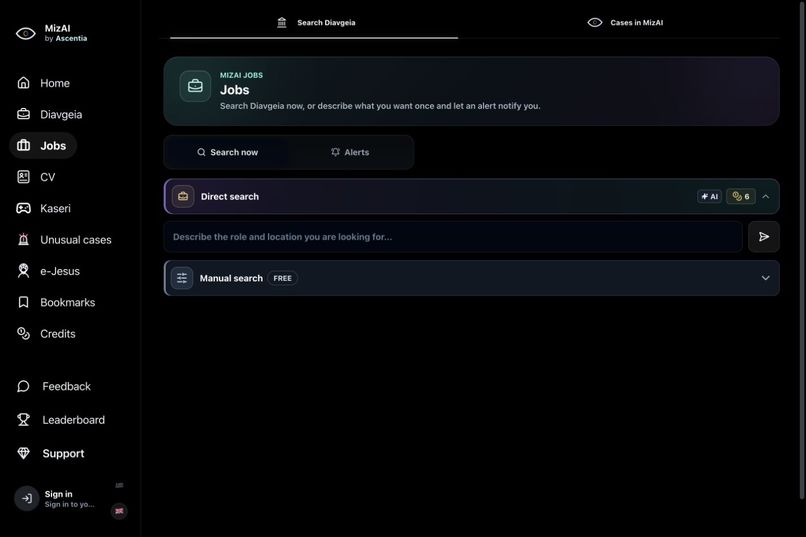
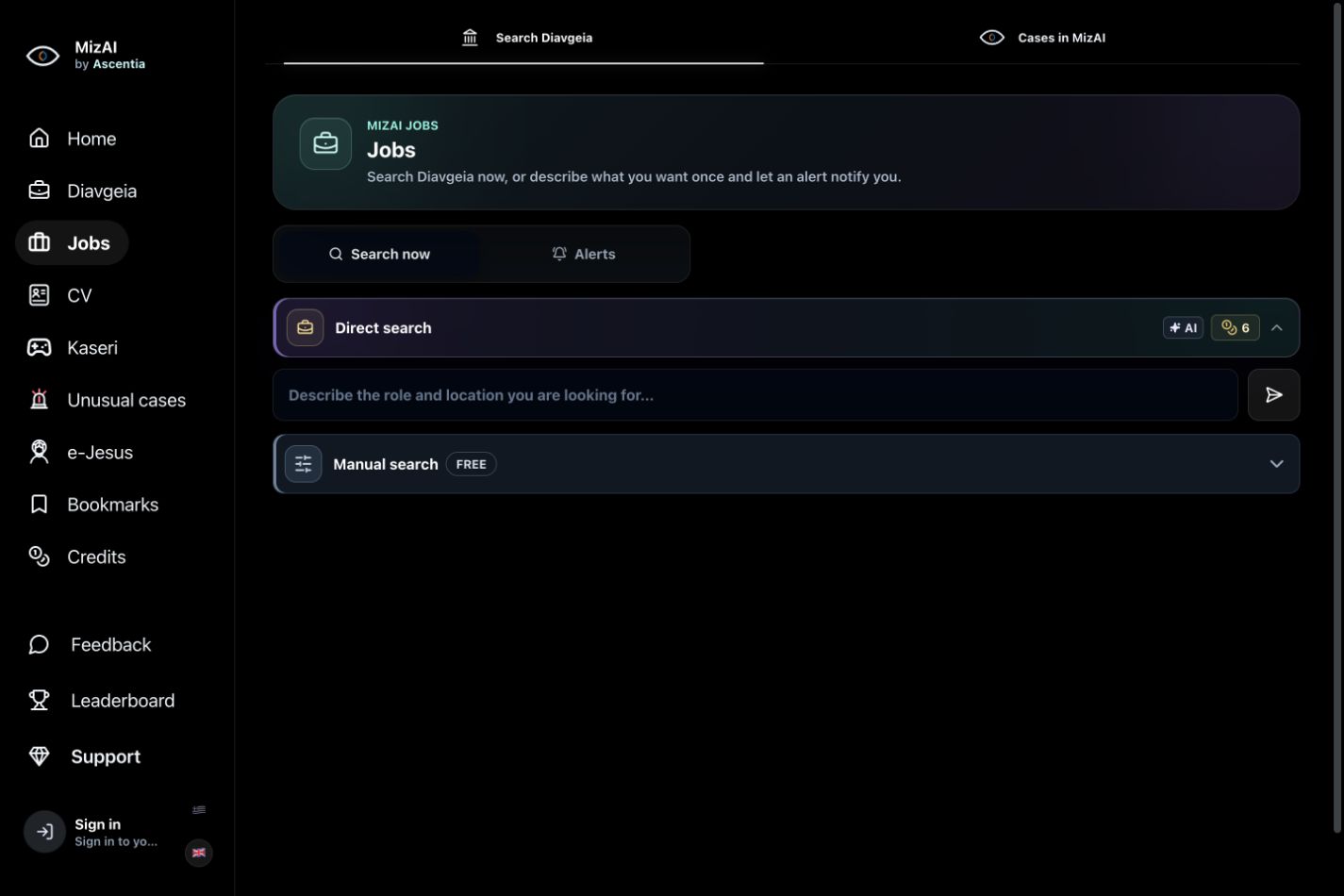
Job Finder with AI search, free manual search, saved criteria, and alerts.
-
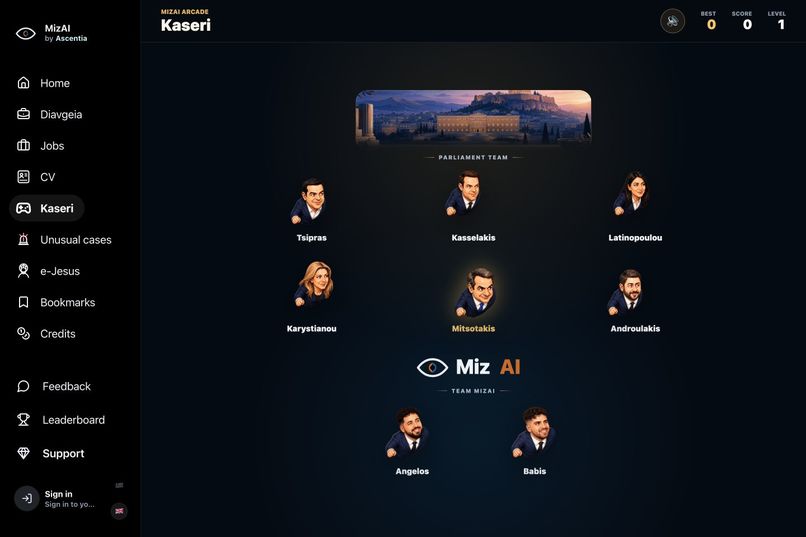
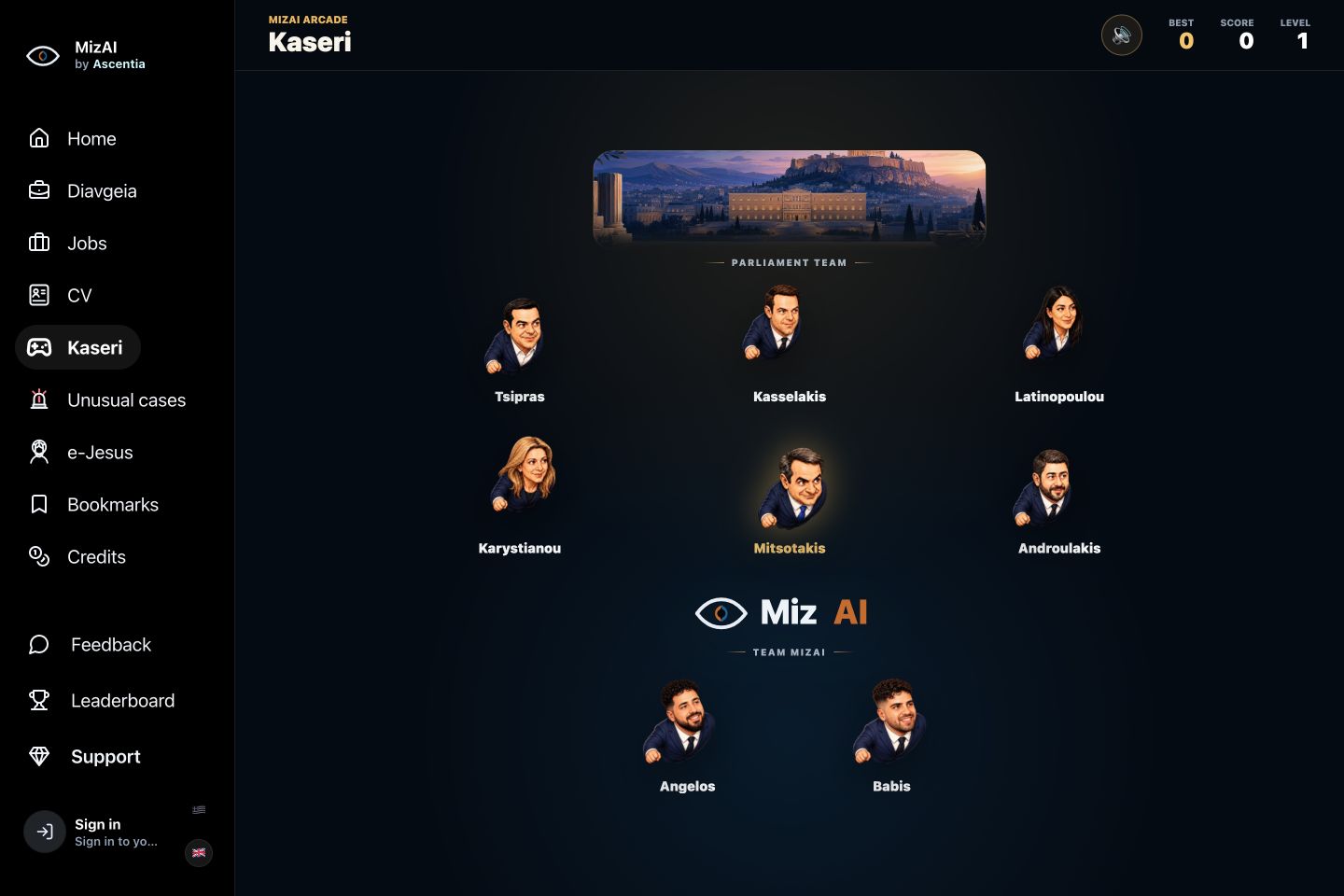
Kaseri: a satirical mobile arcade experience with a privacy-safe leaderboard.
-
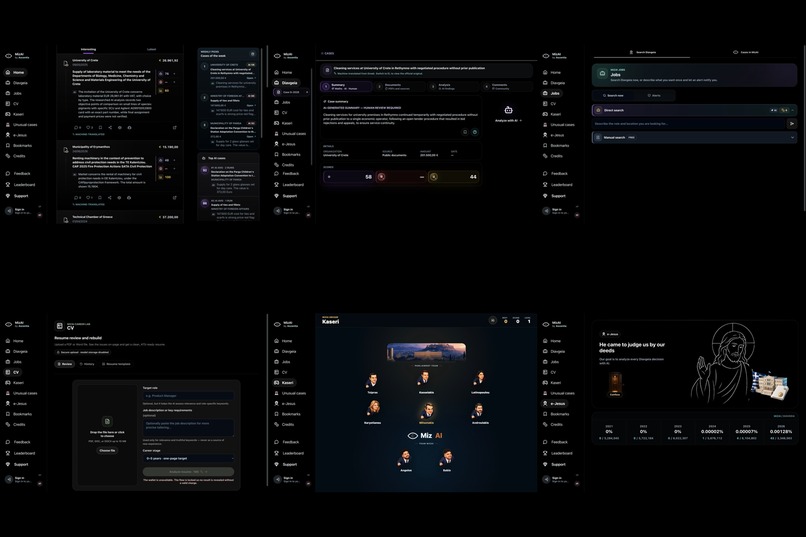
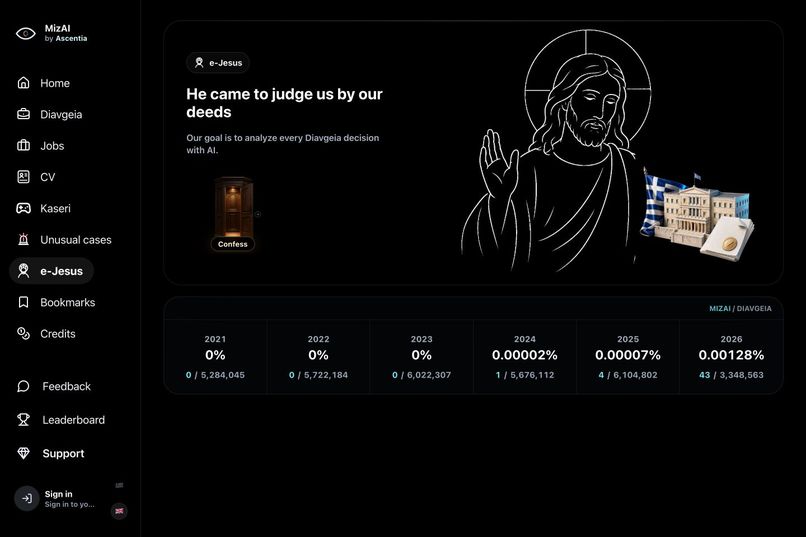
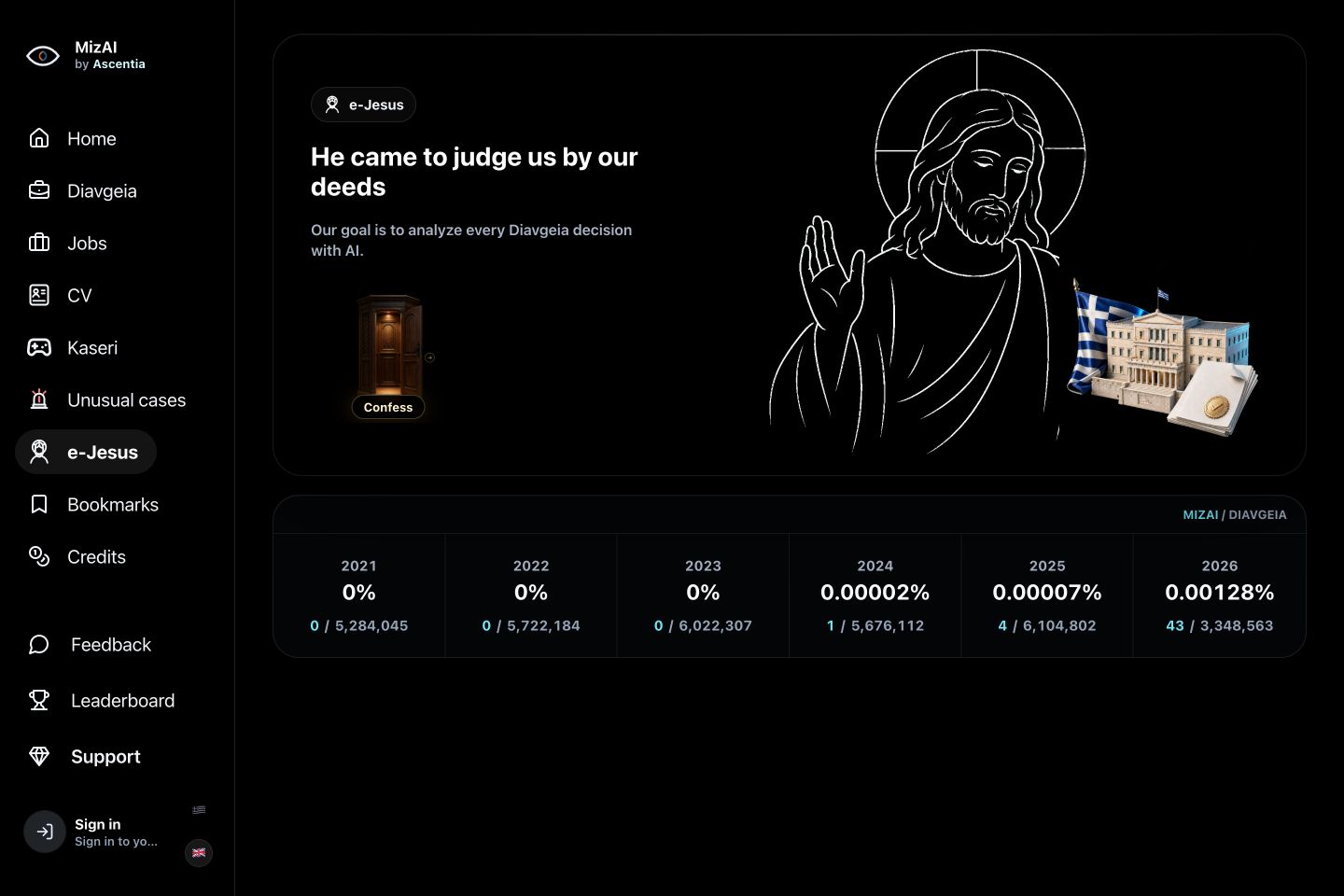
e-Jesus: Diavgeia coverage and a clearly labeled humorous confessional.
Inspiration
Greek public data is scattered across official APIs, identifiers, and long PDFs. Before an analyst can evaluate a procurement case, they often spend hours locating the related decisions, contracts, amounts, and source documents. The same fragmentation makes practical tasks, such as finding a public-sector job notice, unnecessarily difficult. Search can make the problem worse when loose text matches are presented as proof.
MizAI was built around a broader but stricter idea: AI should make public data useful to ordinary people without pretending to be the authority. Serious evidence tools, practical career utilities, community participation, and even satire can live in one platform as long as their boundaries remain explicit.
What it does
MizAI is a working AI-powered civic platform with four connected layers.
Investigate public records
- retrieves public records from Διαύγεια and ΚΗΜΔΗΣ;
- preserves official identifiers, payloads, linked PDFs, and source provenance;
- extracts checkable evidence and separates candidate discovery from confirmed facts;
- presents Maths, AI, and approved Human scores as distinct signals, never one overall verdict;
- supports evidence-bound unusual-case discovery, analysis, and chat with explicit missing-evidence language; and
- offers a source-preserving English experience while keeping the Greek original authoritative.
Participate in review
- lets signed-in users submit justified Human ratings that are moderated before they affect the score;
- supports public comments, likes, bookmarks, sharing, correction requests, and contribution leaderboards; and
- keeps Maths, AI, community activity, and approved Human judgment visibly distinct.
Use public data for work
- provides AI and free manual Job Finder paths over Diavgeia;
- saves job criteria and sends bounded daily alerts without repeatedly spending model tokens; and
- reviews PDF, DOC, and DOCX resumes, marks issues on the original pages, and rebuilds an ATS-ready CV without inventing claims.
Explore playful civic experiences
- includes Kaseri, an original satirical one-touch flying game with privacy-safe leaderboards; and
- includes e-Jesus, which visualizes Diavgeia analysis coverage and offers an explicitly humorous, metered GPT-5.6 confessional.
The core public reviewer path is available without an account at mizai.gr.
What changed during OpenAI Build Week
MizAI existed before the submission period. The repository documents the exact boundary between the pre-period baseline and the eligible extension.
During Build Week I meaningfully extended the product with:
- unified official-source search and navigation across live procurement evidence;
- evidence-first unusual-case discovery with explicit uncertainty and provenance;
- AI/manual Job Finder, saved criteria, and daily alerts;
- a real GPT-5.6 Sol CV analysis and native rebuild pipeline grounded in the uploaded resume;
- GPT-5.6 routing for bounded planning, structured case analysis, chat, CV reconstruction, and e-Jesus;
- a metered e-Jesus confessional plus contextual-response improvements;
- Kaseri mobile, audio, pacing, identity, and privacy improvements;
- a competition-ready English UI and separate translation cache that never overwrites Greek source data;
- ingestion, privacy, security, mobile, and release hardening; and
- extensive regression and browser coverage across routes, languages, and responsive viewports.
The README links the exact baseline and product snapshot, dated commit/PR evidence, and a judge test path.
How I built it
MizAI is a TypeScript/Next.js frontend backed by FastAPI, SQLAlchemy, Alembic, PostgreSQL, and S3-compatible document storage. Official-source ingestion resolves Διαύγεια and ΚΗΜΔΗΣ records, downloads public documents, extracts searchable text, and preserves source metadata. Shared account, privacy, and credit contracts connect case investigation, Job Finder, Career Lab, e-Jesus, and the Kaseri leaderboard, while provider accounting guards every metered AI surface.
AI paths use structured schemas, bounded reasoning/output budgets, idempotency, provider accounting, and store=false for case-content requests. Private Διαύγεια records are a hard block and are excluded from ingestion, scoring, translation, and every public surface.
How I used Codex
Codex was my primary engineering collaborator across isolated worktrees and small pull requests. I used it to:
- trace real official API and PDF behavior before changing retrieval logic;
- implement and review search, ingestion, scoring, alert, translation, mobile, and release paths;
- turn requirements into explicit schemas, migrations, failure states, and tests;
- perform Greek/English browser review across mobile, tablet, and desktop;
- audit security, privacy, provider-cost, and operational boundaries; and
- maintain a dated decision trail that distinguishes suggestions from accepted human decisions.
I made the central product decisions: candidate retrieval is not proof; every important claim must retain an official-source path; private records fail closed; translations never replace originals; AI scores never become fraud verdicts; and provider spend must remain bounded.
How GPT-5.6 is used
- GPT-5.6 Luna handles bounded planning, lower-cost first passes, and the e-Jesus confessional.
- GPT-5.6 Terra is the default evidence-analysis and case-chat model.
- GPT-5.6 Sol powers the deepest investigation tier and grounded CV analysis/reconstruction where the larger reasoning budget is justified.
The model output is structured and evidence-bearing. It records risk reasons, missing evidence, confidence, and disclaimers, and it never replaces the official documents or human review.
Challenges
The hardest problem was not generating text. It was preserving the boundary between a promising search result and a fact that the underlying official record actually supports, while serving very different product surfaces. Greek morphology, inconsistent organization names, long scanned PDFs, source outages, resume grounding, public participation, and asynchronous translation all create opportunities for silent false confidence.
The solution was to make those boundaries product behavior: explicit source states, separate discovery and analysis phases, moderated ratings/comments, grounded CV reconstruction, clear entertainment labels, fail-closed privacy and translation rules, strict schemas, and reproducible dated evidence.
Accomplishments
- A live, public, bilingual multi-product platform rather than a static prototype.
- Traceable official documents and source links on case pages.
- Working Job Finder, Career Lab, community-review, Kaseri, and e-Jesus surfaces.
- Meaningful Build Week changes isolated by timestamped Git history.
- Task-appropriate GPT-5.6 model tiers with cost and reasoning controls.
- Cautious risk language and a correction/legal-review path.
- A private-by-default repository with reproducible local setup and CI evidence.
What I learned
AI quality depends as much on the evidence contract as on the model. A smaller, well-bounded plan can be more trustworthy than a broad autonomous workflow. Product breadth also needs explicit boundaries: a procurement finding, a CV rewrite, a moderated rating, and a satirical chat must never be presented as the same kind of truth. The most useful role for Codex was sustained collaboration across code, browser evidence, tests, and decisions.
What's next
Next steps are to improve reviewed English terminology, expand official-source and Job Finder coverage without weakening provenance, make judge/test flows even easier, grow Career Lab with the same grounding rules, and continue calibrating retrieval on real inputs before changing ranking logic.
Built With
- alembic
- cloudflare
- codex
- diavgeia-opendata-api
- docker
- docx
- fastapi
- gpt-5.6
- kimdis
- minio
- next.js
- openai
- pgvector
- playwright
- postgresql
- pydantic
- python
- react
- sqlalchemy
- tailscale
- tailwind-css
- temporal
- typescript

Log in or sign up for Devpost to join the conversation.