-
-
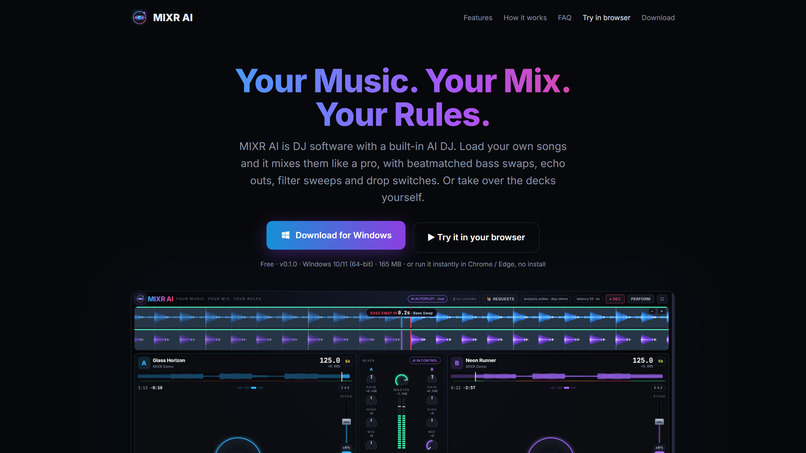
Homepage: Introducing MIXR AI — Your Music. Your Mix. Your Rules.
-
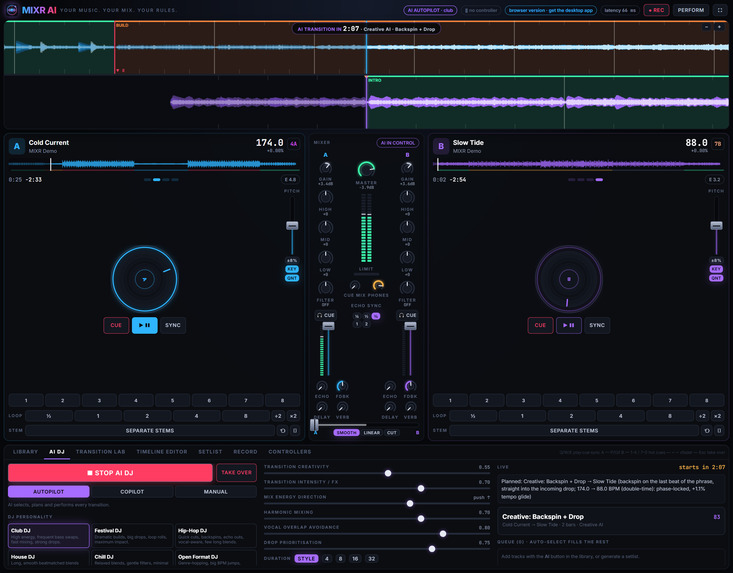
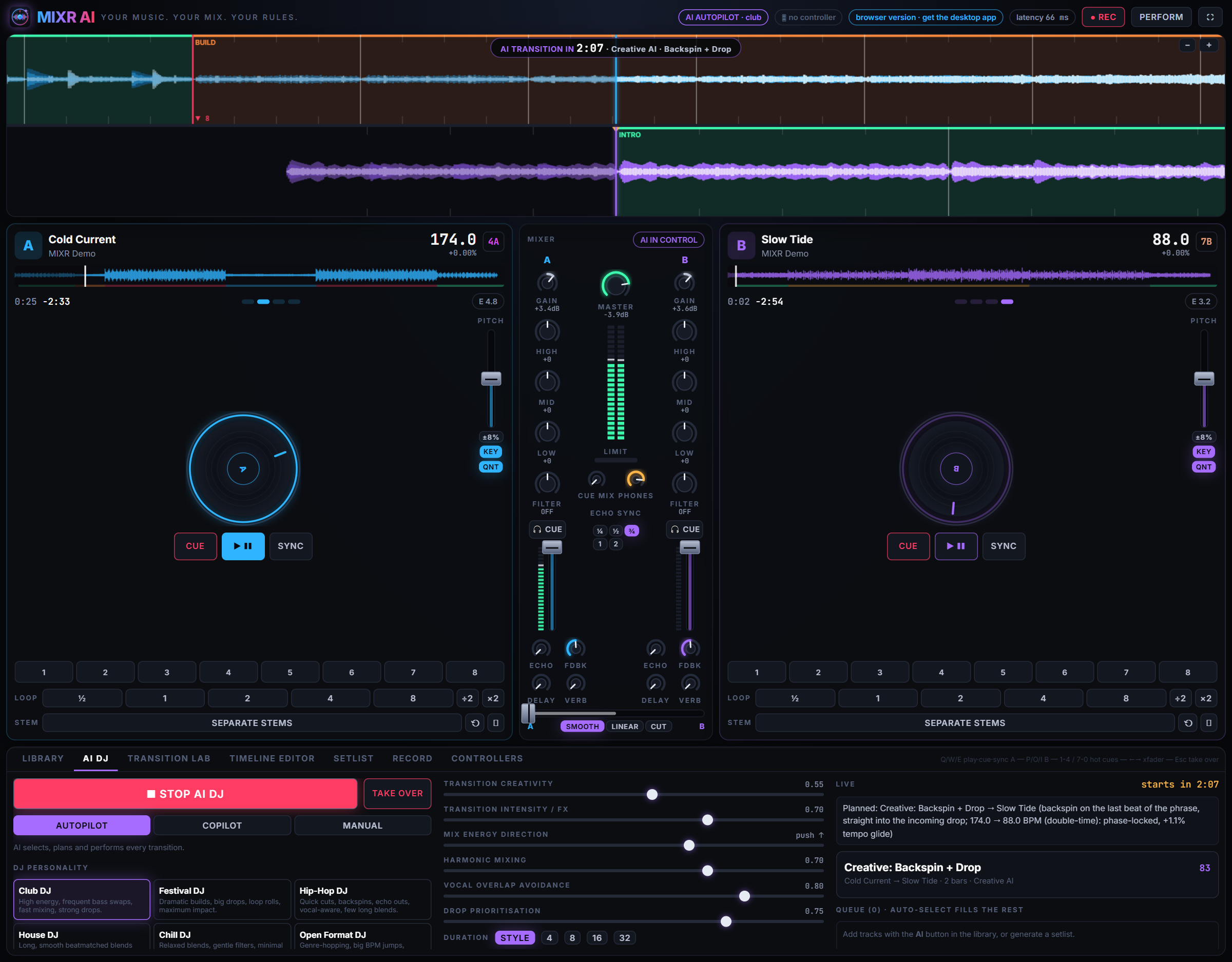
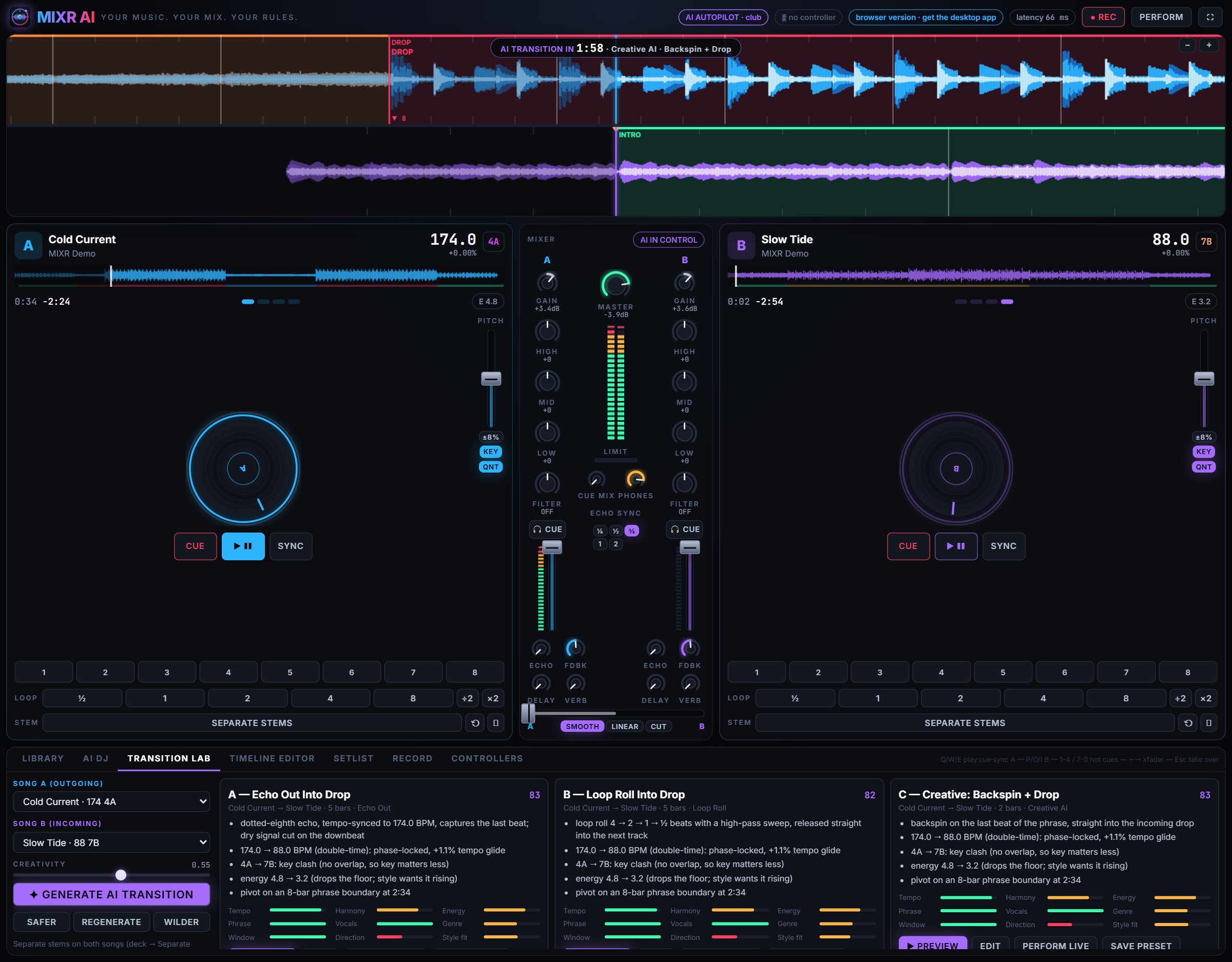
DJ Interface: Professional dual-deck mixing with real-time controls, waveforms, and audio effects.
-
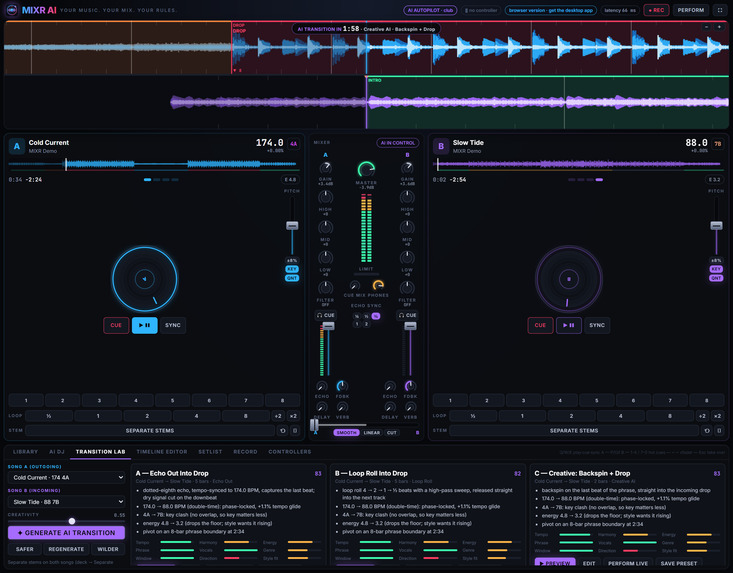
3. AI DJ Mode: Intelligent song analysis and AI-powered transitions for seamless, creative mixes.
Inspiration
We wanted to make DJing more accessible to everyone, regardless of their experience. Professional DJ software like Serato and rekordbox offers powerful tools, but learning how to beatmatch, transition between songs, and maintain the energy of a set can take a lot of practice. We thought, what if AI could handle the technical side of mixing while still giving users the freedom to be creative?
That's how MIXR AI came about. Our goal was to build a platform where anyone could upload their favorite songs and create professional-sounding DJ mixes, while experienced DJs could still manually control every transition.
What It Does
MIXR AI is an AI-powered DJ platform that combines traditional DJ controls with intelligent automatic mixing.
Users can manually mix tracks using two virtual decks, adjust BPM, control EQ, and apply audio effects. Alternatively, they can activate AI DJ mode, which analyzes tracks and determines how to transition between them.
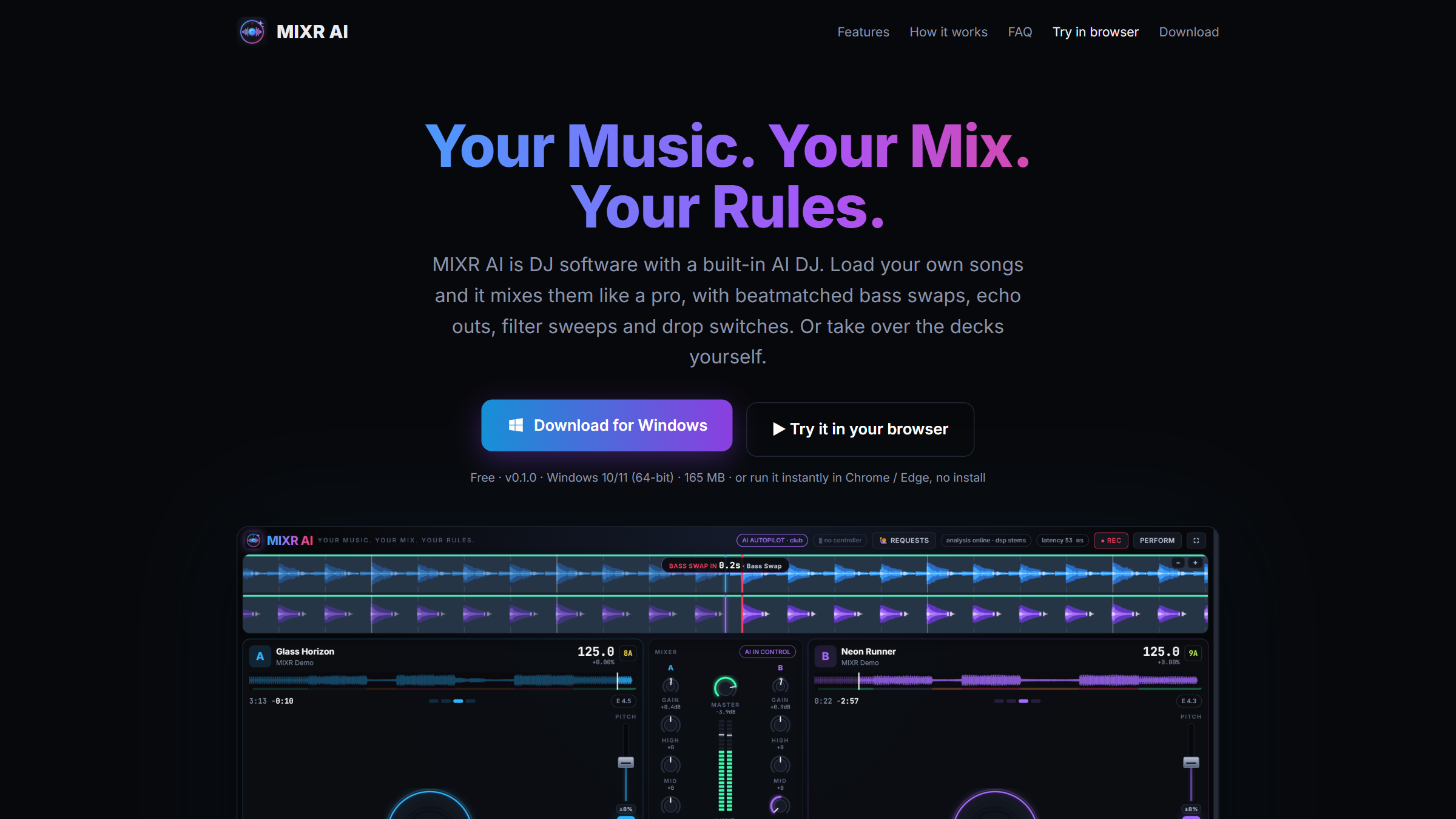
The platform is designed to support creative transitions like bass swaps, echo-outs, beatmatched blends, and drop switches rather than simply fading between songs.
How We Built It
We designed MIXR AI using React, TypeScript, and Tailwind CSS for the frontend, creating an interface inspired by professional DJ software.
For audio processing, we focused on the Web Audio API and a Python-based backend for music analysis. Libraries such as librosa can help analyze BPM, beats, musical keys, and song structure to identify potential transition points.
The core idea was to separate the AI's decision-making from the audio engine. AI determines when and how two tracks should transition, while the audio engine handles the actual playback, synchronization, and effects.
Challenges We Faced
One of the biggest challenges was making transitions sound natural. Mixing music involves more than matching BPM. Songs have different structures, energy levels, vocal sections, and drops, making it difficult to determine the right moment to transition.
Another challenge was maintaining accurate timing between two audio tracks. Even small synchronization errors can make a transition sound off-beat.
We also had to balance advanced AI functionality with an interface that was easy enough for beginners to understand.
What We Learned
This project helped us better understand digital signal processing, real-time audio playback, music analysis, and how AI can work alongside traditional algorithms.
We also learned that AI doesn't necessarily need to generate music to improve the creative process. Instead, it can analyze existing music, make intelligent decisions, and automate complex tasks while keeping the user in control.
What's Next for MIXR AI
We want to continue improving the AI transition engine so it can create even more creative, professional-sounding mixes.
Future features include AI-generated mashups, vocal and instrumental stem separation, personalized DJ styles, intelligent playlist ordering, and the ability to automatically generate complete DJ sets.
Ultimately, our vision is to make MIXR AI a platform where anyone can DJ like a pro, whether they're controlling every beat or letting AI take over.
Built With
- artificial-intelligence
- audio
- audioworklet
- css3
- demucs
- digital-signal-processing
- essentia
- fastapi
- git
- github
- html5
- javascript
- librosa
- machine-learning
- music-information-retrieval
- numpy
- python
- pytorch
- react
- sqlite
- tailwind-css
- typescript
- vite
- web-audio-api
- webassembly

