-
-
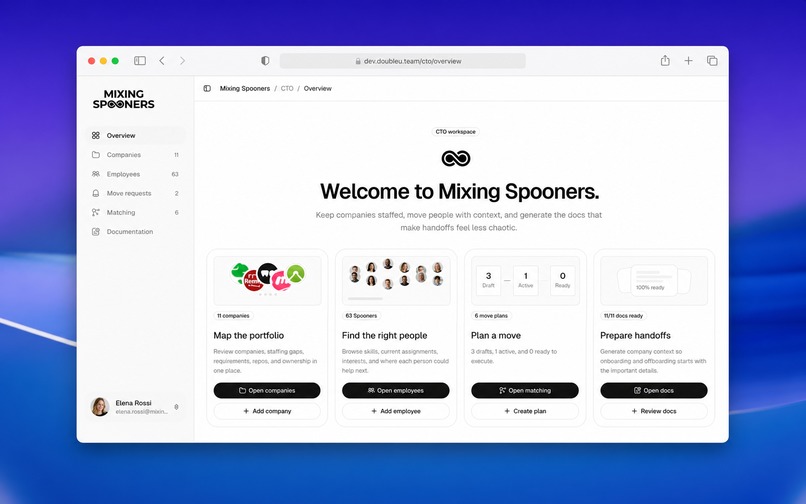
Overview
-
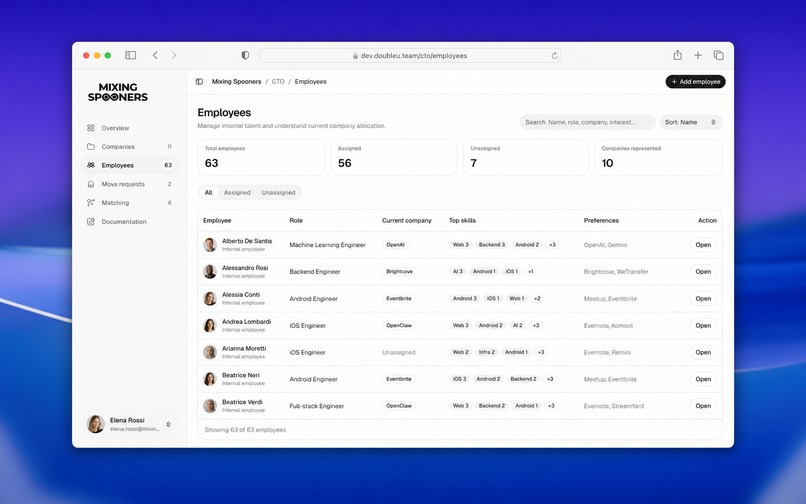
Employees
-
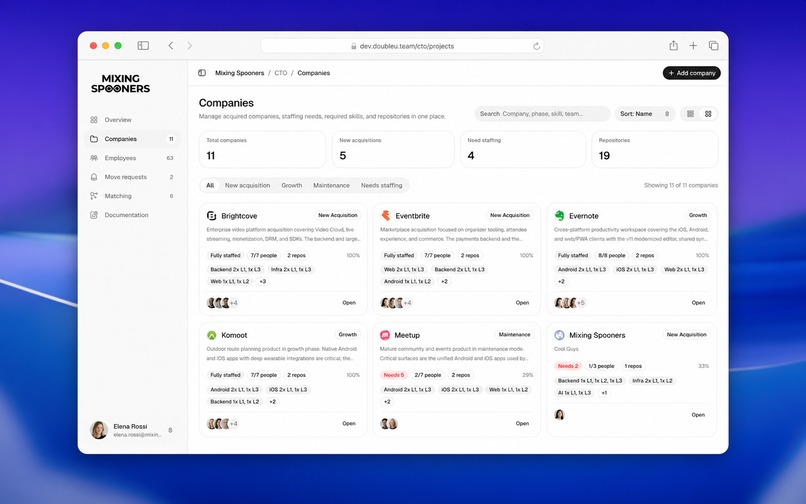
Companies / Projects
-
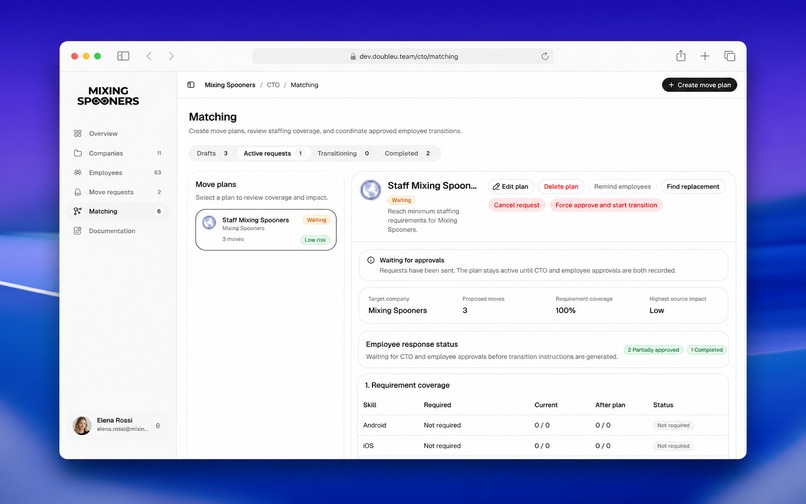
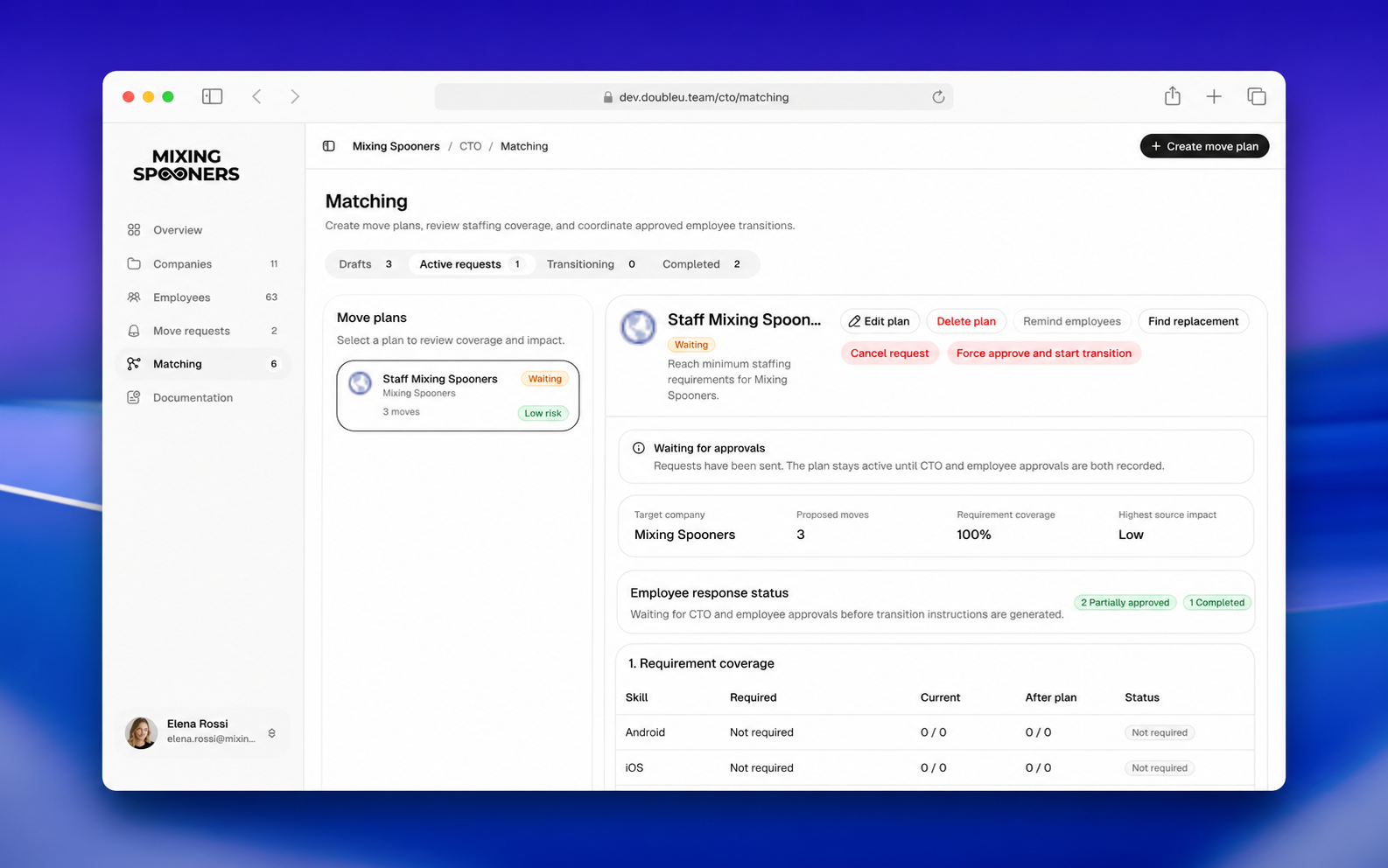
Matching
-
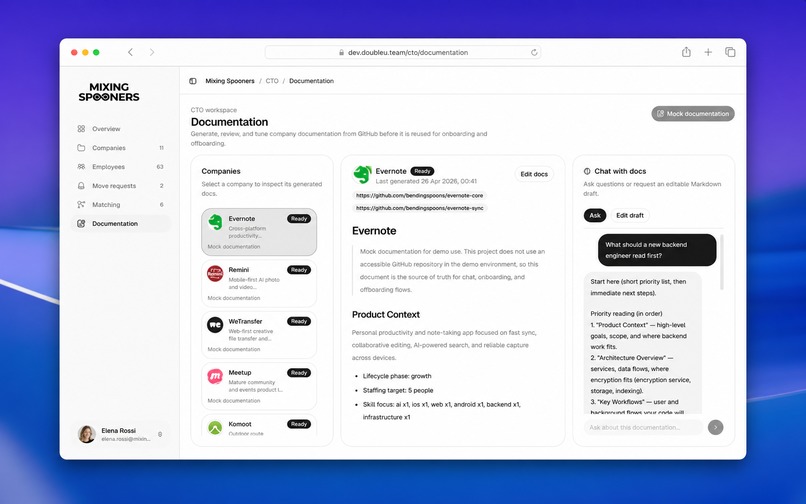
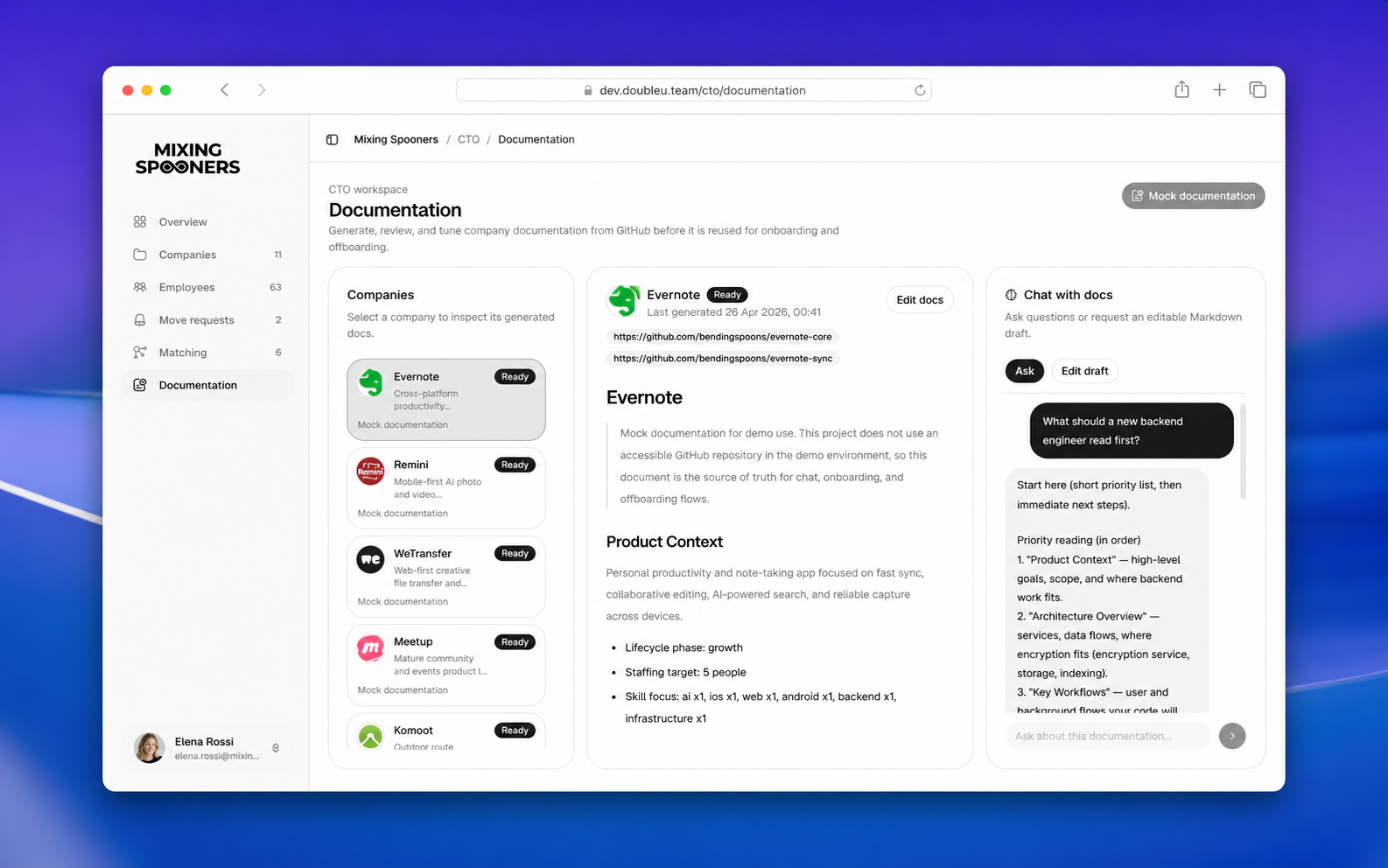
Documentation
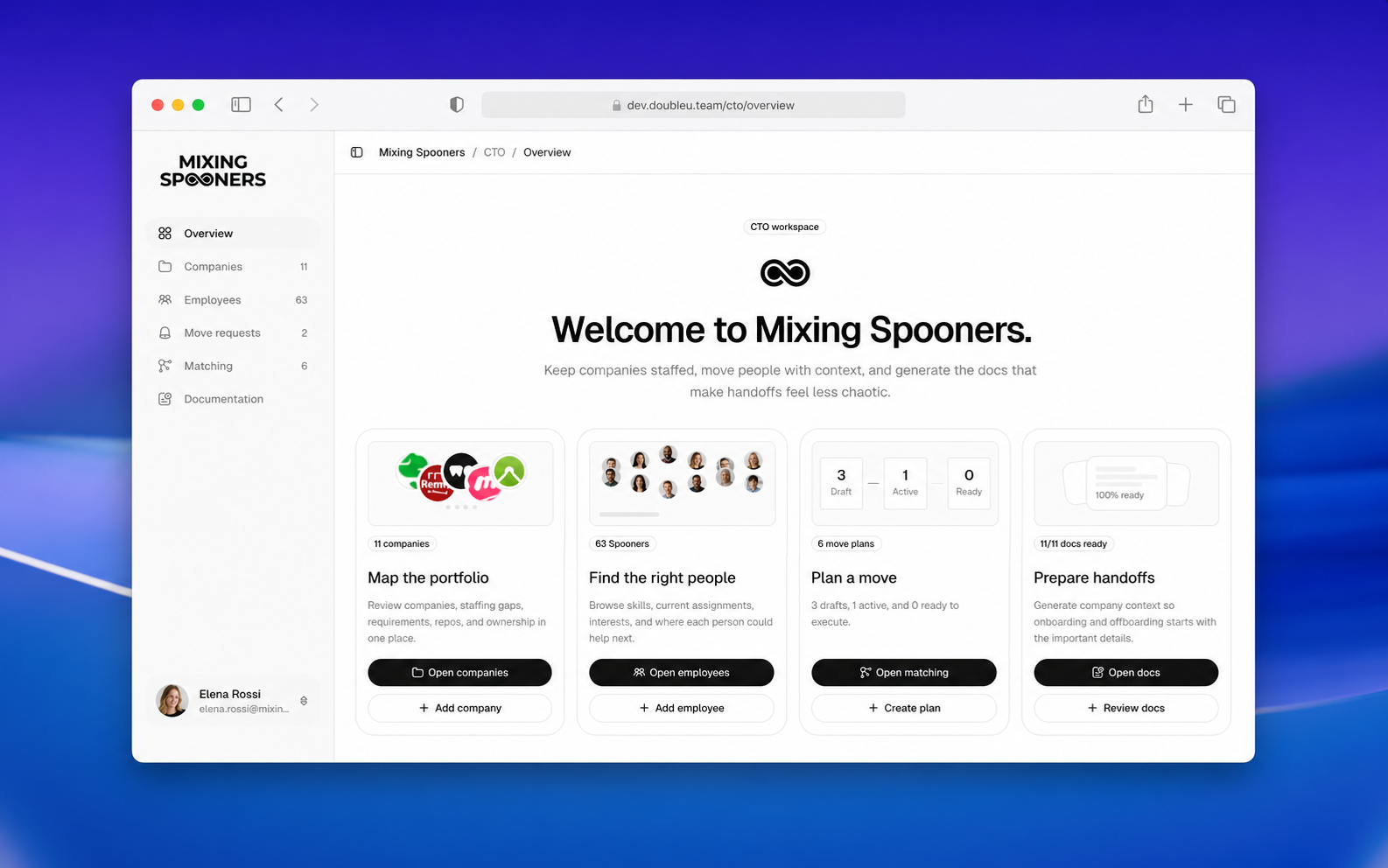
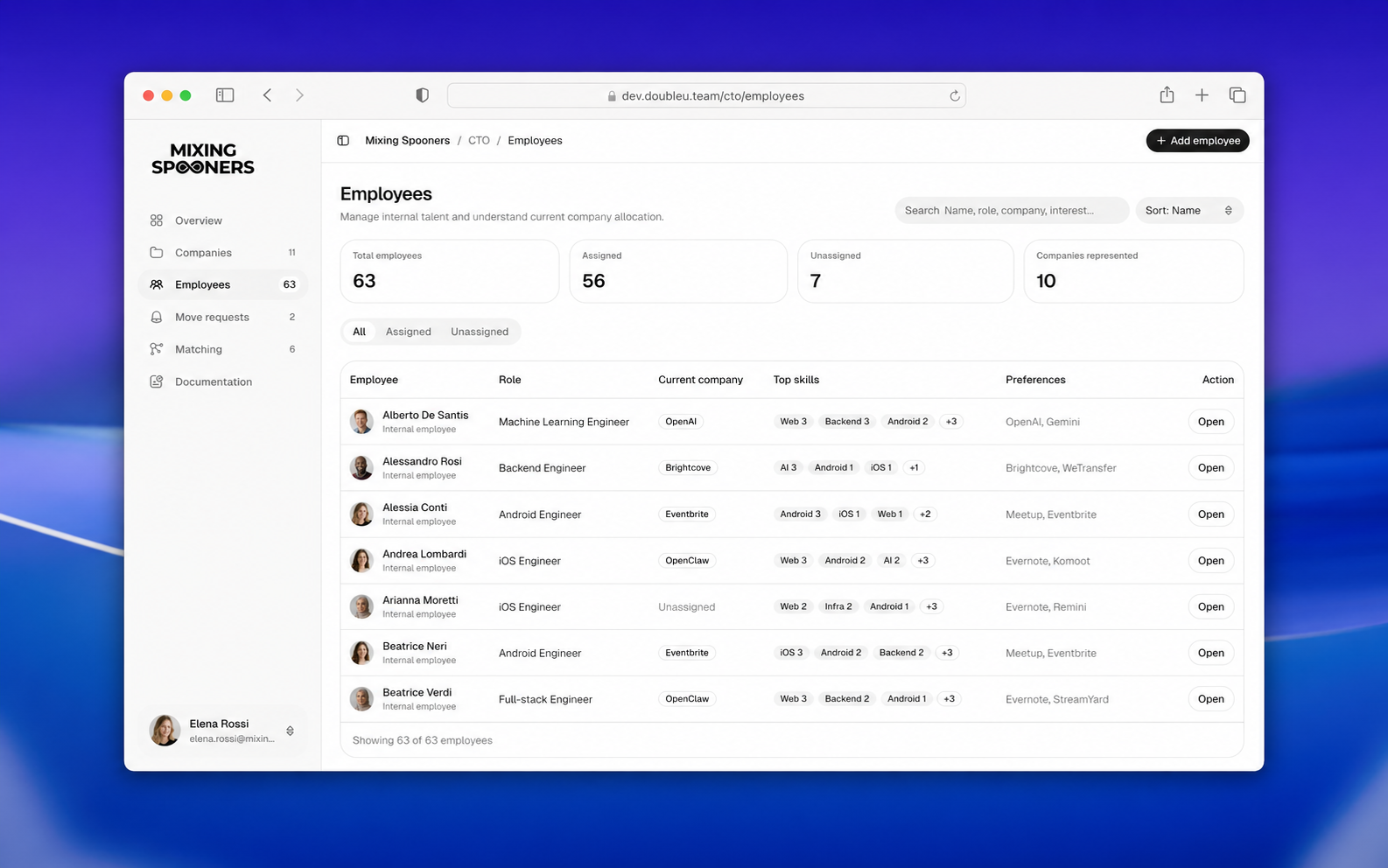
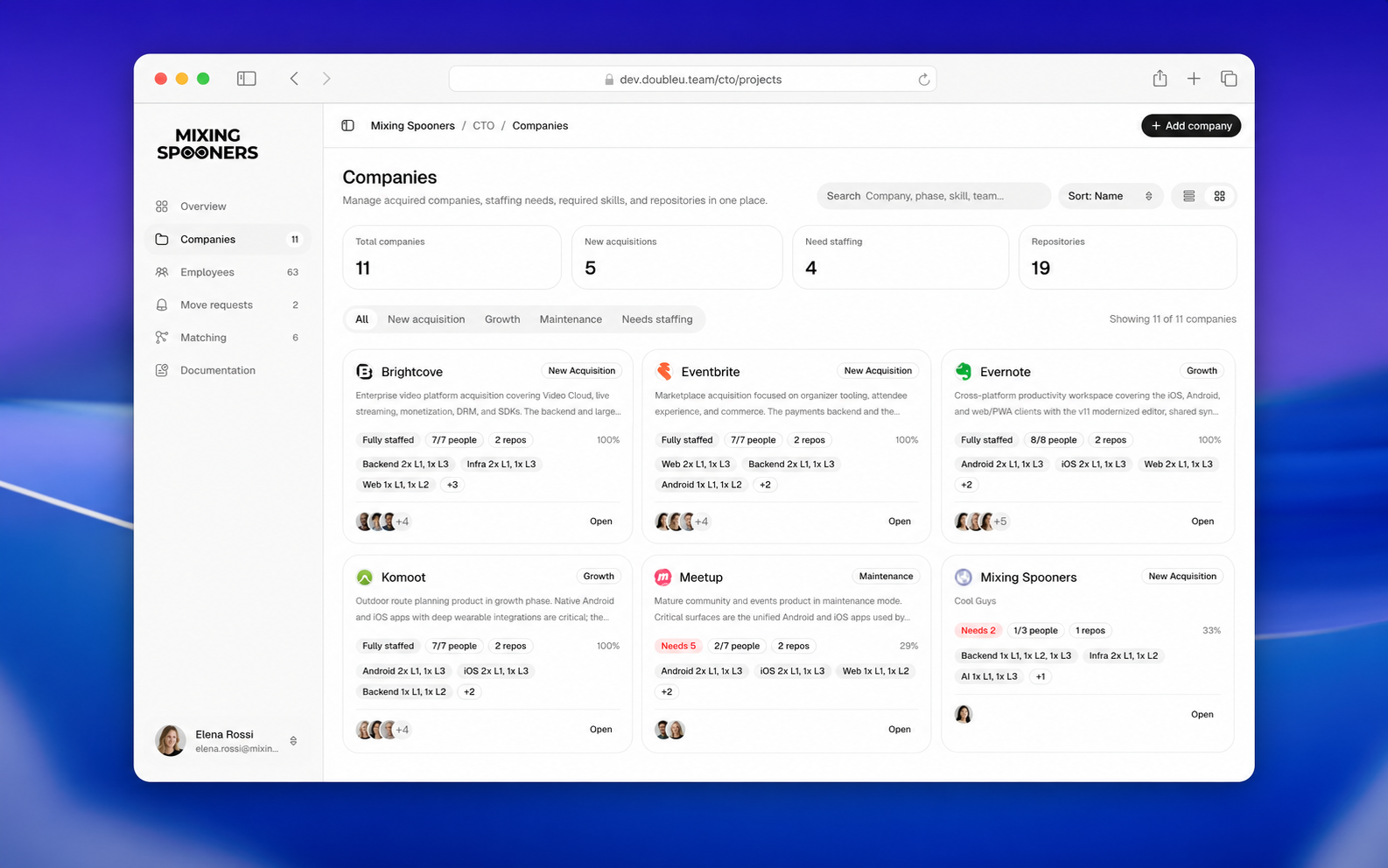
Mixing Spooners
Inspiration
Bending Spoons grows by acquiring and improving digital products, but one critical decision still often depends on manual coordination: deciding which engineers should work on which projects.
We discovered this pain point after speaking with Emanuele from Bending Spoons at HackUPC. Hearing how real teams face this challenge made the problem concrete, and we decided to build something that could make their lives easier.
That problem exists far beyond Bending Spoons. Consultancies, scale-ups, and large engineering organizations constantly reshuffle talent across teams. When this is done poorly, projects slow down, engineers lose motivation, and companies hire externally while the right skills already exist internally.
What it does
Mixing Spooners is an AI-assisted staffing platform for engineering organizations.
Managers add a project, and the platform analyzes its GitHub repository to infer the team profile it needs: skills, seniority, team size, and reasoning. Engineers can submit project preferences, including where they want to move or stay.
The matching engine then combines deterministic constraints with LLM-based reasoning. It respects hard requirements like skills, availability, and current assignments, while also considering softer signals such as growth interests, project preferences, and disruption cost.
If no suitable internal team can fully cover a project, Mixing Spooners generates a hiring recommendation explaining which role is missing and why.
After a transfer is accepted, the platform also generates offboarding and onboarding materials, helping engineers leave their current project cleanly and ramp up faster on the next one.
How we built it
We built a full-stack platform with a project analysis pipeline, a matching engine, manager and engineer flows, and AI-generated onboarding/offboarding support.
The system uses GitHub data to extract project context, structured data models to represent people and projects, deterministic logic for feasibility, and LLMs for contextual reasoning and explanation.
Challenges
The hardest challenge was reducing a messy real-world staffing problem into a focused product. Staffing decisions involve many factors: skills, seniority, preferences, team stability, deadlines, and knowledge transfer. We had to choose the signals that mattered most and could be extracted reliably.
Another key challenge was keeping humans in control. The goal was not to replace managers, but to remove repetitive data gathering and surface better recommendations with clear reasoning.
Accomplishments
In 36 hours, we built an end-to-end product that can analyze projects, recommend team compositions, respect developer preferences, identify hiring gaps, and generate transition materials.
We are especially proud that the platform does not treat engineers as interchangeable resources. It accounts for preferences, current project disruption, and growth opportunities, making staffing more transparent and human-aware.
Why it matters
Mixing Spooners matches the judging criteria by turning staffing from a manual coordination problem into a repeatable decision system.
Measurable leverage: it multiplies manager effectiveness by automating project analysis, team recommendations, hiring-gap detection, and onboarding/offboarding document generation. One manager can evaluate staffing options faster, with clearer trade-offs and less manual data gathering.
Reusability: although inspired by Bending Spoons, the same model applies to consultancies, scale-ups, agencies, and enterprises where people move across many projects.
Platform thinking: Mixing Spooners is designed as a staffing intelligence layer. New integrations like Slack, Notion, Linear, Jira, or HR systems can plug into the same matching and recommendation engine.
Enables others: it helps non-expert managers make more structured staffing decisions and gives engineers more visibility and influence over where they work next.
What we learned
We learned that staffing is not just a people problem or just an optimization problem. It is both. Good recommendations require hard constraints, soft context, and clear explanations.
We also learned the value of validating assumptions early. A conversation with someone close to the real problem shaped the product far more than guessing from the outside.
What's next
Next, we want to add integrations with Notion, Slack, Linear, Jira, and your internal corporate tools to automatically gather richer project and team context.
Longer term, Mixing Spooners could become a continuous staffing intelligence layer: surfacing risks, opportunities, and better team compositions before managers even ask.
Built With
- amazon-web-services
- fastapi
- next.js
- openai
- python
- react
- redbull
- typescript
- vibes


Log in or sign up for Devpost to join the conversation.