Inspiration
Based on our everyday experiences, we identified an opportunity where people not skillful at writing prompts towards GenAI tools might need a more straightforward way. We empathized with a particular persona of small businesses and entrepreneurs who must write engaging social media posts to market their services and products while targeting their customer base. They know they can use GenAI for content generation but need intuitive and easy-to-use tools without perfect prompting. Hence, we designed and developed VibeZAI powered by Google's Gemini.
This experience will provide them with quick value through on-demand content generation while abstracting away technical hindrances. This will free up business people to focus on customers rather than technology.
What it does
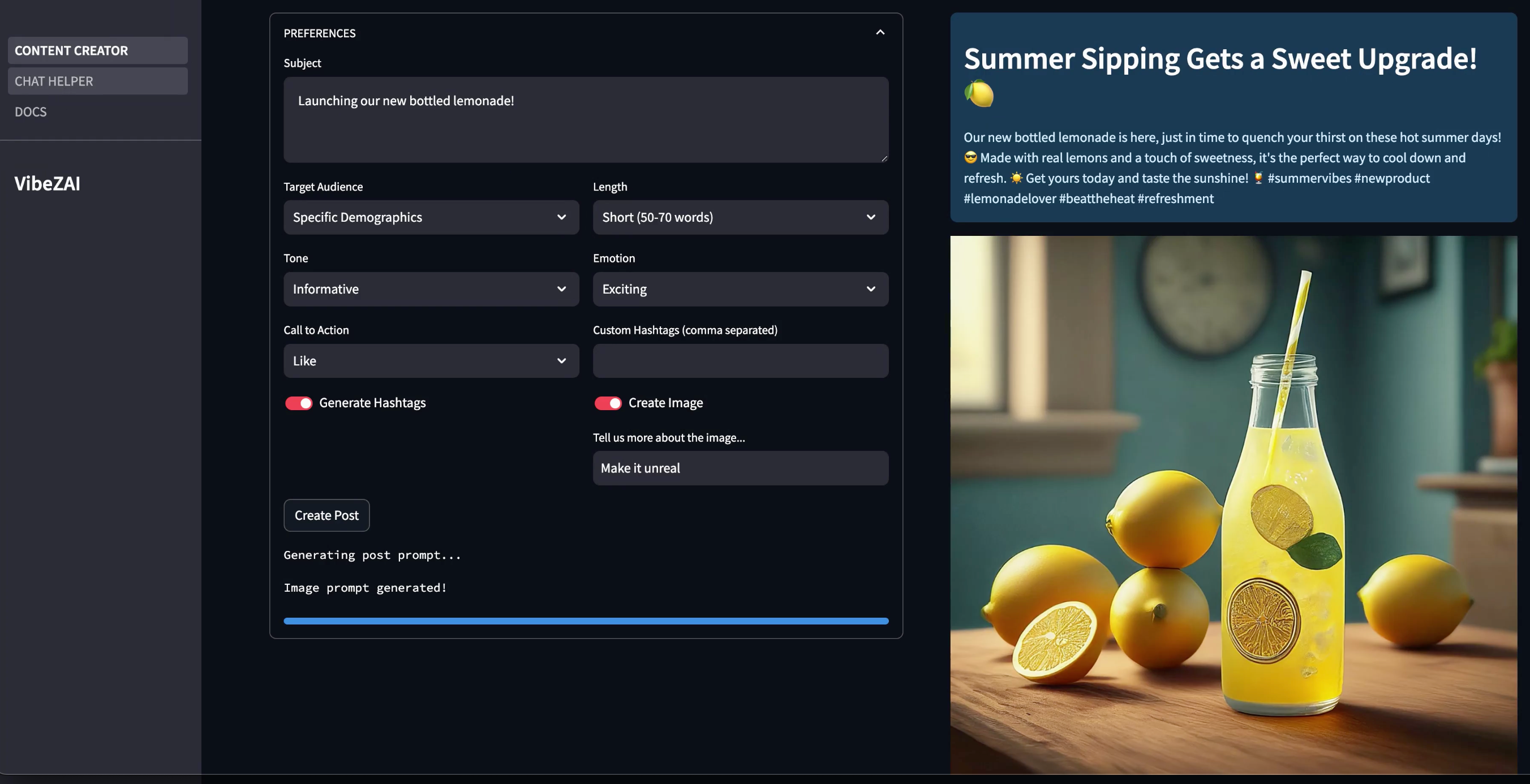
With a simple form-based UI, any user who doesn't have prompting writing skills can provide a little context of what the social media post will be about. They can choose other parameters :
- Target audience
- Length
- Tone
- Emotion
- Call to Action
- Custom Hashtags
- Generating automatic hashtags
- Creating images
Having provided these, they can generate social media posts that they can copy and paste into the platform of their choice. The content is already SEO-optimized behind the scenes.
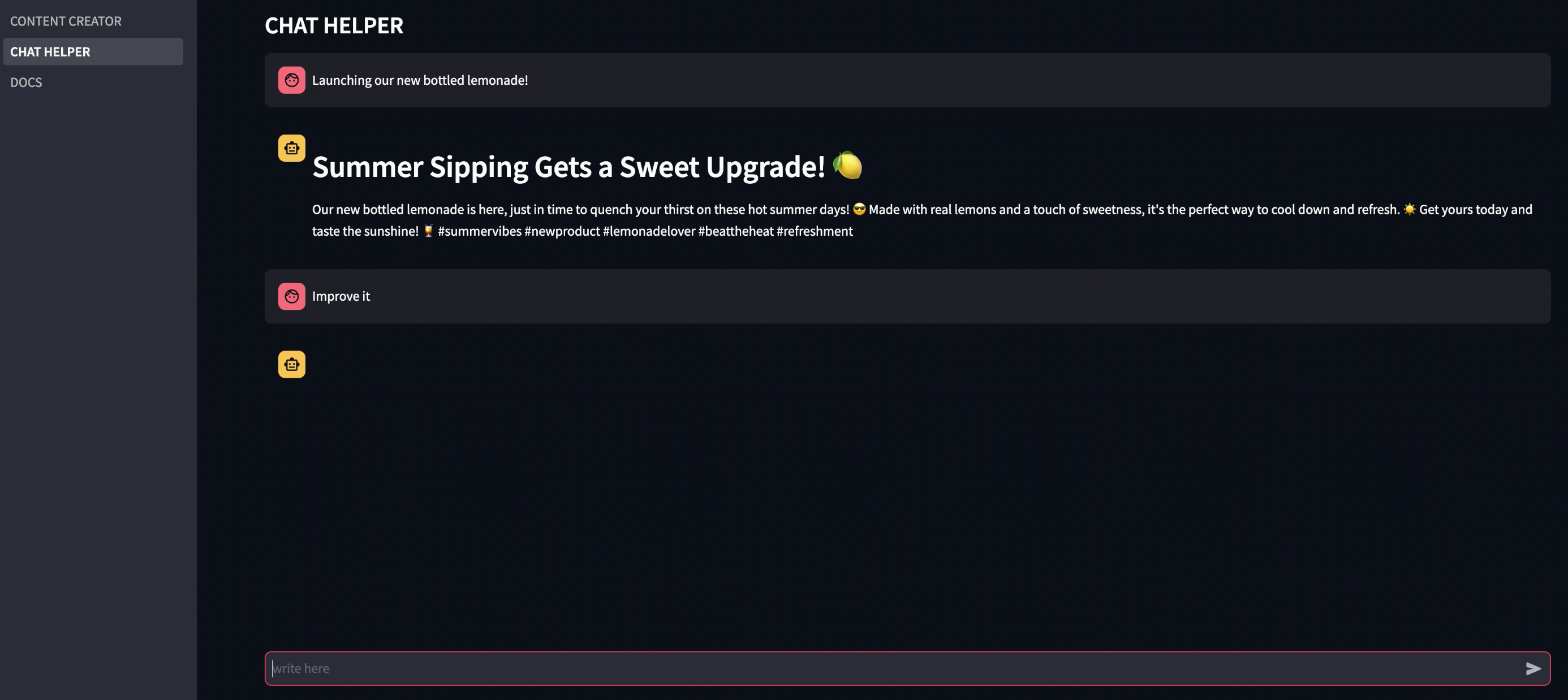
They can also use the Chat Helper UI, a prompting interface with Gemini for advanced users with prompting skills. This will allow them to customize, fine-tune, and make prompts more specific.
The app is mobile-first and responsive. Users can leverage it on desktop or mobile devices.
How we built
Here are the details:
Tech Stack:
Python: The core programming language for our project. Google Cloud Vertex AI: The backbone of our project, providing access to powerful generative AI models.
Gemini (gemini-1.0-pro): Our core text generation workhorse, transforming ideas into polished social media posts and powering the chat AI agent.
ImageGenerationModel (imagegeneration@005): Generating images based on textual descriptions adds visual flair.
Streamlit: Enables rapid building of the web-based user interface for a streamlined workflow.
Streamlit Cloud: Deployment platform for the app, leveraging a GitHub repository for easy updates and version control.
Workflow:
Initialization: Establish the Vertex AI project context (project, location) for model deployment. Model Instantiation: Load the Gemini text generation model (used for post creation and the chat agent) and the ImageGenerationModel.
UI with Streamlit: Construct the app interface, including layout, input fields, areas for content display, and a dedicated chat interface section.
Input & Generation: Capture user preferences and subject matter. When "Create Post" is triggered, Gemini crafts the social media text based on input. If image generation is selected, a prompt is built for the ImageGenerationModel, yielding a complementary image.
Output: Format and display the generated content (post + image, if applicable) within the UI.
Chat AI Integration: The Gemini model powers a chat interface, allowing users to converse with the AI agent for further content ideas, refinements, or general brainstorming.
GitHub Sync & Deployment: The Python codebase is maintained in a GitHub repository. Changes pushed to the repository trigger updates on Streamlit Cloud, ensuring the app reflects the latest code.
Key Notes: The "imagegeneration@005" denotes the specific image model version – iterative improvements are expected during the hackathon.
We prioritized a simple but clean, intuitive UI to showcase the power of the integrated AI models.
Challenges we ran into
We ran into several roadblocks:
- We had trouble coordinating times to meet and discuss, given we are all in different time zones.
- We had to sign up for waitlists for Image Generation and additional multi-modal models.
- We liked the idea of an infographic generation, but Gemini didn't give us good results, so we had to abandon and pivot.
Accomplishments that we're proud of
We are proud of this submission. We all belong to the March cohort of MIT's Building Products and Services with AI course. We essentially developed a working and usable product within 2 weeks using Google's Gemini! Doing this despite our day jobs and family commitments is a great accomplishment as we applied what we gathered from the intensive learning experience.
Here are some of our other highlights:
- Although we are from different countries, time zones, and native languages, we came together on a joint mission.
- We effectively collaborated virtually.
- We capitalized on the many ideas we generated as a group.
- We chose this idea as transparently and democratically as possible while considering our limitations and skills in the team.
- Above all, we were amazed at how we could quickly leverage Google's Gemini technology, which is awesome!
What we learned
We learned the following lessons:
- We learned how to leverage Gemini GenAI and Vertex APIs towards a product idea
- Using Google Studio was handy
What's next for the MITx Group Project
We intend to build upon this as a monetized service. We have the following features planned for the next version:
- Allow users to post content directly from the results pane, eliminating the need to copy and paste.
- Allow the user to generate other types of content, such as emails, longer posts, blogs, and marketing product descriptions.
- Create a native mobile app with a more seamless experience.
- Allow existing users to upload their own images and enhance those for better content.
- Experiment with our version of Gemini LLM and train it on large volumes of social media marketing posts to be more intelligent and specific about user needs.
Built With
- css3
- gemini
- google-cloud
- html5
- python
- streamlit
- vertex-api


Log in or sign up for Devpost to join the conversation.