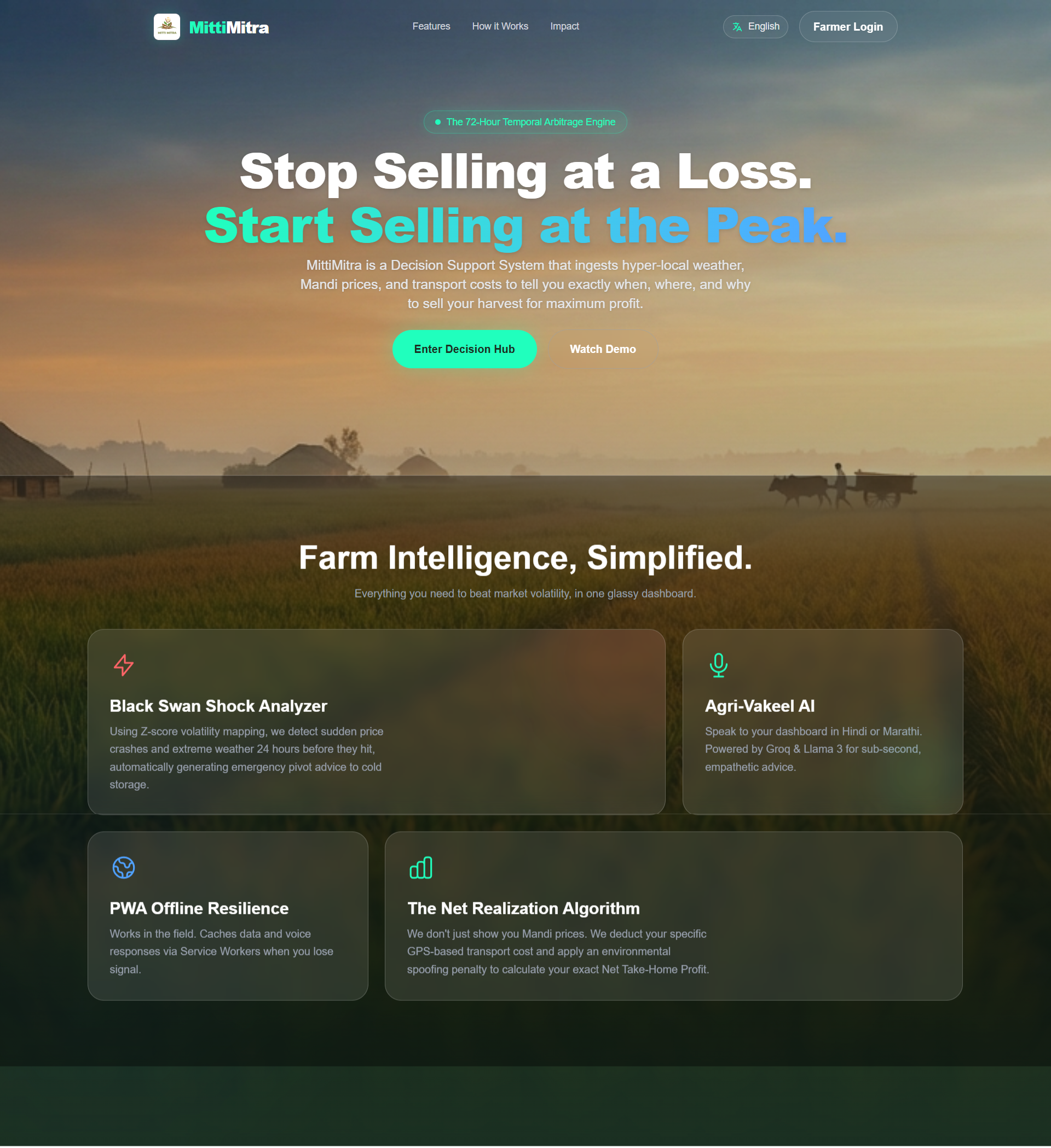
Our journey began with a stark realization of the "Sync-Panic" phenomenon in Indian agriculture. We observed that millions of farmers lose significant value not because they lack yield, but because they lack temporal intelligence. When a regional heatwave or a price signal hits, every farmer harvests simultaneously, leading to market gluts that crash prices while the crops themselves begin to rot in transit. We were inspired to build MittiMitra—a "Farm-to-Market Intelligence Platform"—to bridge this gap between the field's biological reality and the market's economic volatility.How We Built ItWe engineered MittiMitra using a Hybrid Cloud-Edge Architecture to ensure that high-end intelligence could reach even the most remote "Dark Zones" of India.The Backend (Cloud): We utilized FastAPI and Python to create an asynchronous pipeline that ingests real-time commodity prices from over 3,000 mandis via Agmarknet and 3-hourly weather nowcasts from the IMD.The Brain (AI/ML): At the heart of our system is a Deterministic Biophysical Engine. We implemented the $Q_{10}$ temperature coefficient to model the biological "Cost of Time". For human interaction, we integrated Llama 3 70B via Groq LPUs, creating the Agri-Vakeel—a sub-second, explainable AI assistant capable of supporting 7 regional languages.The Frontend (Edge): To handle low-connectivity environments, we built a Next.js Progressive Web App (PWA). By using Service Workers, we move the $Q_{10}$ calculations and decision logic to the device's edge, allowing the app to function with 100% reliability in 0G mode.The Intelligence CoreWe developed a specific Net Profit Formula to guide our "Sell or Hold" verdicts:$$NP(t) = [P \times Y \times Q] - [L + S]$$Where:$P$ = Market Price $Y$ = Yield (Calibrated in Quintals) $Q$ = Quality Factor $L$ = Logistics costs based on distance $S$ = Spoilage Penalty derived from the $Q_{10}$ coefficient The $Q_{10}$ model is a cornerstone of our technical depth: it represents the exponential decay process where rotting speed roughly doubles for every $10^{\circ}$C increase in ambient temperature.Challenges We FacedZero-Latency Mandate: Delivering AI advice in rural areas is difficult. We overcame this by optimizing our inference pipeline with Groq LPUs, achieving sub-500ms response times even for complex regional translations.Data Reliability: Government API data can be inconsistent. We built a robust Data Strategy using Pydantic Schemas for sanitization and Z-Score Outlier Detection to filter "Market Shocks" or glitches before they reach the farmer.Privacy Compliance: Adhering to the DPDP Act 2023 was a priority. We implemented GPS Fuzzing to ensure that exact field locations are never stored permanently, protecting farmer privacy while still maintaining weather accuracy.What We LearnedThis project taught us that in the agricultural sector, Explainability is as important as Accuracy. A farmer will not trust a "SELL" button unless they understand the "Why". By using Explainable AI (XAI) to show the "Invisible Tax" of heat and transport, we learned how to build a tool that isn't just technologically advanced, but socially adoptable.
Built With
- backend:-fastapi-(asynchronous-python)
- postgresql-(via-supabase).-frontend:-next.js-(glassmorphism-ui)
- service-workers-for-offline-caching.-intelligence:-llama-3-via-groq-(explainable-ai)
- volatility
- z-score

Log in or sign up for Devpost to join the conversation.