-
-
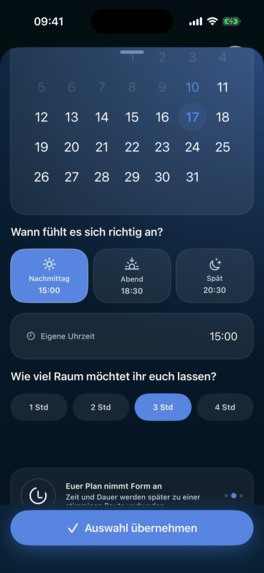
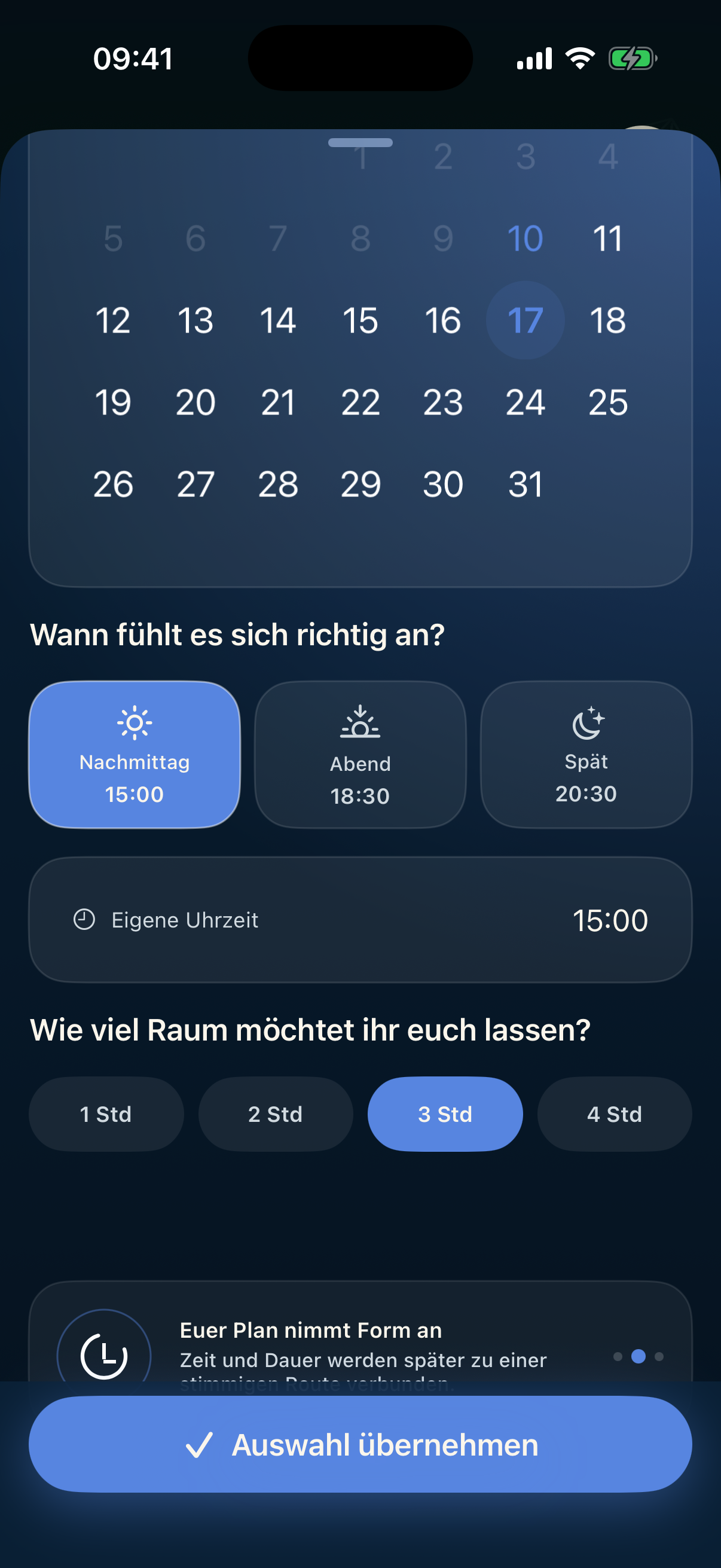
Earlier run · Choose a date, start time and duration for the outing.
-
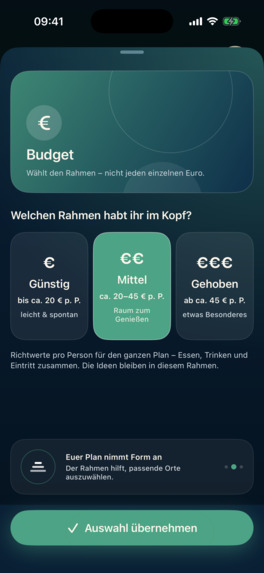
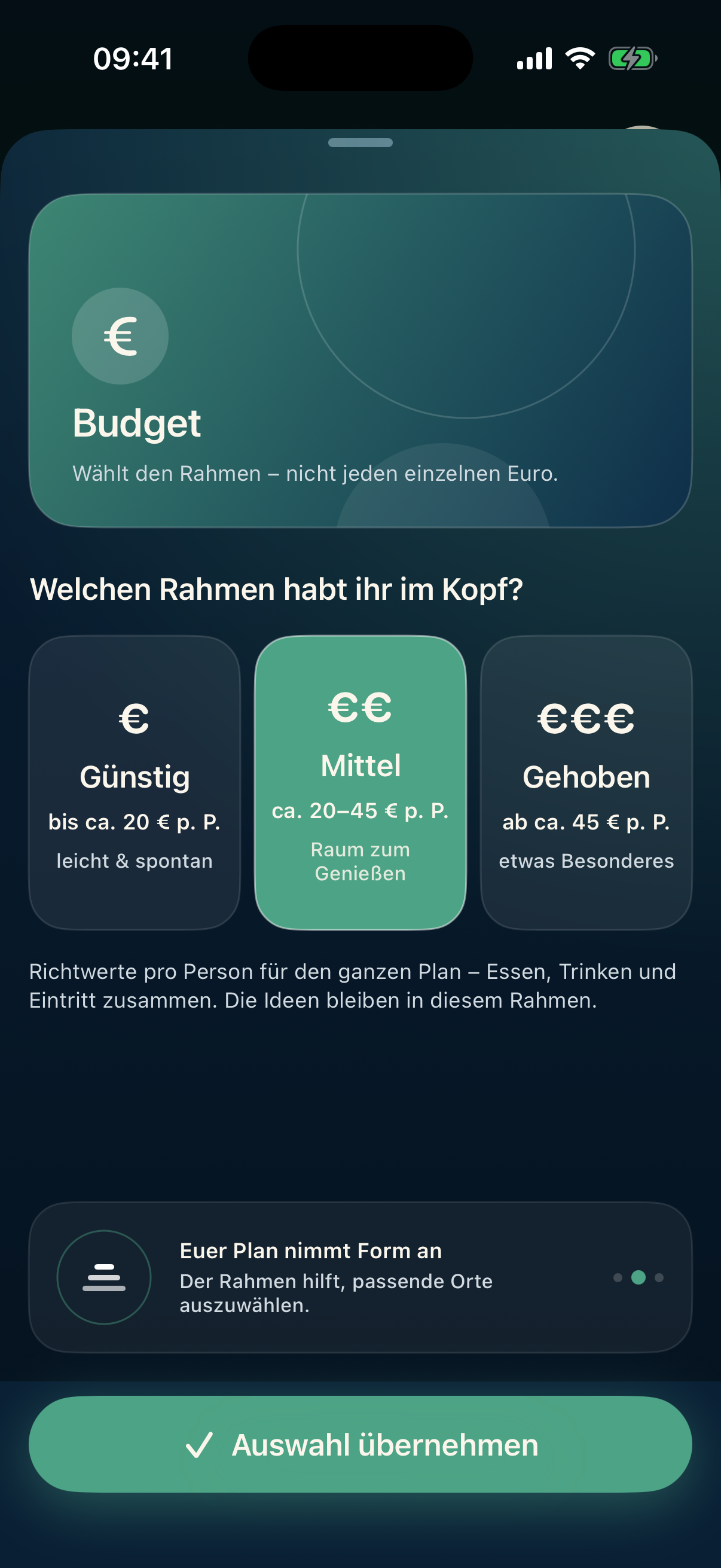
Earlier run · Set a per-person budget before generating suggestions.
-
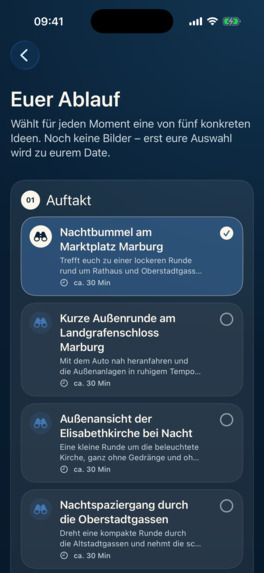
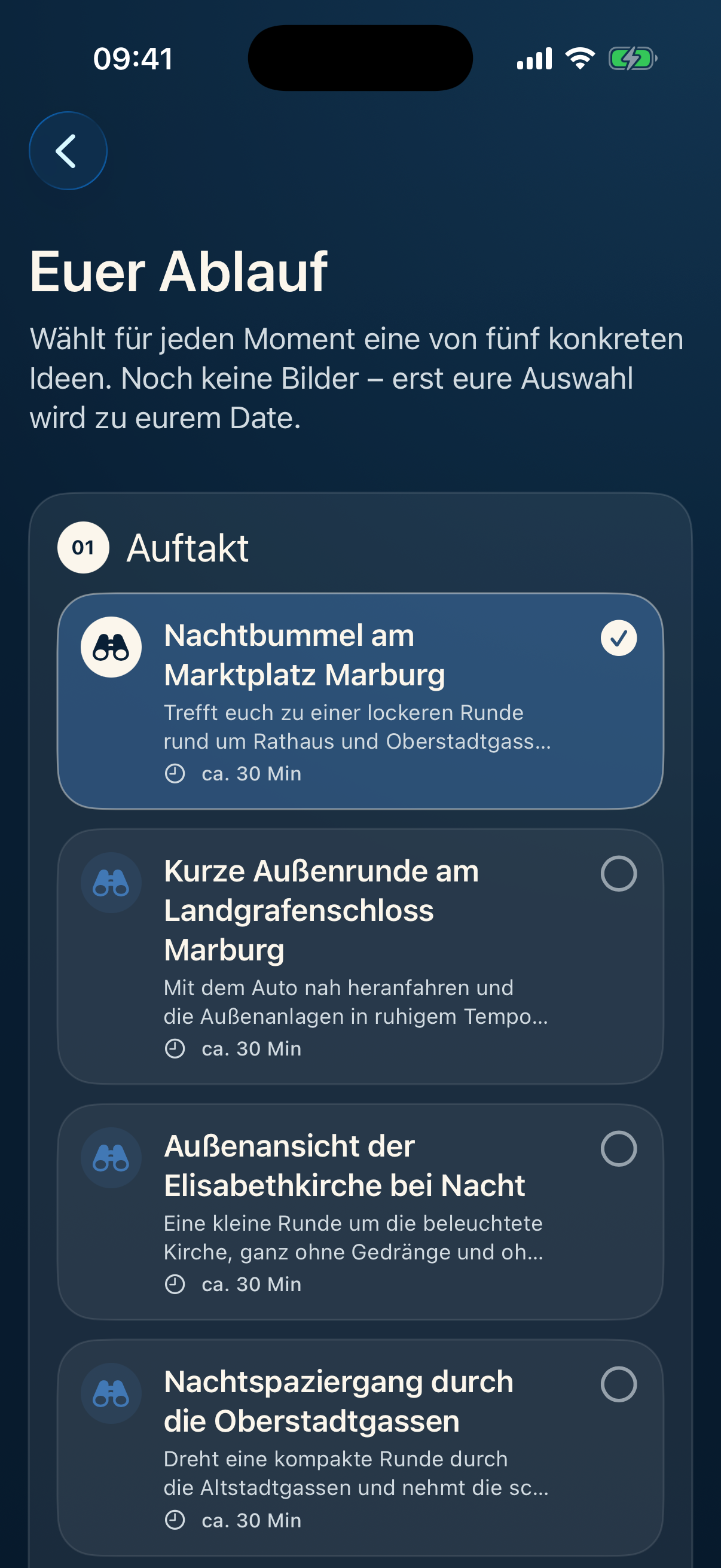
Earlier run · Compare five AI-generated alternatives for the first activity slot.
-
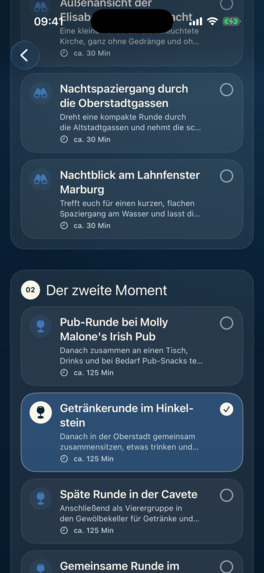
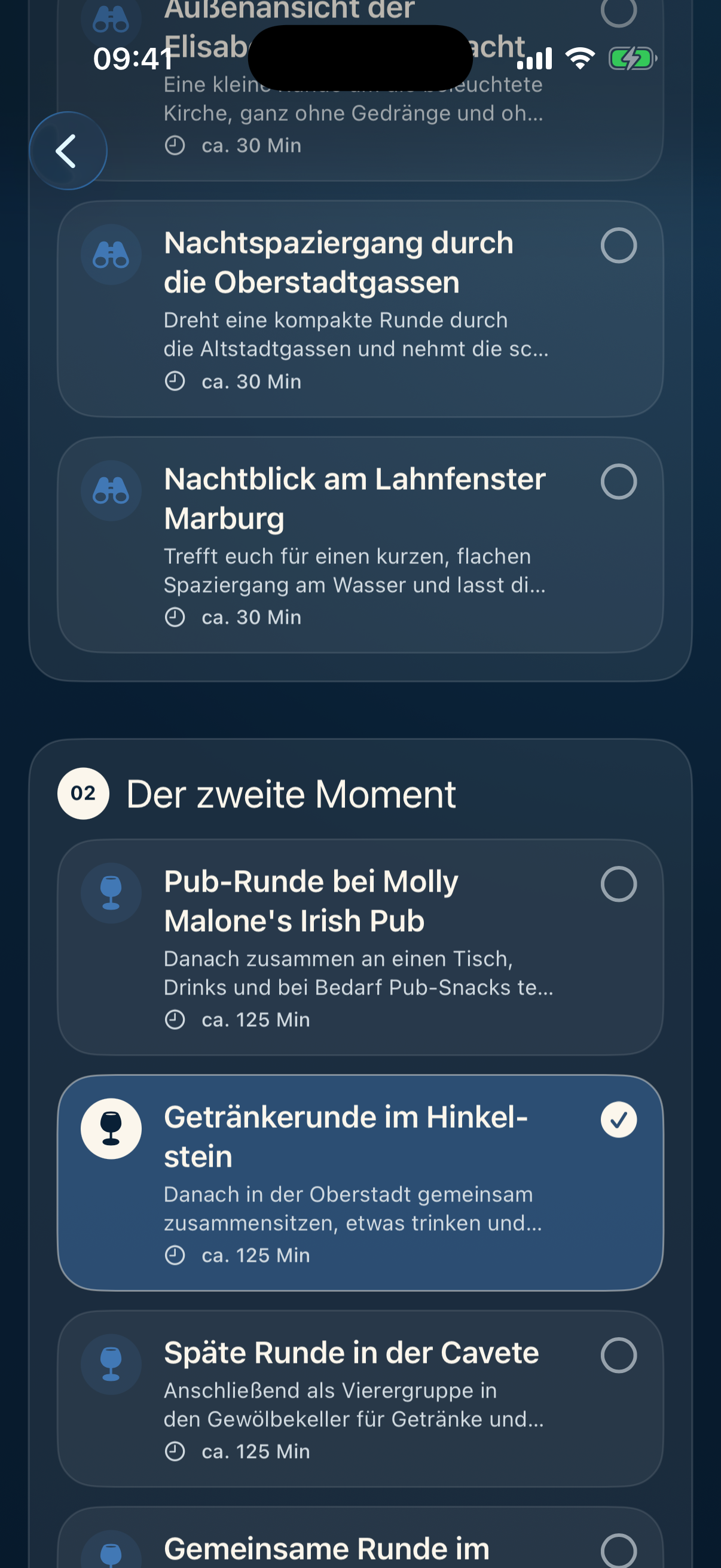
Earlier run · Choose the second activity independently and combine the selections.
-
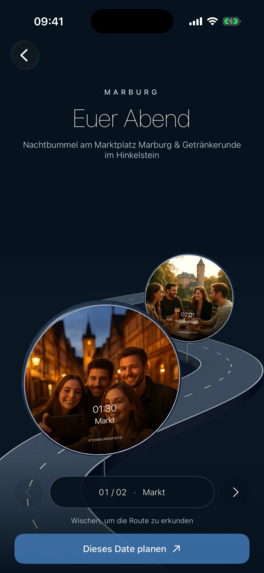
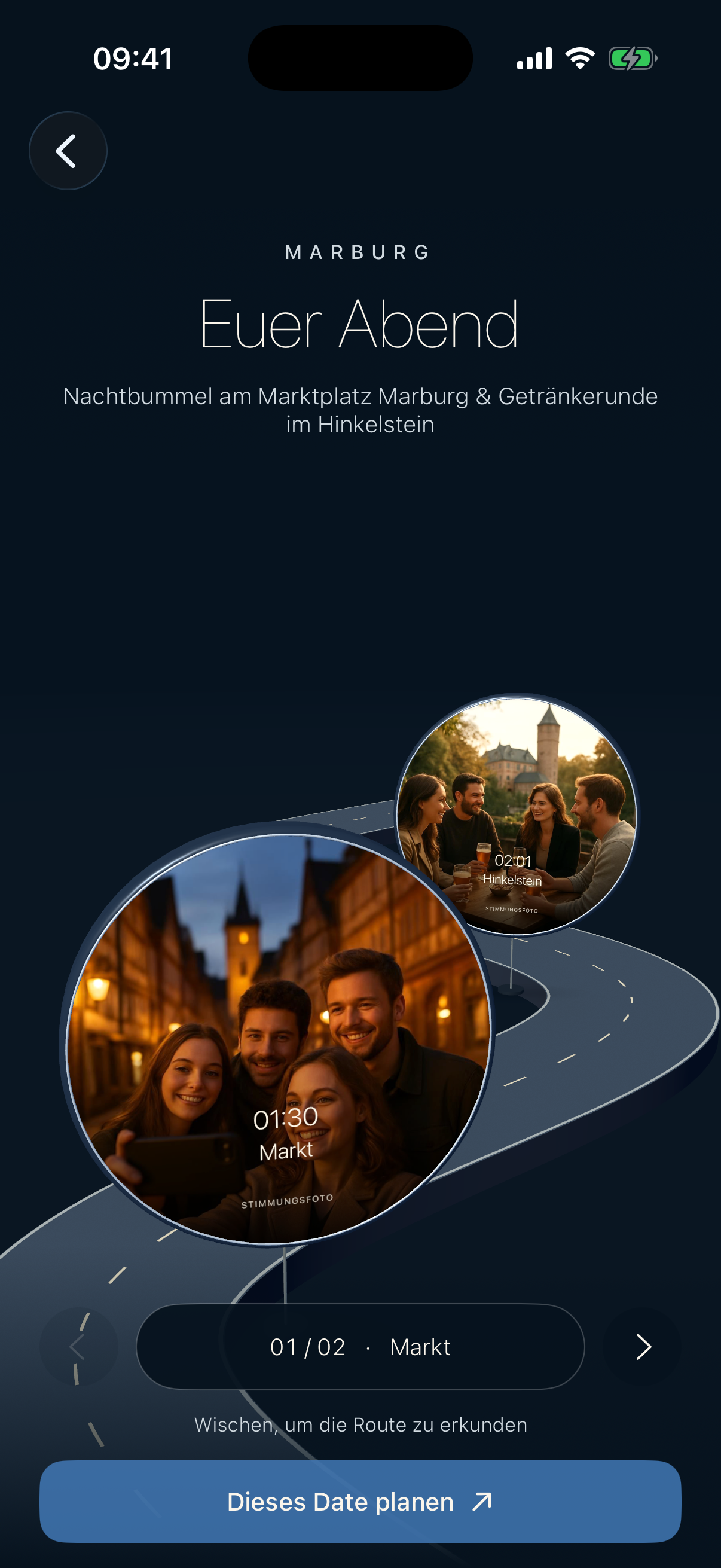
Earlier run · Explore the Marburg route with matched places. AI mood illustrations are not venue photographs.
-
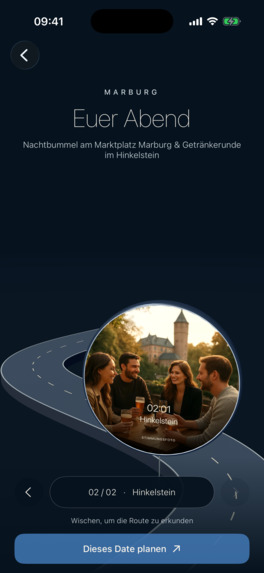
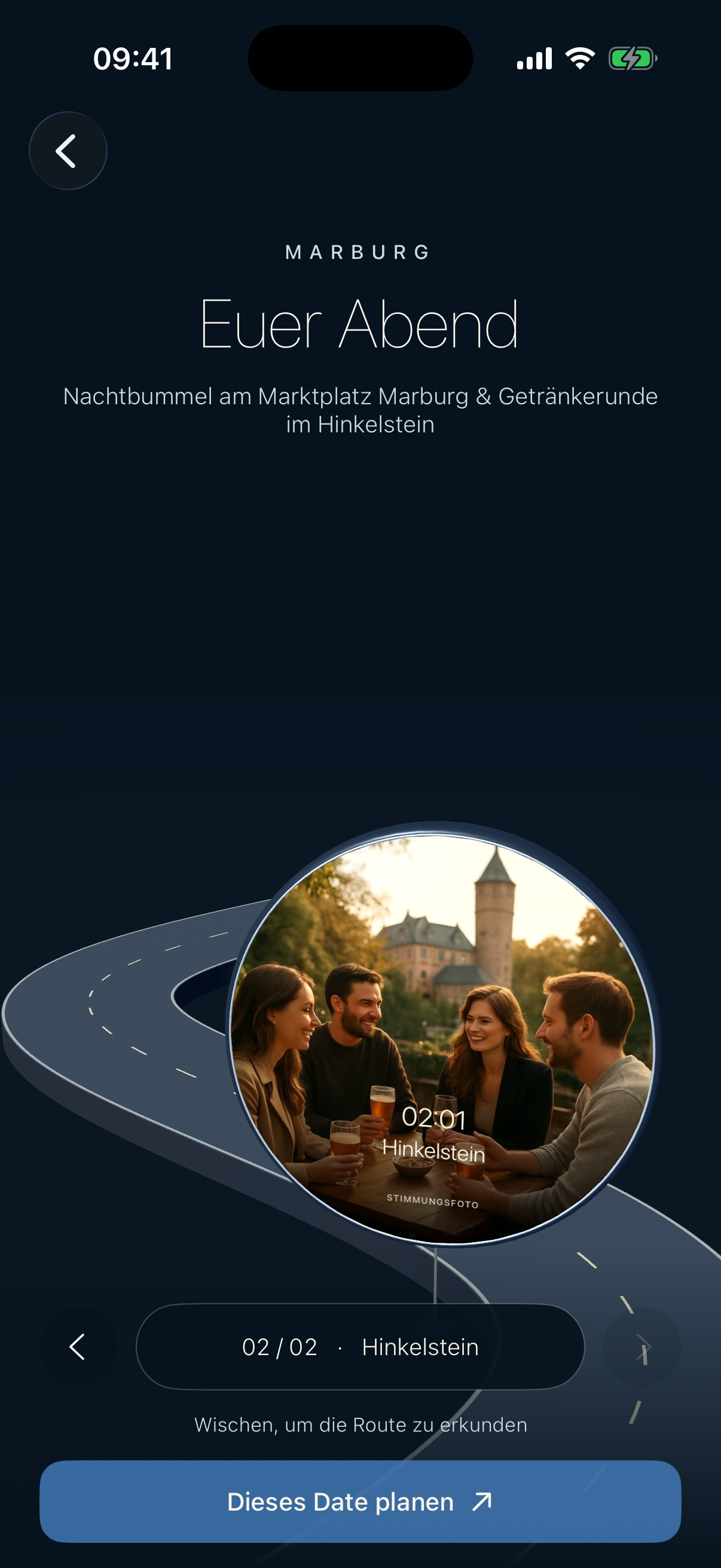
Earlier run · Inspect the second stop and its scheduled time. AI mood illustration.
Inspiration
“We should do something together” is easy to say. Deciding what, where and when is harder. Friends and couples often switch between group chats, maps and calendars before they have an actual plan.
I wanted to make that first step easier: turn a few preferences into concrete options that people can choose and organise together.
What it does
Mite is a native iOS prototype for planning dates and outings with friends. Users choose a city, budget, mood, date, duration and practical preferences. The AI produces five alternatives for each of two or three activity slots. Users can combine their preferred options into a personalised outing instead of accepting one fixed itinerary.
The app searches for the suggested places with Apple MapKit and uses matched location details rather than AI-invented addresses. A visual route helps users explore the selected stops. The broader prototype also includes shared event rooms, chat, availability coordination and expense tracking.
This submission focuses on the planning journey: preferences → AI-generated options → a concrete plan. The fresh click-through demo shows a Marburg example: choosing a meal at Enchilada and a drink at Hinkelstein, inspecting the real-place matches, then saving the route as a shared event.
How I built it
The iOS client uses Swift and SwiftUI. Firebase provides authentication, Firestore, storage and callable backend functions written in TypeScript on Node.js.
The planning backend calls the OpenAI Responses API. It requests a strict structured function response containing five route variants with compatible activity slots. Backend validation checks the generated structure and timing before the suggestions are returned. The model is configurable; the source currently defaults to gpt-5.6-terra.
On the client, MapKit searches for the named venues and filters out results too far from the chosen area. Missing matches stay unresolved. AI-generated mood illustrations support the visual presentation; they are not photographs of the venues or evidence of a visit.
Challenges I ran into
Connecting creative AI output to real places was harder than generating convincing text. A venue name can resolve to a similarly named business in another city, and overly strict category filters can miss relevant places. The implementation uses several search attempts and a distance boundary to improve matching.
Another challenge was making the results editable. Generating compatible alternatives for each activity slot lets users mix and match while keeping the plan understandable.
Accomplishments
The prototype connects structured AI output to an interactive native app: users can choose individual activity options, explore the resulting plan and continue organising an outing in a shared space. The demonstration is recorded from the running iOS Simulator. On November 13, the app generated suggestions and two mood images, resolved the selected venues and saved the group event. Pauses and a local emulator reconnection are omitted from the edit; it is not an uninterrupted one-take recording.
What I learned
Building Mite taught me to treat AI output as a proposal that needs validation. Useful AI features also need a clear data contract, reliable place lookup, understandable error states and a user interface that leaves decisions with the user.
It also gave me practical experience directing AI-assisted development across a SwiftUI client and a TypeScript/Firebase backend.
What's next
I am keeping Mite as a learning project for now. Exploring the market showed me that this problem already has several established solutions, so I am not currently planning a public app launch. The experience of turning an idea into a working native prototype was valuable in its own right.
AI tools and my contribution
I used Claude and OpenAI Codex as coding assistants during development, including implementation, debugging and iteration. AI-generated code is a substantial part of the prototype. My contribution was defining the product idea and requirements, directing the implementation, making product and interface decisions, and reviewing and trying the resulting flows. I am presenting this as AI-assisted development, not as code written entirely by hand.
The AI inside the app is separate from those development tools: OpenAI generates structured outing suggestions, while Apple MapKit supplies place-search results. Optional AI-generated images illustrate the mood of an outing.
Project history and current limitations
Development began in August 2026, before the hackathon started on October 27, 2026. This entry presents its date and group-planning prototype; I do not claim that the app was built entirely during the hackathon. The submission documentation and selection of demo screenshots were prepared during the event. Acceptance of pre-existing projects has not been confirmed by the organiser.
This is a development prototype, not an App Store release. The documented Debug setup uses local Firebase emulators. No public application or TestFlight link is included in this draft. The current app interface is in German; the submission and screenshot captions are in English.
Place matches do not confirm opening hours, booking availability or current prices. Budget and timing are estimates. The screenshot gallery contains an earlier run; the separate click-through video records a fresh run on November 13. The source snapshot passed 21 backend tests, 19 iOS tests and seven local smoke-test suites. Six moderate indirect-dependency advisories remain; callable App Check enforcement and production abuse/budget controls are outside this local prototype.
Built With
- firebase
- mapkit
- node.js
- openai
- swift
- swiftui
- typescript
