-
-
A smart medical supply management system
Inspiration
MiStock AI was inspired by the real-world challenges faced by clinics and hospitals in managing medical supplies efficiently. Many healthcare facilities, especially smaller clinics, still rely on manual tracking or basic systems that fail to provide proactive insights. This often leads to critical shortages of essential items like gloves or syringes, which can directly impact patient care. We wanted to build a solution that not only tracks inventory but also anticipates future needs using intelligent predictions. The goal was to combine healthcare reliability with modern AI-driven decision support in a simple, accessible system.
What it does
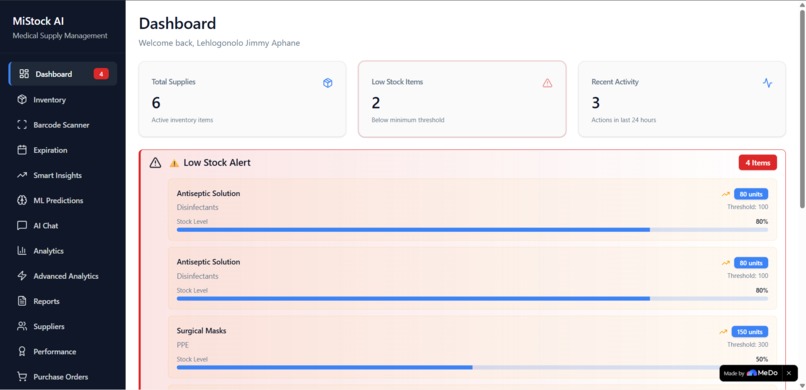
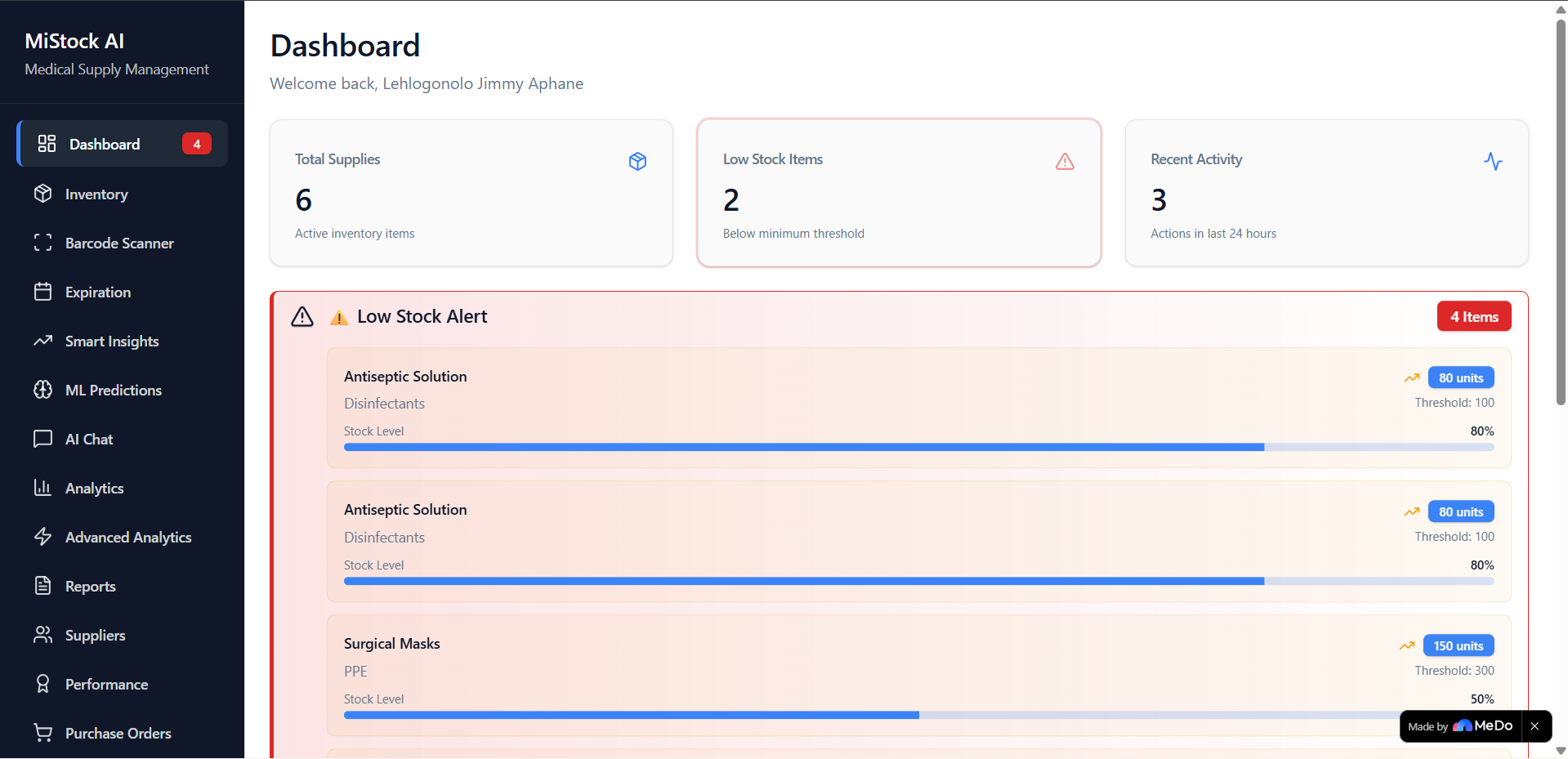
MiStock AI is a smart medical supply management system that enables healthcare staff and administrators to monitor inventory in real time, detect low-stock items instantly, and receive predictive insights on future shortages. The platform includes a dashboard with visual alerts, an inventory management module, AI-powered Smart Insights with usage trend charts, and a chat assistant that answers natural language queries about stock levels and predictions.
How we built it
We designed MiStock AI as a full-stack web application with a focus on scalability and user experience. The frontend was structured with a clean, responsive UI using modern web technologies, incorporating smooth animations and a healthcare-friendly design system. The backend handles authentication, role-based access control, inventory operations, and usage history tracking. For the “AI” component, we implemented rule-based logic combined with weighted calculations to simulate predictive intelligence without requiring a full machine learning model. Historical inventory changes are stored and used to compute both simple and weighted averages, with recent data points given higher importance. Charts were integrated to visualize consumption trends over time, and a lightweight natural language pattern-matching system powers the AI chat assistant.
Challenges we ran into
One of the main challenges was designing a prediction system that feels intelligent without relying on complex machine learning models. Balancing simplicity and usefulness required careful thought, especially when implementing the weighted average logic to ensure recent usage trends had a meaningful impact. Another challenge was handling edge cases, such as insufficient data for predictions or zero consumption rates, without breaking the user experience. Ensuring smooth UI animations while maintaining performance was also tricky, particularly for data-heavy components like charts and tables. Additionally, enforcing strict role-based access control between Admin and Staff users required careful backend and frontend coordination to prevent unauthorized actions.
Accomplishments that we're proud of
We are most proud of building a system that feels genuinely useful and close to real-world deployment. The Smart Insights feature stands out as it provides actionable predictions rather than just raw data, helping users anticipate shortages. The AI chat assistant is another highlight, offering an intuitive way to interact with the system using natural language. We also achieved a polished and professional user interface with smooth transitions and clear visual alerts, which enhances usability in a high-stakes healthcare environment. Overall, we successfully combined data tracking, predictive logic, and user-centric design into one cohesive platform.
What we learned
Through this project, we learned how to design systems that go beyond CRUD functionality and provide intelligent insights. We gained a deeper understanding of how to simulate AI behavior using rule-based systems and weighted statistical methods. Implementing features like trend detection and prediction calculations strengthened our grasp of data analysis concepts. We also improved our skills in structuring scalable applications, handling state management, and designing responsive, user-friendly interfaces. Importantly, we learned how critical it is to consider edge cases and real-world usability when building systems intended for environments like healthcare.
What's next for MiStock AI
The next step for MiStock AI is to evolve from rule-based predictions to true machine learning models that can learn from larger datasets and improve accuracy over time. We also plan to introduce real-time notifications via email or mobile alerts, as well as integrate supplier management and automated restock ordering. Expanding the platform to support multi-clinic environments and cloud deployment is another priority. Additionally, we aim to enhance the AI chat assistant with more advanced natural language processing capabilities, making it more conversational and context-aware. Ultimately, the vision is to transform MiStock AI into a fully intelligent healthcare inventory ecosystem that can operate at scale.
Built With
- sql
- tailwindcss
- typescript
- vite

Log in or sign up for Devpost to join the conversation.