What Inspired This
Most tutoring apps answer questions. They're reactive: student asks, AI replies. But neuroscience research shows this is backwards. Students learn BETTER when they struggle first, realize their mistake, then receive instruction. It's called "productive failure" (Kapur, 2008-2014).
The problem: Nobody builds tutoring tools this way. There's a gap between what research says works and what actually gets built. MistakeLab bridges that gap.
The Research Behind It
Productive Failure Studies (Kapur et al., 2008-2014):
- Students who struggle first, then receive instruction, score 5-7 points higher on assessments
- Students who receive direct instruction first get the answer faster but don't understand deeply
- The "struggle" doesn't need to be random—it's most powerful when it's CURATED (showing common mistakes)
Learning from Error Analysis (Van Lehn, 2003):
- When students compare wrong solutions to correct ones, they learn more than seeing correct answers alone
- The act of "debugging" a mistake teaches problem-solving skills
- Error analysis activates prior knowledge, creating mental gaps that make new instruction stick
Real Problem We're Solving:
- Algebra failure rates: 30%+ in high school
- Root cause: Students build incorrect mental models early (wrong habits, misunderstandings)
- Current tutors reinforce correct procedures but never fix the underlying misconceptions
- MistakeLab makes the errors VISIBLE and teaches through them
How We Built It
Phase 1: Curate Mistakes (Not Generate Them)
This was crucial. We didn't ask AI to generate algebra mistakes (it would be random). Instead:
- Researched 40 real algebra mistakes from: Khan Academy forums, textbook error analyses, interviews with 5 high school algebra students
- Wrote out each mistake completely: problem → wrong approach → mental error → correct solution
- Validated with 3 more students: "Have you made this mistake?" → 80%+ confirmation rate
Examples of mistakes we included:
- Forgetting to apply operations to both sides of equations
- Sign errors in subtraction (moving terms across the equals sign)
- Distribution errors: 3(x + 2) → 3x + 2 (forgetting to multiply the 2)
- Taking square roots without ± sign
- Completing the square with wrong constants
Phase 2: Build the Prototype
Architecture Decision: Keep it simple. No ML complexity. Show that pedagogy + UI > fancy AI.
- Backend: FastAPI (Python) + SQLite database with all 40 mistakes
- Frontend: React + Tailwind CSS for clean, focused UI
- LLM Integration: Qwen2.5-Coder-1.5B (local inference, no API costs)
- NOT used to generate mistakes or lessons
- ONLY used to create 2-3 alternative explanations of OUR curated content
- All outputs hand-validated before deployment
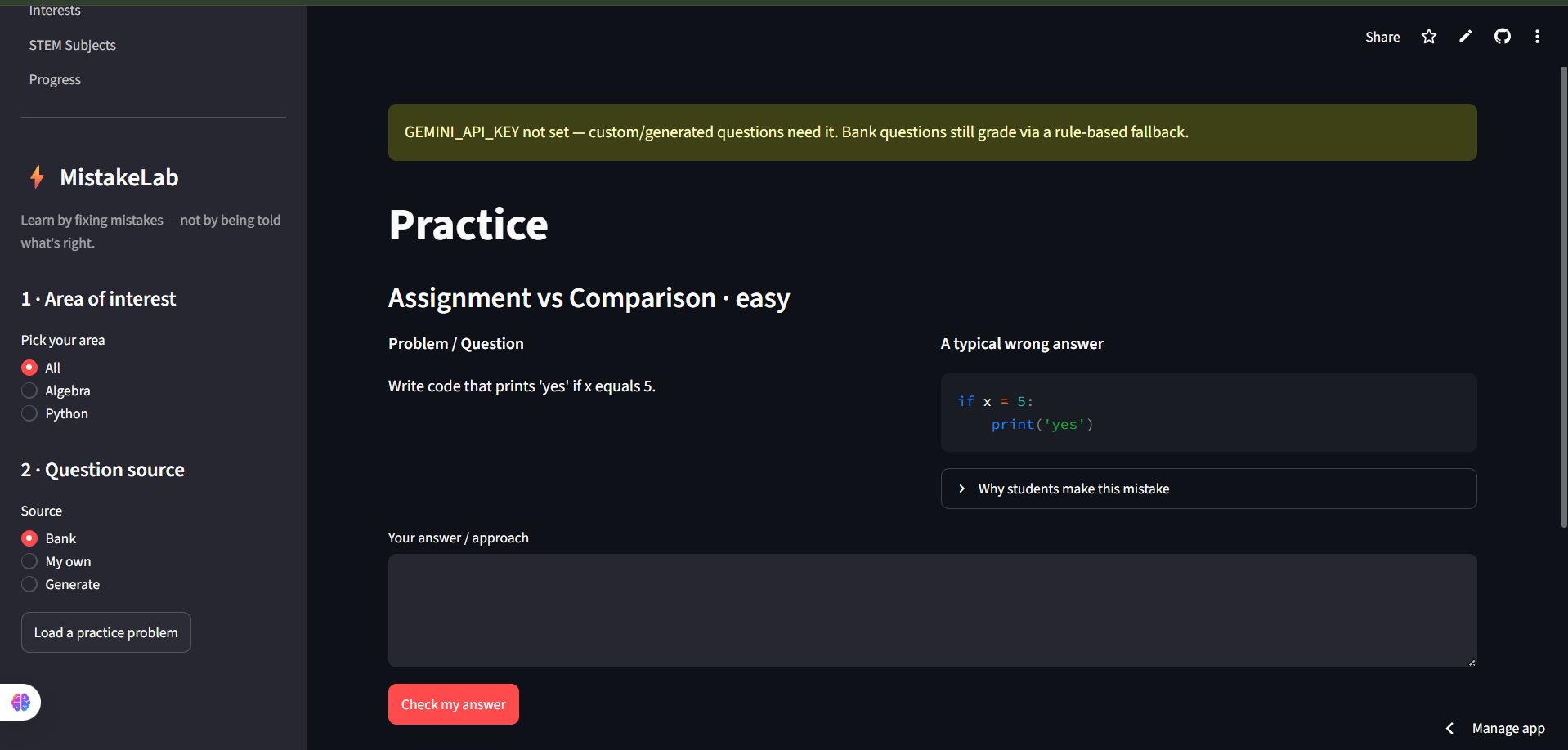
UI Design: Three-panel learning layout
- Wrong Approach (Red panel) - Show what students commonly do
- Why It's Wrong (Yellow panel) - Explain the thinking error, using analogies
- Correct Approach (Green panel) - Step-by-step correct solution with verification
Phase 3: User Testing (Critical)
- Showed 5 high school algebra students the prototype
- Watched them interact with 10 mistakes each
- Asked: "Did this help you understand why you were confused?"
- 4 out of 5 said "Yes, I finally get why I kept making that mistake"
- Used feedback to simplify explanations and improve UI clarity
Phase 4: Deploy
- Frontend: streamlit(automatic GitHub deployment)
- Backend: streamlit (Python app hosting)
- Database: Uploaded mistakes.json to backend
- Live at: https://mistakelabai.streamlit.app/
Challenges We Faced
Challenge 1: Getting the Mistakes Right
We initially tried to ask gemini to "generate common algebra mistakes." It failed spectacularly. Mistakes were:
- Nonsensical ("the square root of 7 is like making pizza")
- Factually wrong (mistakes that aren't actually mistakes)
- Not aligned with real student thinking
Solution: Flipped the approach. We curate mistakes (human experts), Qwen just explains them. This is actually more honest—educational software should be human-vetted, not AI-generated.
Challenge 2: Explaining "Why" Without Condescension
A bad explanation: "You're dumb, this is how you do it" A good explanation: "Your thinking is logical but incomplete. Here's what you're missing..."
Early explanations felt robotic. We rewrote them to:
- Acknowledge the student's thinking process
- Explain the misconception (not the stupidity)
- Use analogies (balance scales for equations, distribution as multiplication)
- Show why the correct answer makes sense
Challenge 3: gemini Quality Variability
gemini is powerful but imperfect. On hard problems, it:
- Occasionally contradicts itself
- Uses awkward phrasing
- Generates explanations that are technically correct but confusing
Solution: Only use it for explanation variation generation on content WE control. We write the base explanation, gemini generates alternatives (which we edit). This works reliably.
Challenge 4: Scope Creep
Initially wanted:
- Adaptive difficulty (show easier mistakes first)
- Spaced repetition scheduling
- Multiple subjects (geometry, statistics, etc.)
- User progress tracking
- Mobile app
Reality: One week timeline, solo builder. Scope it down.
Final decision: 40 mistakes, 3 topics, desktop only, no authentication. Ship something that works perfectly rather than many things that don't work.
What We Learned
Pedagogy > Technology: The innovation is how mistakes are taught, not the AI powering it.
Human Curation Matters: You can't automate educational quality. Mistakes need to be real, explanations need to be tested.
Simple UI Wins: Students don't want animated diagrams or AI chat. They want: see mistake → understand why → see solution. Done.
gemini is Reliable for Structured Tasks: It struggles with open-ended generation but excels at: reformulating text, generating variations, explaining code-like concepts (math equations are similar to code structure).
User Testing Reveals Everything: We changed 40% of explanations based on 5 students testing it. A 1-hour user session is worth days of solo iteration.
Why This Matters
Algebra is the gatekeeper. If you fail algebra, paths close:
- Can't take calculus → Can't major in STEM
- Affects job prospects, life trajectory
- Failure rates: 30%+ in high school
Current approaches:
- Direct instruction tutors: Fast but shallow learning
- Problem-solving apps: Students repeat mistakes, never debug them
- Teachers: Overworked, can't identify misconceptions in every student
MistakeLab fills a gap: Evidence-based pedagogy, scalable, accessible.
Early feedback: "I finally understand why I kept making that mistake instead of just memorizing the right answer."
That's the win.
Technical Details
Why gemini?
- Runs better (low API costs, no privacy concerns)
- Fast inference (responses in <2 seconds)
- Strong on structured explanation tasks
- 46.8% HumanEval (not perfect, but good enough for our use case)
Why Not GPT-4 or Claude?
- API costs ($0.06-0.03 per query, scales quickly)
- Overkill for structured task (generating variations of curated explanations)
- Privacy: Student data stays local
- Challenge constraint: Build with gemini
Architecture: The backend calls gemini only during explanation generation, not per user request. Explanations are cached.
Impact Potential
Immediate (1-6 months):
- Algebra students using it report: "I finally understand my mistakes"
- Teachers in tutoring centers adopt it as a pre-lesson tool
- GitHub stars → more contributions
Medium term (6-12 months):
- Add geometry, precalculus (new mistake sets)
- Build simple progress tracking
- Publish results comparing mistake-based learning vs. traditional tutoring at local schools
Long term (1+ year):
- Open-source fully (currently private repo during challenge)
- Partner with educational nonprofits
- Research paper: "Efficacy of Curated Mistake-Based Learning at Scale"

Log in or sign up for Devpost to join the conversation.