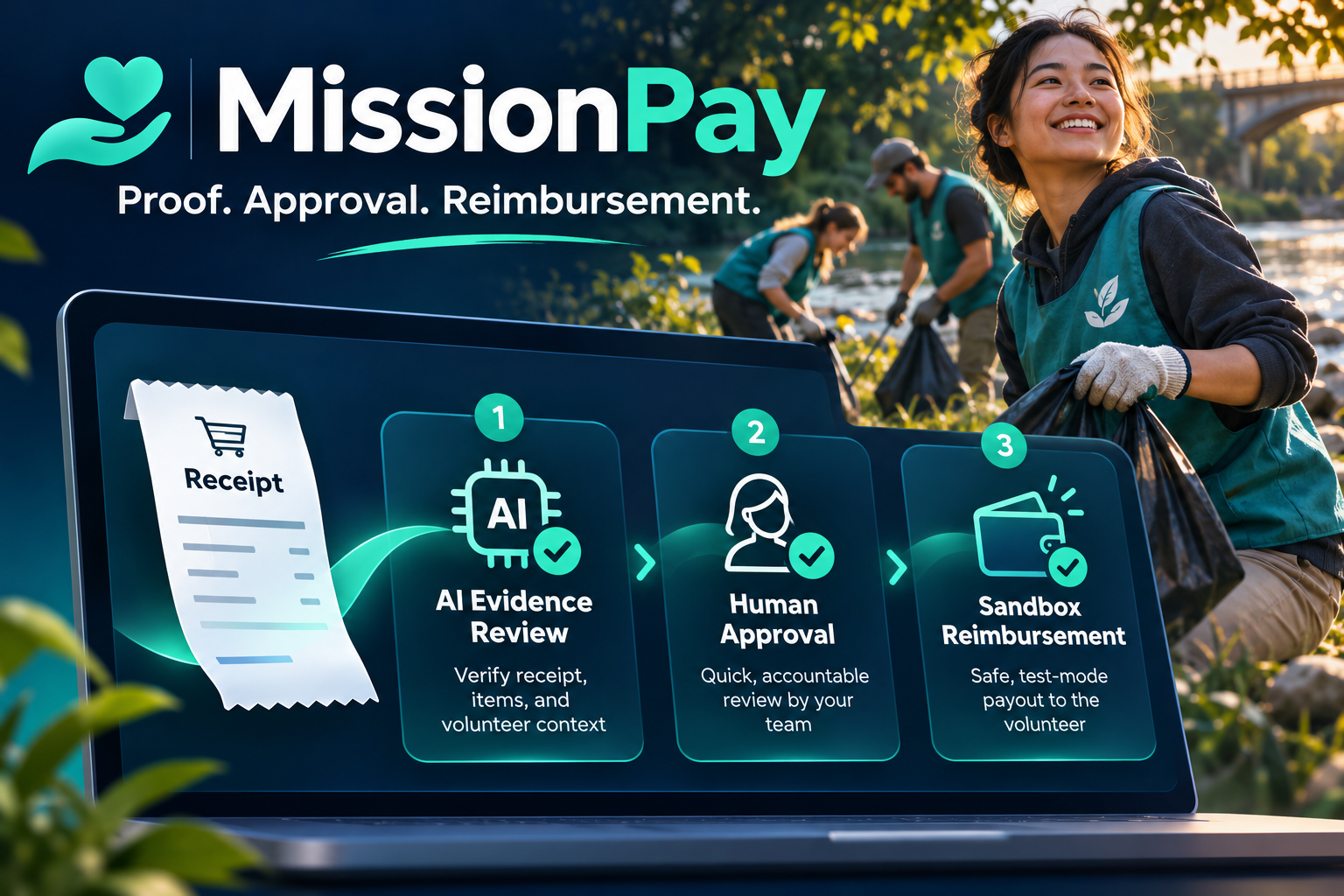
MissionPay: Proof to reimbursement
The people doing the most valuable work in a community shouldn’t have to wait behind a pile of paperwork to be reimbursed for a box of gloves, safety supplies, or other mission-related expenses. At the same time, the organizations supporting that work need to know that restricted funds are being used for the purpose donors intended.
MissionPay brings those needs together. It is a proof-to-reimbursement workflow that helps an organization move from a volunteer’s receipt to a reviewed and traceable PayPal payment. AI helps interpret the evidence, while policy checks, a human reviewer, and independent payment reconciliation keep the decision and the money under control.
The problem
Community organizations often operate with limited staff, restricted budgets, and volunteers who pay for supplies out of pocket. A simple reimbursement can mean collecting receipts, interpreting fund restrictions, checking the amount, getting approval, sending a payment, and later trying to connect that payment back to the original expense.
Each step matters. A missing receipt, the wrong fund, an unclear approval, or a payment marked complete too early can create extra work or weaken trust. These challenges are especially significant when the organization has a responsibility to show how a specific grant or donated fund was used.
How MissionPay works
- A volunteer submits a claim and supporting expense evidence.
- An AI model extracts candidate facts from the receipt, such as the merchant, items, date, and total. The model selects from exact excerpts of the receipt so the reviewer can see the text behind each citation.
- MissionPay applies the recorded fund policy to the claim. The AI proposes facts; it does not decide eligibility or authorize a payment.
- A separate reviewer examines the evidence and interpretation before approving the exact recipient and amount. That authorization is bound to the claim revision and the interpretation the reviewer saw.
- MissionPay creates a payment intent and sends a PayPal Payouts request. A stable operation identity and duplicate controls help prevent the same authorized payment from being sent twice.
- MissionPay retrieves the provider’s payment item and reconciles it against the approved intent. An acknowledged or pending request is not presented as a completed payment. Completion is reported only when the retrieved item matches the expected payment and PayPal reports success. AI that supports accountability
AI can save reviewers time by identifying useful details in a receipt, but a convincing answer isn’t the same as evidence. MissionPay shows the source excerpt alongside each proposed fact so a person can inspect it. A matching excerpt proves that the text appears in the receipt; the reviewer still has to decide whether it supports the model’s interpretation.
That distinction is central to the product. MissionPay keeps evidence interpretation, policy evaluation, human authorization, payment execution, and reconciliation as separate steps. It is designed to make each step visible and to refuse actions when the required authority or evidence is missing.
Why it matters
MissionPay is built around a practical community need: help volunteers get reimbursed while giving organizations a clearer record of how funds were used. A coordinator can review the receipt and the fund decision, approve the exact reimbursement, and see the payment’s independently observed status in one workflow.
The broader opportunity is a more trustworthy way for small organizations to handle mission-related expenses. Instead of spending their limited time piecing together receipts, approvals, and payment records, they can spend more of it supporting the people and causes they serve.
What we built and tested
The project integrates a live hosted AI model with PayPal Payouts in the PayPal sandbox. We tested the end-to-end flow with a synthetic receipt, human authorization, a genuine sandbox payout request, and item-level reconciliation. Two separate sandbox journeys reached a matched completed status, one to a personal sandbox recipient and one to a business sandbox recipient. No real money was moved.
The demonstration video shows the real application and its workflow. We also created a separate interactive judge experience that simulates the AI and payment services, so judges can explore the flow without supplying their own API keys. The simulation is clearly labeled and is separate from the real application in the public repository.
The result
MissionPay turns a receipt into a chain of evidence, authority, and payment status that a person can follow. It shows how AI and PayPal can work together to make a financial workflow more useful without handing the financial decision over to AI.
