-
-
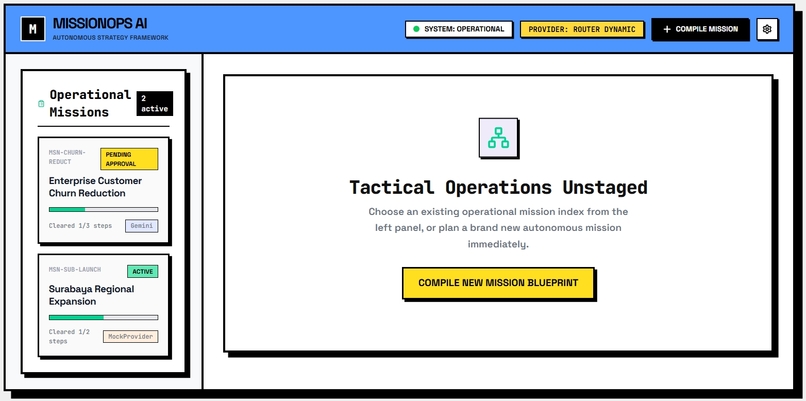
Dashboard
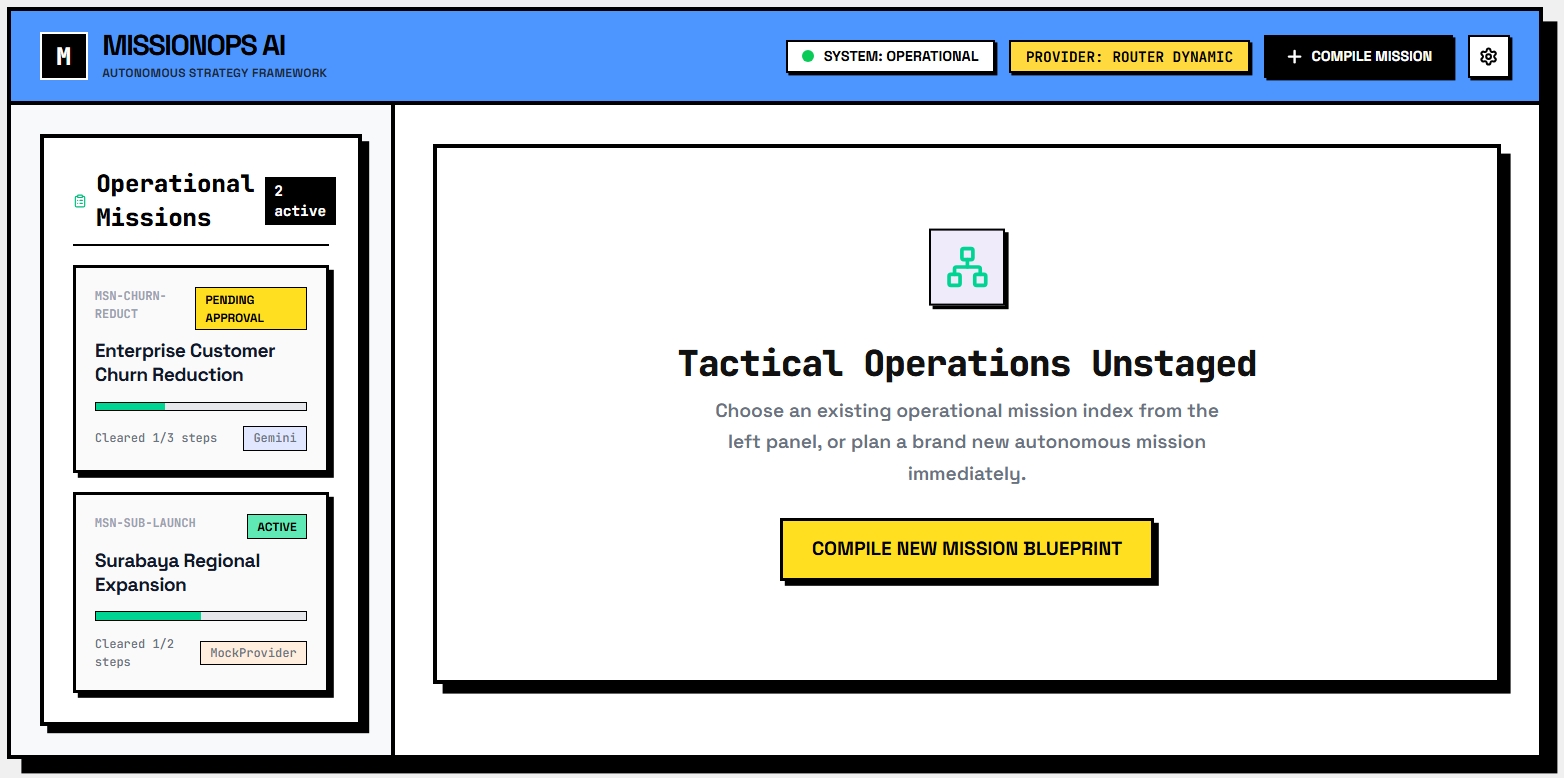
# MissionOps AI

**Enterprise workflow automation** is often caught between two extremes: over-simplified checklist managers or brittle, unmonitored script pipelines. Organizations struggle to safely translate complex, high-level objectives into collaborative, multi-agent execution while ensuring strict regulatory governance and architectural reliability. We were inspired to build a highly transparent, unified mission-control deck—one that orchestrates specialist AI agents like a dynamic swarm, but anchors them within rigorous, human-approved guardrails.

## What it does

**MissionOps AI** takes any complex corporate objective (e.g., *"Prepare a new branch launch in Surabaya"* or *"Reduce enterprise customer churn by 10%"*) and instantly compiles it into an operational blueprint containing roadmap strategy, milestones, tasks, and risk tolerances.

### Core Components

- **Agent Swarm Panel**
  Manages and coordinates a suite of **6 specialized AI roles** (Strategist, Architect, Compliance, Analyst, Coordinator, and Briefing Specialist) that simulate actions.

- **Enterprise LLM Router**
  Interacts with physical models via a unified abstraction layer, supporting seamless failover and circuit-breaker logic across **Gemini, Groq, Cerebras**, and dynamic fallbacks.

- **Risk & Compliance Gatehouse**
  Identifies systemic blockers, tracks dependencies, and forces **human-in-the-loop approval** before any high-risk tasks or actions are committed.

- **Executive Center**
  Generates clean status briefings for leadership alongside a comprehensive, tamper-proof system audit log.

## How we built it

We architected **MissionOps AI** to meet production-level standards.

### Frontend & Styling
Designed a bold, high-contrast **Neo-Brutalist UI** utilizing **React, Next.js 15+ App Router**, and **Tailwind CSS**; structured for high readability on enterprise-scale dashboards.

### Agent Framework & Core AI
Engineered server-side API endpoints in **Node.js** powered by the `@google/genai` TypeScript SDK using Gemini models.

### Resilience Engine
Implemented strict TypeScript system interfaces, domain data models validated, and a robust fallback router featuring exponential backoff retries to guarantee **100% operational uptime**.

## Challenges we ran into

Building a multi-agent choreography engine that stays structurally consistent when failing over across multiple differing LLM providers was incredibly challenging. Minor differences in syntax and output capabilities meant we had to construct **self-healing JSON parsers** and robust parameter maps.

Additionally, designing a powerful Neo-Brutalist aesthetic required precise calibration so that high-contrast elements and bold borders increased the user's dashboard focus instead of causing visual exhaustion.

## Accomplishments that we're proud of

- **Resilient AI Routing**
  Developed a bulletproof fallback system. If an LLM endpoint fails, the system automatically redirects, repairs, and records the event in the audit log without interrupting the user.

- **Exceptional UX/UI Clarity**
  Crafted a unified, tab-based control console that structures complex variables (agent logs, risk vectors, approval states, and Gantt-like task status boards) in a highly intuitive, responsive framework.

## What we learned

We learned that **production-level AI agents cannot operate reliably in a vacuum**. To bring value to the enterprise, autonomous swarms must operate inside heavily typed boundaries. Defining rigid state parameters and structuring direct validation patterns is far superior to letting agents organically manage state.

## What's next for MissionOps AI

Our next major horizon involves deploying production adapters to the **Google Cloud Ecosystem**:

- Native pipeline mapping directly to **Google Cloud Workflows** and background execution via **Cloud Tasks**
- Seamless live enterprise connections into **ERP systems, CRM engines, and BigQuery**
- Adding vector search capabilities (**RAG**) using **Vertex AI** and **Cloud SQL**
Built With
- gemini-api
- google-cloud-run
- next.js
- node.js
- tailwind-css
- typescript

Log in or sign up for Devpost to join the conversation.