-
-
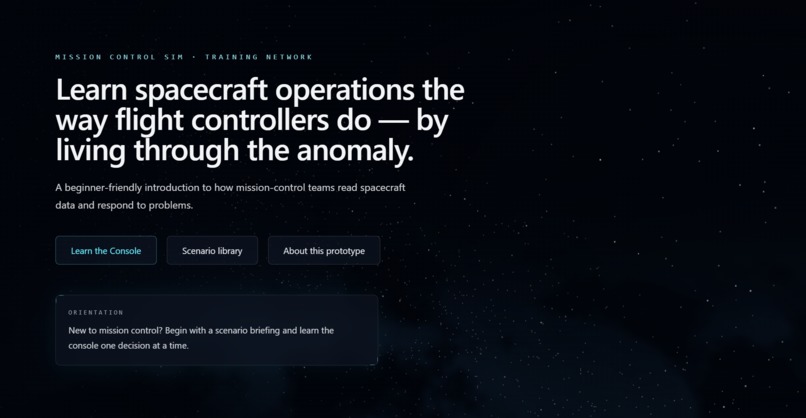
Landing page
-
-
-
-
-
Inspiration
The idea behind Mission Control Sim came from an earlier educational simulation project I was already working on.
A few months ago, I wanted to learn more about advanced scientific research and experience what it is like to work with complex laboratory environments. However, coming from a village, getting access to a real advanced research laboratory is nearly impossible for me. Only a limited number of specialized facilities exist, and without formal education, institutional access, or an invitation, experiencing these environments firsthand can feel out of reach.
Instead of accepting that limitation, I started building my own learning experience. I researched publicly available information and used it to create a browser-based simulation that could help me explore concepts and workflows that I would otherwise have no practical way to experience.
When I joined this hackathon, I was already halfway through the event and had very limited time to brainstorm and build a completely new idea. I asked ChatGPT to analyze the core educational idea behind my existing project, considered the time restrictions I had, and explored another highly specialized environment that could be similarly difficult for beginners to access.
That led me to spacecraft mission control.
The broader goal was to explore whether interactive simulations could make high-end scientific and technical education more accessible to people who may never have the opportunity to access the real facilities themselves.
What it does
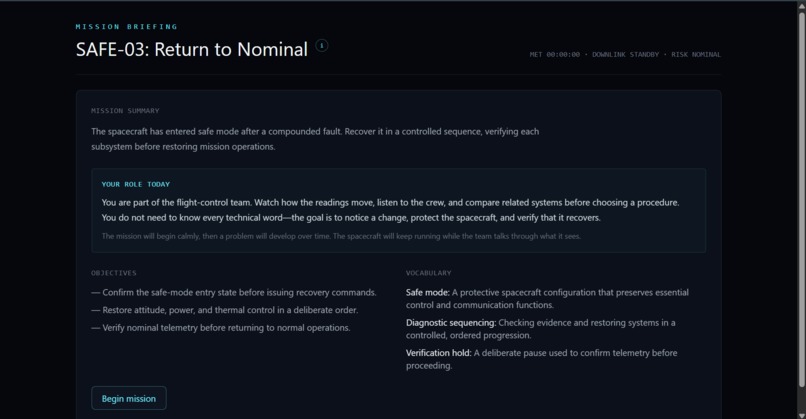
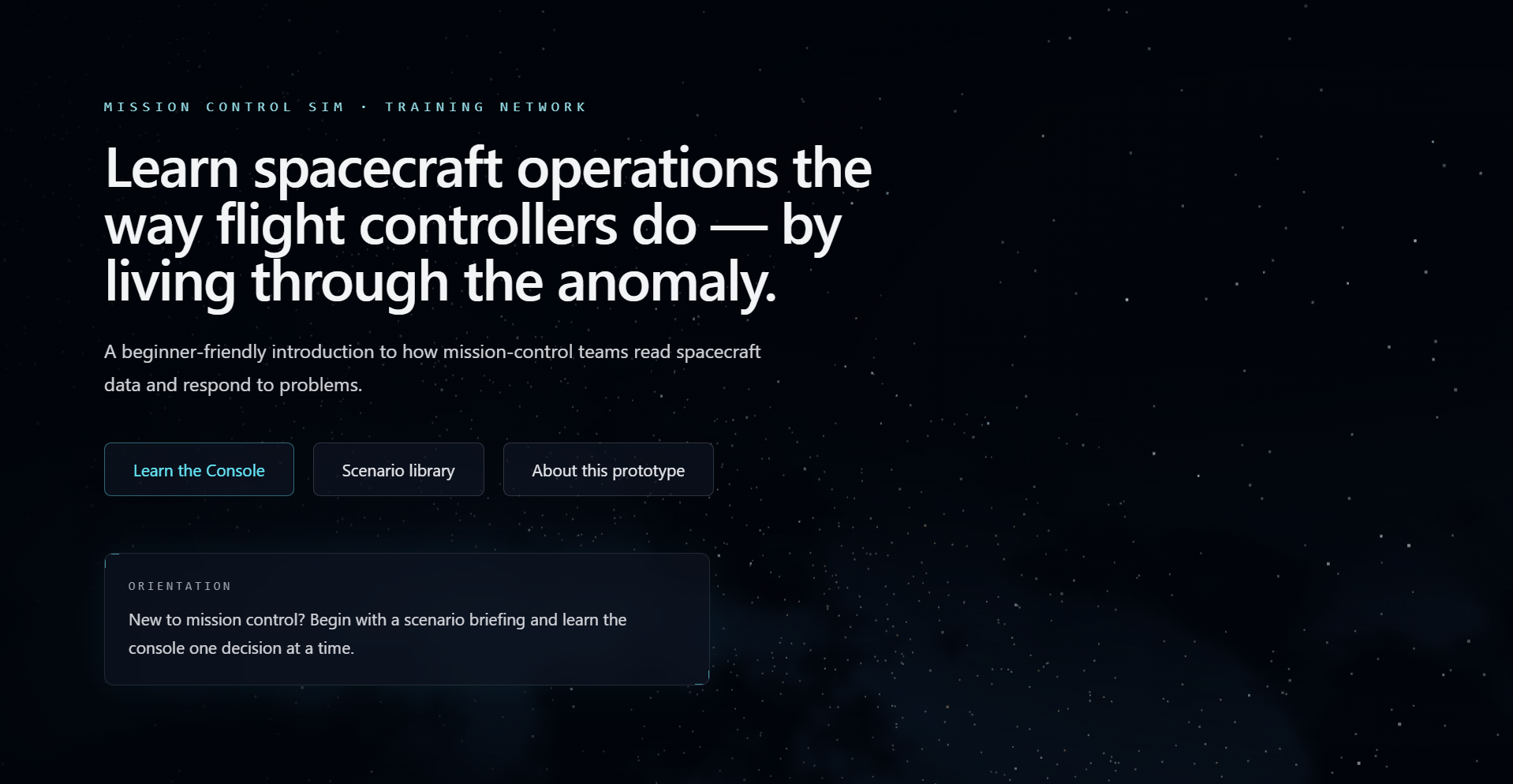
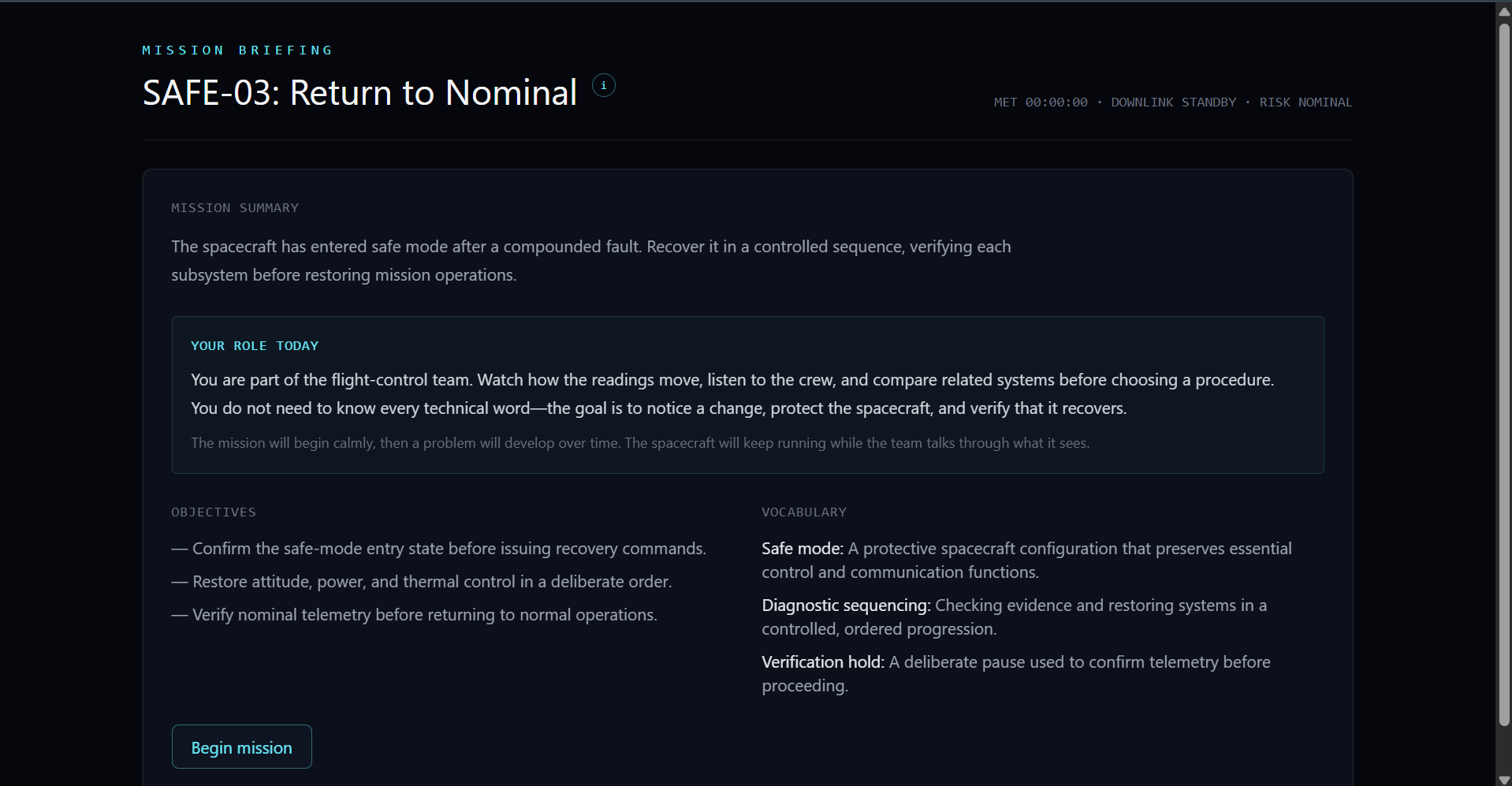
Mission Control Sim is a beginner-friendly educational web prototype that introduces users to basic spacecraft mission-control concepts through interactive, scenario-based simulations.
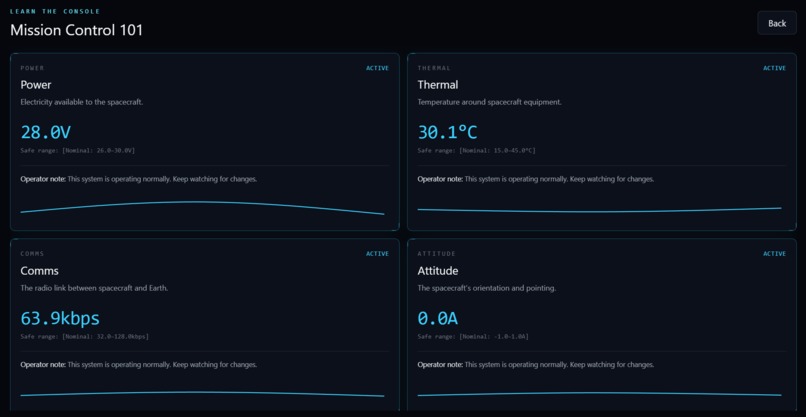
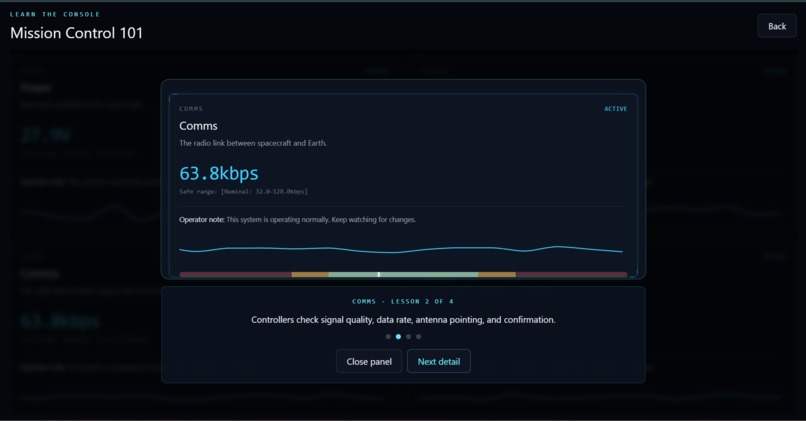
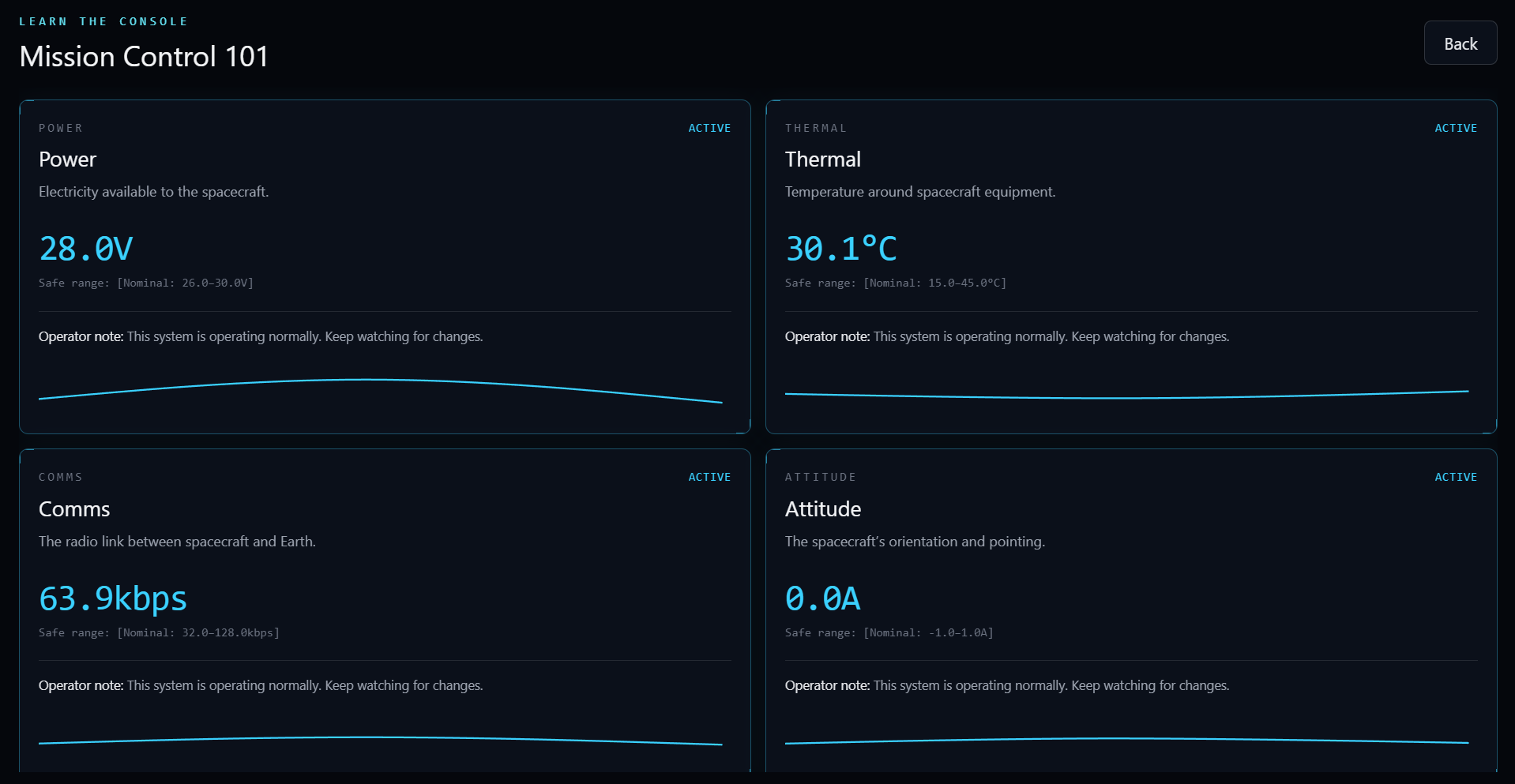
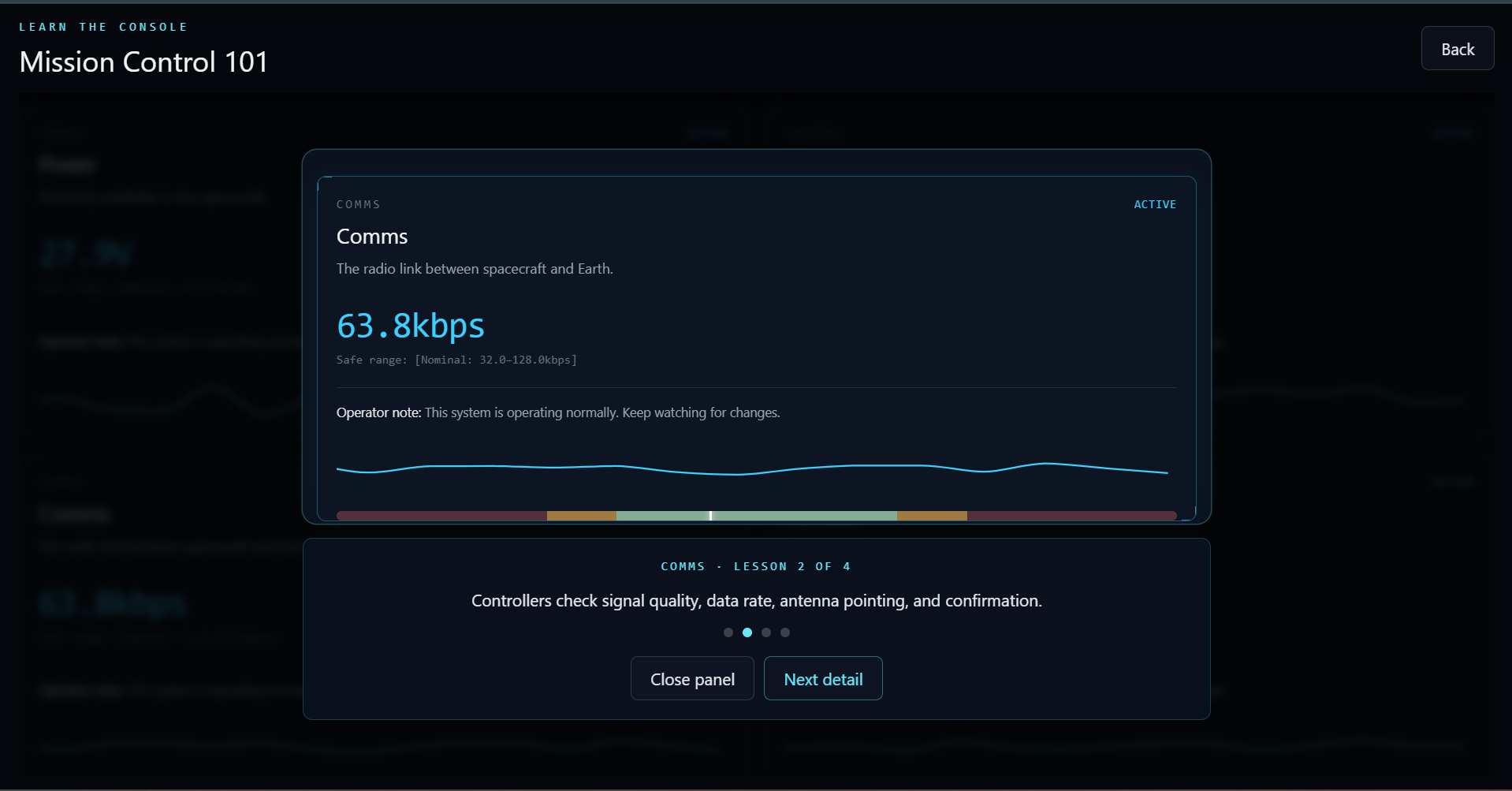
Users can explore a mission-control environment, complete a system orientation, learn basic telemetry concepts, and work through simulated mission scenarios.
The prototype allows users to:
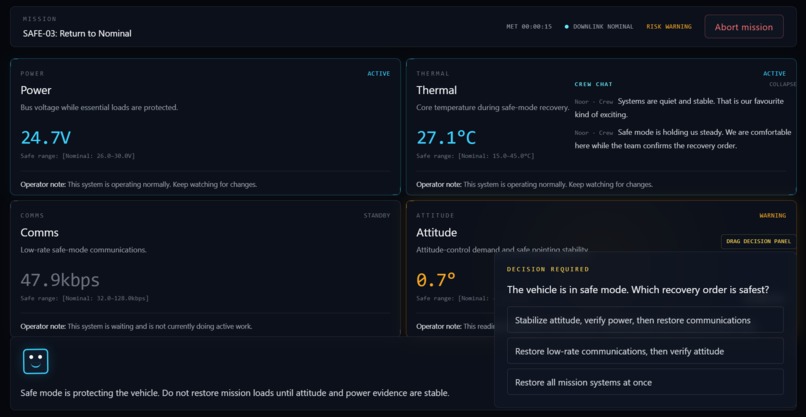
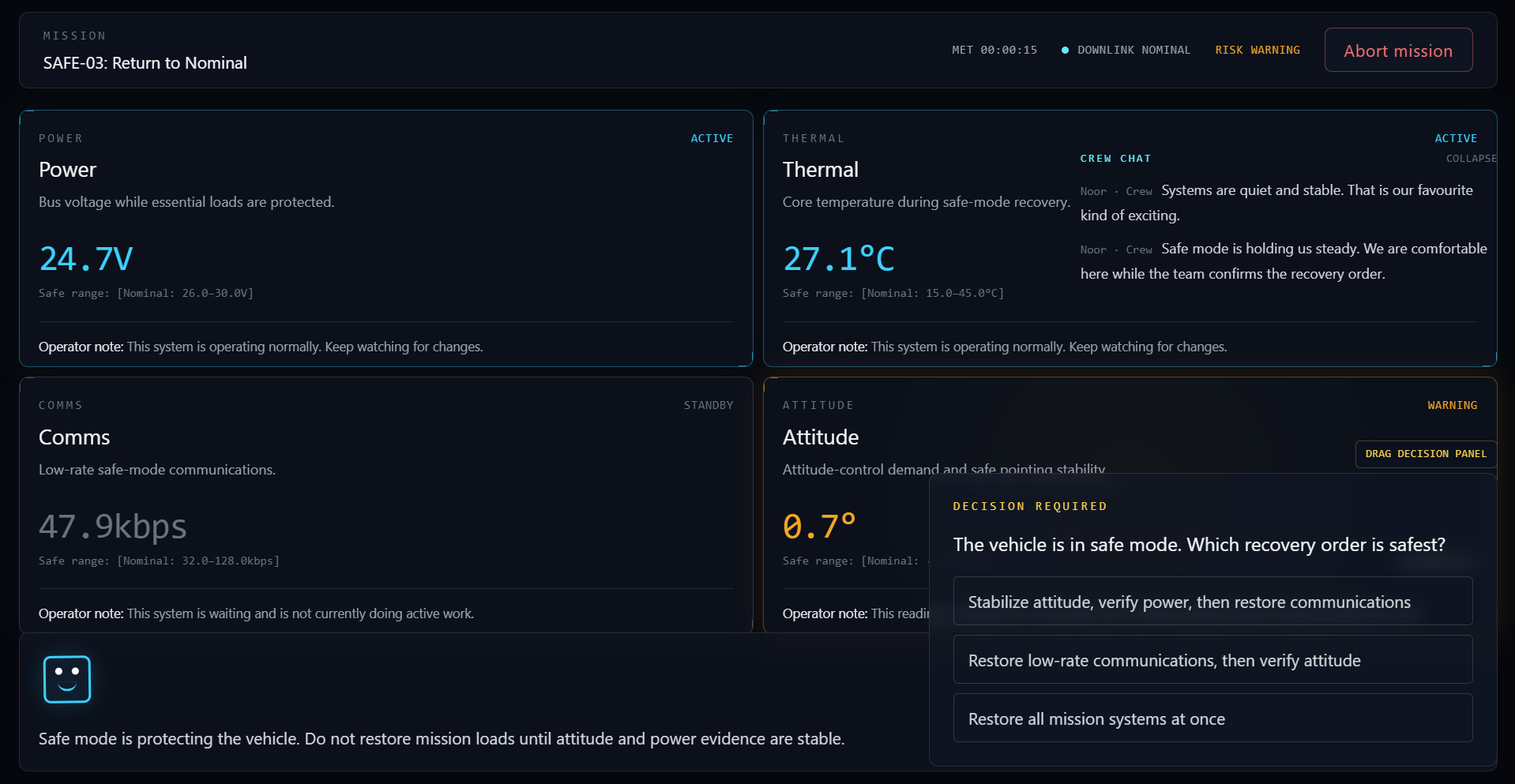
- Monitor simplified spacecraft telemetry
- Observe power, thermal, attitude, and communications systems
- Identify abnormal telemetry conditions
- Compare readings against nominal operating ranges
- Respond to simulated mission anomalies
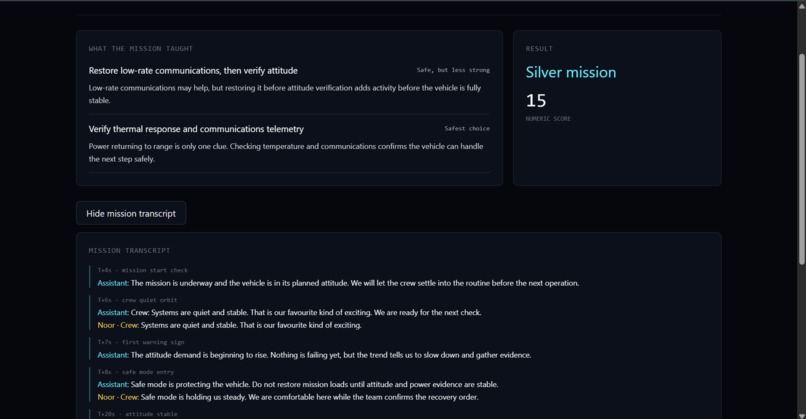
- Make operational decisions
- Observe how decisions affect simulated system conditions
- Follow structured recovery guidance
- Maintain safety margins
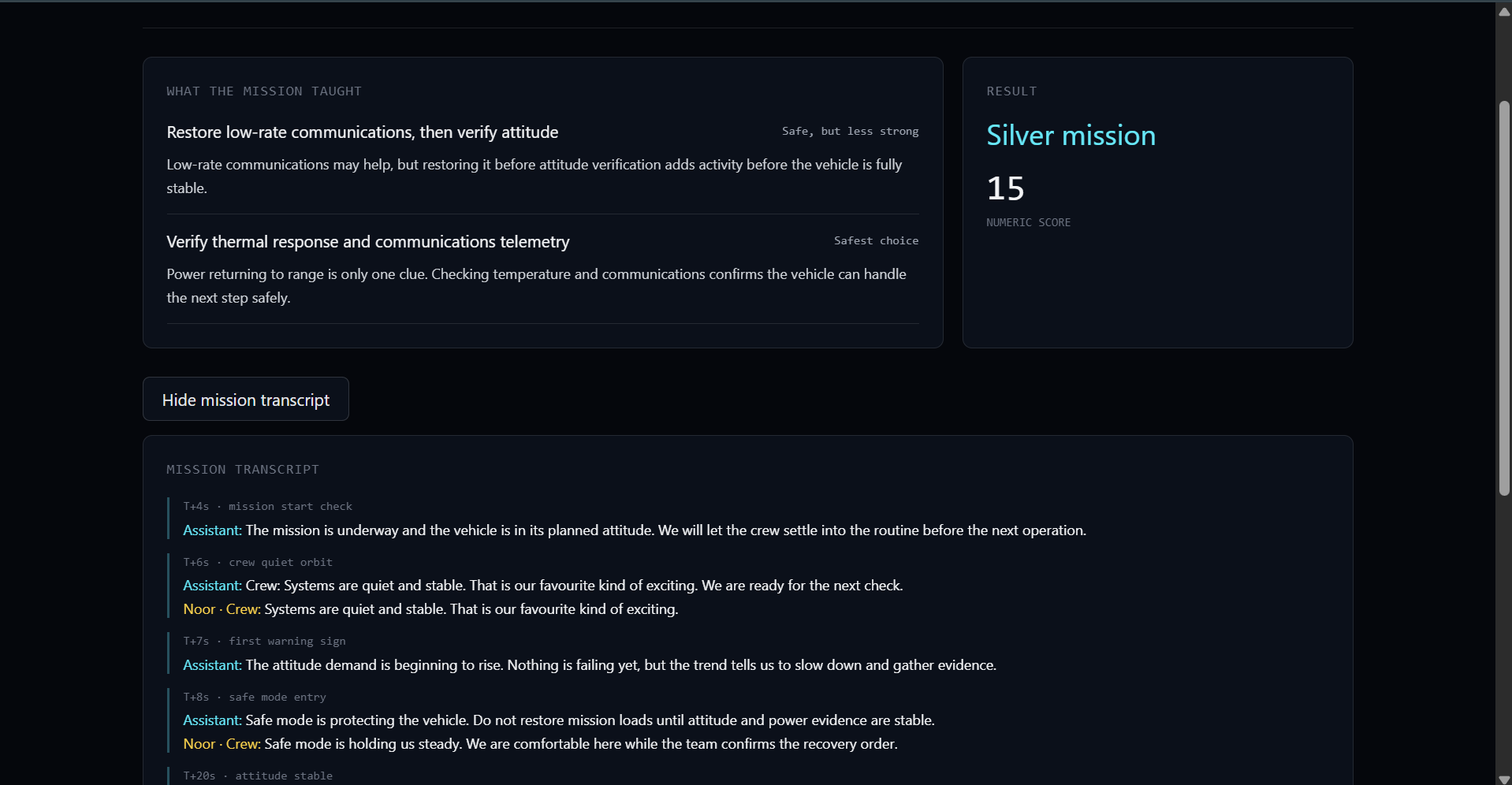
- Review decisions and their consequences through a mission debrief
- Experience a nominal mission scenario to understand stable spacecraft operations
The goal is not to provide professional mission-control training or replace real spacecraft operations. Instead, it provides beginners with an approachable first experience of the reasoning involved in monitoring systems, recognizing anomalies, making decisions, and learning from consequences.
How we built it
I started by analyzing the core educational idea behind my existing Lab Simulator and exploring how the same concept could be applied to another highly specialized field.
Because I joined the hackathon late, I had limited time to research the domain and implement the project. I used ChatGPT to help explore the concept and narrow the scope, then researched the domain and created structured planning and architecture documents to serve as the foundation for implementation. Then I used Chatgpt and other AI tools to create Master coding context files for Codex.
The coding phase was primarily carried out using OpenAI Codex with GPT-5.6 as a core development and reasoning tool.
GPT-5.6 was used to help reason through the educational concept, refine the scope, review implementation decisions, identify gaps, and evaluate how complex technical concepts could be communicated to beginners.
Codex was used as the primary implementation environment. It helped implement the application architecture and user interface, build the mission-control environment, implement telemetry displays and scenario logic, create decision and consequence flows, and iterate on features based on testing.
Codex was also used to audit the implementation, identify weak areas, and make targeted fixes and improvements.
The development process was iterative: research and exploration, scope definition, architecture planning, implementation, testing, auditing, refinement, and deployment.
Challenges we ran into
The biggest challenge was the limited time available.
I joined the hackathon halfway through, which meant I had to move quickly from an existing concept to a new domain while still researching enough to build something meaningful.
Another major challenge was the lack of deep domain knowledge in spacecraft mission operations. The original concept was much broader, but I realized that attempting to build a technically deep or physics-accurate spacecraft simulator without sufficient expertise or validation would be irresponsible.
Because of this, I reduced the scope and focused on building an educational prototype using simplified, authored scenarios and telemetry behavior.
The current prototype does not attempt to implement full orbital mechanics, physics-accurate spacecraft dynamics, high-fidelity spacecraft subsystem models, or professional mission-control procedures.
Instead, I focused on the underlying learning experience: monitoring telemetry, recognizing abnormal conditions, making operational decisions, maintaining safety margins, and understanding the consequences of those decisions.
Accomplishments that we're proud of
The biggest accomplishment is that I was able to turn an idea that started from my own difficulty accessing advanced technical education into a working interactive prototype within a very limited hackathon timeframe.
I am proud that Mission Control Sim provides a way for beginners to explore a highly specialized environment directly from a browser without requiring access to a physical mission-control facility or specialized equipment.
I am also proud of the decision to keep the project honest about its limitations. Rather than presenting a simplified prototype as a professional spacecraft simulator, I focused on creating an approachable educational experience and clearly documenting what the simulation does and does not represent.
The project also demonstrates a broader direction I want to continue exploring: creating accessible simulations for advanced scientific and technical fields where real-world access is difficult or expensive.
What we learned
One of the biggest lessons I learned was the importance of scope when working in a specialized technical domain.
It would have been easy to attempt to build a complex spacecraft simulator and make claims about realism without having the necessary domain expertise or time to validate those claims. Instead, I learned that an educational prototype can still be valuable when it is honest about what it teaches and what it does not.
I also learned that accessibility is not only about making information available. For many technical subjects, meaningful learning also depends on being able to interact with systems, make decisions, and observe consequences.
Interactive simulations can provide part of that experience to people who may never have access to the real facilities.
What's next for Mission_Control_Sim
Mission Control Sim is intended as a foundation for a larger educational simulation experience.
Future versions could include more detailed spacecraft subsystem models, deeper branching scenarios, more complex failure propagation, more realistic telemetry behavior, expanded educational content, additional mission types, domain-reviewed operational procedures, and more advanced mission debriefing and learning analytics.
The broader vision extends beyond spacecraft mission control.
I want to explore whether the same approach can be used to create accessible simulations for other specialized fields where physical access is difficult or expensive—from advanced scientific laboratories to engineering and industrial environments.
Mission Control Sim is a first step toward that vision: using interactive software to make high-end technical learning experiences more accessible to anyone with a browser.

Log in or sign up for Devpost to join the conversation.