-
-
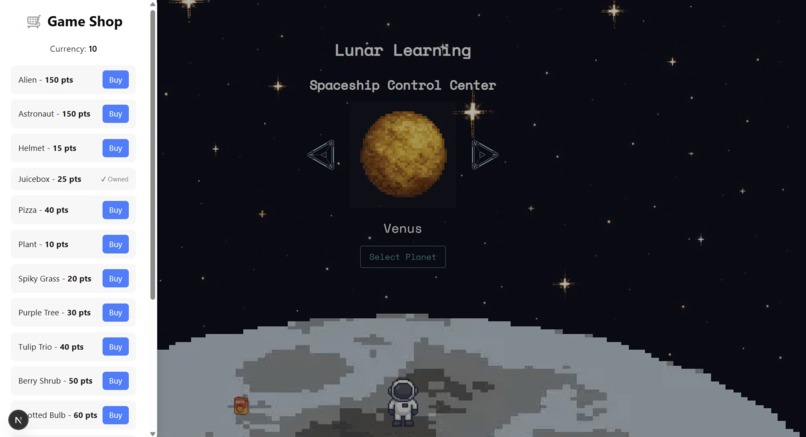
shop where you can buy stuff for your planet!
-
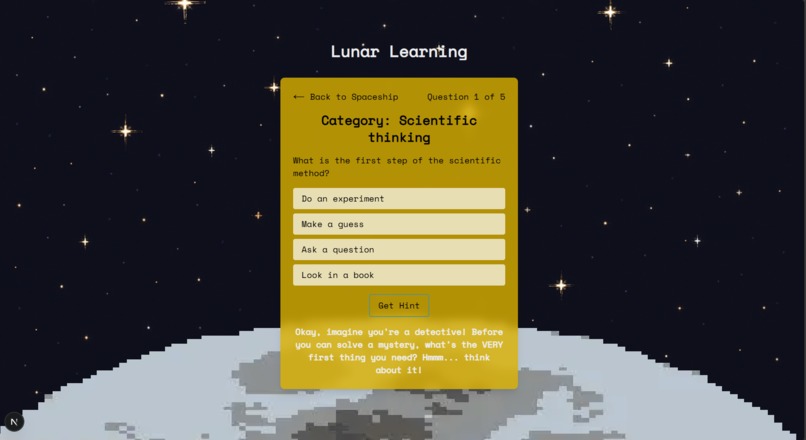
answering questions with a hint!
-
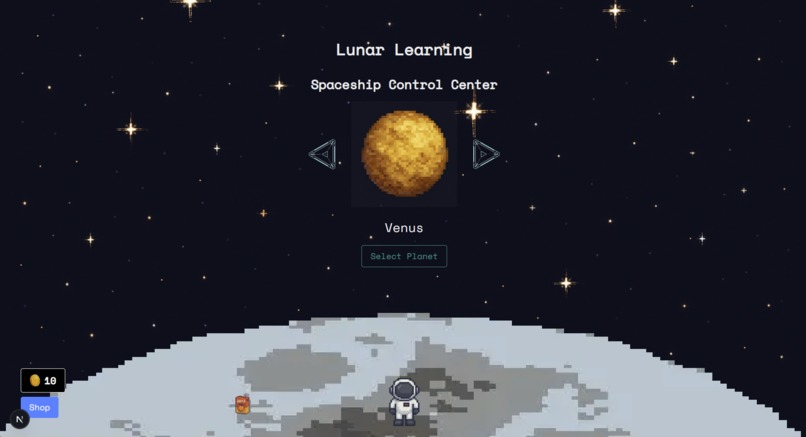
Home page

Project Story
Inspiration
The idea for Lunar Learning was born out of a desire to transform the sometimes frustrating and overwhelming school experience—especially for young learners with learning disabilities—into a fun and engaging adventure. We were inspired by the challenge of making science education accessible and exciting. By reimagining the classroom as a space mission, we hoped to give every student a chance to feel like a brave explorer, discovering the wonders of science one planet at a time.
What it does
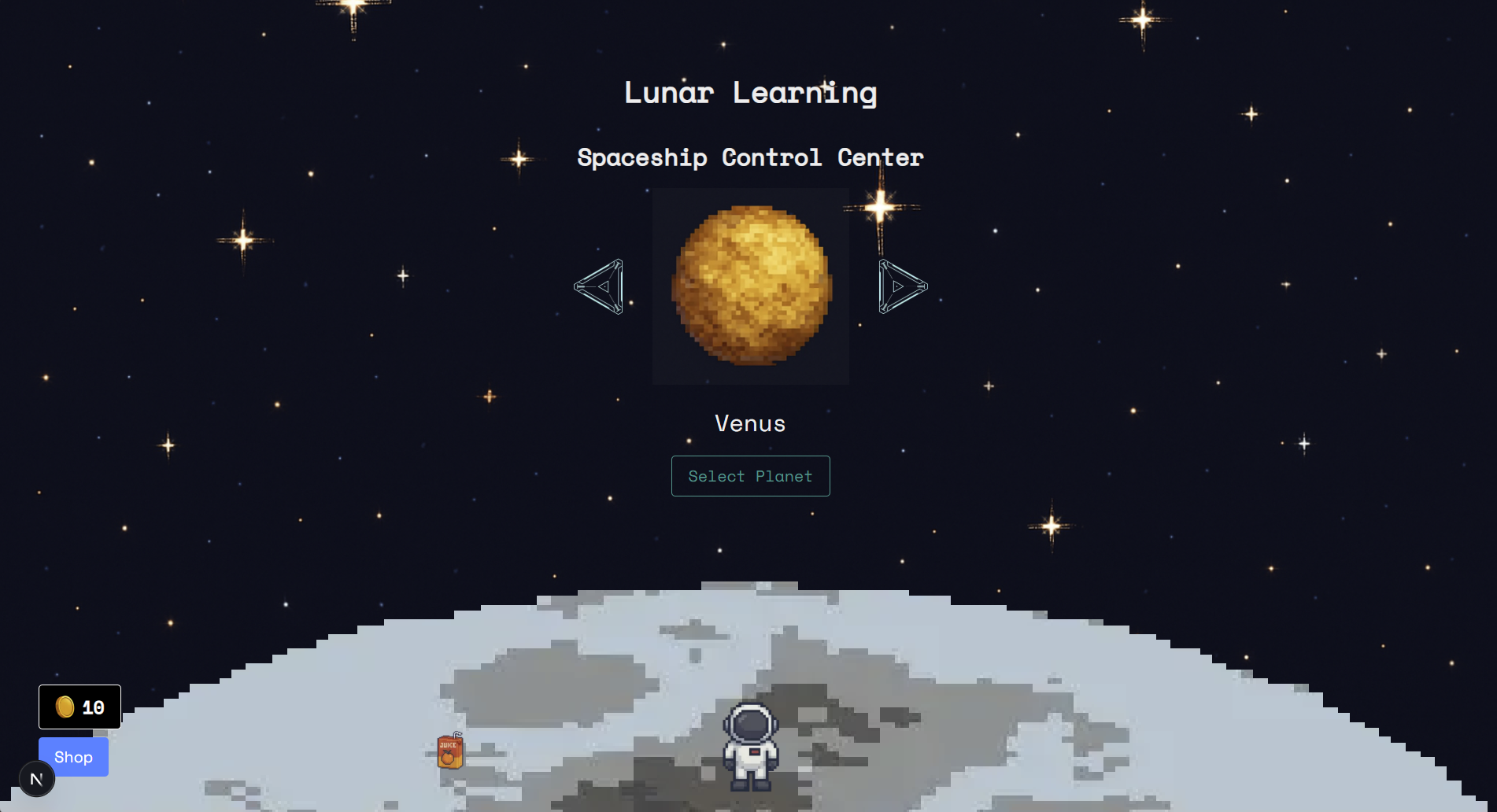
Lunar Learning is a space-themed interactive science game designed for elementary school students with learning disabilities. Students begin their adventure at their personal Moon base, where they can navigate the solar system to visit different planets. Each planet represents a different science topic, offering tailored, interactive question sets. As they answer questions correctly, students earn coins to decorate their Moon base. Upon completing all questions on a planet, a flag appears on that planet to celebrate their achievement. Additionally, Gemini AI is integrated into the game to provide real-time hints, fun facts, and encouraging messages to support learners along the way.
How we built it
Our project was built using Next.js and React, allowing us to create a modern, responsive, and interactive web application. We used Tailwind CSS for fast and flexible styling, ensuring that our user interface was both appealing and accessible. Key components such as the Planet Selector, Question Set, and Shop were developed as modular React components, all managed within a global context using React’s Context API. This architecture allowed us to maintain state easily (e.g., tracking currency, progress, and completed planets) and persist data using local storage. We also integrated Gemini AI to generate adaptive hints and fun facts dynamically, which added an extra layer of engagement and personalization.
Challenges we ran into
One of the biggest challenges was designing an experience that was both educational and engaging for students with diverse learning needs. We had to rethink traditional question-and-answer formats and create intuitive controls for navigation through the solar system. Integrating Gemini AI for real-time content generation also presented technical hurdles, particularly around managing API keys and ensuring the responses were age-appropriate and supportive. Additionally, ensuring that our progress and customization features worked seamlessly across sessions required careful state management and persistent storage solutions.
Accomplishments that we're proud of
- Engaging User Interface: We successfully transformed a standard classroom curriculum into an immersive space adventure, complete with interactive controls, visually appealing themes, and dynamic feedback.
- Adaptive Learning Support: Integrating Gemini AI for hints and encouragement has helped create a learning environment that adapts to each student’s pace and needs.
- State Persistence: Our use of React’s Context API and local storage ensures that student progress is saved and can be resumed later, adding a real sense of accomplishment.
- Team Collaboration: With contributions from Uday, Bee, Zidane, and Syd, we built a project that reflects diverse ideas and expertise, and we're proud of how our team came together to solve real educational challenges.
What we learned
Working on Lunar Learning taught us the importance of empathy in design and development. We learned how to build accessible applications that cater to a wide range of learning styles and challenges. On the technical side, we deepened our understanding of React and Next.js, particularly in state management, context API, and integrating third-party services like Gemini AI. Our team also improved our collaboration skills, learning to merge diverse ideas into a cohesive and innovative project.
What's next for Mission: Learning
Our vision for Lunar Learning is only the beginning. In the future, we plan to:
- Expand the curriculum to include additional subjects and more in-depth science topics.
- Develop multiplayer or cooperative missions that encourage teamwork.
- Enhance the personalization of the Moon base with more unlockable items and customization options.
- Collaborate with educators and learning specialists to further refine the game for classroom integration.
- Explore mobile compatibility to make the experience accessible on any device.
Every child deserves to feel smart, capable, and curious. With Lunar Learning, we’re taking a giant leap towards making that a reality.


Log in or sign up for Devpost to join the conversation.