-
-
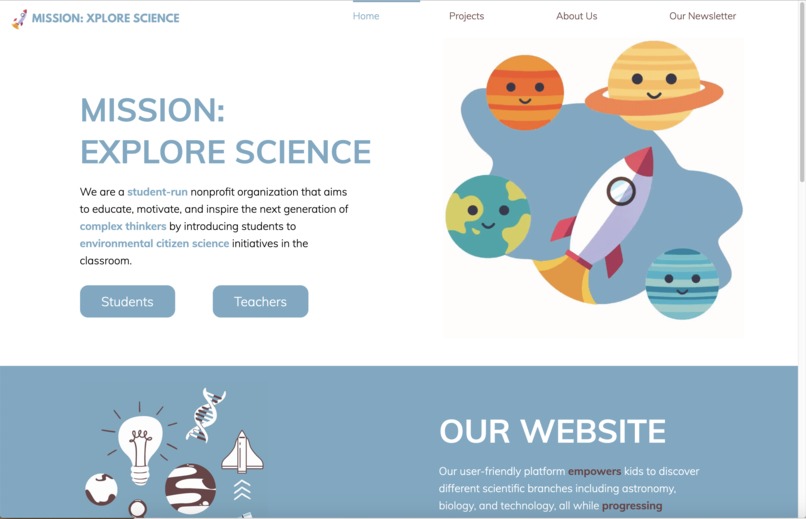
Home page
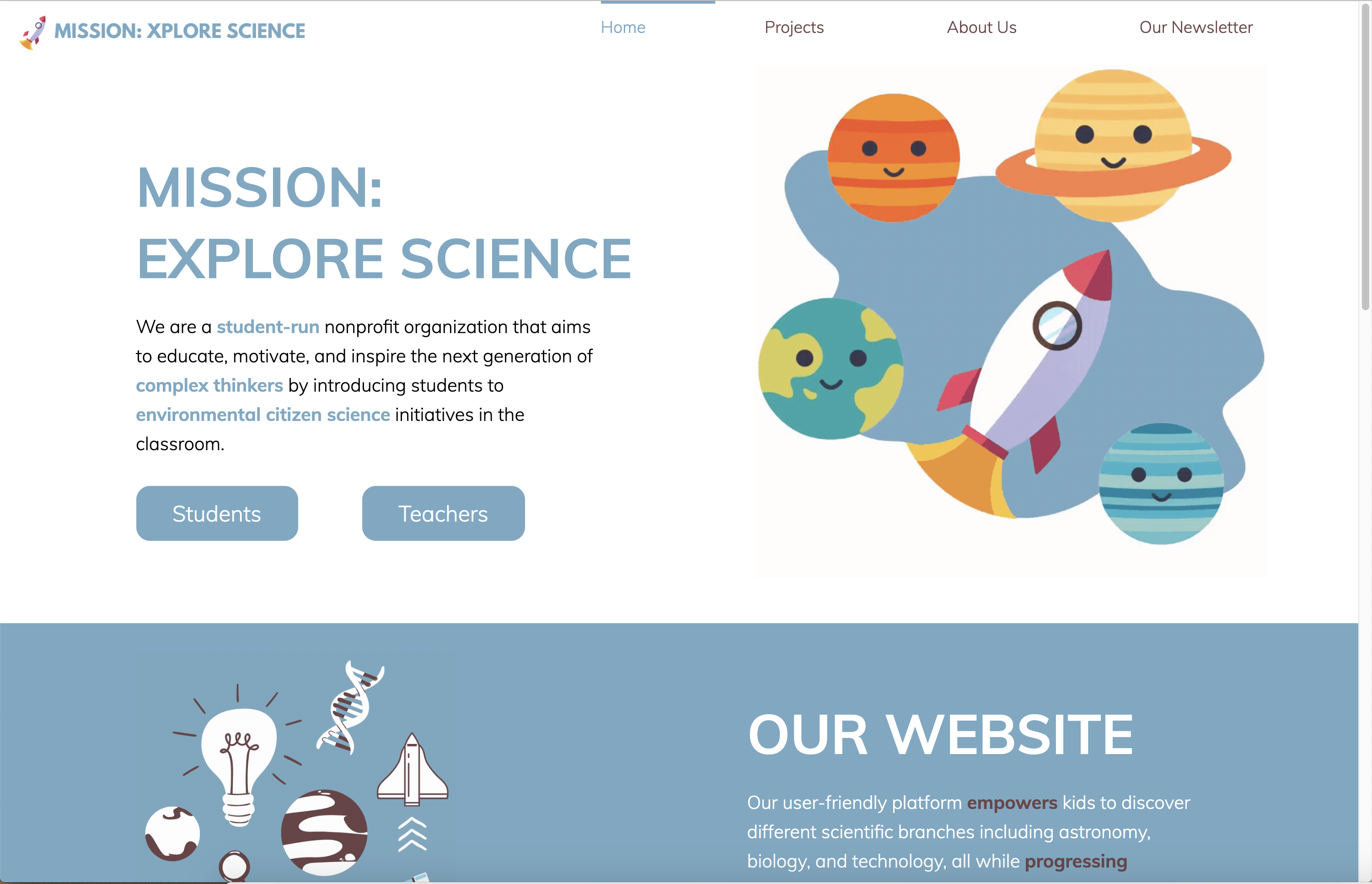
https://drive.google.com/file/d/1uSsjdU4ue1MIew3-aiX6GSA1PF2h3_r_/view
Inspiration
We were inspired to create Mission Explore Science because of our personal interests in environmental and astronomical citizen science. Funnily enough, citizen science was something that we discovered one day at the beginning of this summer while searching for things to do on the internet. We were surprised not only at how easy it was to learn about and do, but also how it is rarely introduced to elementary and middle school students despite its appeal to all audiences. Our team recognizes that young children do not have as much opportunity when it comes to engaging with the scientific community, so we were inspired to create Mission Explore Science to give children more exposure to the environmental sciences and their impacts. We firmly believe that education is the first step to change, and we hope that young students will become empowered to advocate for climate change and environmental sustainability while using our website.
What it does
Our website serves as a platform for young students to engage with environmental citizen science projects. We pull these projects from our database and display them on our site in a kid friendly manner. Through the use of modals and other accessible features, we provide materials in a comprehensible manner for young students. Not only did we compile a variety of citizen science projects, but Mission Explore Science allows students to expand their knowledge by pursuing environmental topics at a deeper level.
How we built it
We built our product collaboratively through GitHub and Repl.it using HTML, CSS, JS, and Python. We started out with simple HTML script and CSS for stylizations, then we moved on to adding more features to our website using JavaScript and JSON databases.
Challenges we ran into
Challenges we ran into included changing the format of all modal links on the project and newsletter pages. After writing a format into the code, we found another format that we liked a lot better, which we implemented to create a more modern and kid-friendly design. Another challenge we ran into was getting event listeners to work with our modals and buttons across the site. We were able to overcome this challenge by using inspect tools and scouring Stack Overflow!
Accomplishments that we're proud of
Accomplishments that we were proud of in particular was managing to get the Javascript section working in tandem with the html and css script, which can be seen for the modals on our “Projects” page and the expandables on the “FAQ” page. It took a while to make sure all three aspects of the code were working together, especially while coding the FAQ page it was hard to fetch the information with the sensitive formatting. However, it was all worth it in the end when it improved the overall quality of our website and ease of navigation.
What we learned
Coming into this process, two of our team members had no previous experience with languages required for website building, like HTML and CSS. With the help of our third member, we all increased our proficiency in these languages, in addition to JSON, JavaScript, and PHP. We learned that trial and error is a useful strategy in computer programming.
What's next for Mission: Explore Science
We plan to add more project content relating to the environment to the relatively bare framework that we have set up. For this, we will compile information on projects from citizen science, re-write and reformat it so it’s more friendly for younger students. We are excited to take Mission Explore Science to the next level to raise environmental awareness for young students in elementary and junior high school!


Log in or sign up for Devpost to join the conversation.