-
-
Mission Control
Inspiration
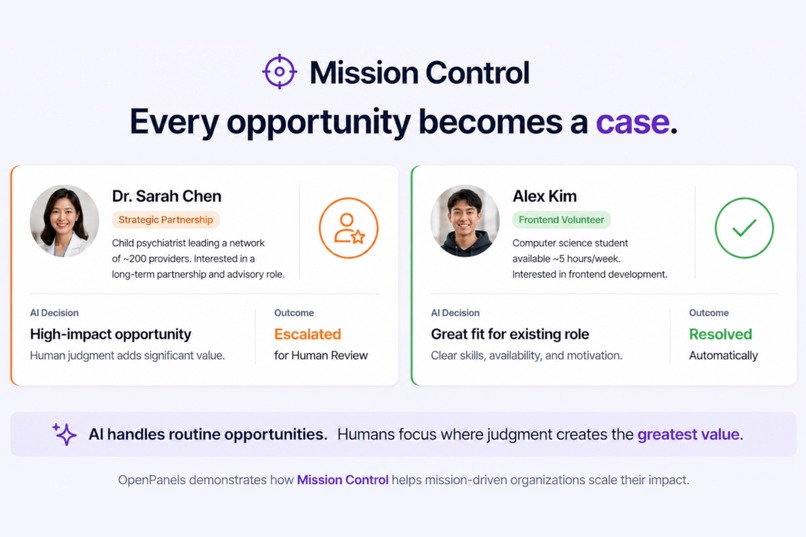
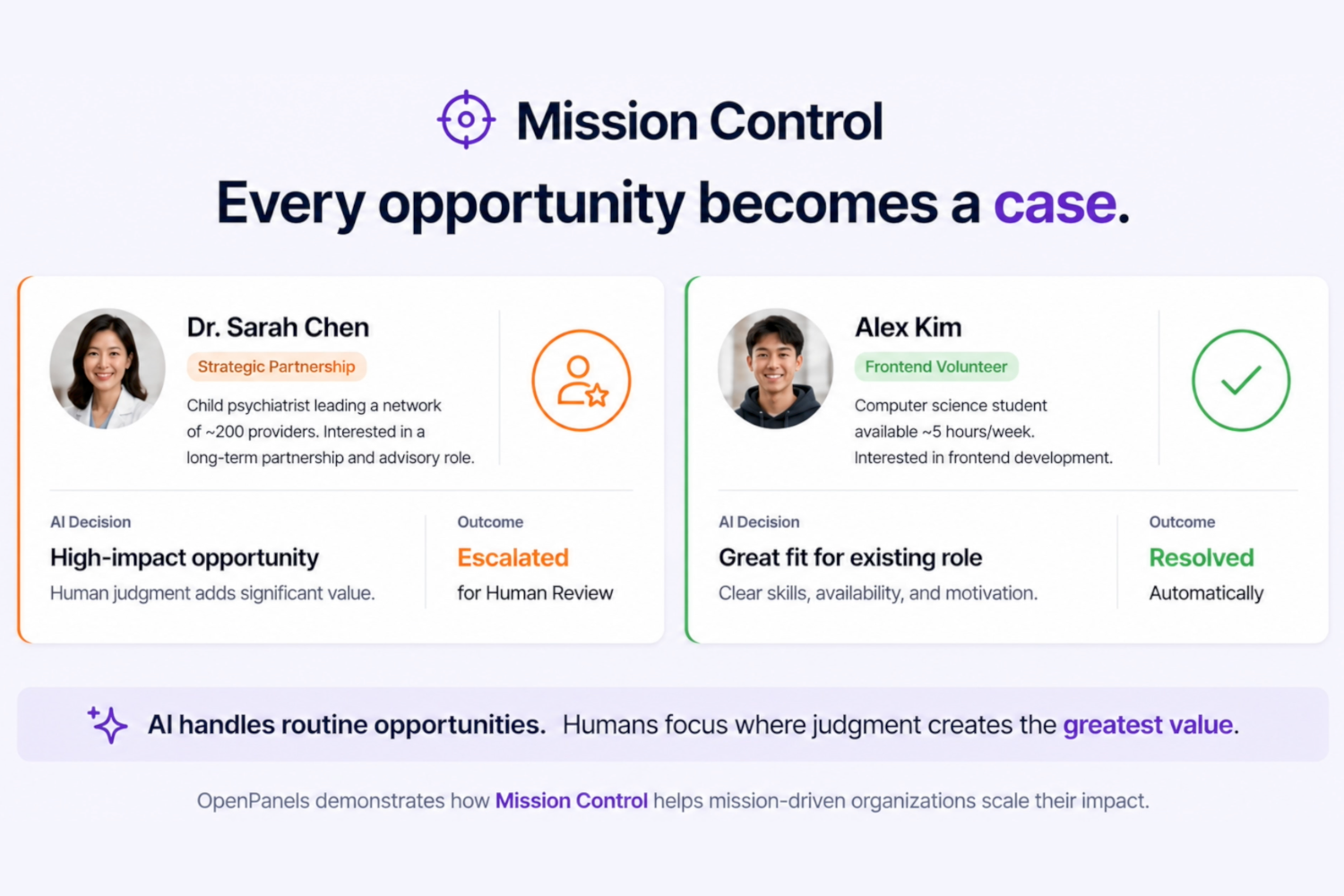
Mission-driven organizations have the opposite of a demand problem: people want to help. OpenPanels, the first deployment of Mission Control, is an open community helping Medicaid families find available mental health providers. It welcomes engineers, clinicians, designers, parents, researchers, and partners alike. The bottleneck is not interest. It is attention. Every inbound opportunity must be read, understood, and routed manually, forcing small teams to spend their limited judgment on routine triage instead of high-impact decisions. We wanted AI to handle the routine so people could focus where their judgment creates the greatest value.
What it does
Mission Control turns every inbound opportunity into a stateful UiPath Maestro Case. Each applicant begins with a short adaptive AI conversation. An autonomous AI agent analyzes the conversation and produces a concise summary, a recommended contribution, and a decision on whether the opportunity should be escalated. Maestro then orchestrates the workflow. Routine contributors are automatically matched and resolved without human effort, while high-impact opportunities pause for human review in Action Center. Reviewers receive a concise AI briefing and can Approve, Adjust, or Decline with a single click. Applicants experience only a simple form, a natural conversation, and a confirmation.
How we built it
The applicant experience is built as a UiPath Coded Web App using Vite, React, TypeScript, and the UiPath TypeScript SDK with PKCE OAuth authentication. Two Agent Builder agents power the AI workflow: IntakeAssistant conducts the conversation, while OpportunityAssessor evaluates the applicant and determines whether escalation is needed. A Maestro Case orchestrates the complete lifecycle through Intake, AI Assessment, Recommendation, Follow-up, Escalation, and Resolution. Conditional branching is driven by a single escalate flag. Escalated cases create a human review task in Action Center while also sending a Gmail notification through Integration Service. All AI runs through Anthropic Claude Sonnet 4.6 via the UiPath model gateway, and the entire solution is packaged and deployed through the uip CLI.
Challenges we ran into
Maestro Case was brand new during the hackathon, so we relied heavily on experimentation alongside limited documentation. We discovered several deployment pitfalls, including bundling the Action App inside the case solution, matching entryPointId values exactly, aligning Action App input and output schemas, configuring Gmail connections within the deployment folder, and remembering that updating caseplan.json requires rebuilding the compiled BPMN before packaging the solution. We also encountered an OAuth issue caused by duplicate acr_values, which we resolved using setMultiLogin().
Accomplishments that we're proud of
Mission Control runs as a complete end-to-end solution consisting of a Maestro Case, two AI agents, two coded applications, human review, and automated email notifications. More importantly, escalation is based on business value rather than a simple confidence threshold. Routine opportunities are handled autonomously, while human reviewers are involved only when their judgment is likely to create significantly more value than AI alone. Combining low-code agents with coded applications also allowed us to build a polished user experience without sacrificing flexibility.
What we learned
We learned that Maestro is most valuable as the orchestration backbone rather than simply a workflow engine. Once the case became the source of truth, agents, coded applications, and integrations became interchangeable components. We also learned that understanding the compiled case artifacts is just as important as editing the source files, and that rapid experimentation with newly released platform capabilities often outpaced available documentation.
What's next for Mission Control
Next, we plan to support multiple reviewers, configurable assignment rules, analytics that continuously improve escalation policies based on reviewer feedback, additional Integration Service connectors such as Slack and CRM systems, and reusable case templates that extend beyond OpenPanels to support partner, donor, volunteer, grant, and other inbound opportunities for any mission-driven organization.
Built With
- anthropic-claude-sonnet-4.6
- gmail-connector
- node.js
- oauth-pkce
- react
- tailwindcss
- typescript
- uipath-action-center
- uipath-agent-builder
- uipath-ai-trust-layer
- uipath-cli
- uipath-coded-action-app
- uipath-coded-web-app
- uipath-integration-service
- uipath-maestro-case
- uipath-orchestrator
- uipath-solutions
- vite
- websockets

Log in or sign up for Devpost to join the conversation.